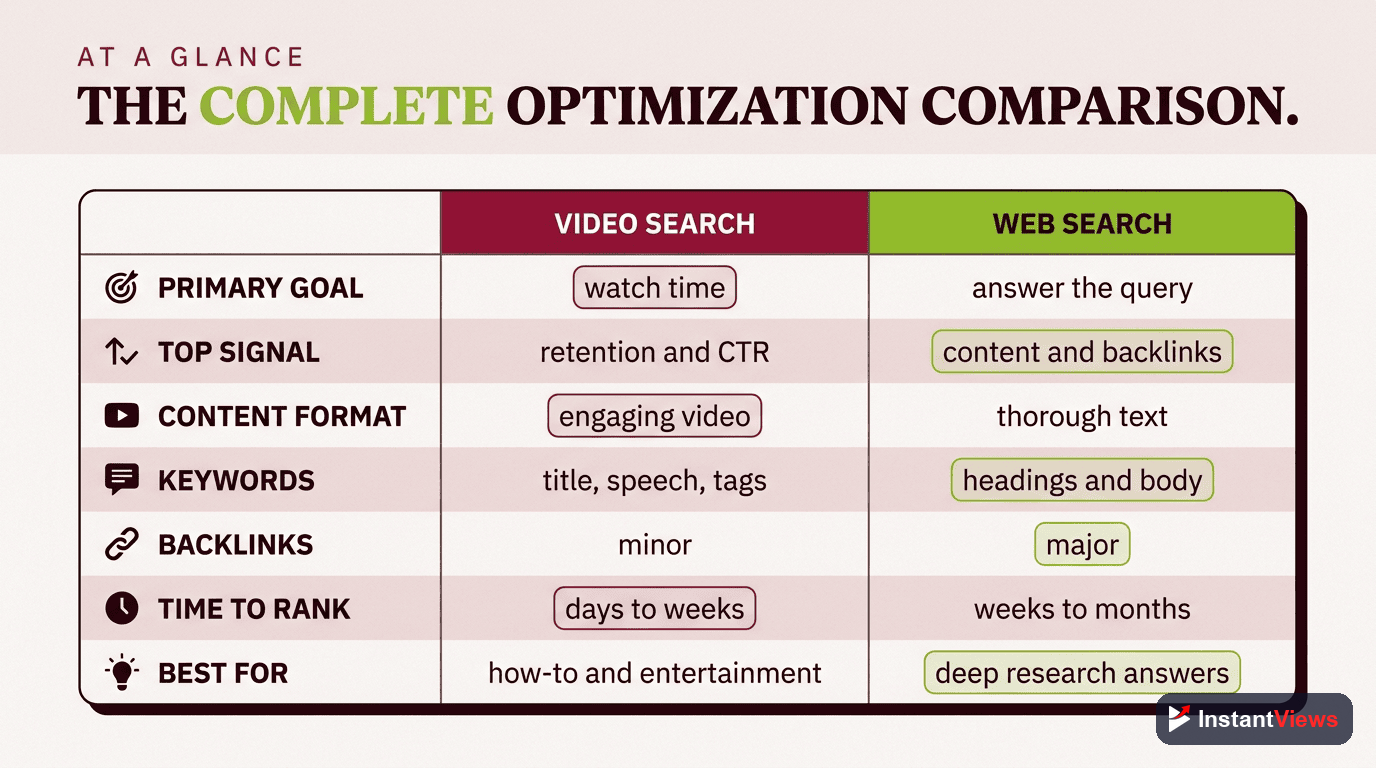
- YouTube SEO prioritizes engagement metrics (watch time, retention) while Google SEO focuses on relevance and authority
- Ranking on YouTube can happen in hours; Google typically takes weeks to months
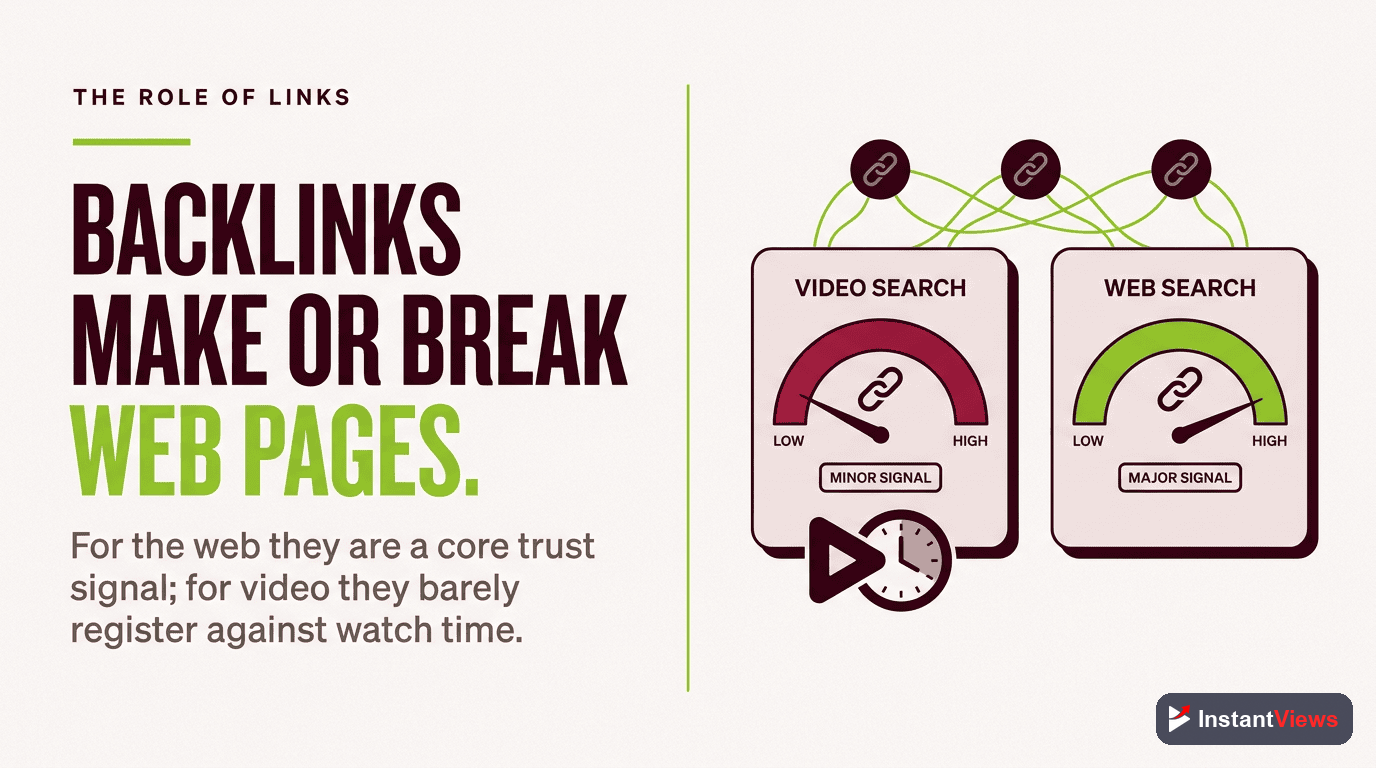
- Backlinks matter significantly for Google but have minimal direct impact on YouTube rankings
- YouTube requires optimizing both metadata AND the video content itself for best results
- Understanding both algorithms helps you dominate video search across platforms
If you've been treating YouTube SEO like Google SEO, you're missing massive opportunities. While both are search engines owned by Google, they operate on fundamentally different principles.
Google wants to show the most authoritative, relevant content. YouTube wants to maximize watch time and keep viewers on the platform. This difference changes everything about how you optimize.
This guide breaks down the key differences between YouTube SEO and Google SEO so you can rank on both platforms with the right strategies.
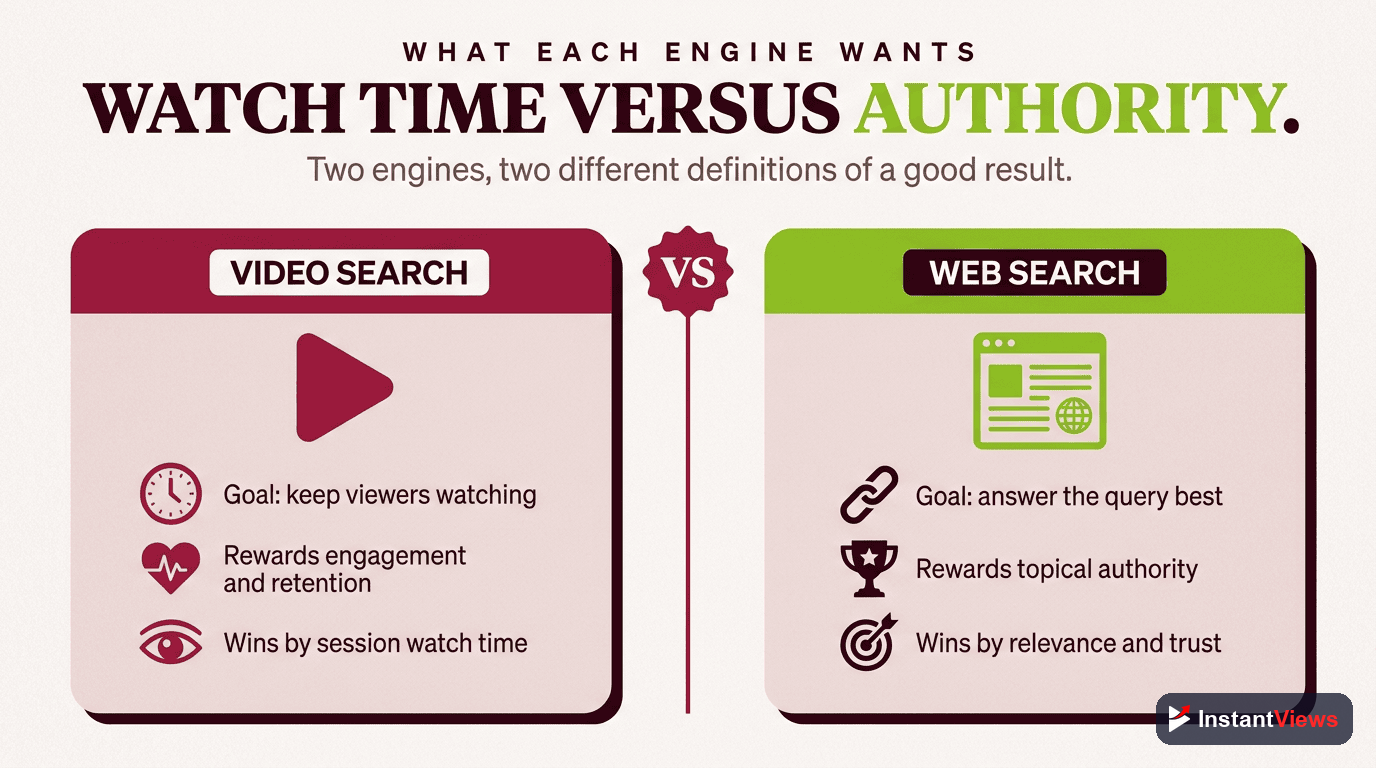
Primary Goal: Watch Time vs Authority
Goal: Maximize Watch Time
YouTube's algorithm is designed to keep people watching videos. The longer viewers stay on the platform, the more ads YouTube can show. Your video's success is measured by how well it keeps viewers engaged and watching more videos.
Goal: Provide Best Answer
Google wants to provide the most authoritative, relevant answer to a query as quickly as possible. Success is measured by whether users find what they're looking for and don't return to search again (low bounce to SERP).
What this means for you: On YouTube, a 10-minute video that keeps viewers watching for 8 minutes will outrank a perfect 2-minute video. On Google, the 2-minute video that perfectly answers the query might rank higher.
Major Ranking Factors Compared
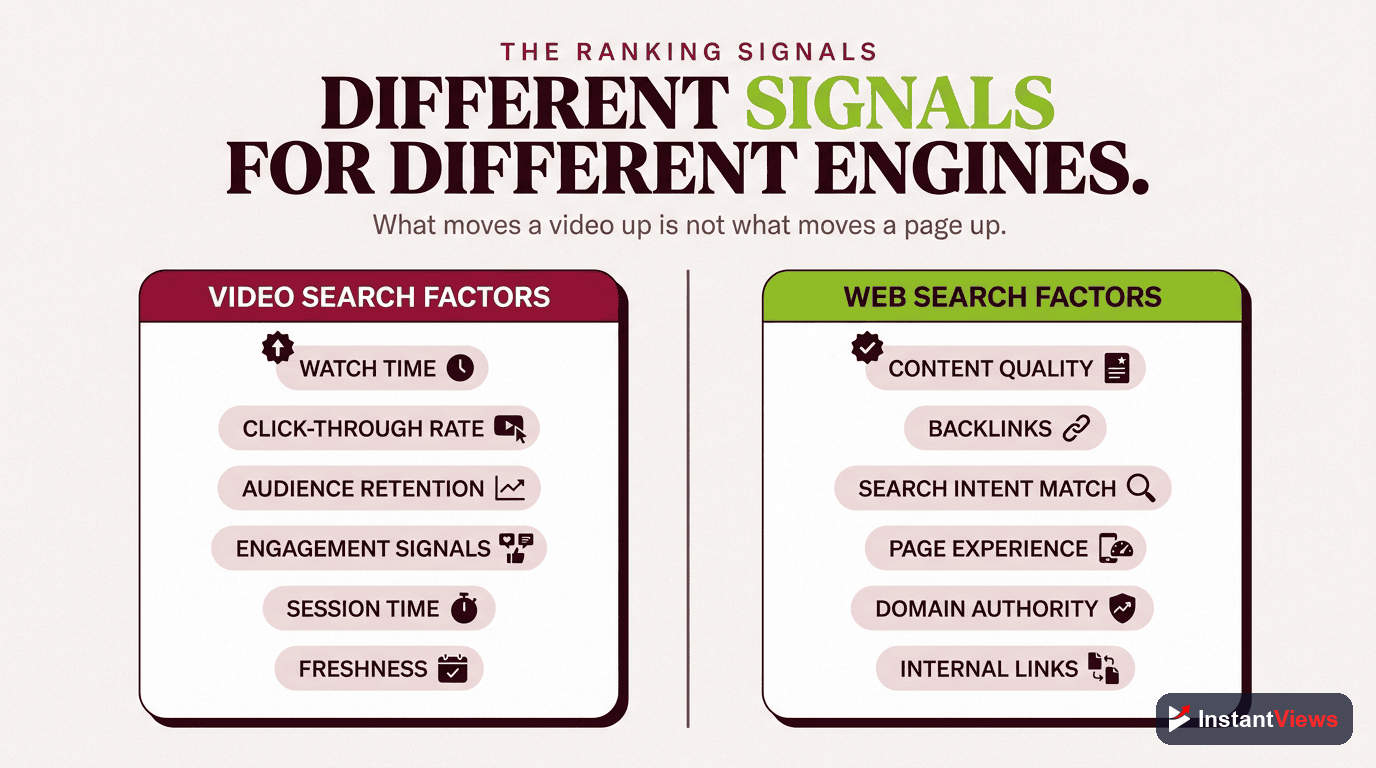
Both platforms care about different signals. Here's what actually matters:
| Ranking Factor | YouTube Importance | Google Importance |
|---|---|---|
| Watch Time / Dwell Time | Critical - Primary factor | Moderate - One of many signals |
| Click-Through Rate | Very High - Affects impressions | Moderate - Affects rankings |
| Backlinks | Low - Minimal direct impact | Critical - Major ranking factor |
| Audience Retention | Critical - Must retain viewers | Low - Not directly measured |
| Content Freshness | High - Algorithm favors new videos | Varies - Depends on query type |
| User Engagement | Very High - Likes, comments, shares | Low - Social signals debated |
| Domain Authority | Moderate - Channel authority matters | Critical - DA heavily weighted |
| Session Duration | Critical - Must keep viewers on YouTube | N/A - Not applicable |
YouTube measures performance continuously after publishing. A video can rank well initially, then drop if engagement metrics decline. Google rankings are more stable once established.
Content Format Requirements
YouTube: Video Content Quality Matters
On YouTube, you can't just optimize metadata - the actual video content determines your success:
- Hook quality - First 30 seconds determine retention
- Pacing - Must maintain engagement throughout
- Visual appeal - Thumbnail and video quality affect CTR
- Audio quality - Poor audio kills watch time
- Value delivery - Must satisfy the promise in title
Google: Content Relevance and Authority
On Google, written content quality and authority signals dominate:
- Comprehensive coverage - In-depth content often ranks better
- E-E-A-T signals - Expertise, Experience, Authority, Trust
- Structured data - Schema markup helps visibility
- Internal linking - Site architecture affects crawling
- Page speed - Technical performance matters

Keyword Strategy Differences
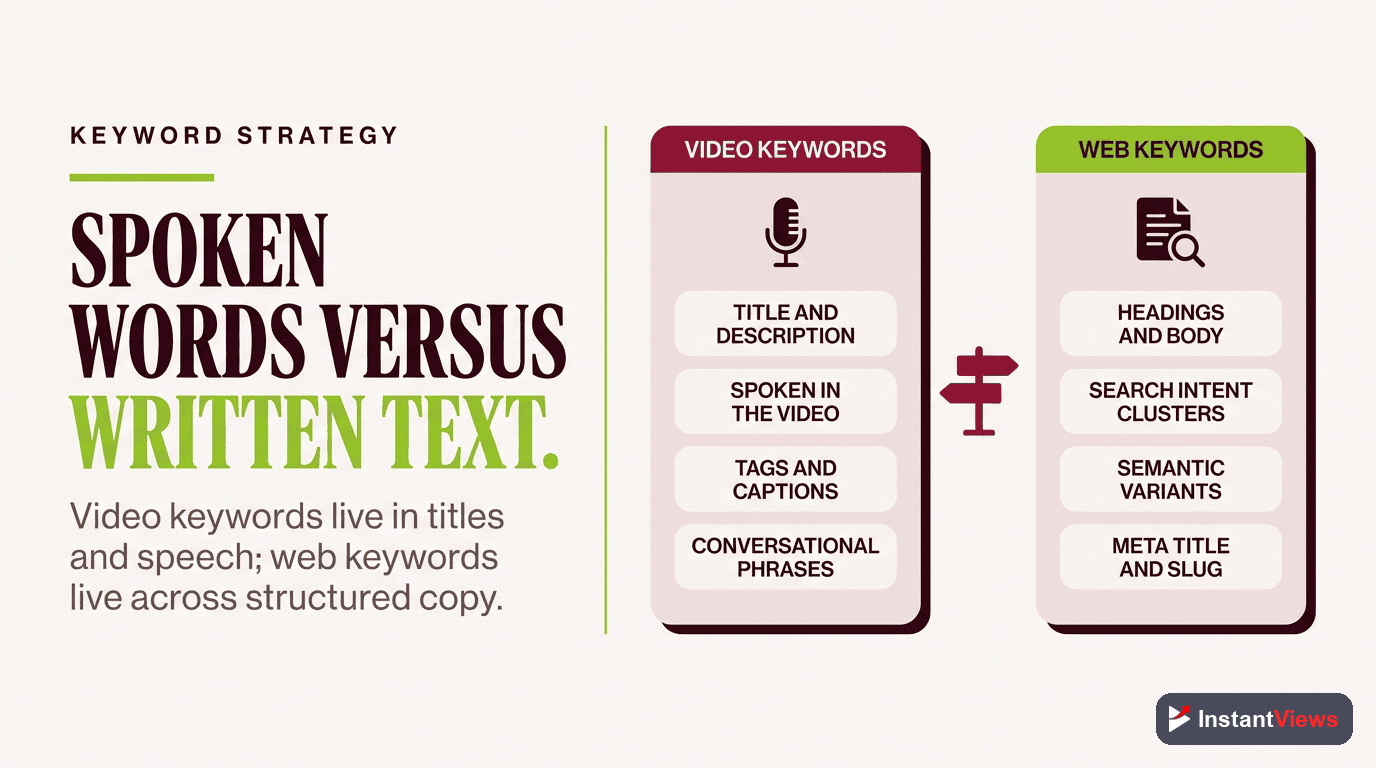
YouTube Keyword Research
YouTube searchers use different language patterns:
- Conversational queries - "how do I" and "tutorial" language
- Entertainment intent - People browse, not just search
- Suggested videos matter - Related video recommendations drive views
- Search + browse hybrid - Algorithm shows videos you didn't search for
Example YouTube keywords: "How to rank YouTube videos fast", "YouTube SEO tutorial 2026", "YouTube algorithm explained"
Google Keyword Research
Google searchers are typically more specific and intent-driven:
- Specific queries - Looking for exact information
- Commercial intent - "best", "review", "vs" terms
- Long-tail precision - More specific = easier to rank
- Search-only - No browse recommendations like YouTube
Example Google keywords: "YouTube SEO checklist", "difference between YouTube and Google SEO", "video SEO best practices"
| Aspect | YouTube Keywords | Google Keywords |
|---|---|---|
| Query Type | Conversational, how-to focused | Specific, question-based |
| Competition | Generally lower for video format | Higher - more content competing |
| Search Suggest | YouTube autocomplete + related videos | Google autocomplete only |
| Intent | Learn, entertainment, inspiration | Information, commercial, navigation |
The Role of Backlinks
YouTube: Minimal Direct Impact
Backlinks don't directly boost YouTube rankings the way they do for Google. However, they help indirectly:
- Traffic signals - External traffic can boost engagement metrics
- Channel authority - Links to channel (not individual videos) may help
- Social proof - Shares and embeds signal value
What matters more: Watch time, CTR, retention, and session duration.
Google: Critical Ranking Factor
Backlinks are one of Google's top 3 ranking factors:
- Link quality - High-authority links pass more value
- Link quantity - More relevant links = higher rankings
- Anchor text - Descriptive anchors help relevance
- Link velocity - Natural growth patterns matter
A mediocre page with strong backlinks often outranks better content with weak links.
"On YouTube, your content IS the ranking factor. On Google, other people linking to your content is the ranking factor."
Time to Rank
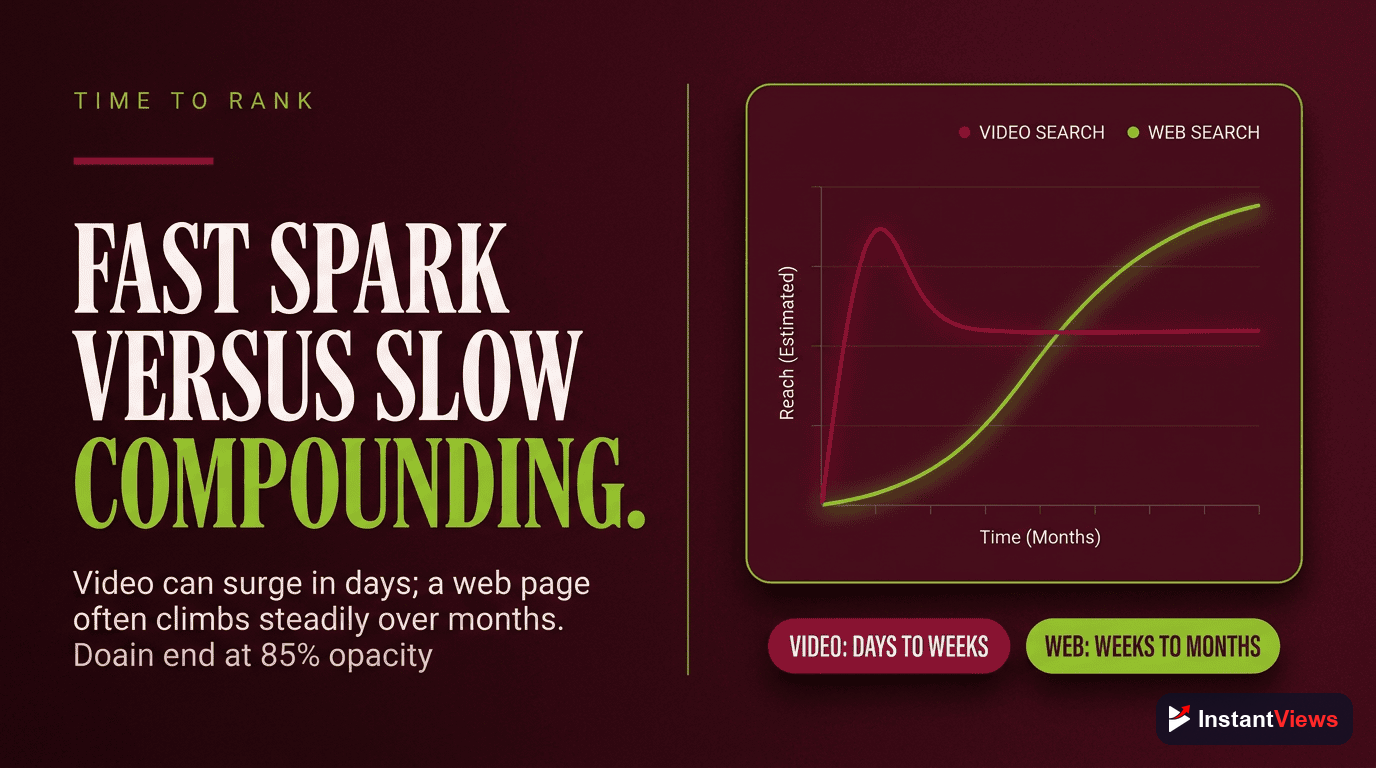
Fast Rankings (Hours to Days)
YouTube gives new videos a "test period" where they're shown to a small audience. If engagement is strong, the algorithm rapidly increases impressions. Videos can rank within hours for the right topics.
- Initial test: First 48 hours
- Momentum phase: 1-7 days
- Can go viral quickly with strong metrics
- Rankings fluctuate based on ongoing performance
Slower Rankings (Weeks to Months)
Google requires time to crawl, index, and evaluate your content against existing rankings. New sites especially face a "sandbox period" where rankings are suppressed initially.
- Crawl and index: 1-7 days
- Initial ranking: 2-4 weeks
- Competitive ranking: 3-6 months
- More stable once established
Complete Optimization Comparison
| Element | YouTube SEO Strategy | Google SEO Strategy |
|---|---|---|
| Title | Front-load keywords, create curiosity, optimize for CTR | Clear, descriptive, include primary keyword |
| Description | First 2 lines critical, include timestamps, add links | Comprehensive content, natural keyword usage |
| Tags/Meta | Use specific tags, include variations, don't overstuff | Meta description for CTR, proper header tags |
| Content Length | As long as value lasts (8-15 min average), retention matters more | Comprehensive coverage (1500+ words for competitive terms) |
| Engagement | Ask for likes/comments, create discussions, community tab | Focus on dwell time and low bounce rate |
| Thumbnails/Images | Critical - High CTR thumbnail essential | Important - Optimize alt text, compress files |
Platform-Specific Best Practices
YouTube SEO Checklist
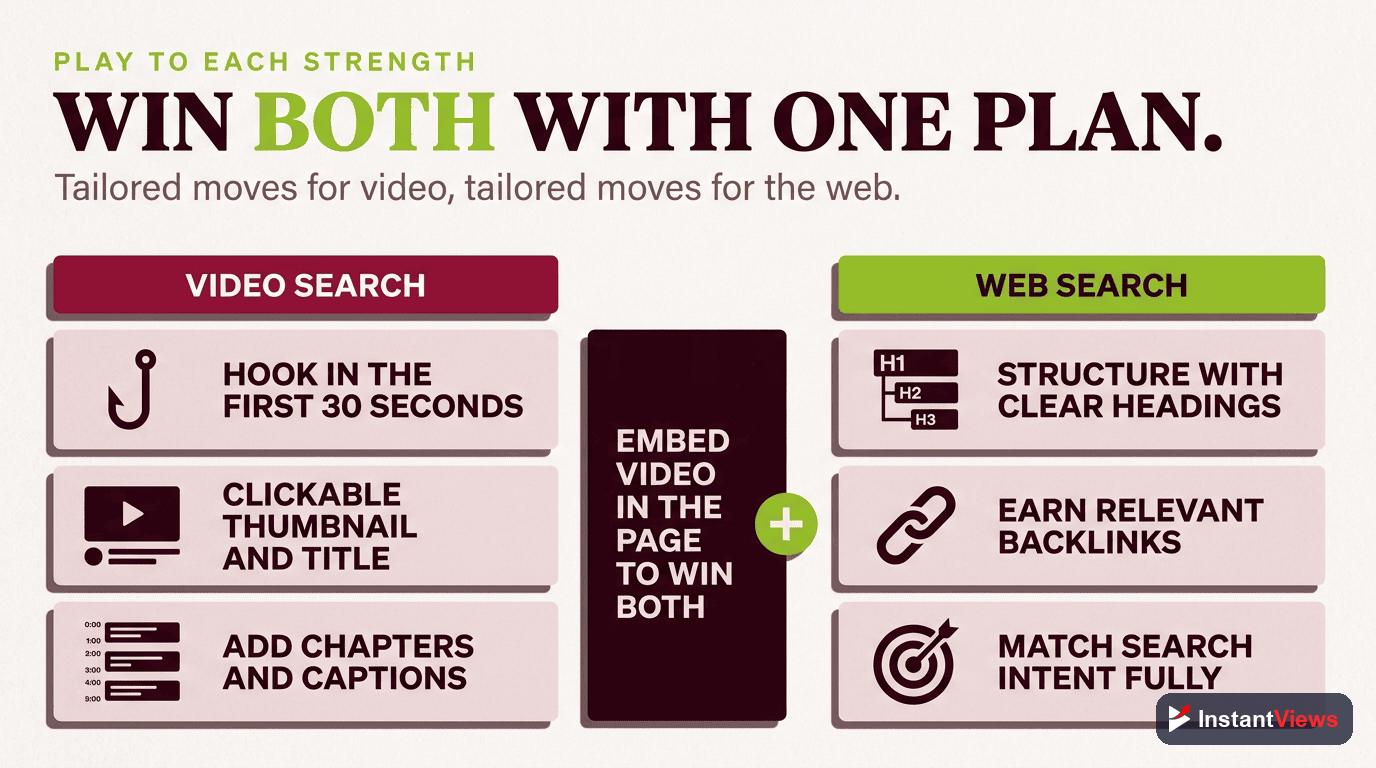
- Create a strong hook - Keep 70%+ of viewers past 30 seconds
- Design high-CTR thumbnail - Stand out in suggested videos
- Write compelling title - Balance keywords with curiosity
- Optimize first 150 characters of description - Include primary keywords
- Add timestamps - Improves user experience and watch time
- Use end screens and cards - Extend session duration
- Encourage engagement - Ask for likes and comments
- Analyze retention graphs - Identify and fix drop-off points
Google SEO Checklist
- Conduct thorough keyword research - Target specific search intent
- Create comprehensive content - Cover topics in-depth
- Build quality backlinks - Focus on relevant, authoritative sites
- Optimize technical SEO - Fast loading, mobile-friendly, proper structure
- Use proper header hierarchy - H1, H2, H3 structure
- Add schema markup - Help Google understand your content
- Improve E-E-A-T signals - Show expertise and authority
- Monitor Core Web Vitals - Page experience matters
Optimize Your YouTube Videos
Get instant analysis of your video's SEO score, engagement potential, and specific optimization recommendations.
Analyze Your Video →The Bottom Line
YouTube SEO and Google SEO require different approaches:
- YouTube rewards engagement - Create content that keeps people watching
- Google rewards authority - Build comprehensive content with strong backlinks
- YouTube is faster - See results in hours or days
- Google is more stable - Rankings last longer once achieved
- Both require quality - No shortcuts on either platform
The best strategy? Optimize for both. Create engaging videos that rank on YouTube, then embed them in comprehensive blog posts optimized for Google. You'll dominate video search across both platforms.
Frequently Asked Questions
YouTube SEO can be easier to rank for in competitive niches because there's less competition in video format. However, it requires different skills - you need to create engaging video content, not just optimize text. Both have their challenges.
Backlinks have minimal direct impact on YouTube rankings. YouTube prioritizes watch time, engagement, and viewer satisfaction over external links. However, backlinks can drive traffic to your videos, which indirectly helps rankings.
While there's overlap, YouTube searchers often use different query patterns. YouTube queries tend to be more conversational and "how-to" focused. Research keywords specifically for each platform using their respective tools.
Video length doesn't directly affect rankings, but watch time does. Longer videos have more opportunity for watch time, but only if viewers stay engaged. Quality and retention matter more than raw length.
YouTube videos can rank faster - sometimes within hours if the topic is trending. Google typically takes weeks to months. However, YouTube rankings are more volatile and can change quickly based on performance metrics.
Optimize for YouTube first since that's where your video lives. YouTube optimization (engagement, retention) automatically helps Google rankings. A video that performs well on YouTube is more likely to rank in Google search results.