- Long videos (1+ hour) need 10-25 chapters for optimal navigation
- Average chapter length should be 4-6 minutes for extended content
- Structure chapters hierarchically: major sections with detailed substeps
- YouTube allows up to 100 chapters, but 15-25 is optimal for usability
- Different long-form types need different strategies: tutorials, documentaries, conferences
Long-form YouTube content—videos over an hour—presents unique challenges for viewer retention and navigation. While a 10-minute video might need 4-5 chapters, a 90-minute documentary requires a completely different approach.
The challenge: Long videos without proper chapters see 40-60% higher abandonment rates. Viewers lose patience when they can't find specific sections, and YouTube's algorithm penalizes videos with poor retention.
This comprehensive guide covers everything you need to know about structuring chapters for long-form YouTube content, including optimal counts, hierarchical organization, and specialized strategies for different video types.
Why Long Videos Need More Chapters
The need for chapters scales exponentially—not linearly—with video length. A video that's 6x longer doesn't just need 6x more chapters; it needs a more sophisticated navigation structure.
The Attention Span Problem
Viewer behavior changes dramatically in long-form content:
- Multiple viewing sessions: 73% of viewers watch long videos in multiple sessions, returning to specific points
- Topic skipping: 68% skip to sections relevant to their immediate needs rather than watching linearly
- Reference viewing: Long tutorials and educational content are often used as reference material
- Mobile constraints: 45% of long-form viewing happens on mobile, where precise scrubbing is difficult
The Discovery Problem
Long videos face unique discoverability challenges that chapters solve:
Each chapter title is a potential search ranking opportunity. A 2-hour video with 20 well-titled chapters has 20 chances to match user search queries, compared to just the video title and description.
YouTube and Google index chapter titles separately, meaning your long video can rank for dozens of different queries based on its chapter structure.

Optimal Chapter Count for Long Videos
The sweet spot for chapter counts varies based on total video length. Here's the data-driven breakdown:
| Video Length | Optimal Chapters | Avg Chapter Duration | Max Recommended |
|---|---|---|---|
| 60-75 minutes | 10-15 chapters | 4-6 minutes | 18 chapters |
| 75-90 minutes | 12-18 chapters | 4-6 minutes | 22 chapters |
| 90-120 minutes | 15-20 chapters | 5-7 minutes | 25 chapters |
| 120-180 minutes | 18-25 chapters | 5-8 minutes | 30 chapters |
| 180+ minutes | 20-30 chapters | 6-10 minutes | 35 chapters |
Factors That Influence Chapter Count
Beyond raw length, consider these factors:
- Content density: Technical tutorials need more granular chapters than interviews or podcasts
- Audience intent: Reference material needs more chapters than entertainment content
- Visual complexity: Demonstration videos benefit from more detailed chapter markers
- Pacing variety: Videos with varied pacing need chapters to help viewers navigate tempo changes
Auto-Generate Perfect Chapters for Long Videos
Our AI analyzes your long-form content and creates optimally-structured chapters automatically. Perfect for 1+ hour videos.
Try Free Timestamp Generator →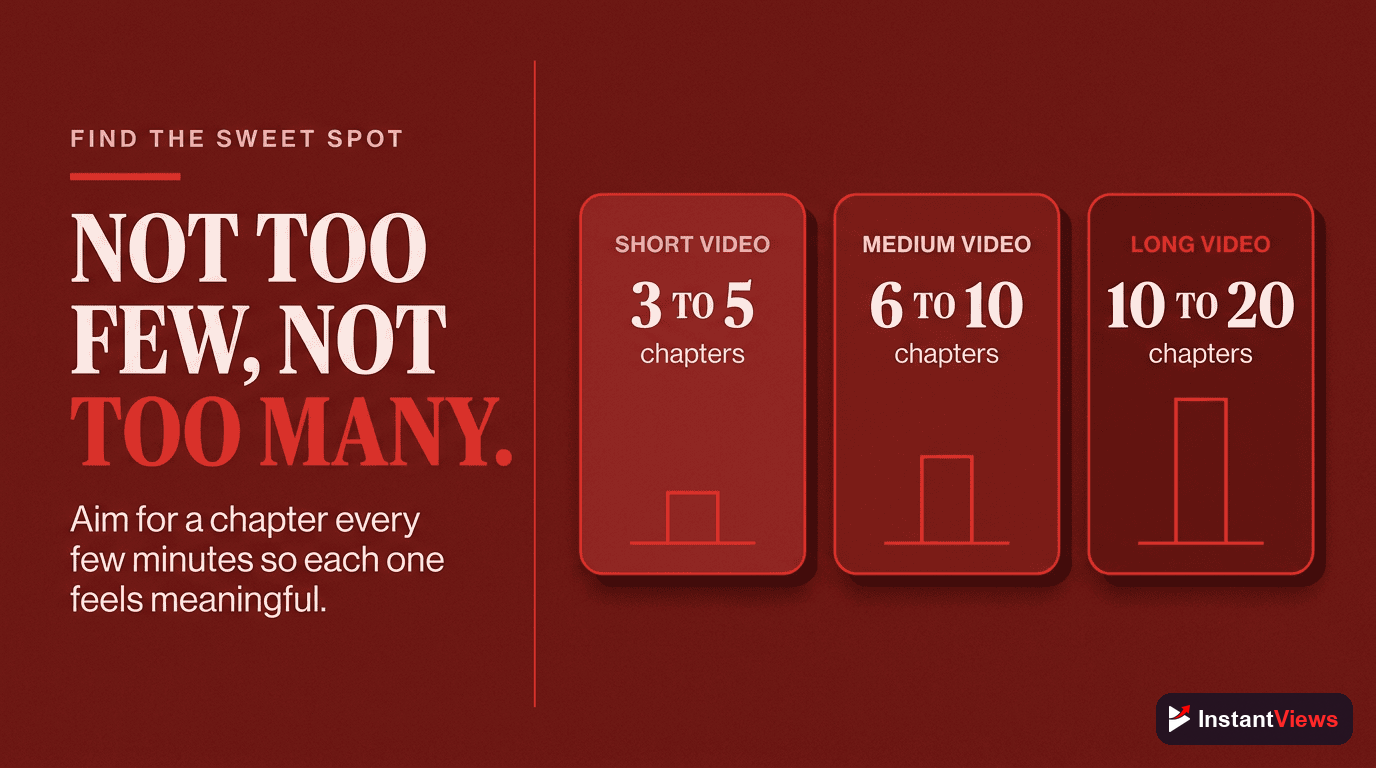
Structuring 1-2 Hour Video Chapters
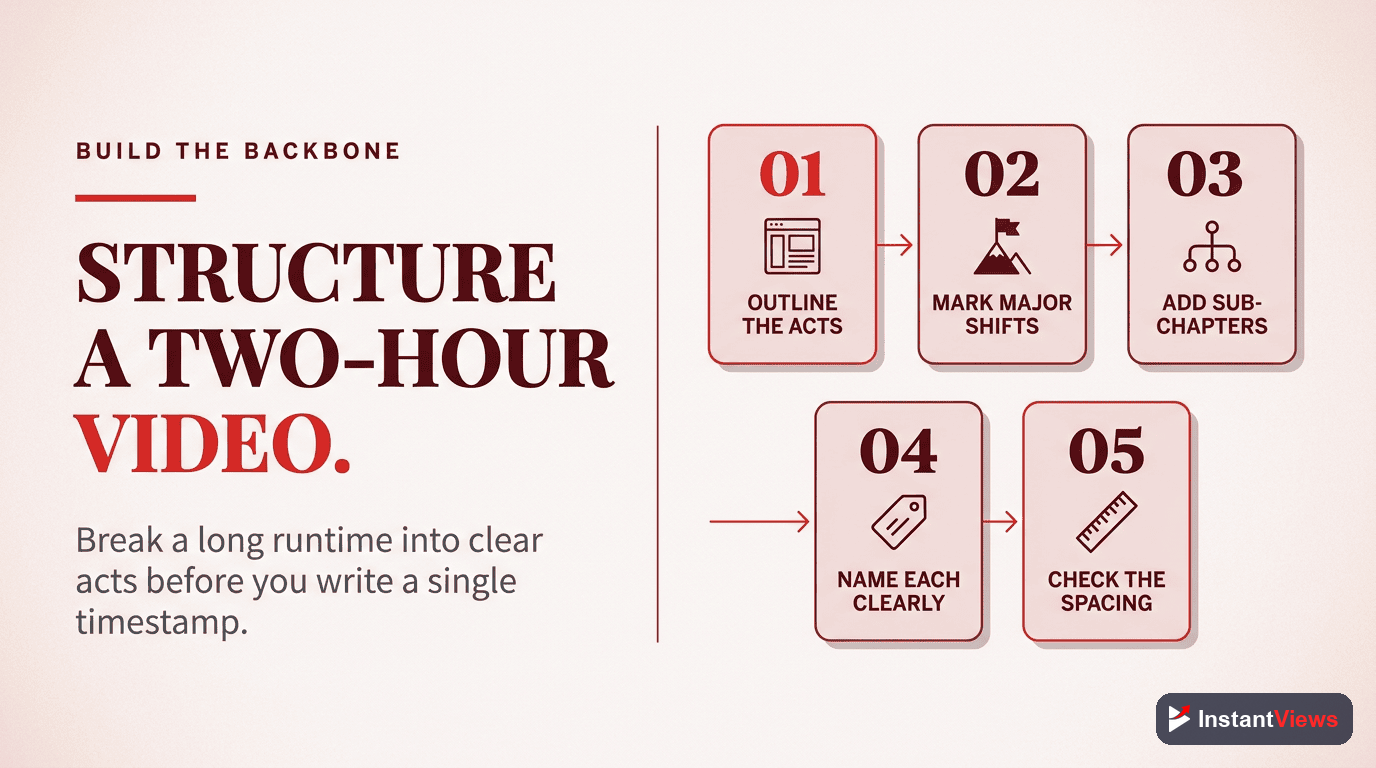
Videos in the 1-2 hour range require a hierarchical chapter structure. Think of it as creating a table of contents for a book rather than just dividing content into equal segments.
Three-Tier Chapter Structure
Tier 1: Major Sections (6-12 minutes)
These are your primary content divisions—the "acts" of your video.
Examples for a 90-minute tutorial:
- 0:00 - Introduction & Setup
- 8:30 - Part 1: Fundamentals
- 28:45 - Part 2: Advanced Techniques
- 58:20 - Part 3: Real-World Applications
- 82:15 - Conclusion & Next Steps
These provide high-level navigation for viewers who want to jump between major topics.
Tier 2: Subtopics (3-6 minutes)
Within each major section, break down into specific topics or steps.
Example breakdown of "Part 2: Advanced Techniques":
- 28:45 - Advanced Technique Overview
- 31:20 - Method 1: Layer Masking
- 37:45 - Method 2: Blend Modes
- 43:10 - Method 3: Smart Objects
- 49:30 - Combining Techniques
- 54:50 - Common Mistakes to Avoid
Tier 3: Detail Points (1-3 minutes)
For complex processes, add granular chapters for specific actions or concepts.
Example breakdown of "Method 1: Layer Masking":
- 31:20 - What Are Layer Masks?
- 32:45 - Creating Your First Mask
- 34:10 - Brush Settings for Masking
- 35:40 - Advanced Mask Refinement
Use detail chapters sparingly—only for the most complex sections that viewers need to reference repeatedly.
Don't use all three tiers everywhere. Reserve Tier 3 detail chapters for your most complex 2-3 sections. The rest should use Tier 1 and Tier 2 only. Too many micro-chapters creates clutter.
Sample 90-Minute Video Structure
Here's a complete example showing all three tiers:
| Timestamp | Chapter Title | Tier | Duration |
|---|---|---|---|
| 0:00 | Introduction & What You'll Learn | 1 | 3:45 |
| 3:45 | Required Software & Setup | 2 | 4:45 |
| 8:30 | Part 1: Fundamentals Overview | 1 | 2:15 |
| 10:45 | Understanding the Interface | 2 | 5:30 |
| 16:15 | Basic Tools & Shortcuts | 2 | 6:20 |
| 22:35 | Your First Project | 2 | 6:10 |
| 28:45 | Part 2: Advanced Techniques | 1 | 2:35 |
| 31:20 | Advanced Technique #1 | 2 | 8:25 |
| 39:45 | Advanced Technique #2 | 2 | 7:50 |
| 47:35 | Advanced Technique #3 | 2 | 9:15 |
| 56:50 | Part 3: Real-World Project | 1 | 2:20 |
| 59:10 | Project Planning & Setup | 2 | 5:40 |
| 64:50 | Building the Project | 2 | 12:25 |
| 77:15 | Final Touches & Export | 2 | 5:00 |
| 82:15 | Conclusion & Next Steps | 1 | 3:45 |
| 86:00 | Bonus: Common Troubleshooting | 2 | 4:00 |
This structure uses 16 chapters across 90 minutes, averaging 5.6 minutes per chapter—right in the optimal range for long-form tutorials.
Documentary-Style Chapter Structure
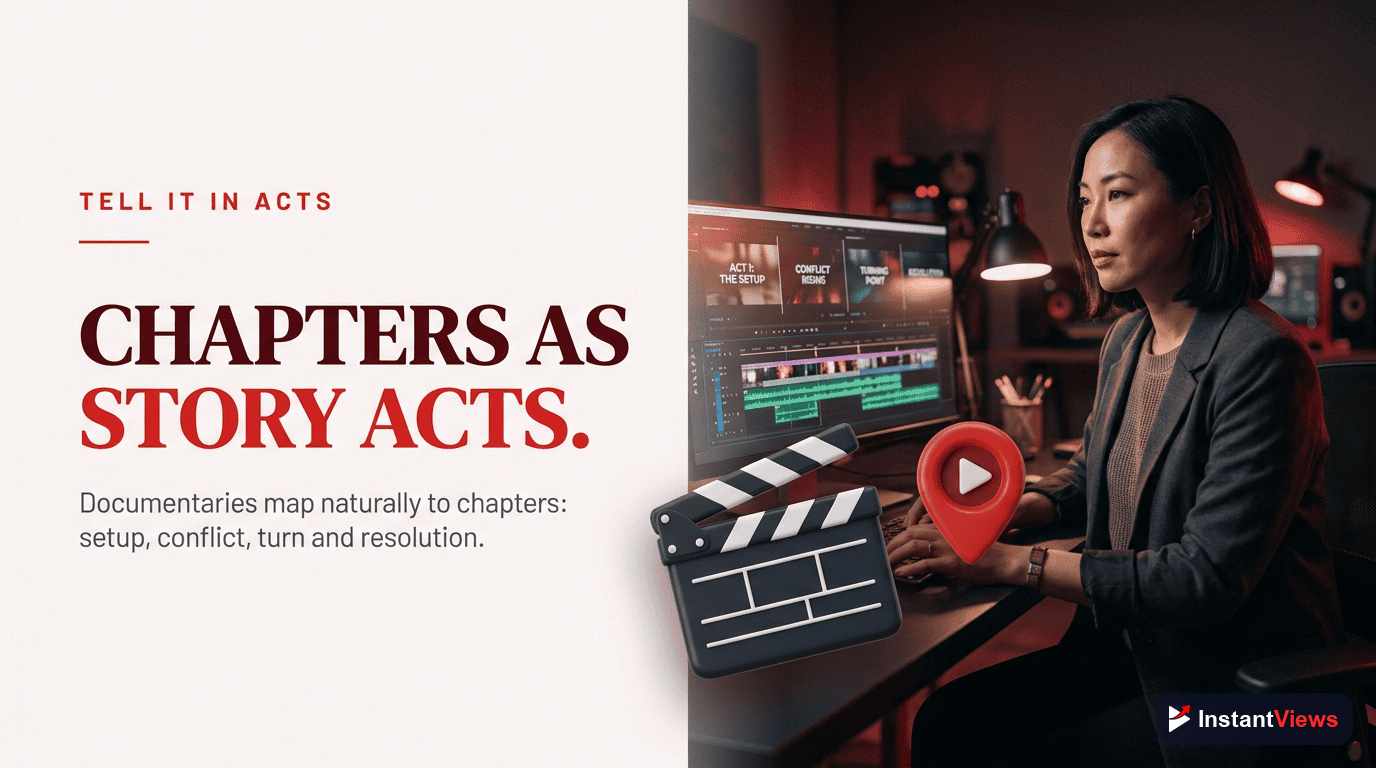
Documentaries and narrative long-form content require a different approach than tutorials. The focus is on story flow rather than instructional steps.
Narrative Chapter Strategy
Story Arc Chapters
Structure chapters around narrative beats, not arbitrary time divisions.
For a 120-minute documentary:
- 0:00 - Opening Hook (2-4 min): Capture attention immediately
- 3:15 - Establishing Context (6-8 min): Set the scene and background
- 10:30 - The Inciting Incident (8-10 min): What triggered this story?
- 19:45 - Act 1: Rising Action (15-20 min): Main story development begins
- 38:20 - Complications & Obstacles (12-15 min): Challenges emerge
- 52:45 - Act 2: Deepening Crisis (18-22 min): Stakes intensify
- 73:10 - Turning Point (8-10 min): Major revelation or shift
- 82:30 - Act 3: Resolution Path (15-18 min): Moving toward conclusion
- 99:20 - Climax & Outcome (10-12 min): Story culmination
- 110:45 - Epilogue & Reflection (8-10 min): Where are they now? What did we learn?
Character-Based Chapters
For documentaries featuring multiple subjects or perspectives:
- Create chapters for each major interview subject
- Add chapters for location or setting changes
- Include chapters for key evidence or case study presentations
- Add transition chapters between perspectives
Long Tutorial Chapter Strategies
Extended tutorials (1+ hour) are among the most challenging content to chapter effectively. Viewers use them both for linear learning and as reference material.
Dual-Purpose Chapter Structure
Create Linear Learning Chapters
Add Reference Navigation Points
Include Checkpoint Chapters
Mark Optional Content Clearly
Example: 2-Hour Programming Tutorial
| Timestamp | Chapter Title | Type |
|---|---|---|
| 0:00 | Introduction & Course Overview | Linear |
| 4:20 | Setting Up Your Environment | Linear |
| 12:35 | Part 1: Variables & Data Types | Linear |
| 23:10 | Part 2: Control Flow | Linear |
| 34:45 | Checkpoint: Variables & Control Flow | Checkpoint |
| 38:20 | Part 3: Functions | Linear |
| 51:15 | Part 4: Objects & Classes | Linear |
| 66:30 | Checkpoint: Functions & Objects | Checkpoint |
| 70:00 | Part 5: Working with APIs | Linear |
| 84:25 | Part 6: Error Handling | Linear |
| 95:40 | Optional: Advanced Async Patterns | Optional |
| 107:15 | Final Project: Building the App | Linear |
| 128:30 | Troubleshooting Common Errors | Reference |
| 135:45 | Keyboard Shortcuts Reference | Reference |
| 139:20 | Next Steps & Resources | Linear |
This structure serves both first-time learners (following the linear path) and returning viewers (jumping to reference chapters).
Let AI Handle Complex Chapter Structure
Generate professional chapters for tutorials, documentaries, and conferences automatically. Save hours of manual work.
Start Free →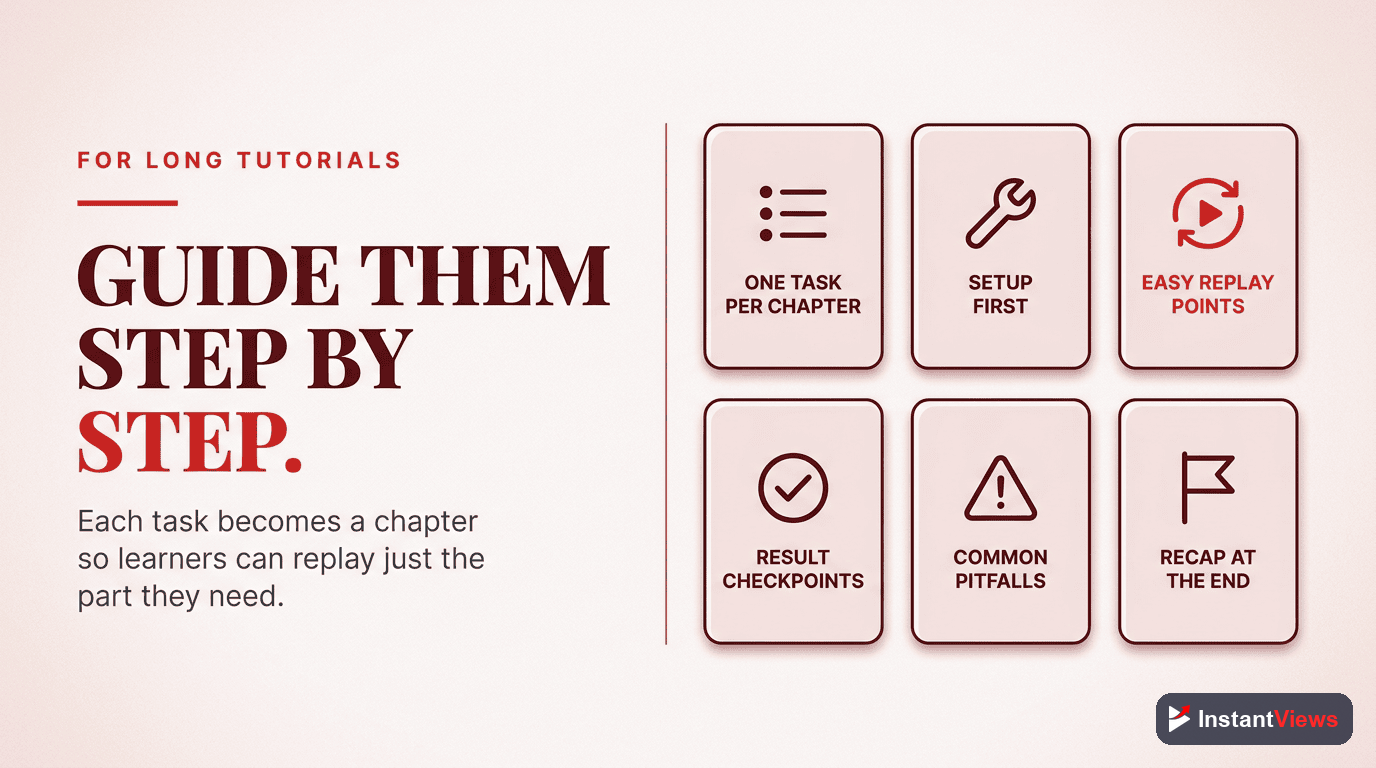
Conference & Presentation Chapters
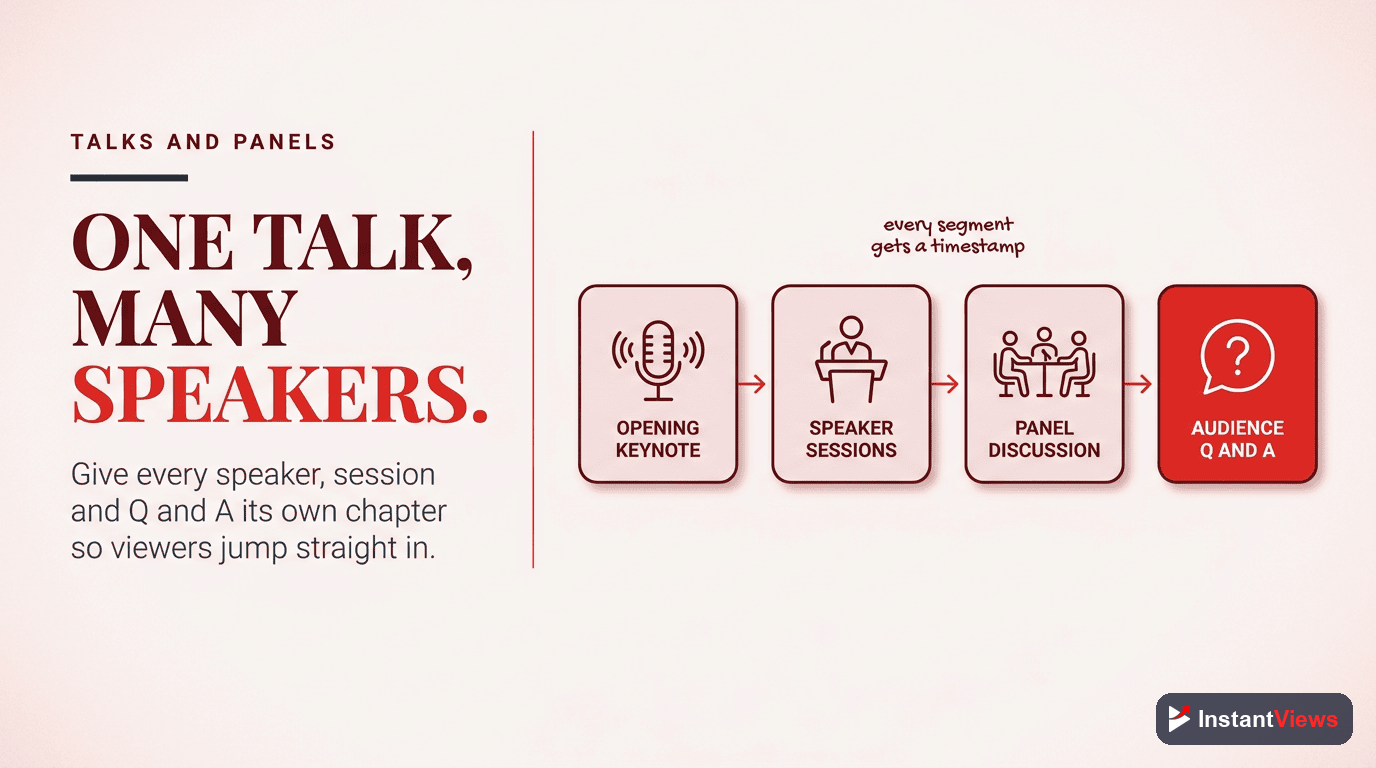
Multi-hour conference recordings or presentation compilations are common on YouTube. These require a speaker-focused chapter strategy.
Speaker-Based Structure
Multi-Speaker Event Structure
For a 3-hour conference with multiple speakers:
- 0:00 - Event Opening & Welcome (5 min)
- 5:15 - Keynote: [Speaker Name] - [Topic] (45 min)
- 50:30 - Q&A: Keynote Discussion (15 min)
- 65:45 - Break & Transition (2 min)
- 67:50 - Session 1: [Speaker Name] - [Topic] (30 min)
- 98:10 - Q&A: Session 1 (10 min)
- 108:25 - Session 2: [Speaker Name] - [Topic] (30 min)
- 138:40 - Q&A: Session 2 (10 min)
- 148:55 - Panel Discussion: [Topic] (35 min)
- 184:10 - Closing Remarks & Announcements (6 min)
Always separate Q&A sessions into their own chapters—many viewers specifically seek out audience questions.
Presentation Subsection Chapters
For longer presentations (45+ minutes), break individual talks into subtopics:
- 50:30 - Keynote: Introduction & Context
- 55:40 - Keynote: Problem Statement
- 62:15 - Keynote: Proposed Solution
- 71:30 - Keynote: Case Study Examples
- 83:20 - Keynote: Implementation Roadmap
- 90:45 - Keynote: Conclusion & Takeaways
Maximum Chapter Limits & Best Practices
YouTube technically allows up to 100 chapters per video, but there are practical limits to consider.
The 25-Chapter Sweet Spot
Data analysis of high-performing long-form content shows that 15-25 chapters provides the best balance between navigation utility and usability:
When to Use More Than 25 Chapters
Exceed 25 chapters only in these specific cases:
- Academic lectures (3+ hours) with many distinct topics
- Complete course compilations combining multiple lessons
- Multi-day event recordings where each day needs full breakdown
- Reference documentation videos designed for lookup rather than linear viewing
Videos with 30+ chapters become difficult to navigate on mobile devices. The progress bar becomes cluttered, and chapter markers overlap. If your audience is primarily mobile, cap chapters at 25 even for very long videos.
Chapter Length Boundaries for Long Videos
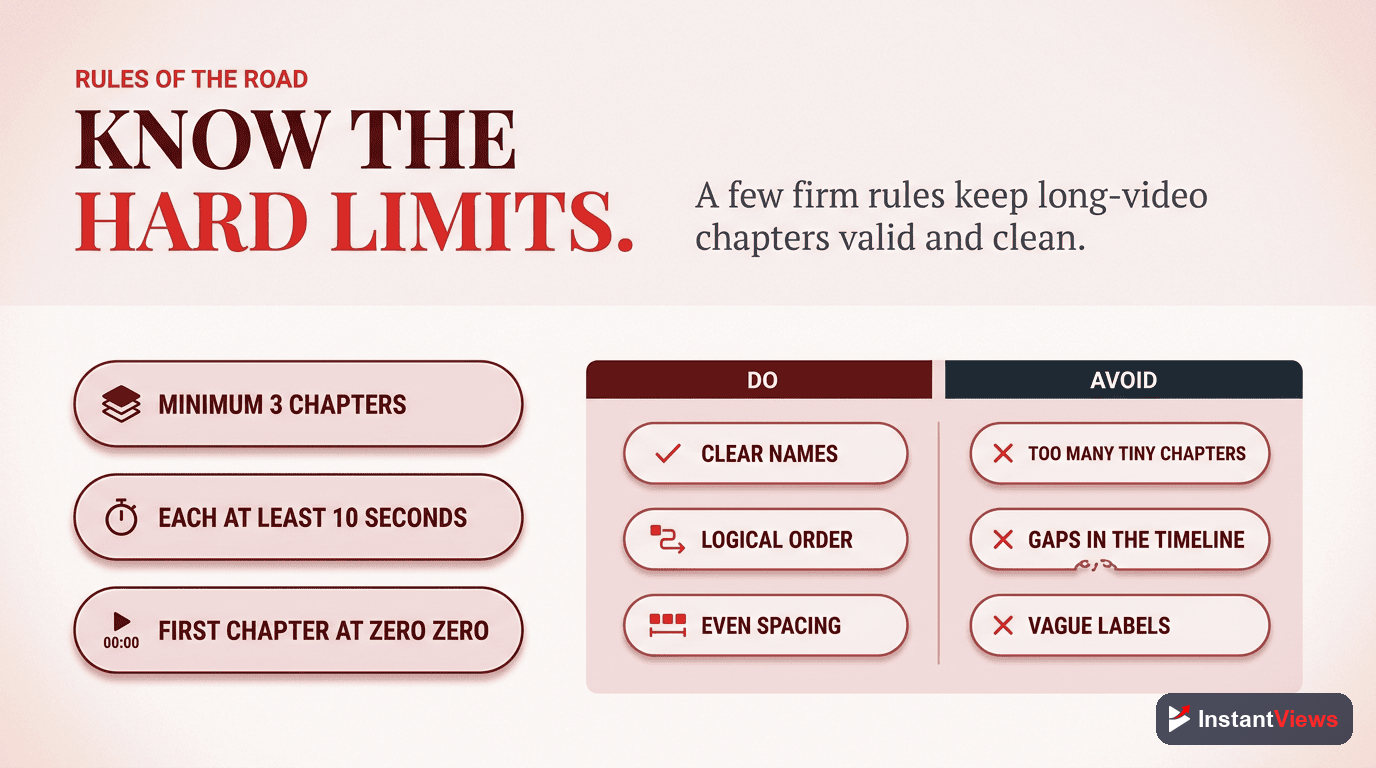
Even in long-form content, respect these duration boundaries:
- Minimum chapter length: 2 minutes (exceptions: intro/outro can be 1-2 min)
- Maximum chapter length: 12 minutes (break longer segments into subtopics)
- Optimal range: 4-8 minutes for most chapters
Testing Your Chapter Structure
The Scroll Test
The Scan Test
The Jump Test
Frequently Asked Questions
A 1-hour video typically works best with 10-15 chapters, averaging 4-6 minutes each. This provides enough navigation points without overwhelming viewers. For educational content, aim for 8-12 chapters with longer segments. For entertainment or podcasts, 12-18 shorter chapters work better.
YouTube allows up to 100 chapters per video. However, for optimal user experience, most long videos should use 15-25 chapters maximum. More than 25 chapters can make the progress bar cluttered and difficult to navigate, especially on mobile devices.
No, chapters in long videos should vary based on content needs. Major topics might need 8-10 minutes, while transitions or summaries could be 2-3 minutes. Aim for reasonable consistency within content types - lecture chapters similar lengths, Q&A chapters similar lengths, etc.
For a 2-hour documentary, use 15-20 chapters organized by narrative segments. Create chapters for: introduction (3-5 min), main story acts (8-12 min each), interviews or case studies (5-8 min), transitions between themes (3-5 min), and conclusion (4-6 min). Each chapter should advance the narrative.
Yes, long videos benefit significantly from chapters. Studies show that chaptered long-form content has 12-18% higher retention than non-chaptered videos. Chapters help viewers find and return to specific segments, reducing abandonment when viewers want to skip to relevant sections.
For tutorials over 1 hour, aim for 5-8 minute chapters covering complete steps or concepts. Break complex procedures into substeps with dedicated chapters. Include overview chapters (3-4 min) at major section beginnings and checkpoint chapters where viewers can test their progress.
Yes, conference videos should absolutely have chapters for each speaker or presentation. Include: event intro (2-3 min), each speaker presentation (full duration), Q&A sessions (separate from talks), breaks/transitions (1-2 min), and closing remarks. This makes multi-hour events easily navigable.
Chapters significantly boost SEO for long videos by creating multiple keyword opportunities. Each chapter title is indexed by YouTube and Google. A 2-hour video with 20 well-titled chapters has 20x the keyword targeting potential, improving discoverability for various search queries related to your content.
Conclusion: Mastering Long-Form Chapter Structure
Long-form YouTube content requires sophisticated chapter strategies that go beyond simple time divisions. The key principles for 1+ hour videos:
- Scale appropriately: 10-25 chapters for most long videos, with 4-6 minute average duration
- Use hierarchical structure: Major sections, subtopics, and (sparingly) detail points
- Match content type: Narrative flow for documentaries, instructional progression for tutorials, speaker focus for conferences
- Serve multiple audiences: Both linear learners and reference users need to navigate effectively
- Test usability: Especially on mobile devices where most long-form viewing happens
The effort you invest in thoughtful chapter structure directly impacts viewer retention, satisfaction, and your video's discoverability in YouTube search. For long-form content, chapters aren't optional—they're essential infrastructure.
Remember: A well-chaptered 90-minute video will outperform a non-chaptered one by 15-20% in average view duration. That difference compounds into significant algorithmic advantage over time.
Next steps:
- Audit your existing long-form videos and add chapters to your top performers
- Create a chapter template for your most common video types
- Monitor analytics to see which chapters get the most engagement
- Iterate and improve your structure based on viewer behavior
Related guides: