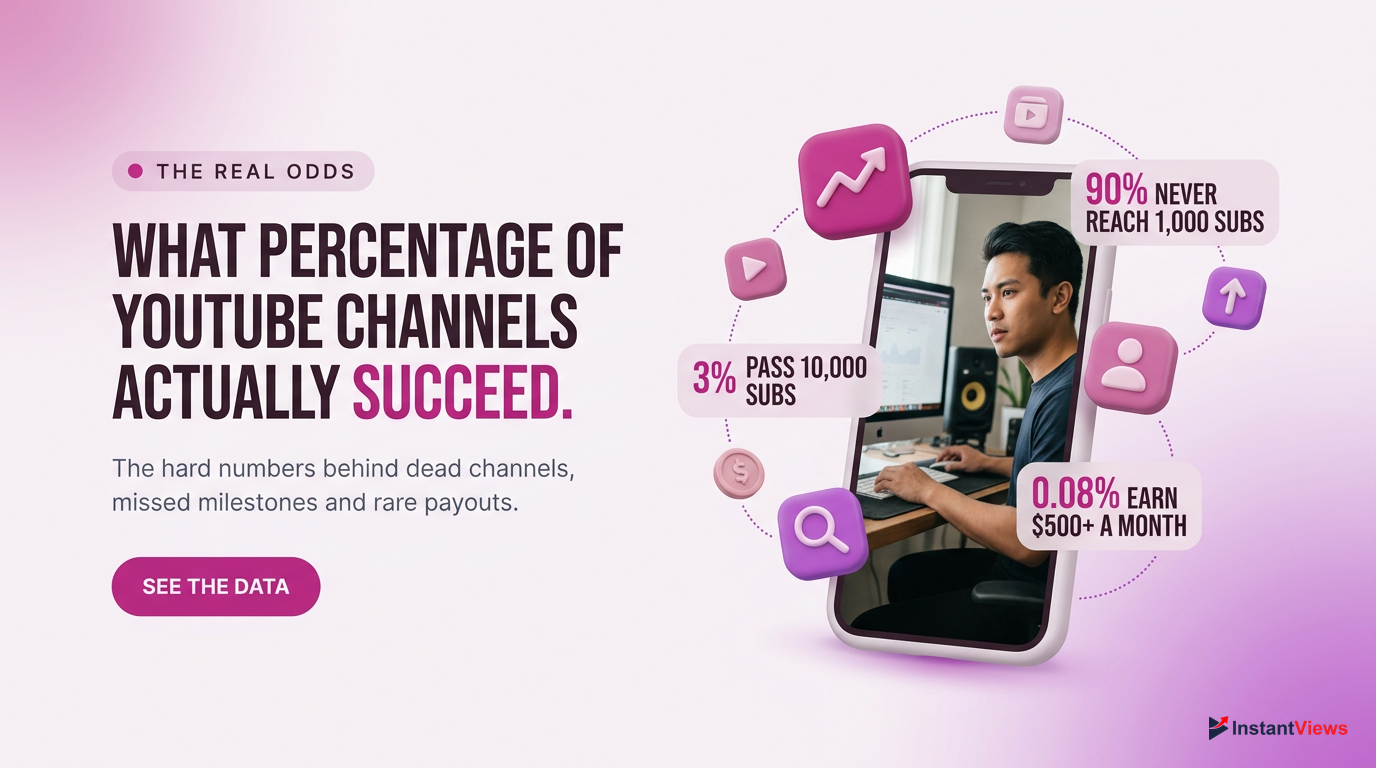
- Over 600 million YouTube channels exist, but 92% are considered completely dead.
- Only 8.86% to 10% of all YouTube channels ever reach the 1,000 subscriber milestone.
- Just 2% to 2.6% of active channels are monetized in the YouTube Partner Program.
- A mere 0.08% of all channels earn a 'living wage' of $500 or more per month.
- Hitting 1,000 subscribers doesn't guarantee income; 89% of these channels make under $20 a month.
If you are pouring hours into scripting, filming, and editing videos, you have likely asked yourself a tough question: what percentage of YouTube channels actually succeed? The creator economy is often painted as a gold rush, with highlight reels of influencers buying mansions and sports cars. However, the reality hidden in the platform's backend data tells a vastly different, much more sobering story.
As of early 2026, the landscape of YouTube has shifted dramatically. With the rise of AI-generated content, hyper-competitive Shorts algorithms, and changing monetization thresholds, the barrier to entry is lower than ever, but the barrier to actual financial success has skyrocketed. We analyzed the most up-to-date, verified statistics from industry leaders like Statista, Social Blade, vidIQ, and YouTube itself to uncover the truth.
In this comprehensive data study, we are stripping away the fluff and looking strictly at the numbers. From the staggering abandonment rates of new creators to the exact percentage of channels that secure the coveted Gold Play Button, this guide breaks down the real odds. Whether you are a brand new creator or a seasoned veteran, understanding these verified 2026 statistics is crucial for setting realistic goals and navigating the platform.
- The Brutal Reality: Total Channels vs. Active Creators
- The 90% Abandonment Rate: Why Most Channels Die in 6 Months
- The First Major Hurdle: Reaching 1,000 Subscribers
- The 10,000 Subscriber Milestone: Entering the Top 3%
- The Elite Tiers: Silver and Gold Play Buttons
- The Monetization Mirage: Entering the YPP
- The Watch-Hour Bottleneck: Why 1k Subs Isn't Enough
- The "Living Wage" Reality: Can You Actually Make a Living?
- The View Count Trap: Why 1k Subs Equals Negligible Revenue
- How to Defy the Odds and Actually Succeed on YouTube
- FAQ
The Brutal Reality: Total Channels vs. Active Creators
To understand exactly what percentage of YouTube channels succeed, we first have to look at the sheer volume of competition on the platform. According to early 2026 data from Statista and Social Blade, over 600 million YouTube channels have been created since the platform's inception. This is a staggering figure, representing nearly 8% of the global population. However, this massive number is highly deceptive when calculating actual success rates.

The 600 million figure includes every single account ever registered, including burner accounts, viewers who accidentally created a channel to leave a comment, and channels with zero uploaded videos. When we filter out the noise and look strictly at "active" channels—defined as those that post at least one video per month—the landscape shrinks dramatically.
Recent 2026 reports from Tubular Labs and DemandSage reveal that only about 47 million to 65 million channels are genuinely active on a monthly basis. Even at the most generous estimates, which sometimes push the active number closer to 115 million when including sporadic uploaders, the vast majority of the platform is a ghost town. This massive discrepancy between created channels and active creators is the first filter of YouTube success. Simply by uploading consistently once a month, you are already separating yourself from hundreds of millions of abandoned accounts.
Success on YouTube cannot be measured against the 600 million total channels. True competitive analysis must be measured against the 47 to 65 million creators who are actually actively uploading content in 2026.
Understanding this baseline is critical. When new creators feel overwhelmed by the idea of competing against hundreds of millions of people, they are often worrying about ghosts. The real competition is much smaller, though still fiercely competitive. The first step to succeeding on YouTube isn't going viral; it is simply remaining in the active pool of creators.
The 90% Abandonment Rate: Why Most Channels Die in 6 Months
One of the most shocking statistics regarding what percentage of YouTube channels succeed is how quickly new creators give up. The initial excitement of starting a channel is almost universally met with the harsh reality of the algorithm. According to verified 2025 data from Statista and a May 2026 report by YouTubeToolkit, roughly 90% of all newly created YouTube channels show absolutely no activity after their first six months.
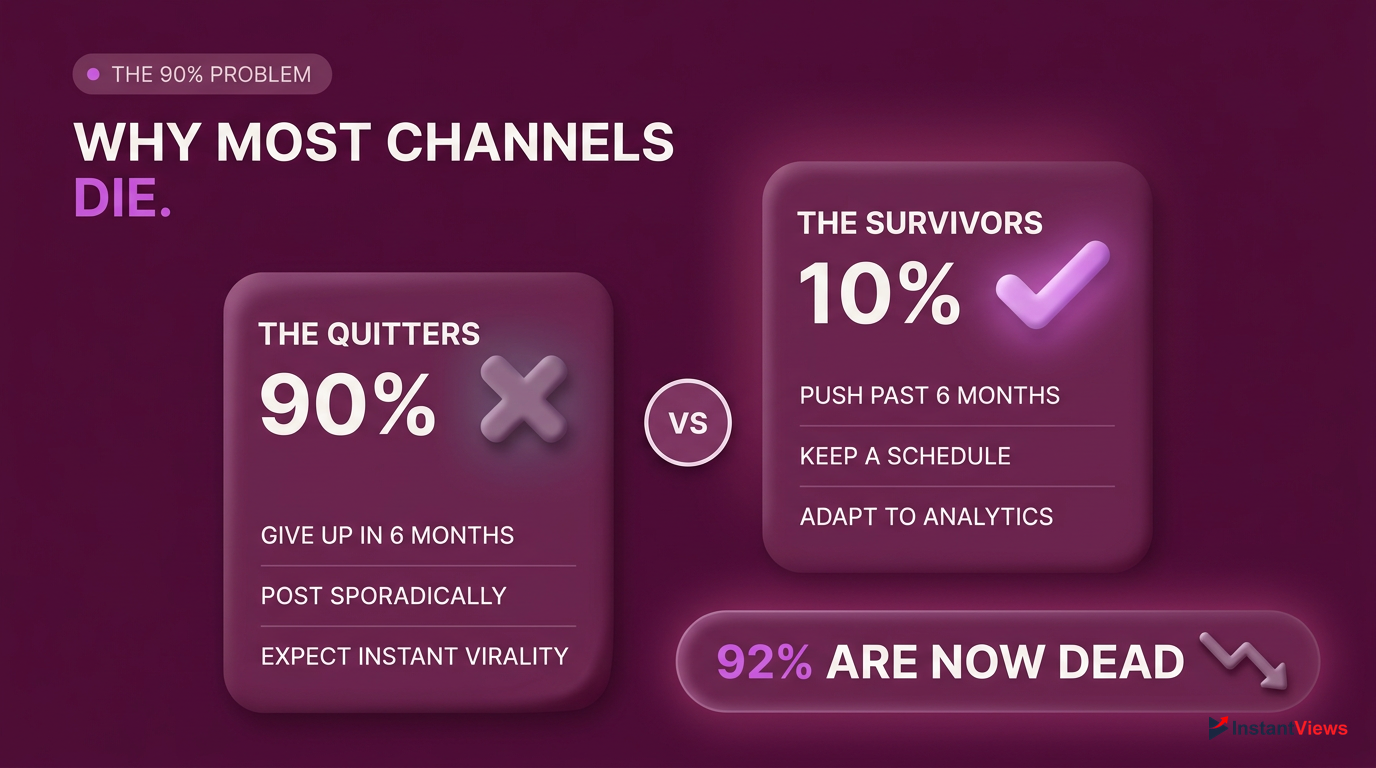
The Quitters
- Give up within 6 months
- Post sporadically
- Expect instant virality
The Survivors
- Push past the 6-month mark
- Maintain upload schedules
- Adapt to analytics
This massive attrition rate is the primary reason why 92% of all channels ever created are currently classified as "dead" (meaning they have not uploaded a single video in over six months). The psychological toll of spending hours editing a video only to receive single-digit views is the ultimate filter for creators. YouTube's algorithm requires a vast amount of data to understand who to serve your content to, and six months is often the minimum time required for the system to categorize a new channel properly.
Why do so many fail so quickly? The data suggests a massive disconnect between expectation and reality. Many creators enter the platform expecting a linear growth curve. When they don't see immediate subscriber gains or viral traction, burnout sets in rapidly. They abandon their channels right before the algorithm has enough metadata to start testing their content with wider audiences.
If you are starting a channel in 2026, expect zero algorithmic traction for the first 3 to 6 months. Planning your content schedule around this "sandbox" period is crucial to avoid becoming part of the 90% abandonment statistic.
Therefore, simply surviving the first six months of consistent uploading puts you ahead of 9 out of 10 people who try their hand at YouTube. Consistency, rather than immediate quality or virality, is the most statistically significant indicator of whether a channel will survive its infancy.
The First Major Hurdle: Reaching 1,000 Subscribers
For almost every creator, the 1,000 subscriber mark is the holy grail. It is the psychological milestone that proves your content has an audience, and it is the first half of the requirement for the YouTube Partner Program. But what percentage of YouTube channels succeed in reaching this goal? The numbers are incredibly sobering.
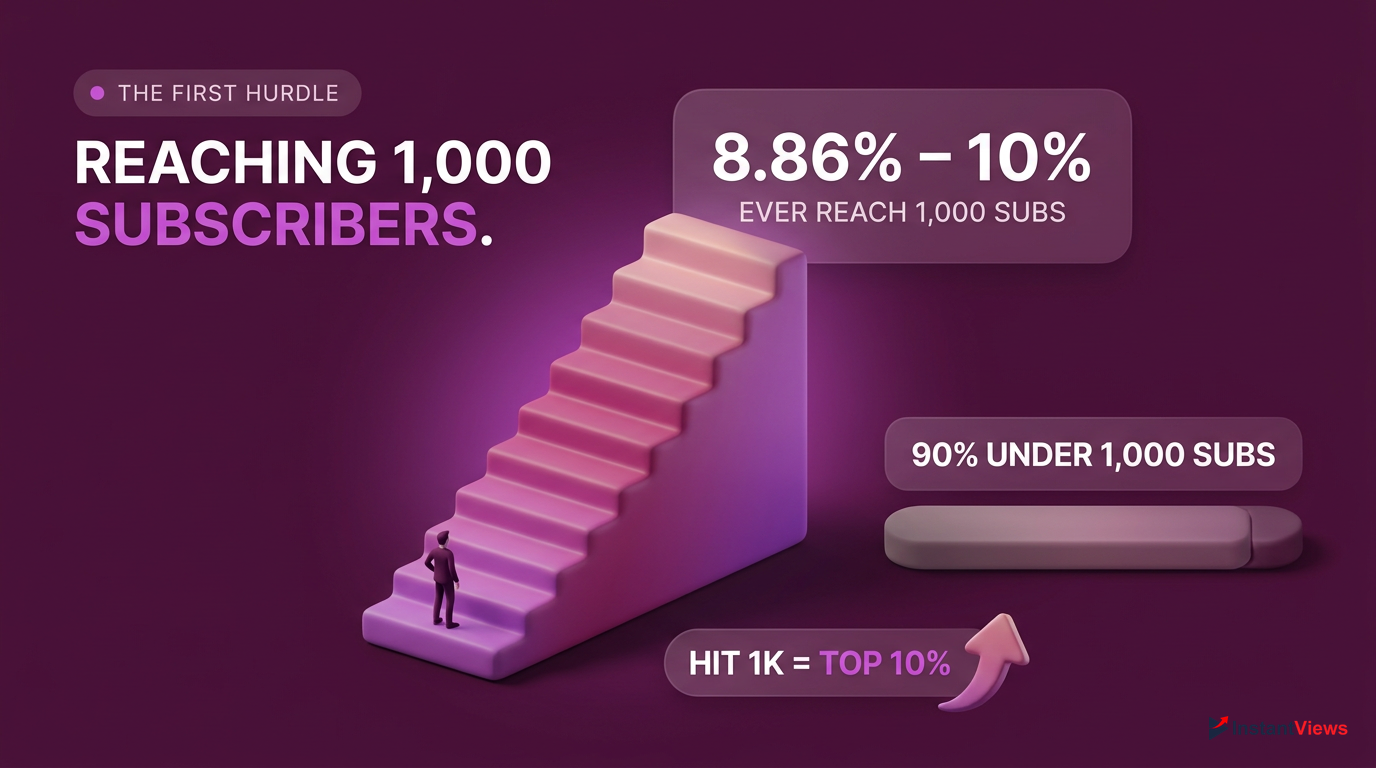
According to an August 2025 report by Awesome Creator Academy (citing Social Blade and Pex data), a staggering 90% of all YouTube channels have less than 1,000 subscribers. When looking at the platform as a whole, only about 8.86% to 10% of channels ever cross this threshold. This data point alone illustrates how difficult it is to build a foundational audience on the platform.
However, context is vital here. A 2025 study by vidIQ noted that if you hit 1,000 subscribers, you are actually in the top 34% of active creators. This means that while 90% of the total platform fails to reach this mark, your odds improve significantly if you simply remain active and consistent.
Reaching 1,000 subscribers requires a shift from making content for yourself to making content for an audience. It requires understanding thumbnails, click-through rates (CTR), and audience retention. Most of the 90% who fail to reach this mark are uploading unoptimized content, lacking clear value propositions, or simply giving up before the compound interest of their video library can take effect.
Hitting 1,000 subscribers is no longer just about long-form videos. In 2026, many creators use YouTube Shorts to rapidly acquire subscribers, though this strategy presents its own challenges when it comes to watch hours.
If you have crossed the 1,000 subscriber mark, you have achieved something that 9 out of 10 people who start a YouTube channel never will. You have officially moved out of the hobbyist tier and into the top third of active creators.
The 10,000 Subscriber Milestone: Entering the Top 3%
If reaching 1,000 subscribers is a monumental task, hitting 10,000 subscribers places a creator into an entirely different echelon. When asking what percentage of YouTube channels succeed at a level where they have a dedicated, returning community, the 10k mark is a highly accurate indicator. The drop-off from 1k to 10k is incredibly steep.
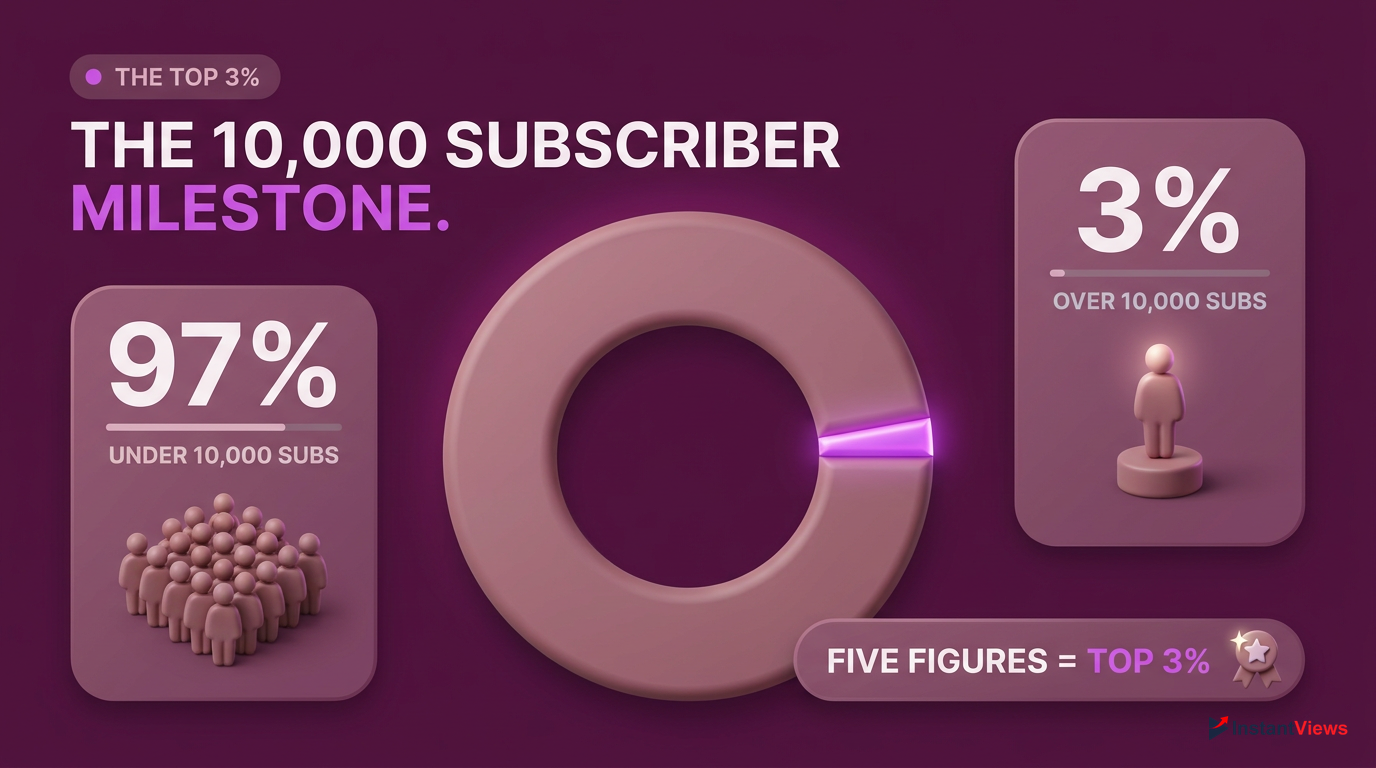
According to the same August 2025 data from Awesome Creator Academy, 97% of all YouTube channels have less than 10,000 subscribers. This means that if your channel displays a five-figure subscriber count, you are officially in the top 3% of all channels ever created on the platform.
Getting from 1,000 to 10,000 subscribers usually requires a creator to find their specific niche and double down on it. While the first 1,000 subscribers can sometimes be gained through a single lucky video, a few viral Shorts, or leveraging personal networks, reaching 10,000 requires repeatable, systemic success. It means the creator has learned how to satisfy the algorithm consistently and has built a brand that viewers actively want to return to.
To bridge the gap between 1k and 10k, analyze your "Returning Viewers" metric in YouTube Studio. Channels that stall at 2k or 3k usually have high new viewer acquisition but terrible returning viewer retention.
At this stage, creators often start seeing the snowball effect. YouTube's recommendation engine heavily favors channels that have a proven track record of keeping viewers on the platform. A channel with 10,000 subscribers has enough historical data for YouTube to confidently suggest its new uploads to lookalike audiences. However, despite being in the top 3%, many creators at this level still struggle to make a full-time living, relying heavily on sponsorships or affiliate marketing rather than pure AdSense revenue.
The Elite Tiers: Silver and Gold Play Buttons
When the general public thinks about successful YouTubers, they picture creators holding massive metal plaques. The Silver Play Button (100,000 subscribers) and the Gold Play Button (1,000,000 subscribers) are the ultimate physical manifestations of platform success. But exactly what percentage of YouTube channels succeed in reaching these elite tiers? The verified 2026 data shows just how rare these milestones truly are.
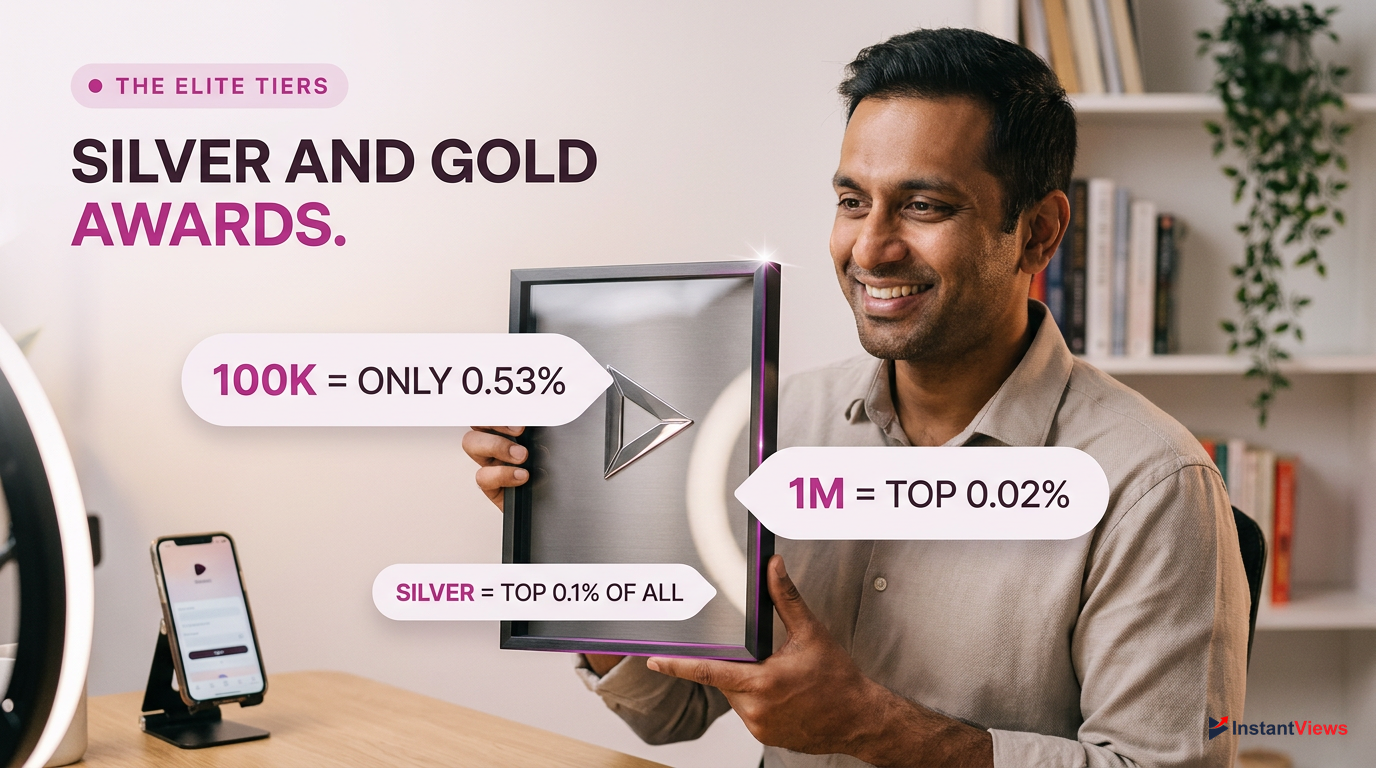
According to Global Media Insight (2026), roughly 620,000 channels have surpassed the 100,000 subscriber mark. While 620,000 sounds like a large number of people, when placed against the 115 million active channels, it represents a mere 0.53% of active creators. If you look at all 600 million channels ever created, a Silver Play Button places you in the top 0.1%.
The Gold Play Button is exponentially rarer. DemandSage (Dec 2025) and vidIQ (Oct 2025) report that at least 69,000 creators boast over a million subscribers. Achieving this places a channel in the top 0.1% of active creators, and an astonishing 0.01% of all channels ever created.
| Milestone | Total Channels | % of Active | % of All Created |
|---|---|---|---|
| Silver (100k) | ~620,000 | 0.53% | 0.1% |
| Gold (1M) | ~69,000 | 0.1% | 0.01% |
These numbers highlight the extreme Pareto principle (the 80/20 rule, or in this case, the 99.9/0.1 rule) at play on YouTube. The platform's viewership is heavily concentrated at the very top. Creators who reach these levels have typically built massive production teams, diversified their content formats across Shorts, Long-form, and Live streams, and treat their channels as full-fledged media corporations rather than solo creator projects.
The Monetization Mirage: Entering the YPP
Having subscribers is great for ego, but revenue is what sustains a channel. The ultimate goal for most creators is getting accepted into the YouTube Partner Program (YPP) to earn a share of ad revenue. So, what percentage of YouTube channels succeed in getting monetized? The data from YouTube itself provides a clear, undeniable answer.
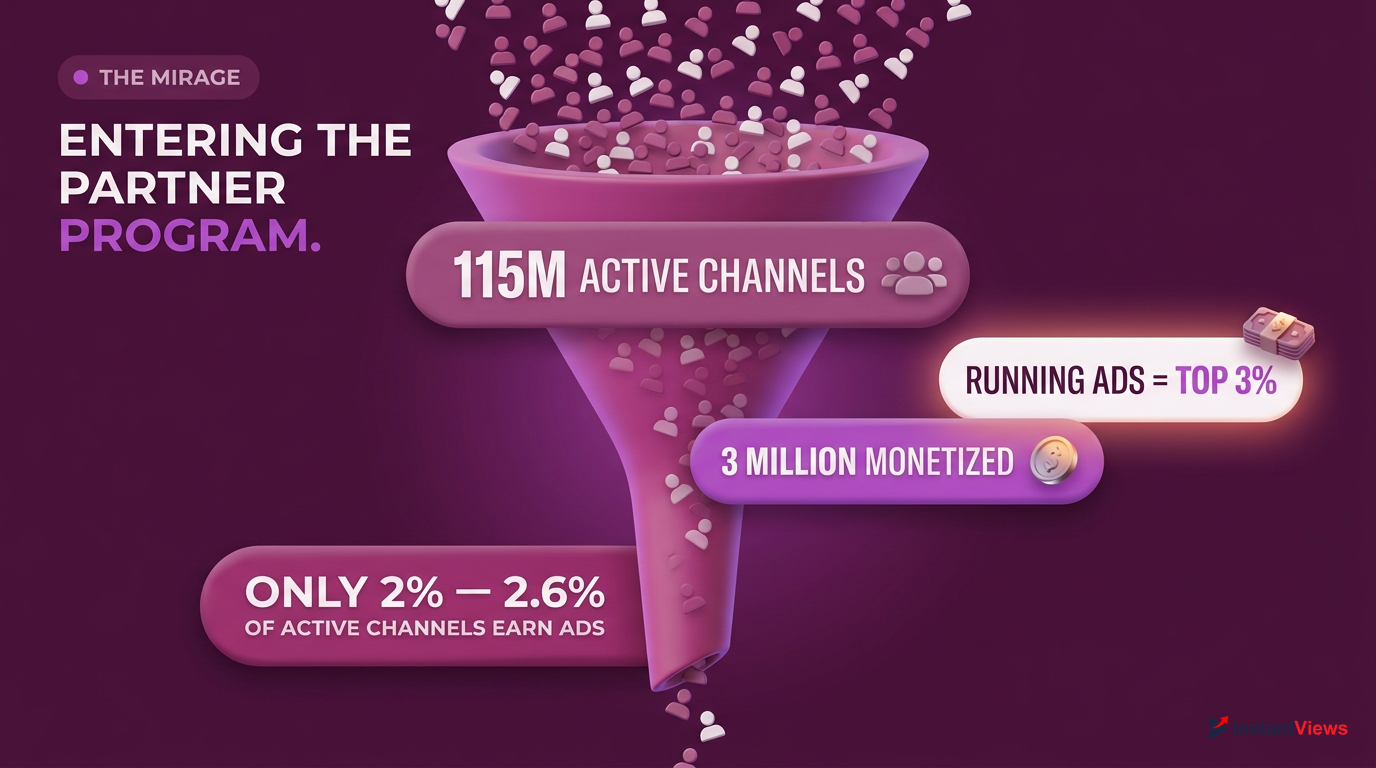
In 2025, YouTube CEO Neal Mohan and Google officially confirmed that there are currently 3 million channels monetized under the YPP. When we compare this verified number against the broader platform statistics, the reality of YouTube as a career path becomes starkly clear.
Out of the estimated 115 million active channels, only about 2.4 million to 3 million are in the YPP. This means that a mere 2% to 2.6% of active channels are actually monetized. If you are currently running ads on your videos and earning a paycheck from Google, you are in the top 2.6% of the active creator workforce.
Unmonetized
- Active but earning $0
- Missed sub/watch hour goals
- Rely on outside income
Monetized (YPP)
- Top tier of active creators
- Cleared strict thresholds
- Earn AdSense revenue
This 2.6% figure is a crucial reality check. It proves that YouTube is not a get-rich-quick scheme; it is a highly exclusive platform where only a tiny fraction of participants ever see a direct financial return from the platform itself. The strict requirements to enter the YPP act as a massive gatekeeper, ensuring that YouTube only shares revenue with creators who have proven their ability to keep viewers on the platform for extended periods. For the other 97.4% of active creators, the platform remains a time-consuming, unpaid hobby.
The Watch-Hour Bottleneck: Why 1k Subs Isn't Enough
Many creators celebrate wildly when they hit 1,000 subscribers, assuming that monetization is immediately unlocked. However, they quickly run into the most brutal filter on the platform: the watch-hour requirement. To enter the YPP, a channel needs 1,000 subscribers AND either 4,000 valid public watch hours in the last 12 months, or 10 million valid public Shorts views in the last 90 days.
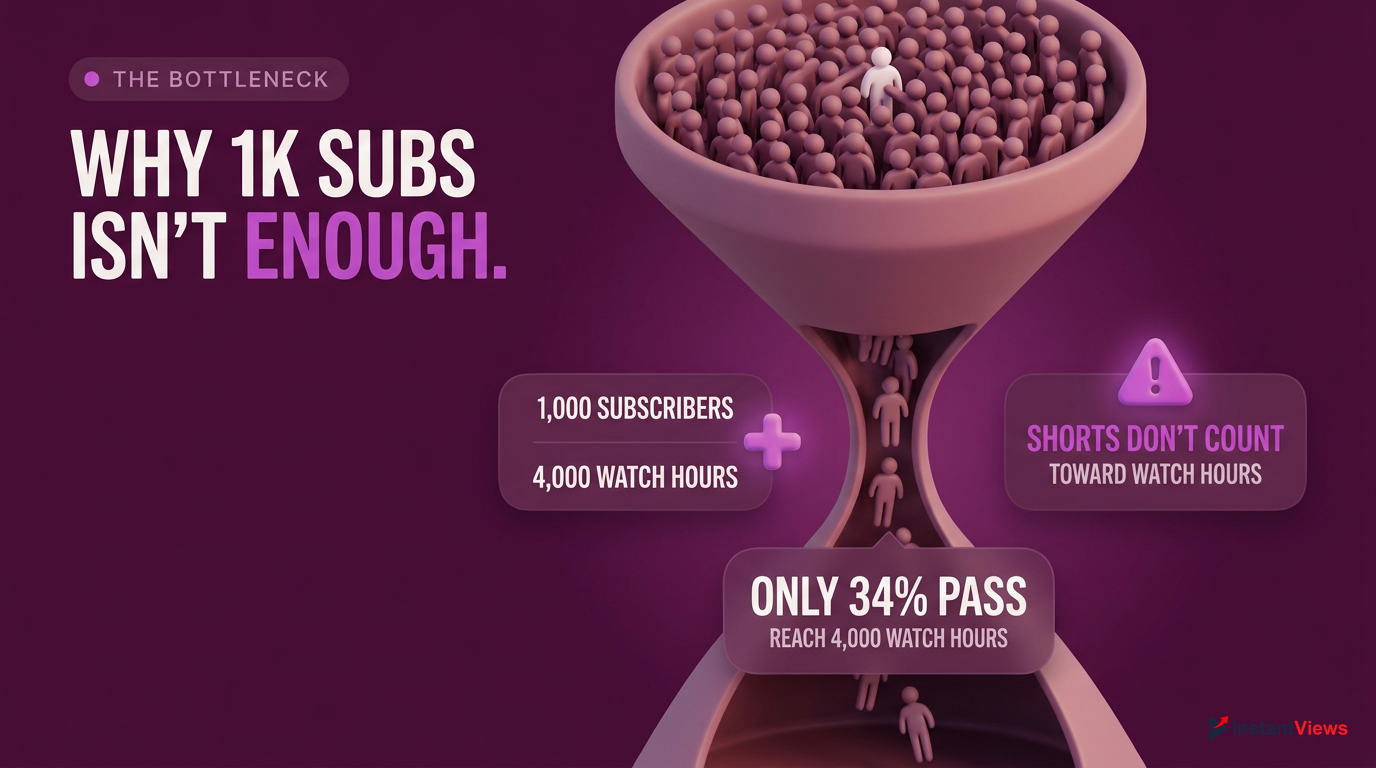
According to a May 2026 report by YouTubeToolkit, only 34% of channels that successfully hit the 1,000 subscriber mark ever reach the 4,000 watch hours required to actually apply for monetization. This is the great bottleneck of YouTube success.
Shorts views do NOT count toward the 4,000 watch hours. Many creators use Shorts to get 1,000 subs quickly, only to realize their long-form videos have zero watch time, leaving them stranded outside the YPP.
Why is this bottleneck so severe? It comes down to viewer intent and content depth. It is relatively easy to convince 1,000 people to click a "Subscribe" button after watching a funny 15-second Short or a viral clip. It is exponentially harder to convince those same people to sit through 4,000 hours (240,000 minutes) of long-form content within a single year.
This 34% pass rate highlights a critical flaw in many creators' strategies. They optimize for vanity metrics (subscribers) rather than deep engagement (watch time). To beat this bottleneck, creators must focus on high-retention, long-form content. If your channel averages a 4-minute view duration, you need 60,000 views a year to hit the threshold. If you only average 1 minute, you need 240,000 views. The math heavily favors creators who can hold attention, not just attract clicks.
The "Living Wage" Reality: Can You Actually Make a Living?
Getting monetized is a massive achievement, but it does not mean you can quit your day job. When people ask what percentage of YouTube channels succeed, they usually mean: "What percentage make enough money to live on?" The data surrounding this question is perhaps the most sobering of all.
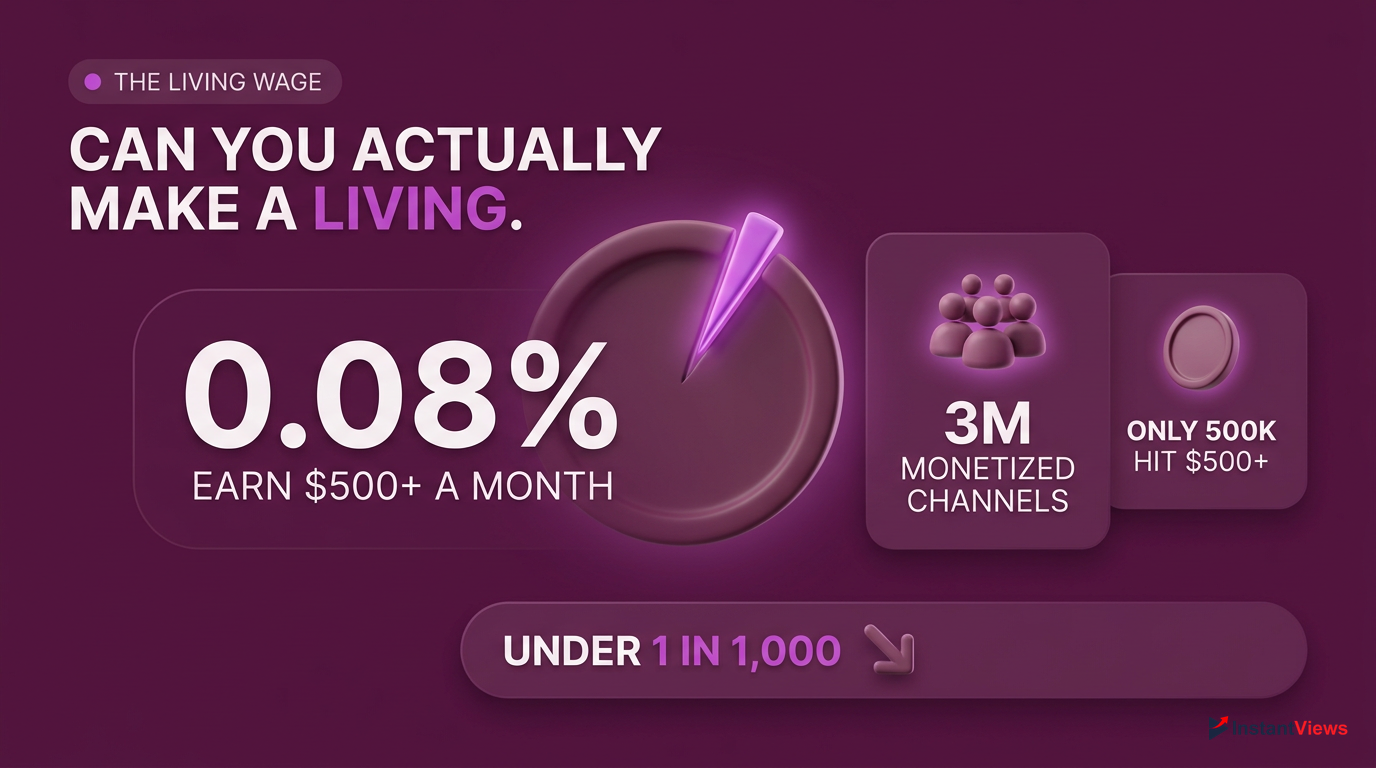
According to verified May 2026 data from YouTubeToolkit, of the 3 million channels currently in the YouTube Partner Program, only about 500,000 earn $500 or more per month from AdSense. While $500 is not a full-time living wage in most Western countries, it represents a significant, consistent side income. However, this group of 500,000 creators represents just 0.08% of all channels in existence.
Let that sink in: fewer than 1 in 1,000 channels ever created will generate $500 a month. If we look strictly at the 3 million monetized channels, only about 16.6% of them are clearing this $500/month hurdle. The vast majority of monetized channels are making pocket change—often less than $50 a month.
This reality dictates that creators cannot rely solely on YouTube AdSense for a living wage until they are generating millions of views per month. This is why the most successful creators in 2026 diversify their income streams immediately. They use YouTube as a top-of-funnel traffic source to drive viewers to Patreon, merchandise stores, digital products, and direct brand sponsorships. Relying on the platform's ad revenue alone is a mathematical trap that keeps 99.92% of creators from achieving full-time financial freedom.
The View Count Trap: Why 1k Subs Equals Negligible Revenue
To further illustrate the financial reality of the platform, we must look at the actual view counts of channels that have just crossed the monetization threshold. A massive May 2026 study by vidIQ analyzed over 1 million channels with exactly 1,000 subscribers to see how much traffic they were actually generating.
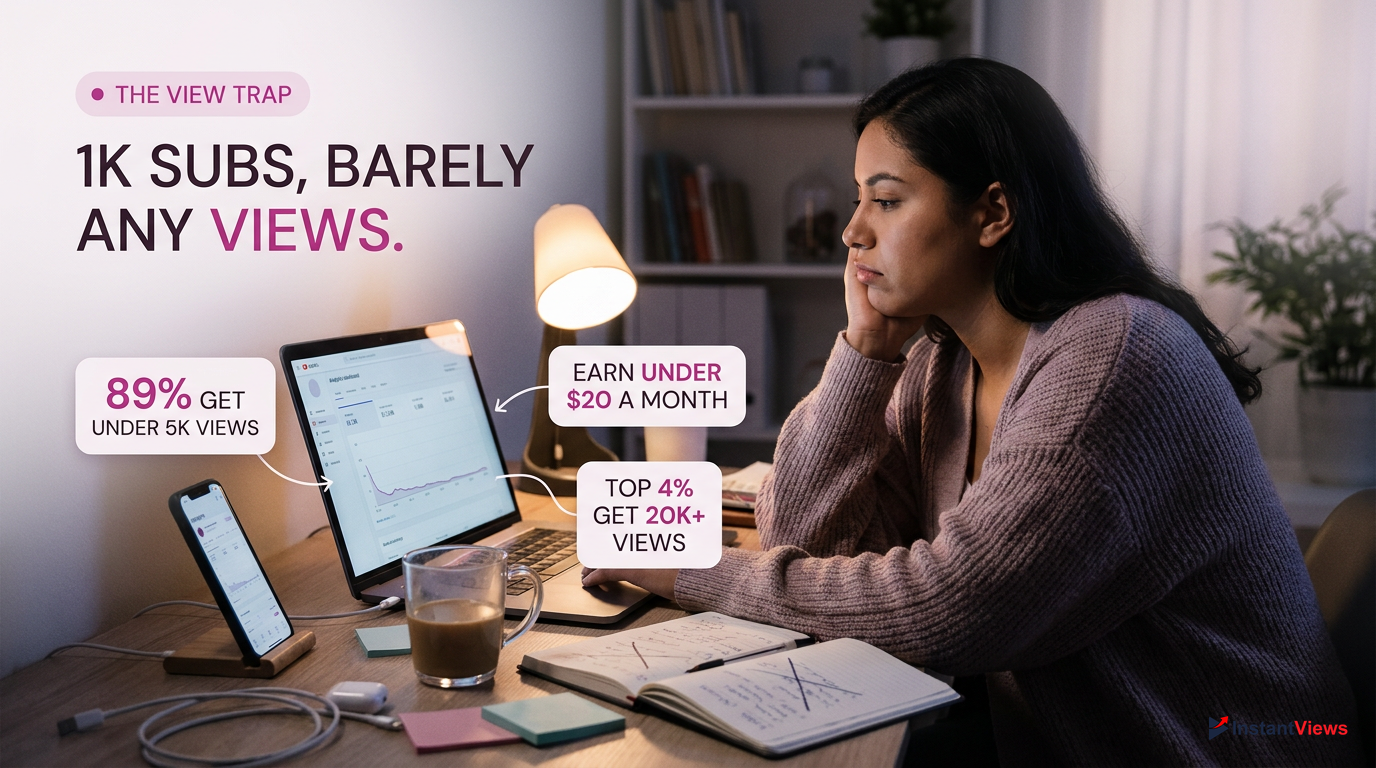
The findings were staggering: 89% of channels with exactly 1,000 subscribers get under 5,000 monthly views. Because YouTube RPMs (Revenue Per Mille) typically range from $2 to $5 for standard content, 5,000 views translates to less than $20 a month in ad revenue. This means that even after achieving the milestone that 90% of creators fail to reach, the financial reward is almost non-existent.
The 89% Majority
- Monthly Views
- Earn under $20/month
- Struggle with watch hours
The 4% Elite
- Monthly Views
- Earn $27 - $503/month
- Clear YPP easily
The vidIQ study further revealed that only 4% of channels with 1,000 subscribers pull in 20,000+ monthly views. This elite 4% are the ones who actually clear the watch-hour bar comfortably and earn between $27 and $503 a month. The gap between having subscribers and having active, returning viewers is massive.
Subscribers are a vanity metric in 2026. Monthly active views are the only metric that dictates financial success. A channel with 1,000 subs and 50,000 monthly views is infinitely more successful than a channel with 10,000 subs and 2,000 monthly views.
This data proves that "dead subscribers" are a massive problem for mid-tier channels. If you participated in sub-for-sub schemes, relied on a single viral Short that didn't translate to your core niche, or took a long break from uploading, your subscriber count might look healthy, but your view count will keep you in the lowest earning bracket.
How to Defy the Odds and Actually Succeed on YouTube
Now that we have thoroughly answered what percentage of YouTube channels succeed with hard 2026 data, the path forward is clear. The odds are undeniably stacked against new creators. With 92% of channels dead, 90% failing to reach 1,000 subscribers, and only 0.08% making over $500 a month, success requires a calculated, data-driven approach rather than blind luck.
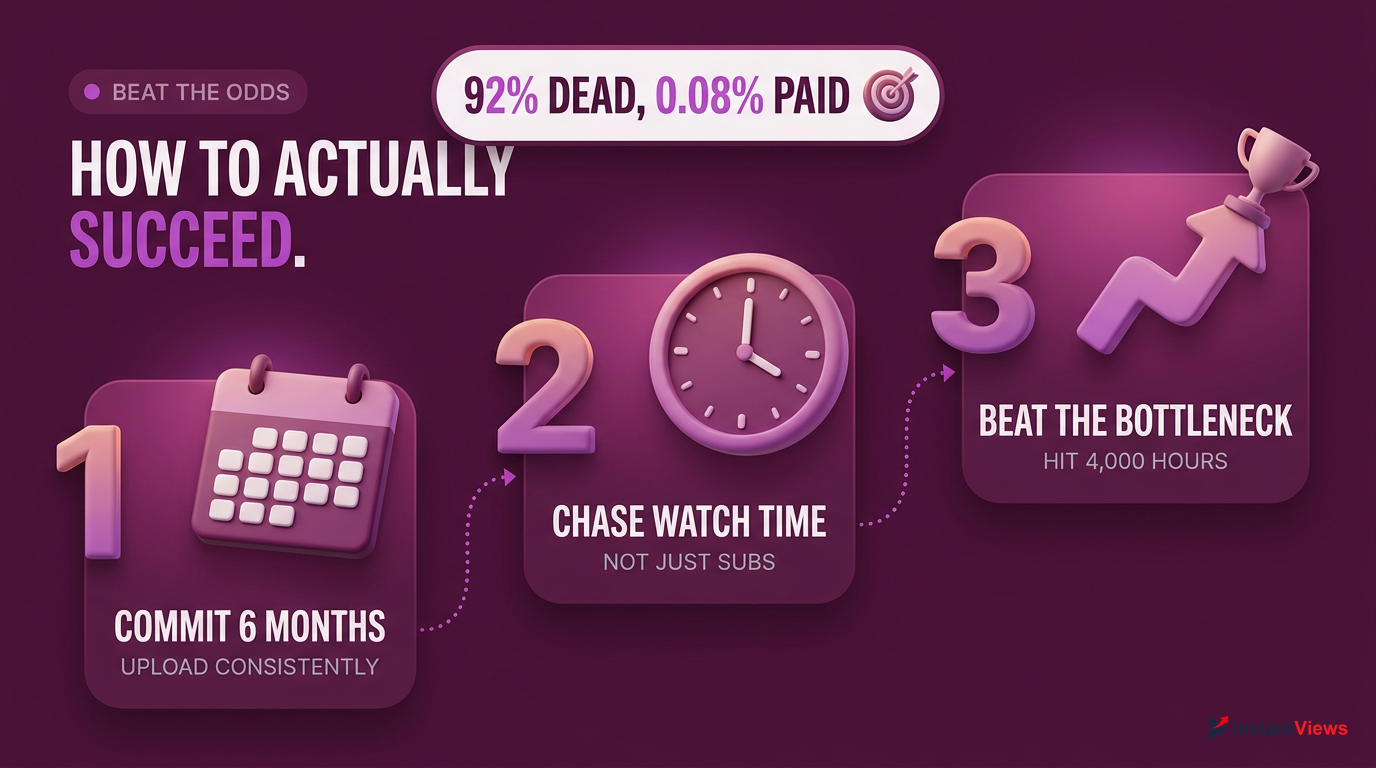
To move from the 90% who abandon their channels into the 2.6% who achieve monetization, you must structure your channel to survive the initial 6-month algorithmic sandbox and beat the 4,000 watch-hour bottleneck.
- Commit to 6 Months: Do not look at analytics for the first 24 weeks. Upload consistently to beat the 90% abandonment rate.
- Focus on Watch Time, Not Subs: Design videos to hold attention. A 50% average view duration on a 10-minute video will push you through the watch-hour bottleneck faster than chasing viral Shorts.
- Build Returning Viewers: Niche down. The 4% of 1k-sub channels getting 20k+ views do so because their audience returns for every upload.
- Diversify Income Early: Knowing that AdSense pays less than $20/month for 89% of newly monetized channels, launch a Patreon or affiliate links on day one.
The statistics are harsh, but they are also a roadmap. The creators who fail are the ones who expect instant gratification, focus on the wrong metrics, and rely solely on AdSense. By understanding these verified numbers, you can set realistic expectations, outlast the competition, and build a channel that actually falls into the elite percentage of YouTube success stories.
Success on YouTube is rare. Only 10% reach 1k subs, 2.6% get monetized, and 0.08% make a living wage. To win, you must outlast the 6-month quitters, focus on watch hours over vanity metrics, and diversify your income outside of YouTube AdSense.
Frequently Asked Questions
Based on 2026 data, success is rare. Only 8.86% to 10% of all channels reach 1,000 subscribers. Furthermore, only 2% to 2.6% of active channels ever get monetized, and a mere 0.08% of all channels earn a living wage of $500 or more per month.
Only about 10% of all YouTube channels ever created reach the 1,000 subscriber mark. However, if you look strictly at active creators who upload consistently, hitting 1,000 subscribers places you in the top 34% of the active platform.
There are currently 3 million channels monetized under the YouTube Partner Program (YPP). Out of the estimated 115 million active channels on the platform, this means only about 2% to 2.6% of active creators are earning ad revenue.
A shockingly low number. Only about 500,000 channels earn $500 or more per month from YouTube AdSense. This represents just 0.08% of all channels in existence, proving that most creators must rely on outside sponsorships or merchandise to survive.
Most channels fail due to burnout and unrealistic expectations. Roughly 90% of YouTube channels show no activity after six months of creation. Creators often quit before the algorithm has enough data to properly categorize and push their content to wider audiences.
Around 620,000 channels have surpassed the 100,000 subscriber mark to earn a Silver Play Button. This represents roughly 0.53% of all active channels, and just 0.1% of all channels ever created.
At least 69,000 creators boast over 1,000,000 subscribers, earning them a Gold Play Button. Achieving this elite milestone places a channel in the top 0.1% of active creators and the top 0.01% of all channels ever created.
Hitting 1,000 subscribers does not guarantee income. You must also reach 4,000 watch hours. Data shows only 34% of channels with 1k subs clear this watch-hour hurdle. Furthermore, 89% of channels with exactly 1k subs get under 5,000 monthly views, earning less than $20/month.
While over 600 million channels have been created, only about 47 million to 65 million are considered strictly "active" (posting at least once a month). Broader estimates that include sporadic uploaders push the active number to a maximum of 115 million.
No, but you must be realistic. With 92% of all created channels considered "dead," the active competition is smaller than it appears. Success requires surviving the initial 6-month sandbox phase and focusing heavily on watch time rather than just subscriber counts.