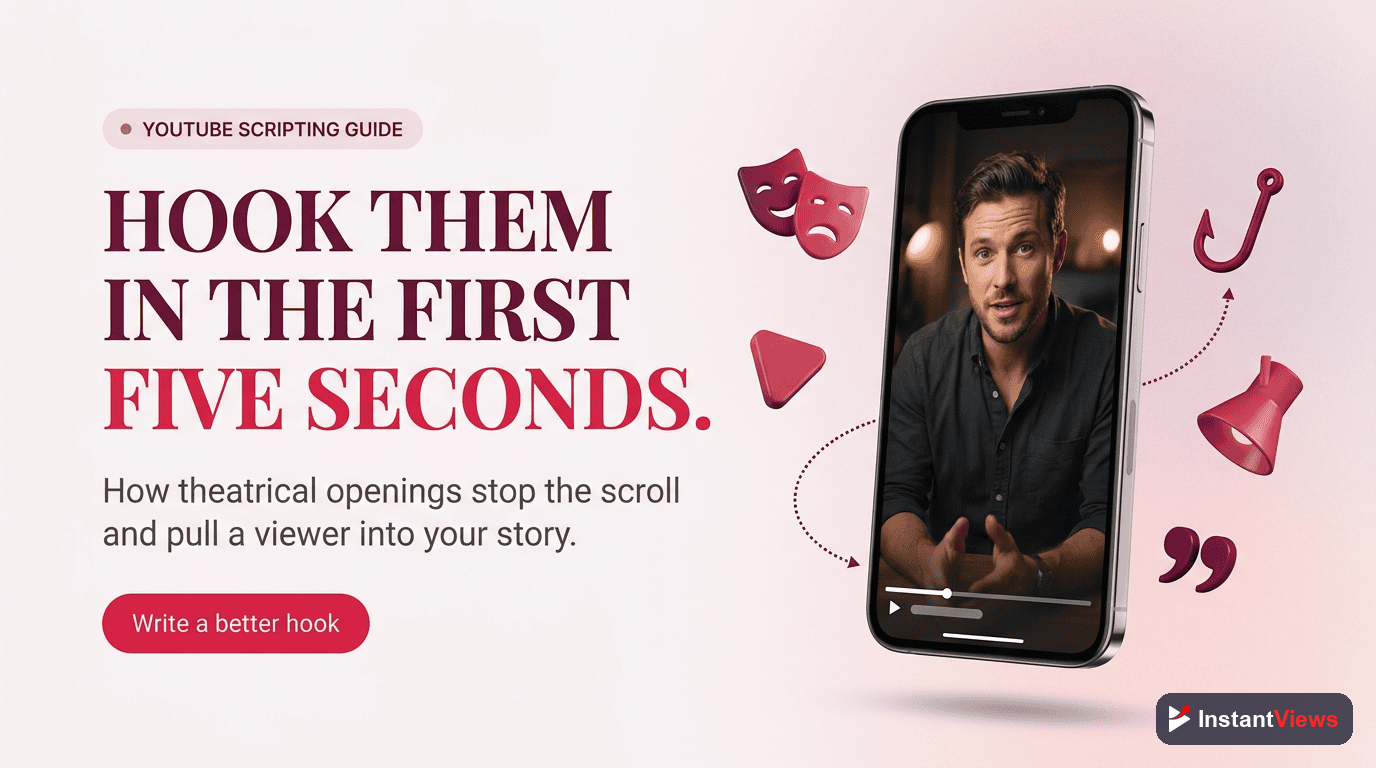
- Theatrical hooks capture attention within 3 seconds using drama, tension, and emotional impact
- Videos with strong hooks see 60-80% higher retention rates in the first 30 seconds
- The best hooks create a curiosity gap that makes viewers need to keep watching
- Different hook types work for different content: cold opens, bold statements, visual spectacles
- InstantViews Video Analyzer provides AI-powered hook suggestions based on your content
You have 3 seconds to capture a viewer's attention on YouTube. After that, they're scrolling to the next video.
This is where theatrical hooks come in. Unlike generic introductions or slow builds, theatrical hooks use dramatic storytelling techniques to create immediate impact - tension, conflict, stakes, emotion - that makes viewers stop scrolling and start watching.
The top YouTube creators understand this. MrBeast doesn't start with "Hey guys, welcome back." He starts with explosions, impossible challenges, or jaw-dropping statements that make you need to watch.
This guide breaks down everything you need to know about creating theatrical hooks that keep viewers watching.
What Are Theatrical Hooks?
A theatrical hook is a dramatic opening technique that captures attention using storytelling elements borrowed from film and theater:
- Immediate tension - Creating conflict or stakes in the first frame
- Emotional impact - Making viewers feel something instantly
- Visual spectacle - Eye-catching imagery that demands attention
- Curiosity gap - Showing something without explaining it
Unlike traditional hooks that ask questions or make promises, theatrical hooks drop viewers into a dramatic moment that makes them need to understand what's happening.
Why Theatrical Hooks Work
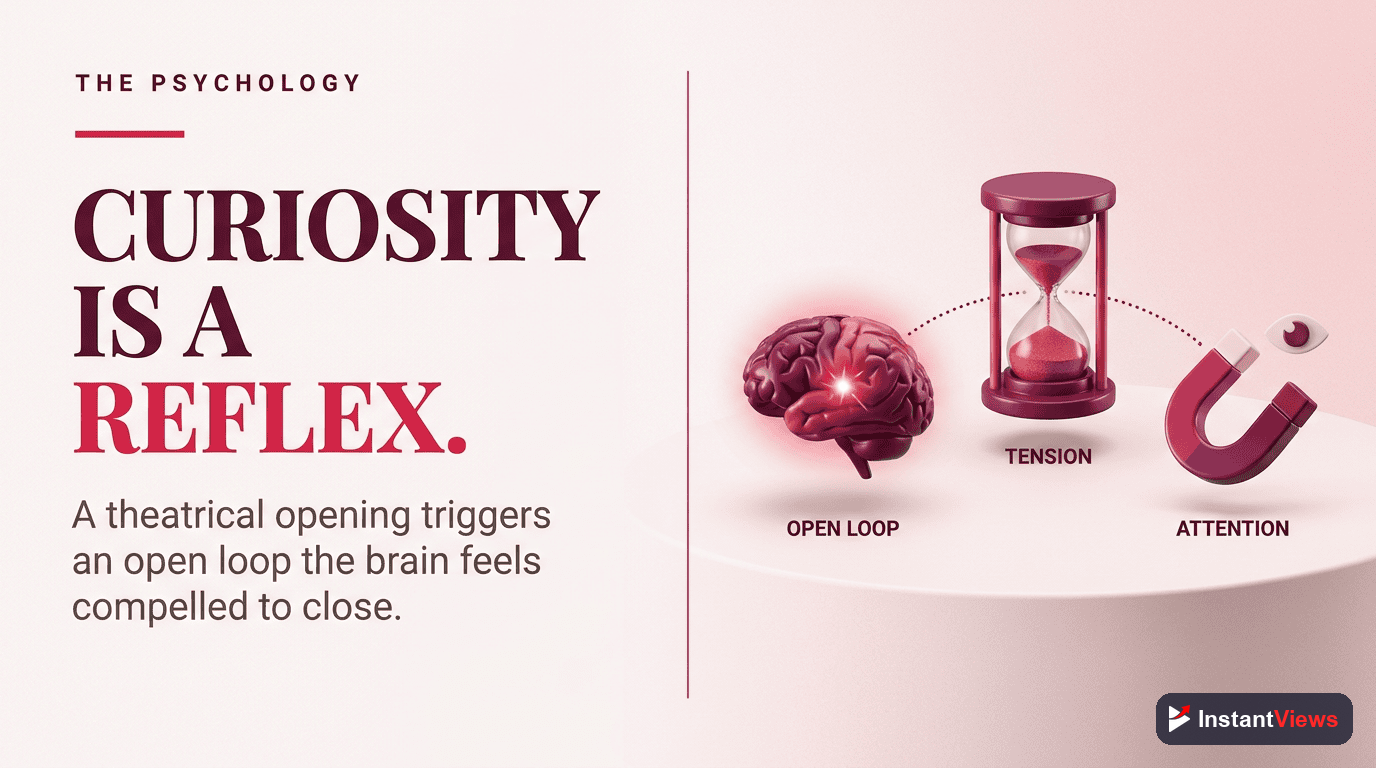
The psychology behind theatrical hooks is simple: humans are wired for stories and conflict.
When you open with drama instead of explanation, you trigger several powerful psychological responses:
- Pattern interruption - Breaking viewers' expectations makes them pay attention
- Curiosity gap - Creating information gaps that the brain wants to close
- Emotional engagement - Emotions create stronger memory formation than facts
- Loss aversion - Fear of missing out keeps viewers watching
Data backs this up. Videos with strong theatrical hooks see:
- 60-80% retention in the first 30 seconds (vs. 30-40% for weak hooks)
- 2-3x higher average view duration
- 40% better click-through rates from suggested videos
Types of Dramatic Openings
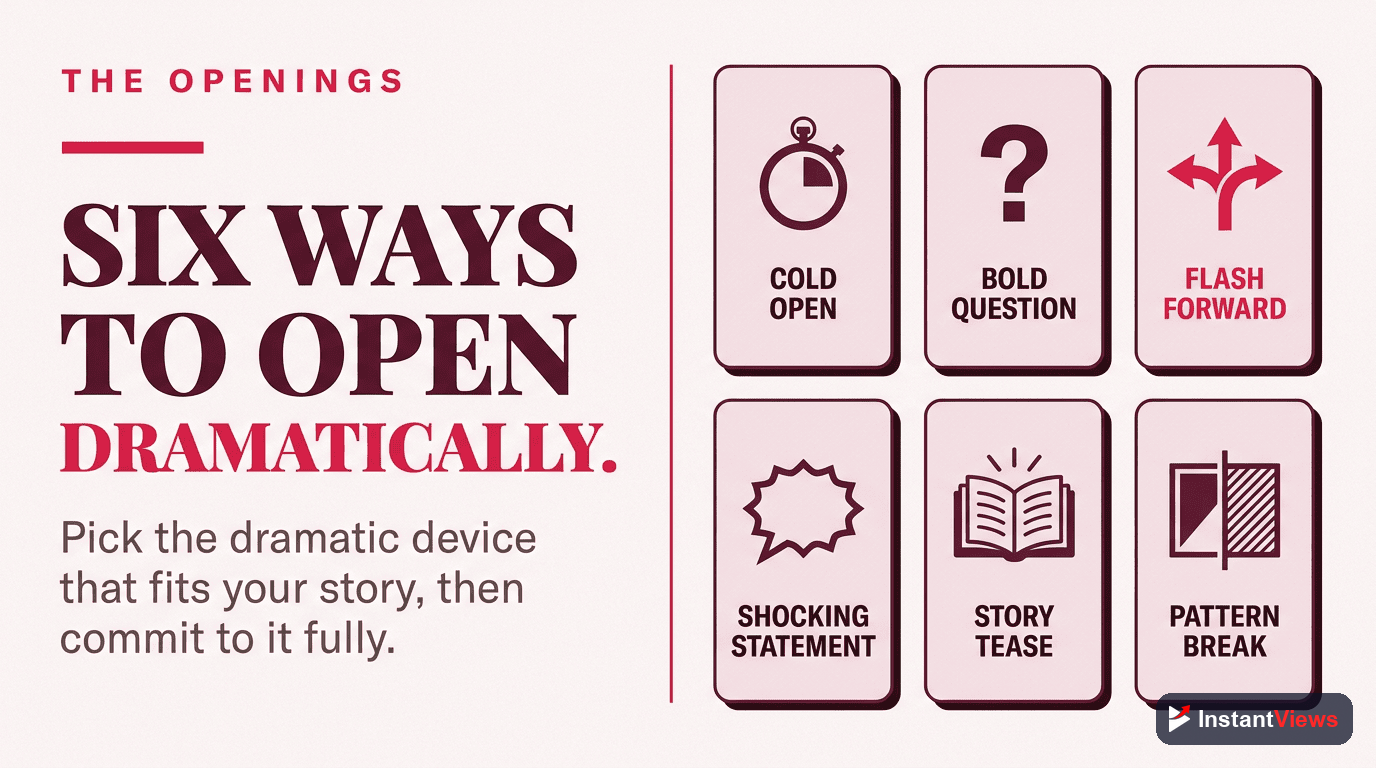
There are several theatrical hook types you can use. Each works for different content styles:
Cold Open / In Medias Res
Start in the middle of the action with no explanation. Drop viewers into the most dramatic moment, creating immediate confusion and curiosity.
"This is the moment I realized I lost $50,000." [Pause, dramatic music] "Let me show you how it happened..."
Visual Spectacle Hook
Open with jaw-dropping visuals that are impossible to ignore. Use stunning cinematography, special effects, or unexpected imagery.
[Explosion fills screen] [Camera pulls back to reveal full scene] "We built the world's largest firework..."
Bold Statement Hook
Make a shocking, controversial, or surprising statement that challenges beliefs or expectations. The statement must be defensible in your video.
"Everything you know about productivity is wrong. Here's why working less actually gets you better results..."
Conflict/Stakes Hook
Establish immediate conflict with clear stakes. Show what's at risk and why viewers should care about the outcome.
"I have 24 hours to build a functioning app or I lose my entire investment. The clock starts now."
Mystery/Question Hook
Present a mystery or impossible scenario that demands explanation. Show the result before revealing the process.
[Shows completed impossible Rubik's cube] "This shouldn't exist. But I built it. Here's how..."
Transformation Hook
Show before/after or transformation results upfront. The dramatic contrast creates instant curiosity about the process.
[Split screen: abandoned building vs. luxury apartment] "Same space. 30 days. Watch how we did it."
Creating Tension and Curiosity
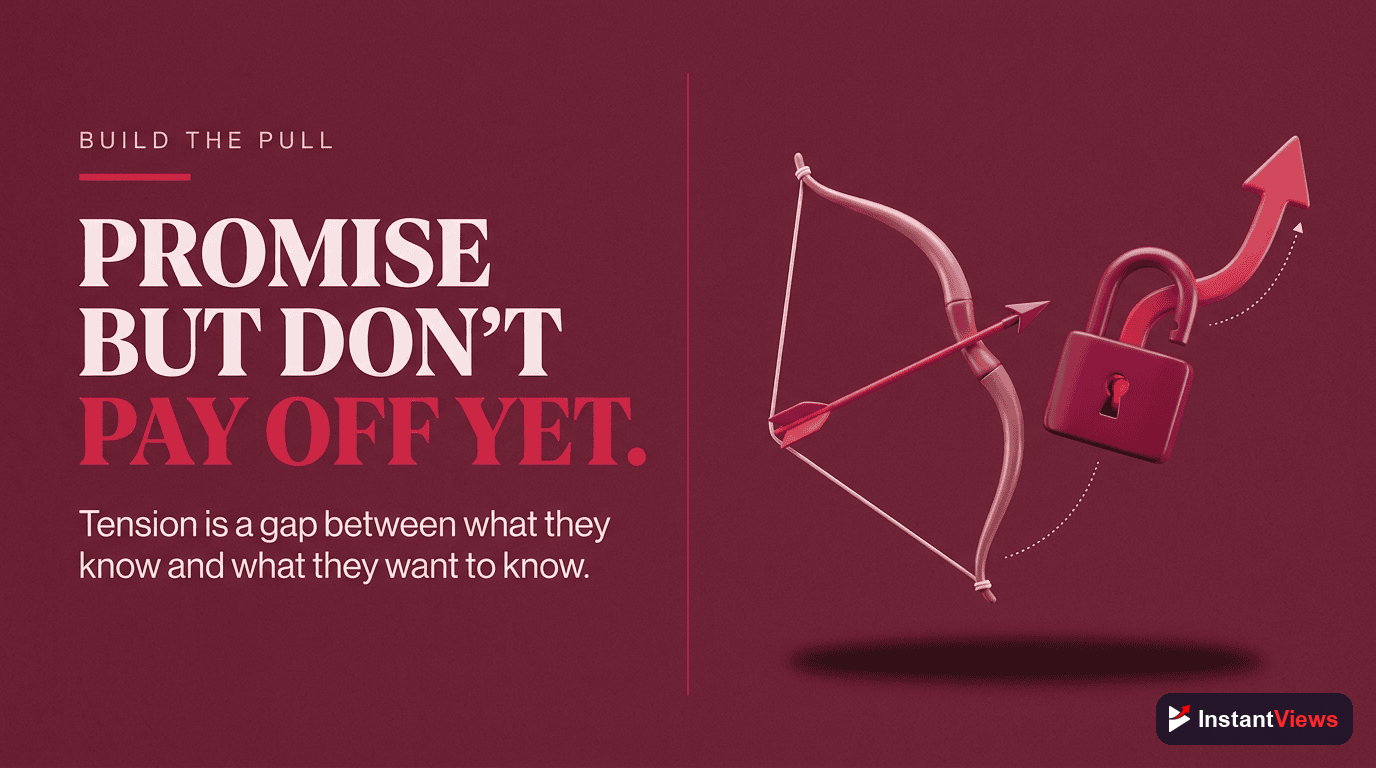
The core of every theatrical hook is tension. Here's how to build it:
1. Start with the Peak Moment
Don't build up to drama - start with it. Your hook should be the most intense moment from your video, pulled to the beginning.
Weak: "Today I'm going to attempt something crazy..."
Strong: [Shows person hanging from helicopter] "This wasn't supposed to happen."
2. Use the Curiosity Gap Technique
Show enough to create questions, but not enough to answer them. The gap between what viewers see and what they understand keeps them watching.
Formula: Show outcome → Create confusion → Promise explanation
[Show dramatic result - 2 seconds]
[Pause for impact - 1 second]
[Statement that raises questions - 3 seconds]
[Transition to explanation - 2 seconds]

Example:
[Shows person holding $10,000 in cash]
[Pause]
"I made this in one day using a spreadsheet."
"Let me show you exactly how..."
3. Create Emotional Contrast
Rapid shifts between emotions create tension. Combine unexpected elements:
- Calm visuals + intense music
- Happy setting + ominous narration
- Slow motion + dramatic sound effects
- Silence + sudden action
4. Use the Rule of Three Seconds
Break your hook into 3-second segments, each escalating the tension:
| Seconds | Purpose | Example |
|---|---|---|
| 0-3 | Visual impact | Dramatic footage with no context |
| 3-6 | Create confusion | Statement that raises questions |
| 6-8 | Promise payoff | Tease the explanation coming |
Hook Formulas That Work
Here are proven theatrical hook formulas you can adapt for your content:
Formula 1: The Disaster Opening
[Show disaster/failure moment]
"This is the moment everything went wrong."
[Pause for impact]
"Here's what happened..."

Real Example:
[Shows destroyed cake on floor]
"I just ruined a $3,000 wedding cake."
[Pause]
"And somehow, the wedding was saved. Let me explain..."
Formula 2: The Shocking Result
[Show unexpected result]
"This [result] came from [unlikely source]."
[Create curiosity gap]
"Watch how I did it."

Real Example:
[Shows luxury watch]
"This $15,000 watch cost me $47 to make."
[Pause on watch close-up]
"Same quality. 1% of the price. Here's the process..."
Formula 3: The Time Pressure Hook
[Show timer/deadline]
"I have [X time] to [achieve impossible goal]."
[Show the stakes]
"If I fail, [consequence]."

Real Example:
[Shows countdown timer: 23:47:12]
"24 hours to build a profitable business from zero."
[Shows bank account: $0.00]
"If it doesn't make money by tomorrow, I lose my apartment."
Formula 4: The Impossible Question
[Show impossible scenario]
"How is this possible?"
[Pause]
"It shouldn't be. But it is. Watch..."

Real Example:
[Shows water flowing upward]
"Water doesn't flow up. Except here it does."
[Pause]
"No editing. No tricks. Pure physics. Let me show you..."
Formula 5: The Contrast Hook
[Show A - 2 seconds]
[Quick cut to B - 2 seconds]
"[Timeframe]. [Transformation statement]."
"Here's how."

Real Example:
[Shows cluttered garage]
[Cut to modern recording studio]
"30 days. Same space."
"Zero construction experience. Watch the transformation..."
Get AI-Powered Hook Suggestions
Upload your video to InstantViews Video Analyzer and get custom theatrical hook recommendations based on your content and audience.
Analyze Your Video →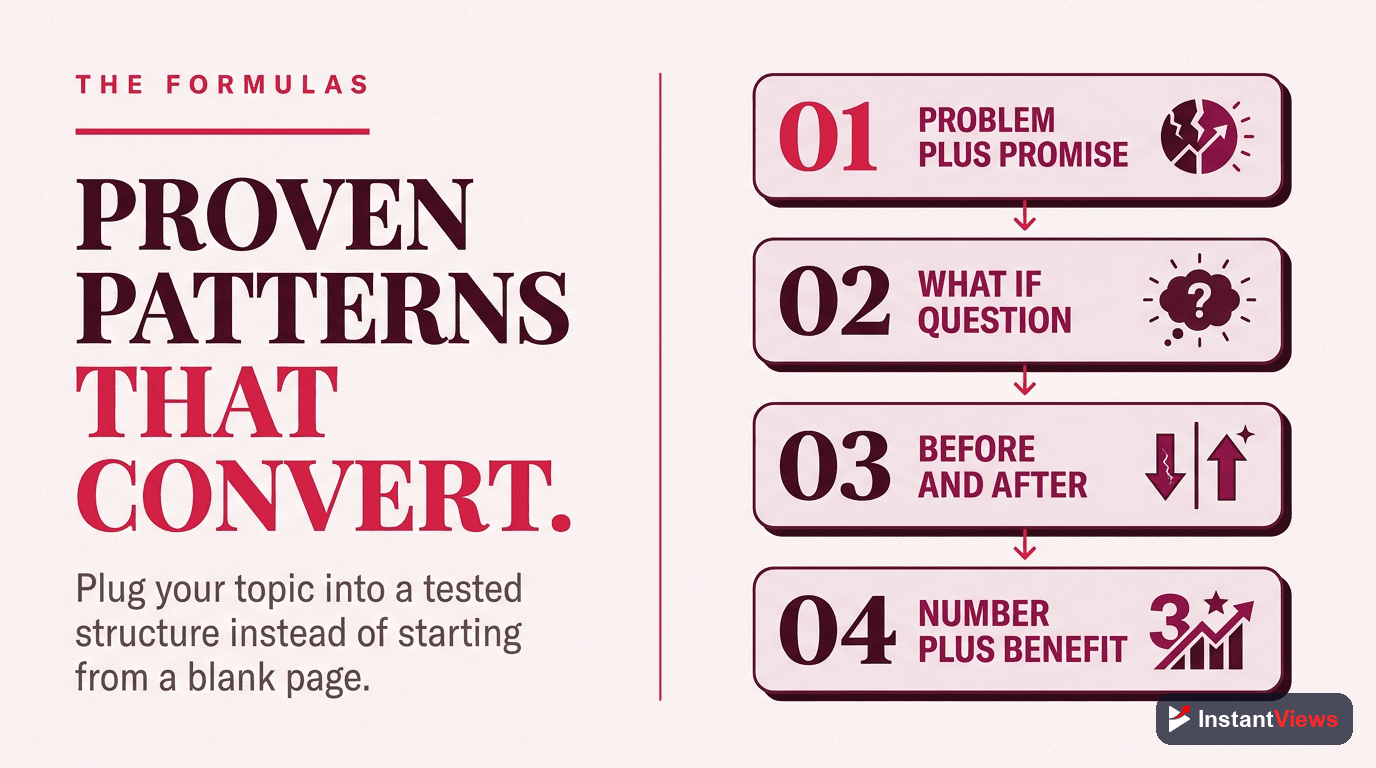
Examples from Successful Creators
Let's break down how top creators use theatrical hooks:
MrBeast: The Stakes Hook
"I Spent 50 Hours Buried Alive" - Opens with him already underground in darkness, showing the claustrophobic space and timer. Immediate tension with clear stakes.
Why it works: Shows the end result (buried) before explaining why, creating instant curiosity about how he got there and if he'll survive.
Veritasium: The Impossible Question Hook
"This equation will change how you see the world" - Opens with a simple equation on screen, then demonstrates an impossible-seeming result in real life.
Why it works: Creates cognitive dissonance - what you're seeing shouldn't be possible, so you keep watching to understand why it is.
Casey Neistat: The Visual Spectacle Hook
Many videos open mid-action - skateboarding through NYC, drone shots at sunrise, or time-lapses of builds - with no explanation until after the visual impact.
Why it works: Cinematic visuals with no context create an emotional response before the logical brain can process what's happening.
MKBHD: The Bold Statement Hook
"This is the worst product I've ever reviewed" - Opens with the provocative statement before showing what the product is.
Why it works: Creates instant controversy and curiosity. Viewers need to know what product could be so bad and why.
| Creator | Primary Hook Style | Avg. First 30sec Retention |
|---|---|---|
| MrBeast | Stakes + Spectacle | 85-90% |
| Veritasium | Impossible Question | 75-80% |
| Casey Neistat | Visual Spectacle | 70-80% |
| MKBHD | Bold Statement | 65-75% |
How InstantViews Video Analyzer Suggests Theatrical Hooks
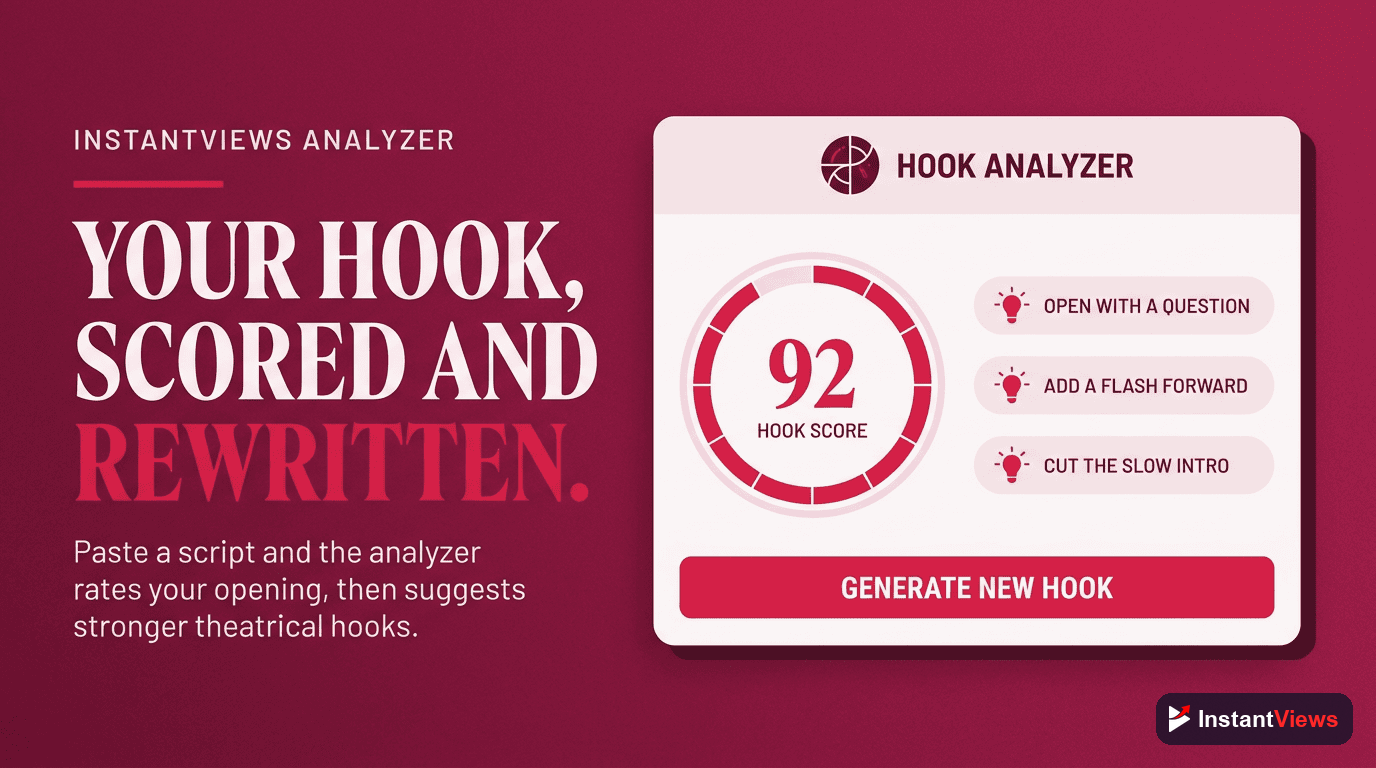
The InstantViews Video Analyzer uses AI to analyze your video content and suggest optimal theatrical hooks:
What It Analyzes:
- Peak moments - Identifies the most dramatic segments in your video
- Emotional intensity - Maps emotional high points that work as hooks
- Visual impact - Detects eye-catching visuals for spectacle hooks
- Story structure - Finds conflict points that create natural tension
Hook Recommendations Include:
- Suggested timestamp to pull for cold open
- Hook type that matches your content style
- Script suggestions for narration
- Music and pacing recommendations
- Retention score prediction
Related Analyzer Features:
Beyond hooks, the Video Analyzer helps with complete retention optimization:
- Audience retention analysis and improvement suggestions
- Pacing optimization for maximum engagement
- Hook testing across multiple formats
Common Mistakes to Avoid
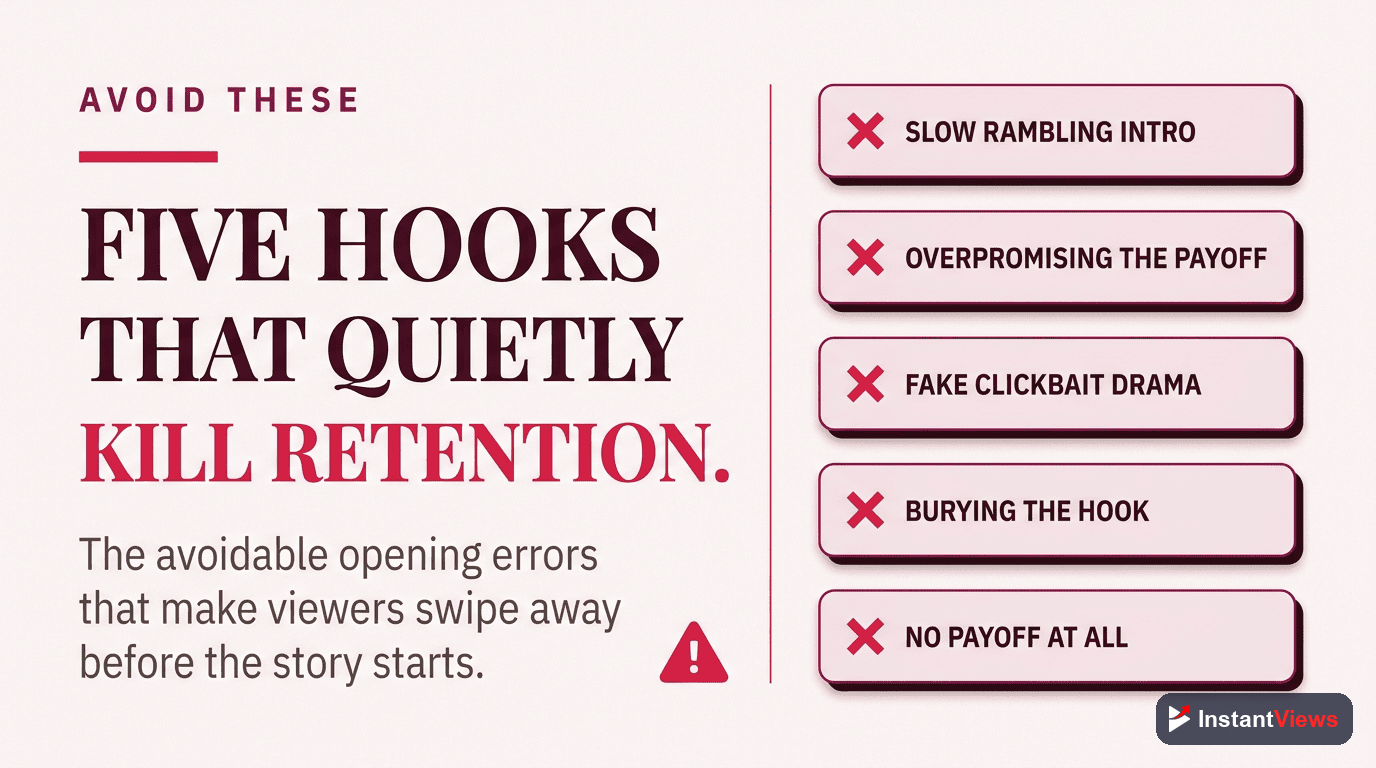
Even with a strong concept, these mistakes can kill your theatrical hook:
1. Making the Hook Too Long
Your hook should be 3-8 seconds maximum. Longer than that and you lose the impact. Get to the drama immediately.
Bad: 15-second setup before the dramatic moment
Good: Dramatic moment in frame 1, explanation comes after
2. Explaining Too Much
Don't tell viewers what they're about to see. Show it and let them be confused. Confusion drives retention.
Bad: "I'm about to show you something crazy..."
Good: [Shows the crazy thing with no warning]
3. Using Clickbait Without Payoff
Your hook must be from actual content in the video. False hooks destroy trust and increase abandonment.
YouTube's algorithm detects when viewers feel deceived (high early drop-off rates) and will stop recommending your videos. Only use hooks that your content actually delivers on.
4. Forgetting About Silent Viewing
Your hook must work without sound. Use text overlays, visual drama, and compelling imagery that creates curiosity even when muted.
5. Not Testing Different Hooks
What works for one video might not work for another. Test different hook styles and track which ones give you the best retention.
6. Slow Pacing
Theatrical hooks need fast pacing. Every frame should add new information or escalate tension. Cut out pauses and filler.
"The first 3 seconds determine if viewers stay. The next 7 determine if they engage. After 10 seconds, you've either won them or lost them forever." - YouTube Creator Playbook
Frequently Asked Questions
A theatrical hook is a dramatic video opening technique that captures attention in the first 3-5 seconds using suspense, tension, bold statements, or compelling visuals. These hooks create immediate curiosity that makes viewers want to keep watching to see what happens next.
The most effective hooks are 3-8 seconds long. The first 3 seconds are critical for capturing attention on mobile devices. Your hook should deliver immediate impact, then transition smoothly into your intro within 8-10 seconds to maintain momentum.
Theatrical hooks use dramatic storytelling techniques - tension, conflict, stakes, and emotional impact - rather than just stating facts or questions. They make viewers feel something immediately, creating a cinematic experience that stands out from typical YouTube intros.
Absolutely. Educational content benefits greatly from theatrical hooks. Instead of "In this video I'll show you," start with a dramatic result, a shocking statistic, or a compelling problem statement that makes the tutorial feel urgent and valuable.
Check your YouTube Analytics for retention graphs. A successful hook shows minimal drop-off in the first 10 seconds, with the curve staying above 80%. Also monitor average view duration and click-through rate from impressions. The InstantViews Video Analyzer provides hook effectiveness scoring.
Not necessarily. Theatrical hooks work best for storytelling, entertainment, and high-stakes content. For some tutorial or reference videos, viewers want direct information. Test different hook styles with your audience to see what works best for your niche and content type.