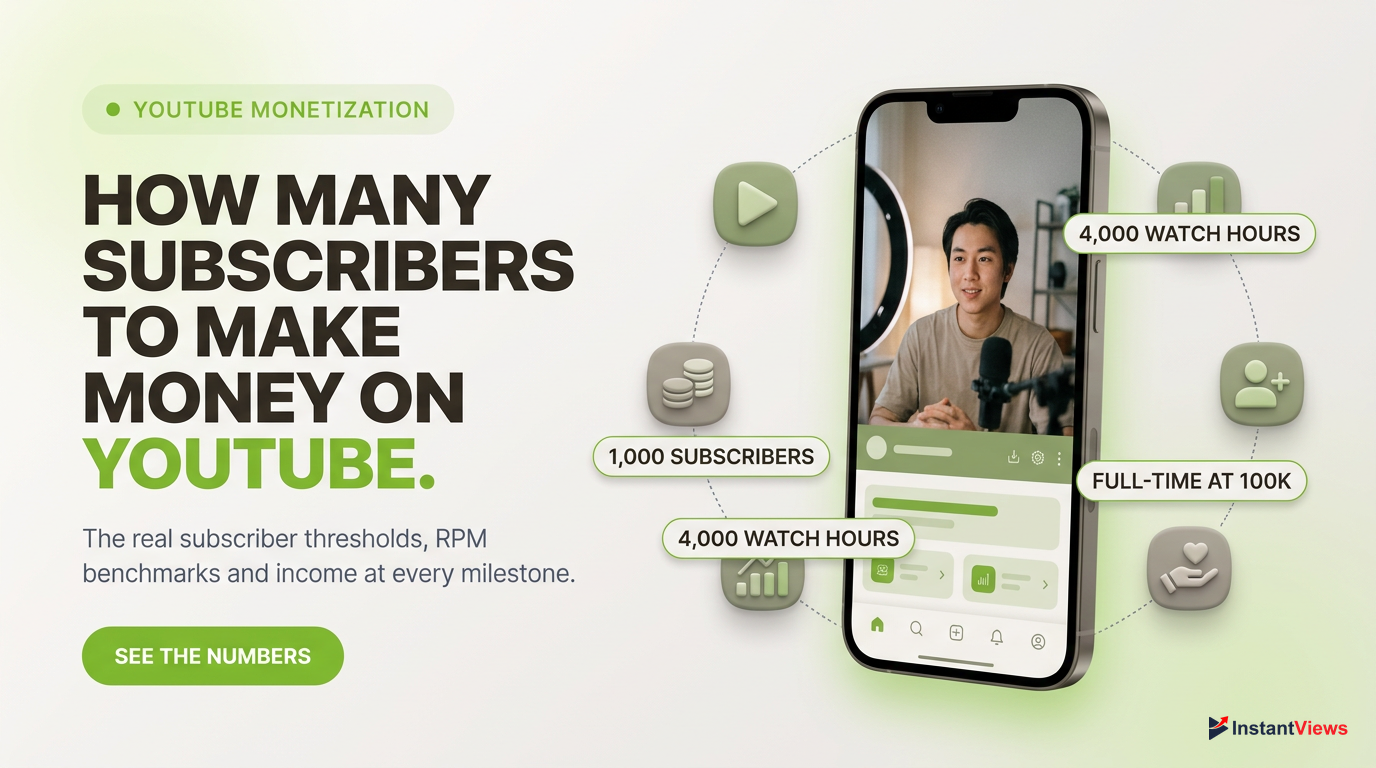
- You need 1,000 subscribers and 4,000 watch hours (or 10M Shorts views) to unlock full ad revenue.
- A lower tier of 500 subscribers unlocks fan funding like Super Chats and Memberships.
- Global average RPM for long-form videos is $3 to $5 per 1,000 views.
- Finance and business are the highest-paying niches, averaging $10 to $25 RPM.
- AdSense usually only accounts for 30% to 60% of a full-time creator's income.
If you are grinding away on your channel, the biggest question on your mind is likely: exactly how many subscribers to make money on YouTube? The internet is full of vague answers and outdated advice, but the reality of the creator economy in 2026 is driven by hard data and strict platform thresholds.
Subscriber count is only one piece of the puzzle. While reaching specific subscriber milestones is required to unlock YouTube's monetization features, your actual income is dictated by views, your specific niche, and viewer geography. A channel with 10,000 subscribers in the finance niche can easily out-earn a gaming channel with 100,000 subscribers.
In this comprehensive, data-driven guide, we are breaking down the exact numbers. Using verified 2026 benchmarks, we will explore the official YouTube Partner Program thresholds, average RPMs across different niches, and real-world income reports from creators at various subscriber levels.
- The Exact YouTube Partner Program (YPP) Thresholds for 2026
- Real Average Earnings: RPM by Niche (2025–2026 Benchmarks)
- The Reality of YouTube Shorts Revenue
- Realistic Income at 1,000 Subscribers
- What to Expect at 10,000 Subscribers
- The 100,000 Subscriber Milestone: Full-Time Income
- 1,000,000 Subscribers: Running a Media Business
- Income Beyond Ads: The Power of Brand Sponsorships
- Affiliate Marketing and Fan Funding
- Case Study: Real Creator Earnings in 2026
- FAQ
The Exact YouTube Partner Program (YPP) Thresholds for 2026
To start earning money directly from YouTube, you must be accepted into the YouTube Partner Program (YPP). In recent years, YouTube split this program into two distinct tiers, allowing creators to start earning through fan funding before they unlock traditional ad revenue.

Understanding these two tiers is crucial when asking how many subscribers to make money on YouTube. The first tier focuses on direct audience support, while the second tier unlocks the lucrative AdSense program.
| Requirement | Tier 1 (Fan Funding) | Tier 2 (Ad Revenue) |
|---|---|---|
| Subscribers | 500 | 1,000 |
| Uploads (Last 90 Days) | 3 valid public uploads | N/A |
| Watch Hours (Last 12 Mo) | 3,000 | 4,000 |
| Shorts Views (Last 90 Days) | 3 Million | 10 Million |
| Features Unlocked | Memberships, Supers, Shopping | AdSense, Premium Revenue |
It is important to note that you only need to meet either the watch hours requirement or the Shorts views requirement, not both. The subscriber requirement, however, is mandatory for both tiers.
Watch hours generated from YouTube Shorts do not count toward the 4,000 public watch hours requirement for long-form videos.
Real Average Earnings: RPM by Niche (2025–2026 Benchmarks)
Once you hit the 1,000 subscriber mark and unlock ad revenue, how much you actually make depends heavily on your RPM (Revenue Per Mille). RPM is the amount of money a creator takes home per 1,000 views after YouTube takes its 45% cut.
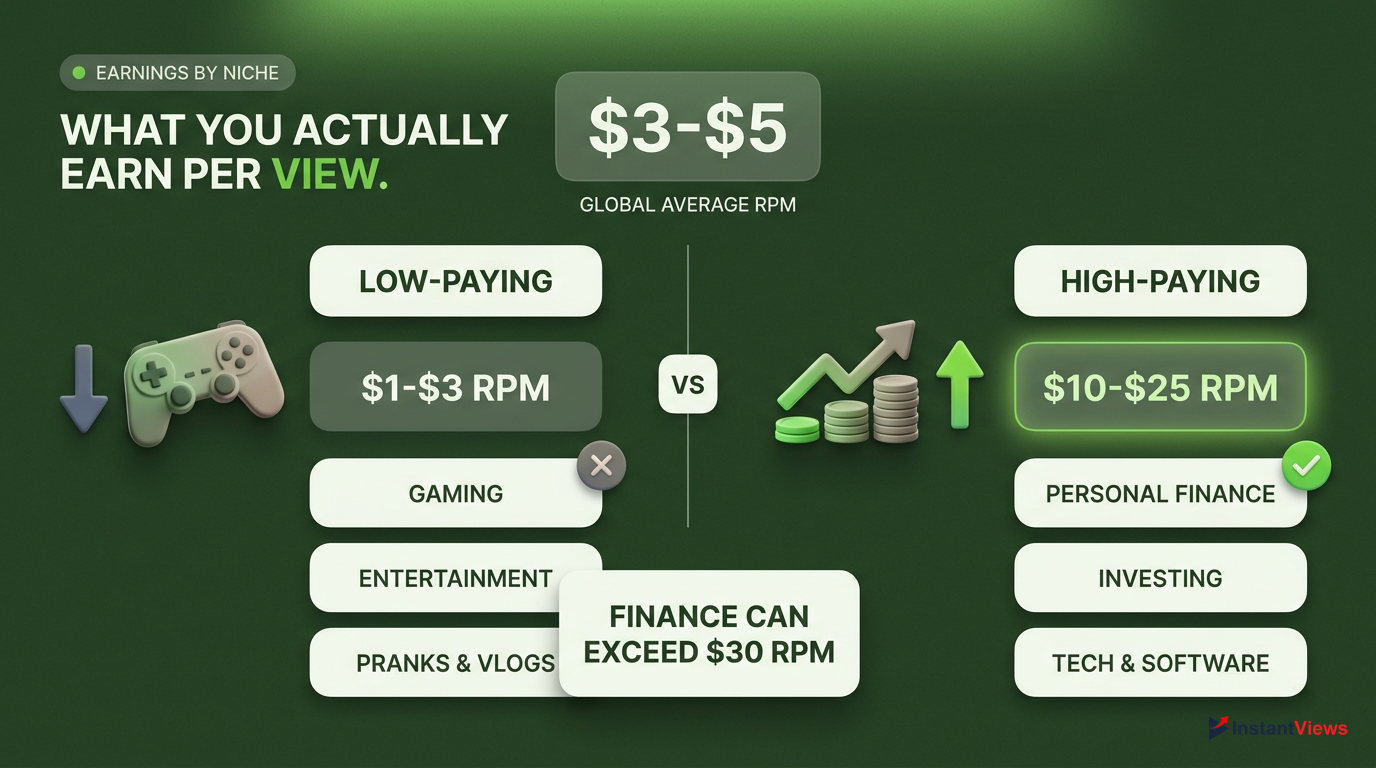
Not all views are created equal. Advertisers pay significantly more to reach audiences with higher disposable income or specific purchasing intent. This creates a massive disparity in earnings between different types of content.
Low-Paying Niches
- Gaming
- Broad Entertainment
- Pranks/Vlogs
High-Paying Niches
- Personal Finance
- Investing/Business
- Tech/Software
For example, a personal finance channel discussing credit cards or investing can see RPMs exceeding $30, because banks and brokerages are willing to pay a premium for those leads. Conversely, a gaming channel's audience typically skews younger with less purchasing power, resulting in RPMs closer to $1 to $3.
Geography also plays a massive role. A US-skewed channel earns 3 to 8x what a Tier-3-skewed channel does. US/UK viewers might generate a $6–$12 CPM, while viewers in India or Southeast Asia might generate a $1–$3 CPM.
The Reality of YouTube Shorts Revenue
With the explosion of short-form content, many creators wonder if they can build a sustainable income entirely on YouTube Shorts. While Shorts are incredible for rapid subscriber growth, the direct ad revenue is significantly lower than long-form content.
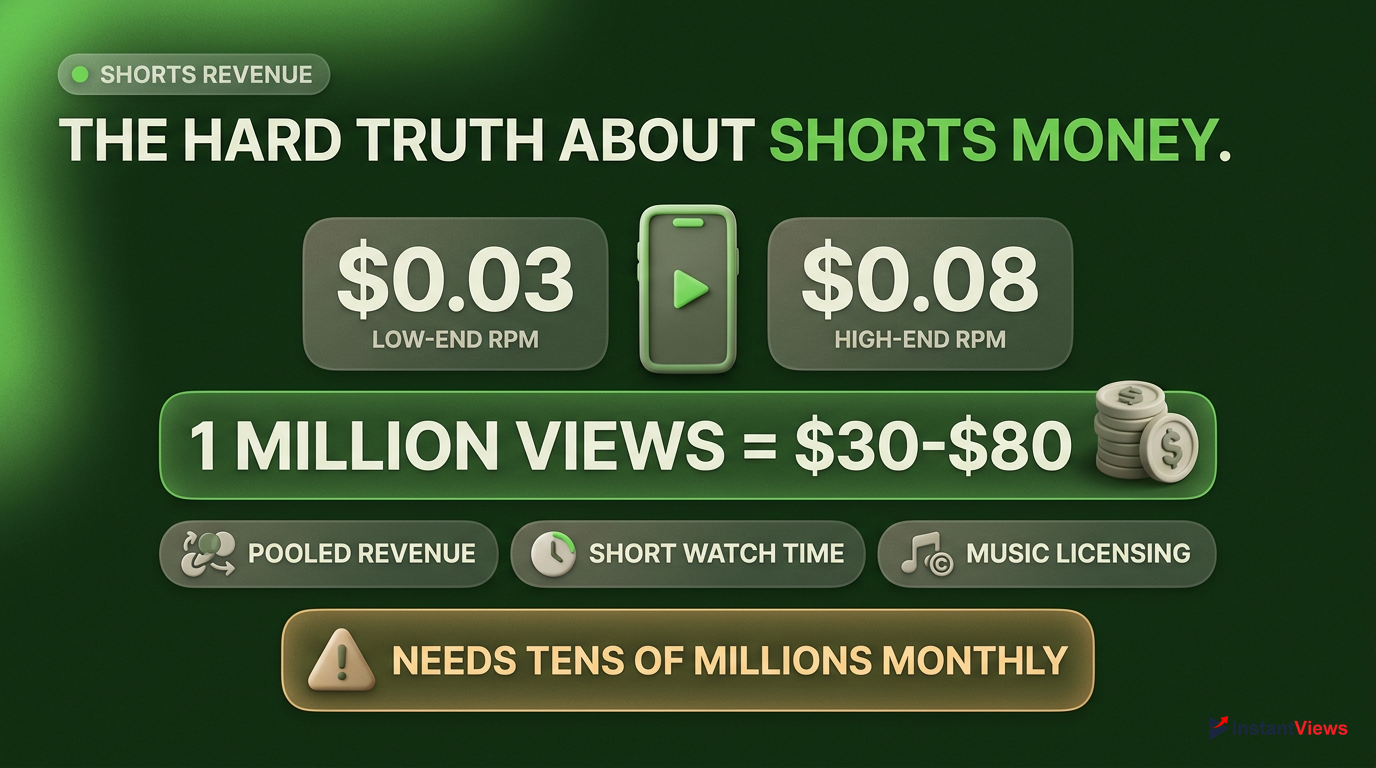
The average RPM for Shorts in 2026 sits between $0.03 and $0.08 per 1,000 views. This means that 1 million views on a Short will typically only generate between $30 and $80. This is due to YouTube's pooled revenue model for Shorts, shorter overall watch times, and deductions for music licensing.
Relying solely on Shorts AdSense is difficult. You need tens of millions of views monthly to make a full-time living. Most successful Shorts creators use the format for reach, funneling viewers to long-form videos or brand deals.
If your goal is to figure out how many subscribers to make money on YouTube primarily through Shorts, you need to aim for a massive audience scale to compensate for the micro-pennies earned per view.
Realistic Income at 1,000 Subscribers
Reaching 1,000 subscribers is a massive milestone—it is the gateway to Tier 2 monetization. However, the reality of earnings at this stage is often sobering for new creators. Having 1,000 subscribers does not guarantee consistent viewership.
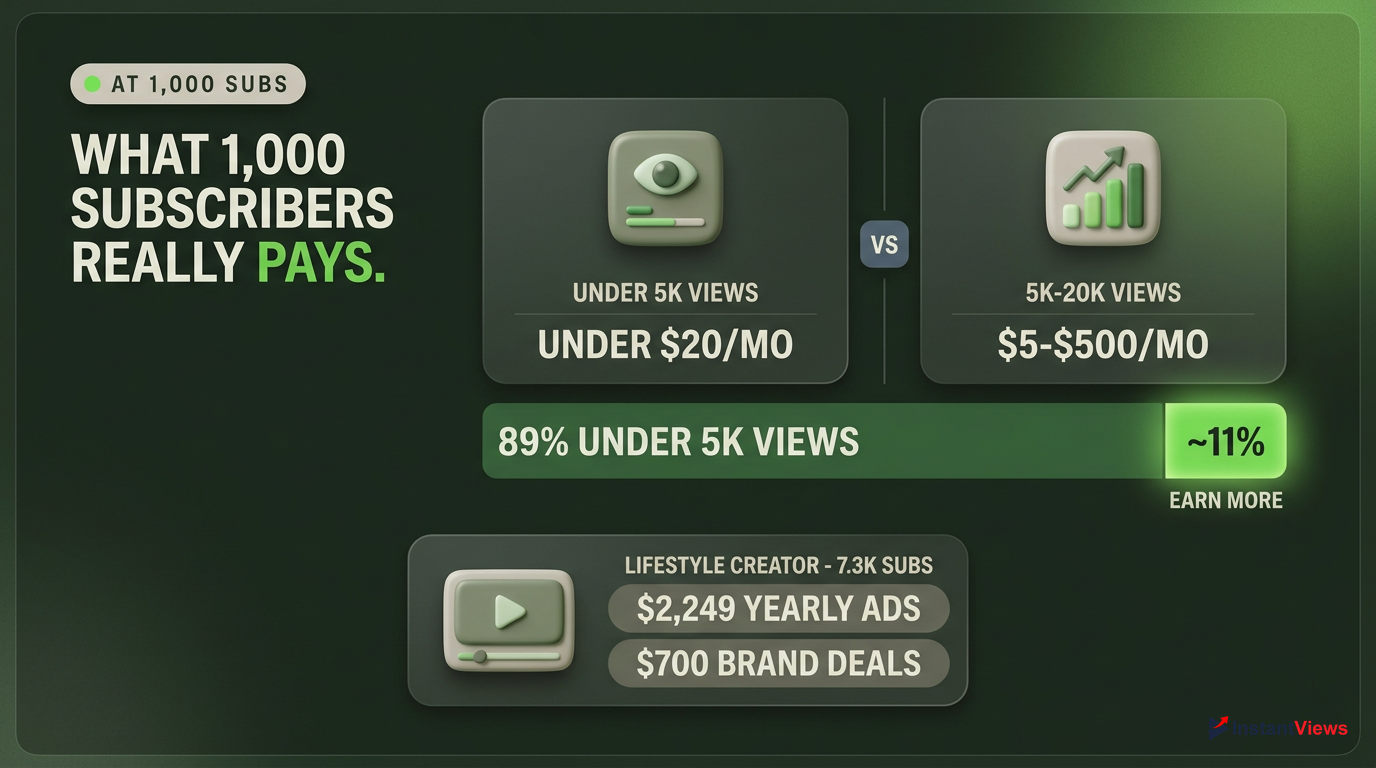
According to 2026 data analyzing over 1 million channels, roughly 89% of channels at the 1,000 subscriber level get under 5,000 monthly views. At an average RPM, this translates to earning under $20 a month. The remaining ~11% that manage to pull 5,000 to 20,000+ views can earn between $5 and $500 a month from ads, depending heavily on their niche.
As seen in the real-world example of Emily Elizabeth, a smaller creator with around 7,300 subscribers managed to earn just over $2,200 in a year from AdSense. At this stage, consistency and building a library of evergreen content are more important than immediate financial returns.
What to Expect at 10,000 Subscribers
When you cross the 10,000 subscriber mark, you transition from a beginner to an established micro-influencer. At this stage, your back catalog of videos is likely generating consistent daily views, and your income becomes more predictable.

Creators at the 10,000 subscriber level typically earn between $200 and $2,000 a month in total income. While AdSense might only contribute $50 to $300 of that total, this is the stage where other revenue streams begin to open up.
- You can start negotiating small, dedicated sponsorships.
- Affiliate marketing links in descriptions start generating regular commissions.
- A small percentage of your audience may join channel memberships or Patreon.
For example, a tech channel with 10,000 subscribers might only make $150 from ads, but could easily make an additional $500 from Amazon affiliate links if they are reviewing popular gadgets. Diversification is key at this tier.
The 100,000 Subscriber Milestone: Full-Time Income
Reaching 100,000 subscribers and earning the Silver Play Button is where YouTube often transitions from a serious side hustle to a full-time career. At this level, the compounding effect of your audience size and video library creates substantial revenue.
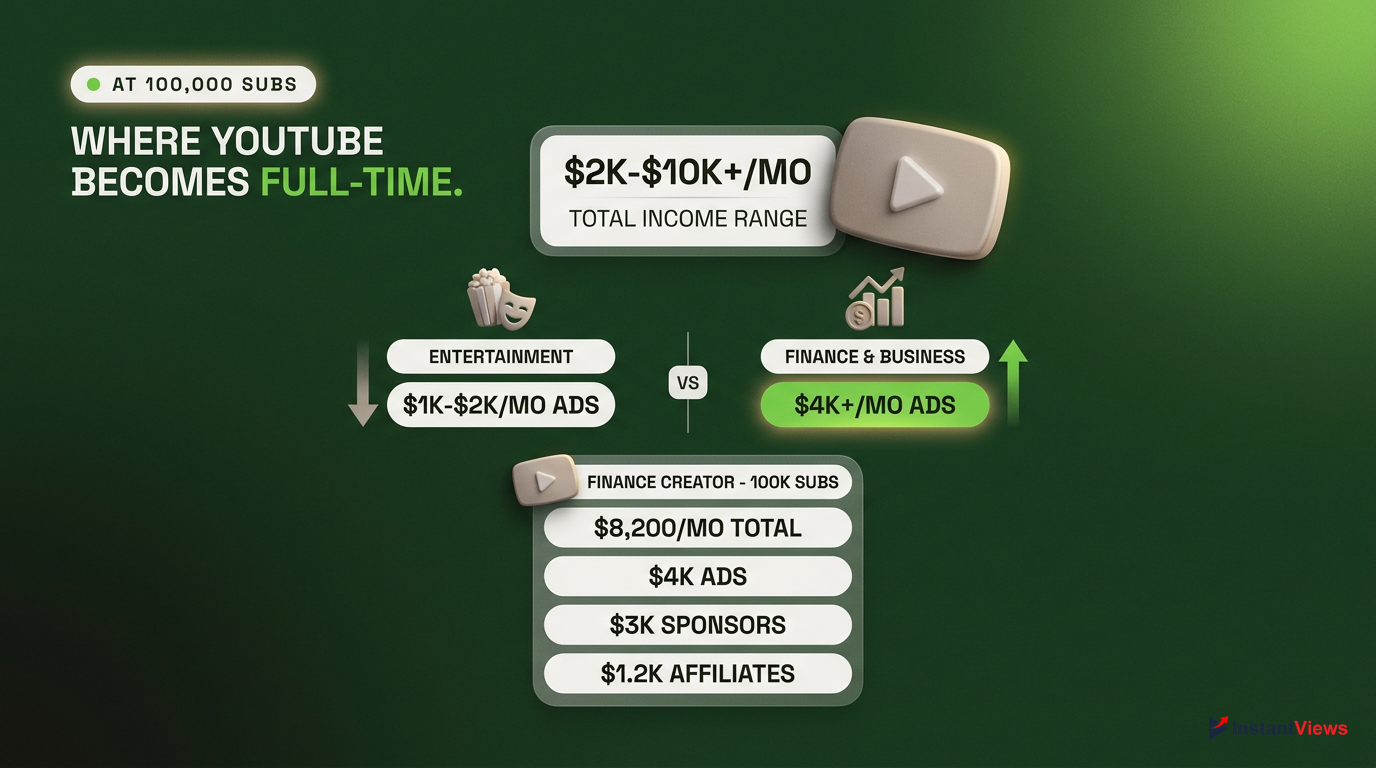
Income at this tier usually ranges from $2,000 to $10,000+ a month, but the niche disparity becomes glaringly obvious here. A 100k-sub finance channel might make $4,000 from ads, $3,000 from two sponsorships, and $1,200 from affiliates (Total: $8,200/month). Conversely, a 100k-sub entertainment channel might only make $1,000–$2,000 total if they struggle to secure brand deals.
Real-world data backs this up. The finance channel "According to Nicole" reported earning approximately $43,000 USD in AdSense revenue over a single year with roughly 100,000 subscribers. Meanwhile, entertainment creator Phelous (126k subs) reported earning $4,550 monthly from ads and $1,260 from sponsorships.
1,000,000 Subscribers: Running a Media Business
At 1,000,000 subscribers, you are no longer just a YouTuber; you are running a full-fledged media business. Creators at this level usually have teams (editors, thumbnail designers, managers) and multiple highly optimized revenue streams.
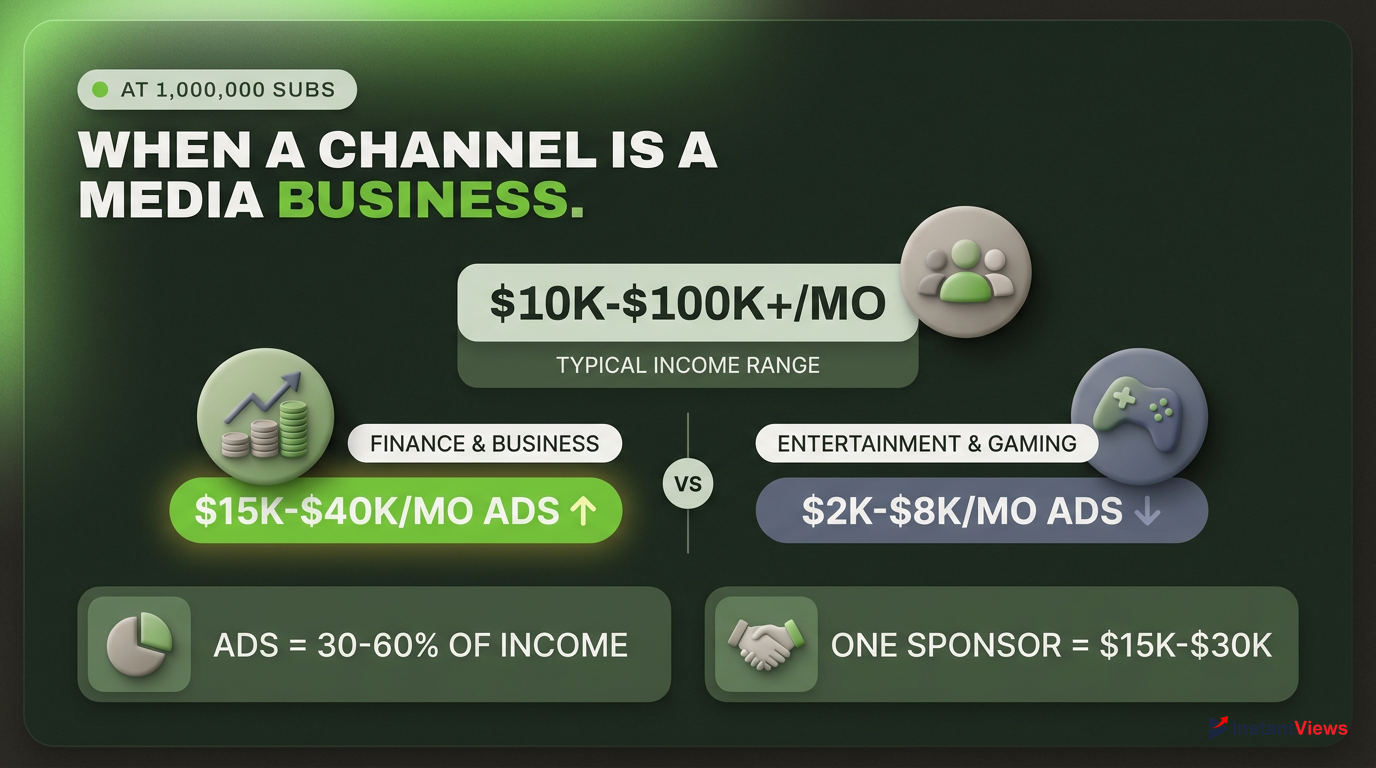
The revenue numbers at this scale are staggering, but again, highly dependent on the niche. A 1M-sub finance or business channel can earn $15,000 to $40,000 a month just from AdSense. An entertainment or gaming channel of the same size might earn $2,000 to $8,000 a month from ads.
Because entertainment channels have lower RPMs, they rely heavily on massive brand deals to make up the difference. At 1 million subscribers, a single dedicated video sponsorship can easily command $15,000 to $30,000, depending on the average views per video. At this level, creators are also launching their own products, software, or merchandise lines to maximize their audience value.
Income Beyond Ads: The Power of Brand Sponsorships
If you are wondering how many subscribers to make money on YouTube, you must look beyond AdSense. Brand sponsorships are the biggest earner for most mid-to-large channels. Brands pay you directly to integrate a 60-to-90-second ad read into your video.
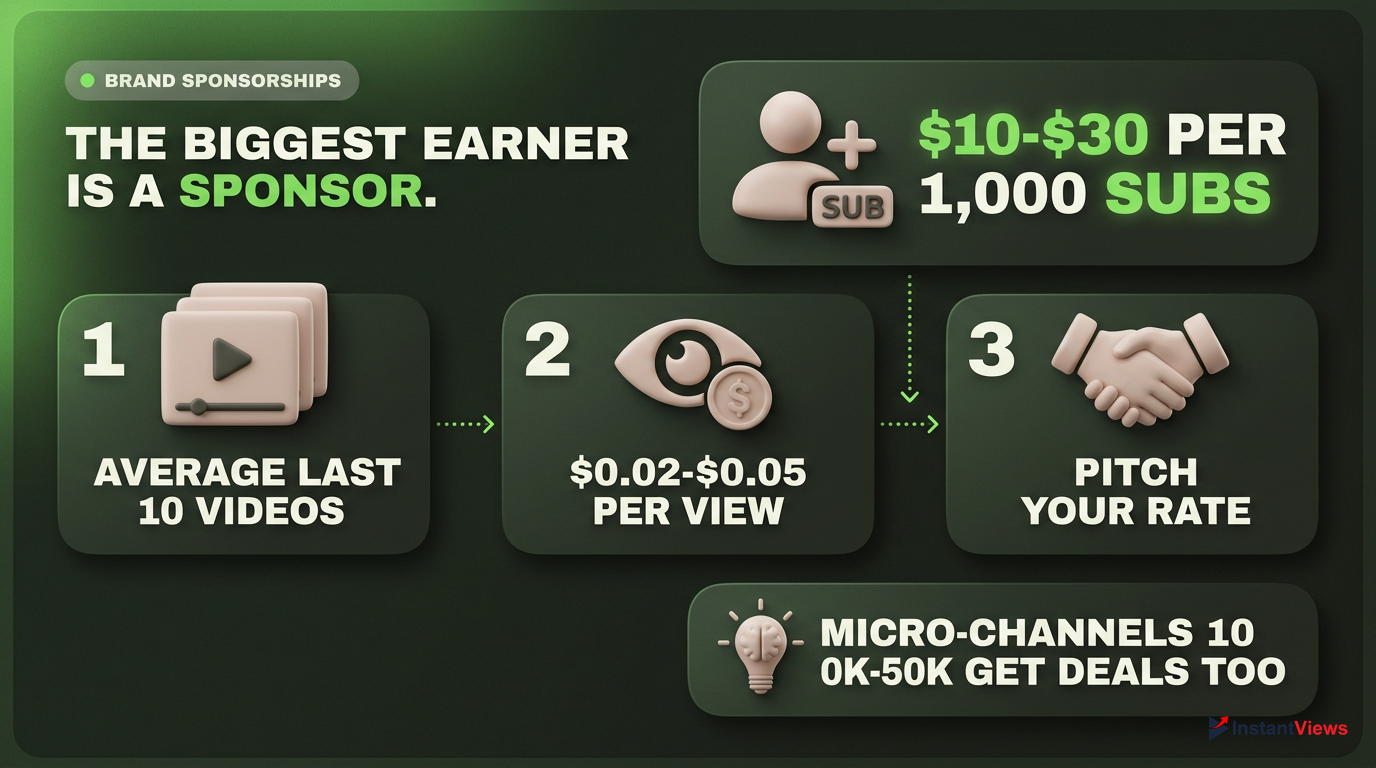
You don't need 100k subscribers to get sponsorships. Micro-influencers (10k-50k subs) with highly engaged, niche audiences are very attractive to brands looking for targeted marketing.
Pricing for sponsorships is usually calculated based on your average views over the last 10 videos, not your total subscriber count. However, the industry rule of thumb is $10 to $30 per 1,000 subscribers for a dedicated video.
Calculate Your Average Views
Look at your last 10 videos (excluding outliers) to find your baseline viewership.
Determine Your CPV (Cost Per View)
Standard rates are $0.02 to $0.05 per view for a 60-second mid-roll.
Pitch the Brand
A creator averaging 200,000 views per video typically charges $4,000 to $10,000 for an integration.
Sponsorships provide a stable, predictable income that isn't subject to the daily fluctuations of YouTube's AdSense RPMs.
Affiliate Marketing and Fan Funding
Two of the most accessible revenue streams for smaller channels are affiliate marketing and fan funding. These can be activated long before you reach the massive subscriber numbers required for huge brand deals.

- Passive income from old videos
- No minimum subscriber requirement to start
- Highly lucrative in tech/finance niches
- Requires viewer to make a purchase
- Low conversion rates (usually 1-3%)
Affiliate marketing involves earning commissions by linking products in your description. For example, a tech review channel with 80,000 subscribers and 300,000 monthly views can generate $5,000 to $9,000 a month if just 2% of viewers click links and 3% buy a product with a $50 average commission.
If a gaming channel with 100,000 subscribers converts just 1% of its audience to a $5/month membership, that adds $5,000 a month in recurring gross revenue (before YouTube's 30% cut).
Fan funding (Channel Memberships, Patreon, Super Chats) allows your most dedicated viewers to support you directly. This is especially powerful for community-driven niches like gaming, live streaming, or deep-dive video essays.
Case Study: Real Creator Earnings in 2026
To truly understand how many subscribers to make money on YouTube, we need to look at verified, real-world data from creators operating in 2026. These examples highlight how wildly income can vary based on niche, format, and monetization strategy.
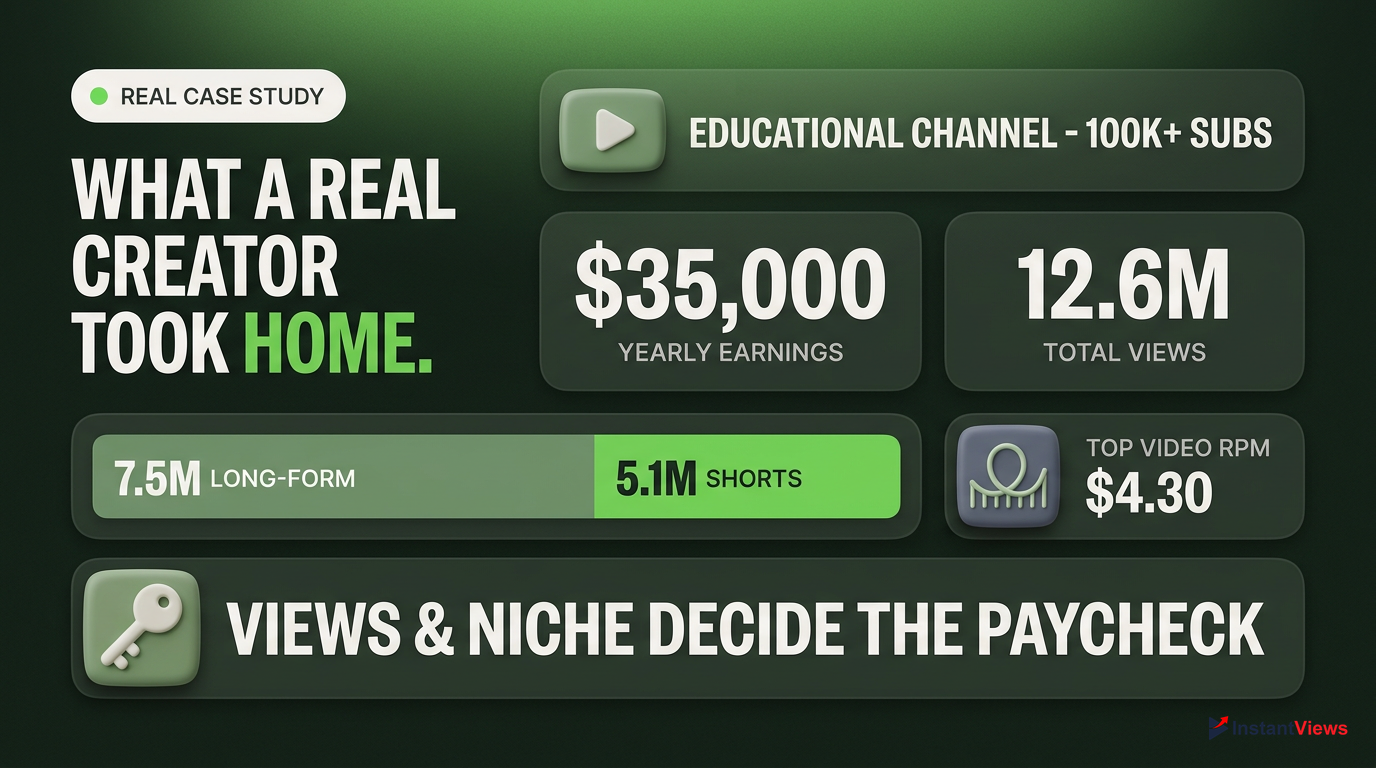
The educational channel "Everything Explained" reported earning approximately $35,000 USD (£27,908) in 2025 alone from 12.6 million views. This view count was split between 7.5 million long-form views and 5.1 million Shorts views. One of their top-performing long-form videos, "Top 10 Fastest Roller Coasters," achieved a solid RPM of $4.30 USD (£3.40).
Subscriber count unlocks the door, but views and niche determine the paycheck. A smaller channel in a high-paying niche with strong affiliate links can easily out-earn a massive channel relying solely on low-RPM entertainment AdSense.
These real numbers prove that while reaching 1,000 subscribers is the necessary first step, building a sustainable income requires a strategic approach to your niche, audience engagement, and diversifying your revenue streams beyond just YouTube AdSense.
Frequently Asked Questions
You need 1,000 subscribers and either 4,000 public watch hours (last 12 months) or 10 million Shorts views (last 90 days) to unlock full AdSense revenue. A lower tier of 500 subscribers unlocks fan funding features like Memberships and Super Chats.
The global average RPM (Revenue Per Mille) for long-form videos is $3 to $5 per 1,000 views. However, this varies wildly by niche. High-paying niches like finance average $10 to $25, while gaming averages $1 to $3.
No, YouTube Shorts pay significantly less than long-form content. The average RPM for Shorts in 2026 is between $0.03 and $0.08 per 1,000 views, meaning 1 million views typically earns only $30 to $80.
A creator with 10,000 subscribers typically earns between $200 and $2,000 a month in total income. AdSense may only make up $50 to $300 of this, with the rest coming from early sponsorships and affiliate marketing.
Income at 100,000 subscribers usually ranges from $2,000 to $10,000+ a month. A finance channel might make $8,000+ from ads and sponsorships, while an entertainment channel might make closer to $2,000 total.
Personal finance, investing, and business are the highest-paying niches on YouTube. Advertisers (banks, brokerages) pay a premium for this audience, resulting in average RPMs of $10 to $25, with top performers exceeding $30.
You do not get paid for subscribers; you get paid for views (specifically, ad impressions). Subscribers are only required to unlock the YouTube Partner Program thresholds. Once monetized, your income is entirely dependent on how many views your videos generate.
The industry rule of thumb for sponsorships is $10 to $30 per 1,000 average views on a dedicated video. A creator averaging 200,000 views per video typically charges $4,000 to $10,000 for a 60-second mid-roll integration.
Yes, you can make money before reaching 1,000 subscribers through affiliate marketing (linking products in your description) or brand sponsorships if you have a highly engaged, niche audience. You can also unlock fan funding at 500 subscribers.
Yes, massively. A US-skewed channel earns 3 to 8x what a Tier-3-skewed channel does. Viewers in the US or UK might generate a $6–$12 CPM, while viewers in India or Southeast Asia might generate a $1–$3 CPM.