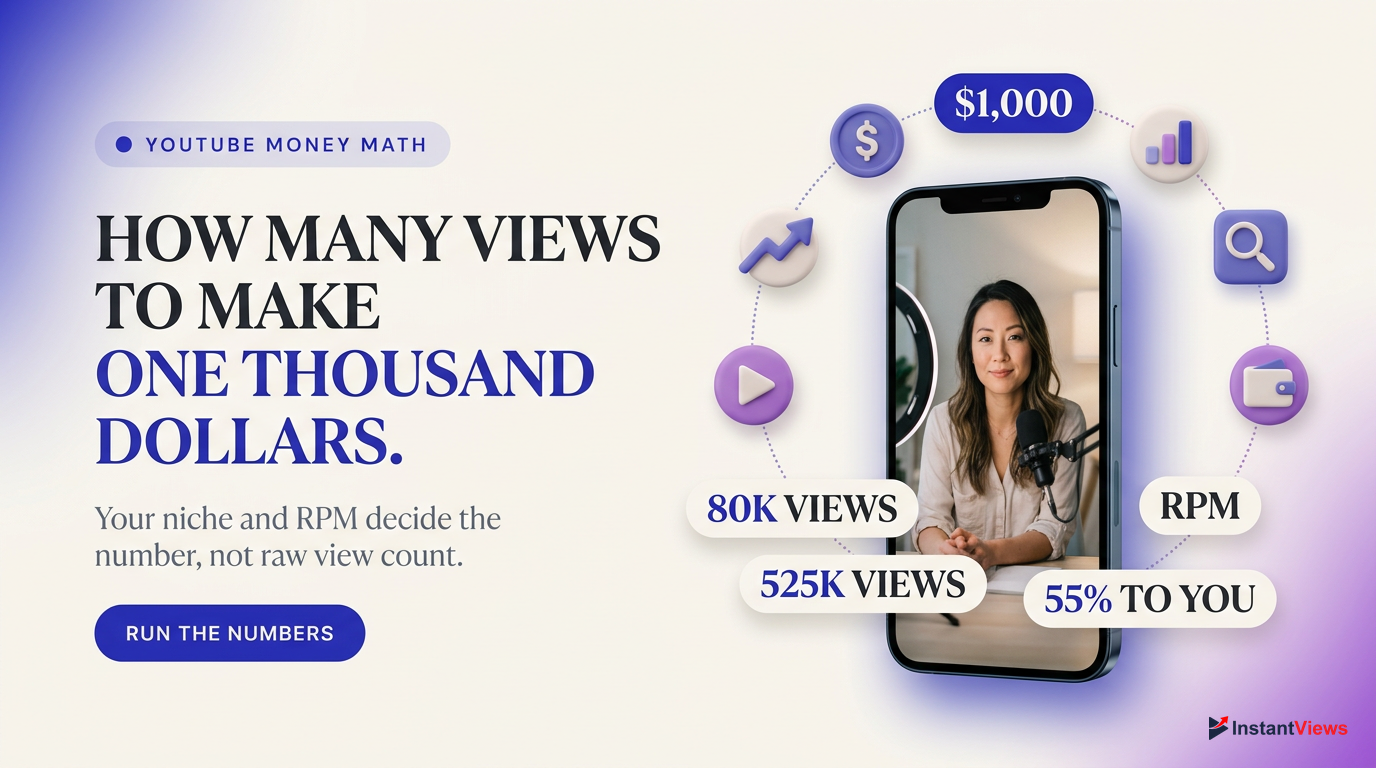
- For long-form videos, YouTube takes a 45% cut, leaving creators with 55% of ad revenue.
- Finance channels need as few as 80,000 views to make $1,000 due to high RPMs ($12.40 avg).
- Gaming channels typically need over 526,000 views to hit $1,000 due to lower advertiser budgets.
- YouTube Shorts require a massive 20,000,000 views to make $1,000 at an average $0.05 RPM.
- 1 million long-form views can net $4,000-$6,000, while 1 million Shorts views net just $30-$70.
If you're building a channel, the ultimate question is always the same: exactly how many views to make 1000 dollars on YouTube? It sounds like a simple math problem, but the reality is far more complex. The answer depends entirely on your niche, your audience demographics, and whether you are posting long-form videos or YouTube Shorts.
To get a concrete answer, we analyzed verified 2025–2026 data from creator dashboards, industry reports, and YouTube analytics tools like vidIQ and YTMoneyCalculator. We looked past the gross CPM numbers to find the actual take-home RPM (Revenue Per Mille) that creators are seeing in their bank accounts.
In this data-driven breakdown, we will reveal the exact math behind YouTube's revenue split, compare the highest and lowest paying niches, and show you real-world examples of how many views it actually takes to hit that $1,000 milestone in 2026.
- CPM vs. RPM and YouTube’s 45% Cut
- High RPM Niches: Finance & Tech
- Average & Low RPM: Entertainment & Gaming
- Real Creator Earnings: 2026 Case Studies
- The Reality of YouTube Shorts RPM
- How to Calculate Your Views to $1,000
- The 3 Factors That Influence Your RPM
- Maximizing RPM with Mid-Roll Ads
- Beyond AdSense: Hitting $1,000 Faster
- Conclusion: Setting Realistic Expectations
- FAQ
CPM vs. RPM and YouTube’s 45% Cut
Before calculating how many views to make 1000 dollars on YouTube, you must understand the difference between what advertisers pay and what you actually keep. Many new creators confuse CPM with RPM, leading to wildly inaccurate revenue projections.

CPM (Cost Per Mille) is the gross amount advertisers pay YouTube per 1,000 ad impressions. RPM (Revenue Per Mille) is the net amount the creator actually takes home per 1,000 total video views. RPM is the only metric that matters for your bank account because it accounts for YouTube's cut, as well as non-monetized views (like users with ad-blockers, skipped ads, or YouTube Premium subscribers).
A niche with a gross CPM of $20 typically translates to an actual take-home RPM of just $7 to $11 once YouTube takes its share and non-monetized views are factored in.
YouTube's revenue split depends on the format. For traditional long-form videos, YouTube takes a 45% cut, leaving the creator with 55%. However, for YouTube Shorts, the split is reversed: YouTube keeps 55% (partly to cover music licensing costs) and the creator receives only 45%.
| Format | Creator Share | YouTube Share |
|---|---|---|
| Long-Form Videos | 55% | 45% |
| YouTube Shorts | 45% | 55% |
High RPM Niches: Finance & Tech
If you want to know how many views to make 1000 dollars on YouTube with the least amount of effort, look at the finance and technology niches. These categories command the highest RPMs because advertisers (banks, brokerages, software companies) are willing to pay top dollar to reach their audiences.
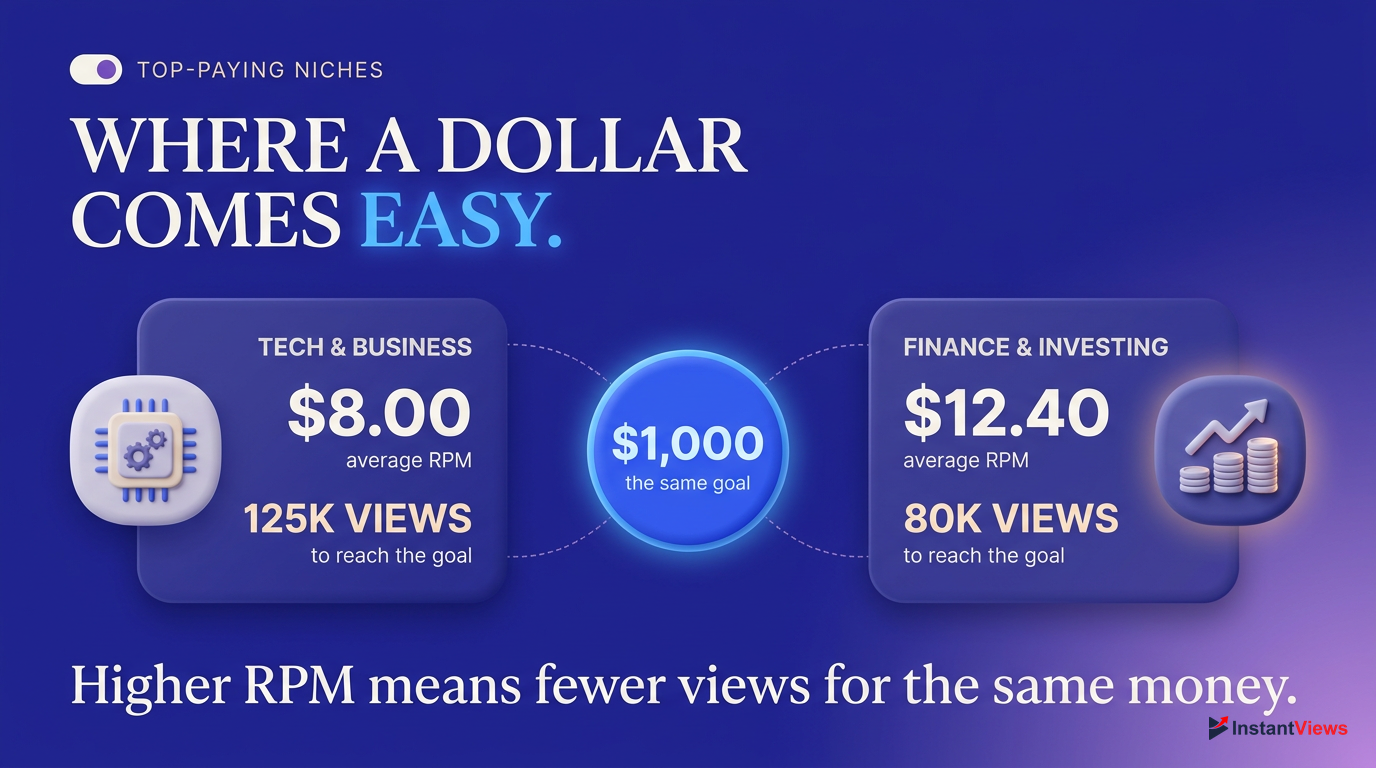
Tech & Business
- $8.00 Avg RPM
Finance & Investing
- $12.40 Avg RPM
Finance channels average an incredible RPM of $10 to $30. Based on an average $12.40 RPM, a finance creator needs only 80,000 views to make $1,000. This is why personal finance is often considered the most lucrative niche on the platform.
Technology and software channels are also highly profitable, averaging an RPM of $6 to $15. At an $8.00 RPM, a tech creator needs roughly 125,000 views to hit the $1,000 mark. The high purchasing power of the audience drives these premium rates.
Choosing a niche with high-value advertisers (like finance or B2B software) drastically reduces the number of views required to make a full-time income.
Average & Low RPM: Entertainment & Gaming
On the other end of the spectrum, broad entertainment and gaming channels require significantly more volume to generate the same revenue. While these niches often get more total views, their RPMs are much lower due to younger audiences and lower advertiser budgets.
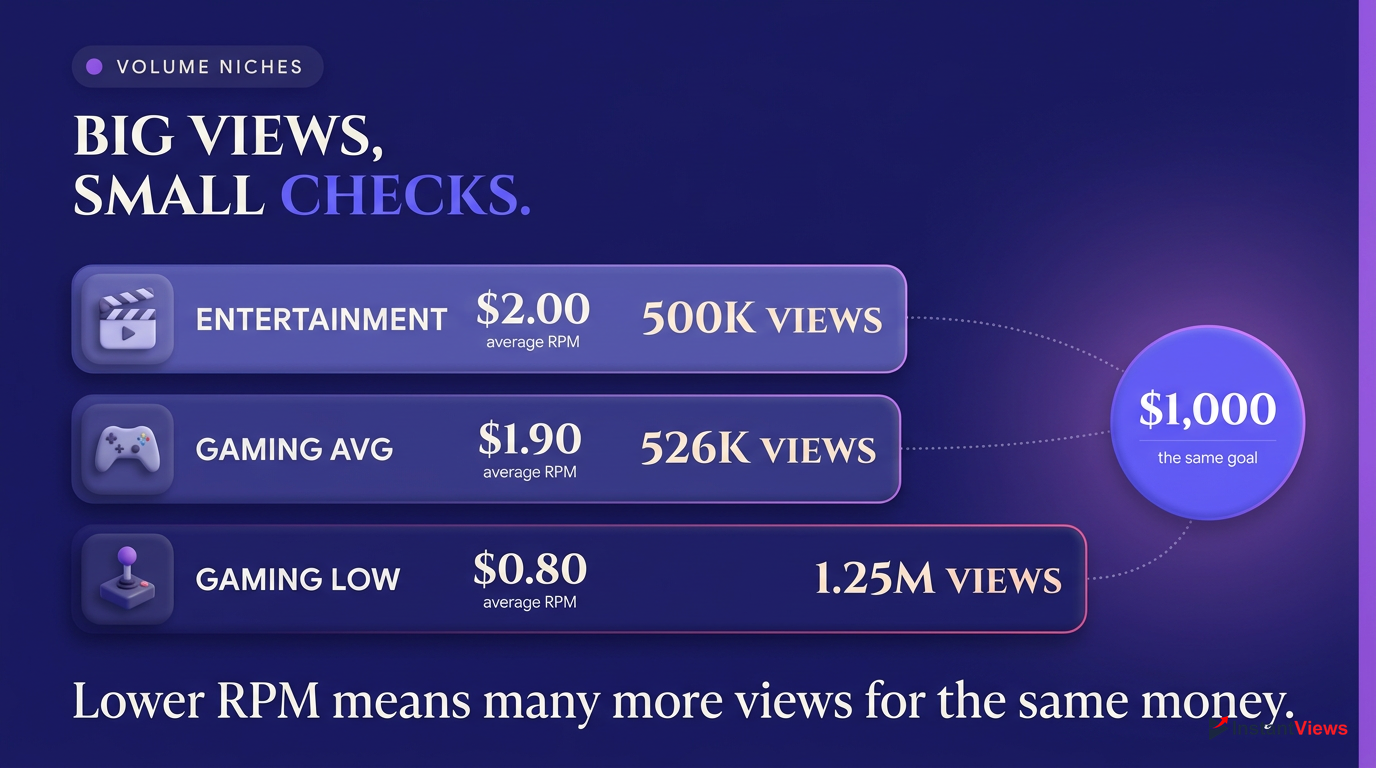
General entertainment and vlog channels average an RPM of $1 to $3. At a $2.00 RPM, an entertainment channel needs 500,000 views to make $1,000. This requires consistent, viral content to maintain a steady income.
Gaming channels face the toughest math. They average an RPM of $1 to $4, with a global average sitting around $1.90. At this rate, a gaming creator needs 526,000 views to make $1,000. At the lowest end of the spectrum ($0.80 RPM), a gaming channel would need a massive 1,250,000 views just to earn $1,000.
If you are starting a gaming channel, do not rely solely on AdSense. You will need millions of views to make a living. Focus on sponsorships, affiliate marketing, and merchandise to supplement your income.
Real Creator Earnings: 2026 Case Studies
To prove how many views to make 1000 dollars on YouTube varies by niche, let's look at verified data from real creators across different categories in 2025-2026.
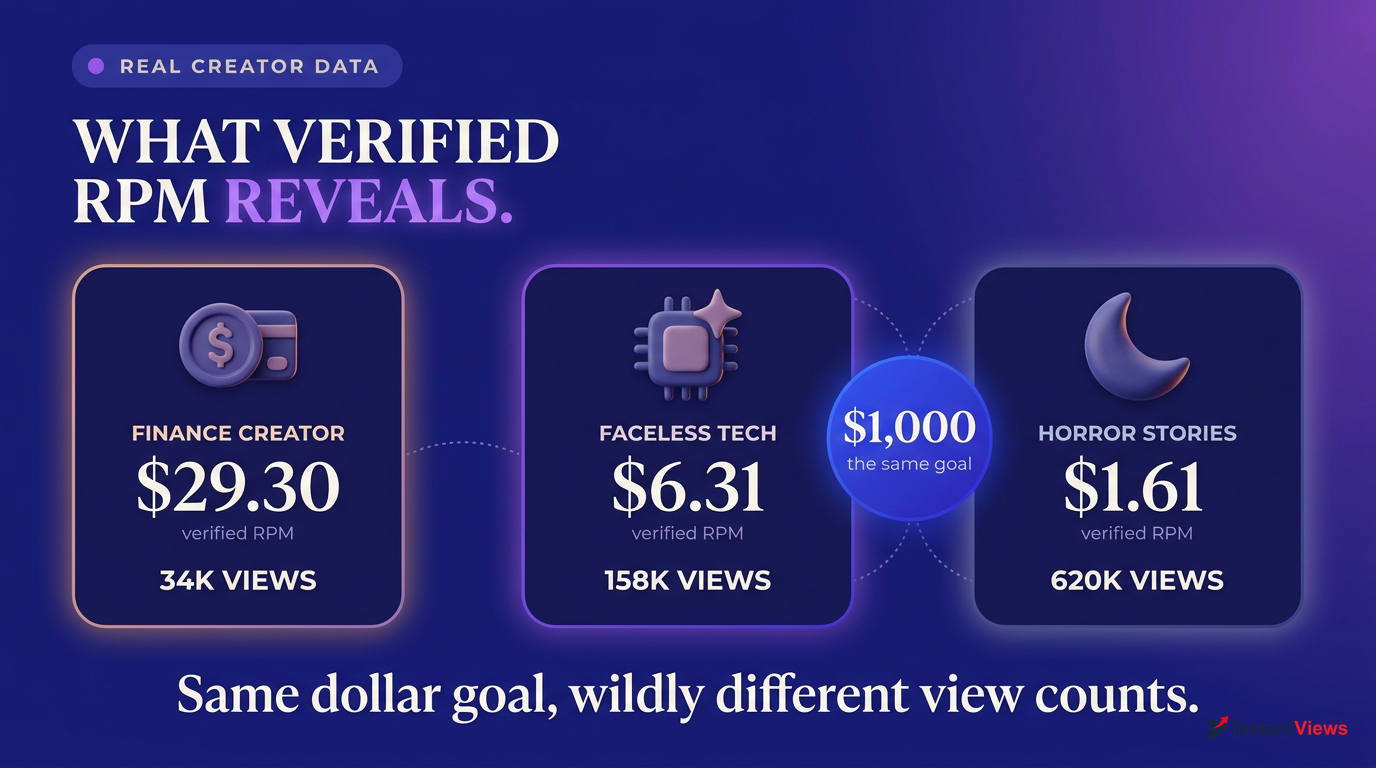
Josh Mayo reported an exceptionally high RPM of $29.30 per 1,000 views. Because his content targets highly profitable financial products, he only needs roughly 34,129 views to make $1,000.
In the tech space, a faceless channel called "How to AI" reported earning $45,000 from 7 million views across 2024/2025. This resulted in a verified RPM of $6.31, meaning they need roughly 158,000 views to make $1,000.
For entertainment, "Mr. Nightmare" (a horror storytelling channel) earned between $96,000 and $268,000 from 36 million views, putting his RPM between $2.00 and $7.31. His RPM is boosted by creating long videos that hold audience retention, allowing for multiple mid-roll ads. Conversely, a Business Insider survey found some broad entertainment channels earning as little as $1.61 per 1,000 views, requiring 621,000 views to hit $1,000.
The Reality of YouTube Shorts RPM
When calculating how many views to make 1000 dollars on YouTube, you must separate long-form content from YouTube Shorts. The monetization models are entirely different, and the revenue disparity is massive.
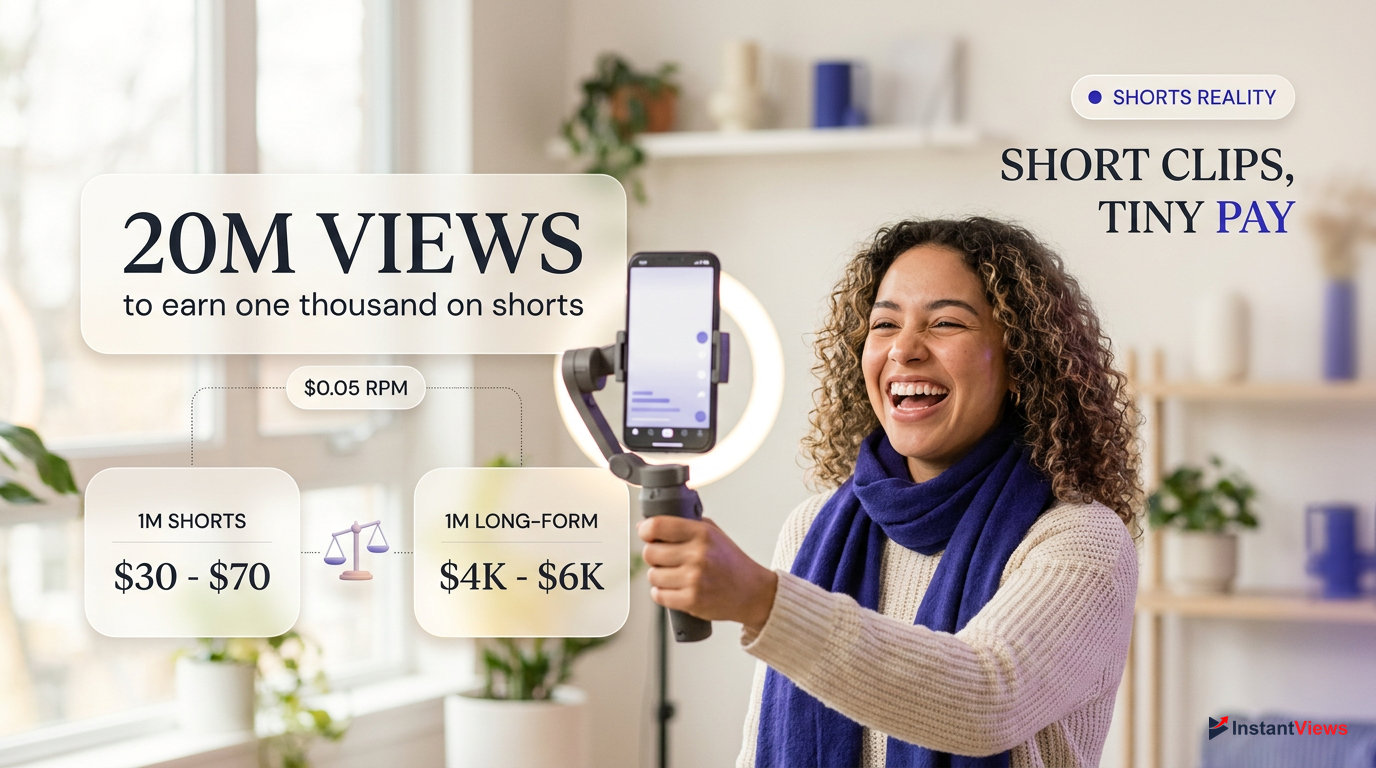
YouTube Shorts operate on a pooled revenue model. Because ads are shown between Shorts rather than on a specific creator's video, the revenue is pooled and distributed based on view share. This results in an RPM that is 50 to 100 times lower than long-form content. In 2025–2026, Shorts RPM typically ranges from just $0.01 to $0.07 per 1,000 views.
1 Million Shorts Views
- Pooled revenue model
1 Million Long-Form Views
- Direct ad placement
At an average Shorts RPM of $0.05, a creator needs a staggering 20,000,000 views to make $1,000. To put this in perspective: 1 million views on a long-form video in a decent niche will net a creator $4,000 to $6,000. That exact same 1 million views on YouTube Shorts will only net the creator $30 to $70.
Do not rely on Shorts for direct AdSense revenue. Use Shorts as a top-of-funnel discovery tool to drive subscribers to your highly monetized long-form videos or to promote affiliate links.
How to Calculate Your Views to $1,000
If you are already monetized, calculating exactly how many views to make 1000 dollars on YouTube for your specific channel is straightforward. You don't need to guess; the exact data is in your YouTube Studio.
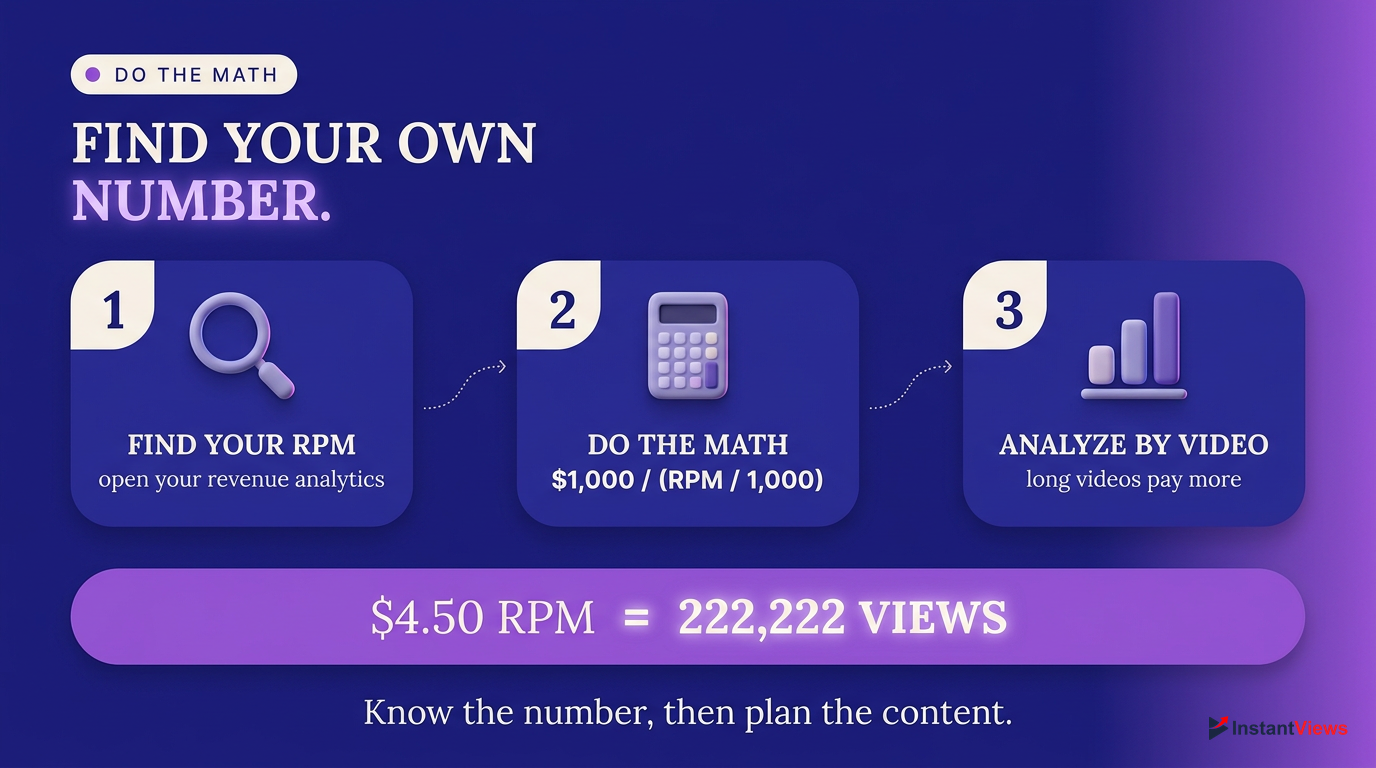
Find Your RPM
Open YouTube Studio, navigate to the 'Analytics' tab, and click on 'Revenue'. Look for the metric labeled 'RPM (Revenue per mille)'.
Do the Math
Use this formula: $1,000 / (Your RPM / 1,000) = Views Needed. For example, if your RPM is $4.50: $1,000 / ($4.50 / 1,000) = 222,222 views.
Analyze by Video
Go to 'Advanced Mode' in Analytics and view RPM by specific videos. You will likely find that videos over 8 minutes long have significantly higher RPMs due to mid-roll ads.
Understanding this math allows you to set realistic goals. If you know you need 222,000 views to make $1,000, you can reverse-engineer your content strategy. Do you need one viral video, or ten videos that consistently get 22,000 views each month?
Your channel's average RPM is useful, but analyzing RPM on a per-video basis reveals exactly which topics are the most profitable, allowing you to double down on high-earning content.
The 3 Factors That Influence Your RPM
Why does one channel need 80,000 views to make $1,000 while another needs 500,000? The answer lies in the three main factors that dictate your RPM: audience geography, video length, and advertiser demand.
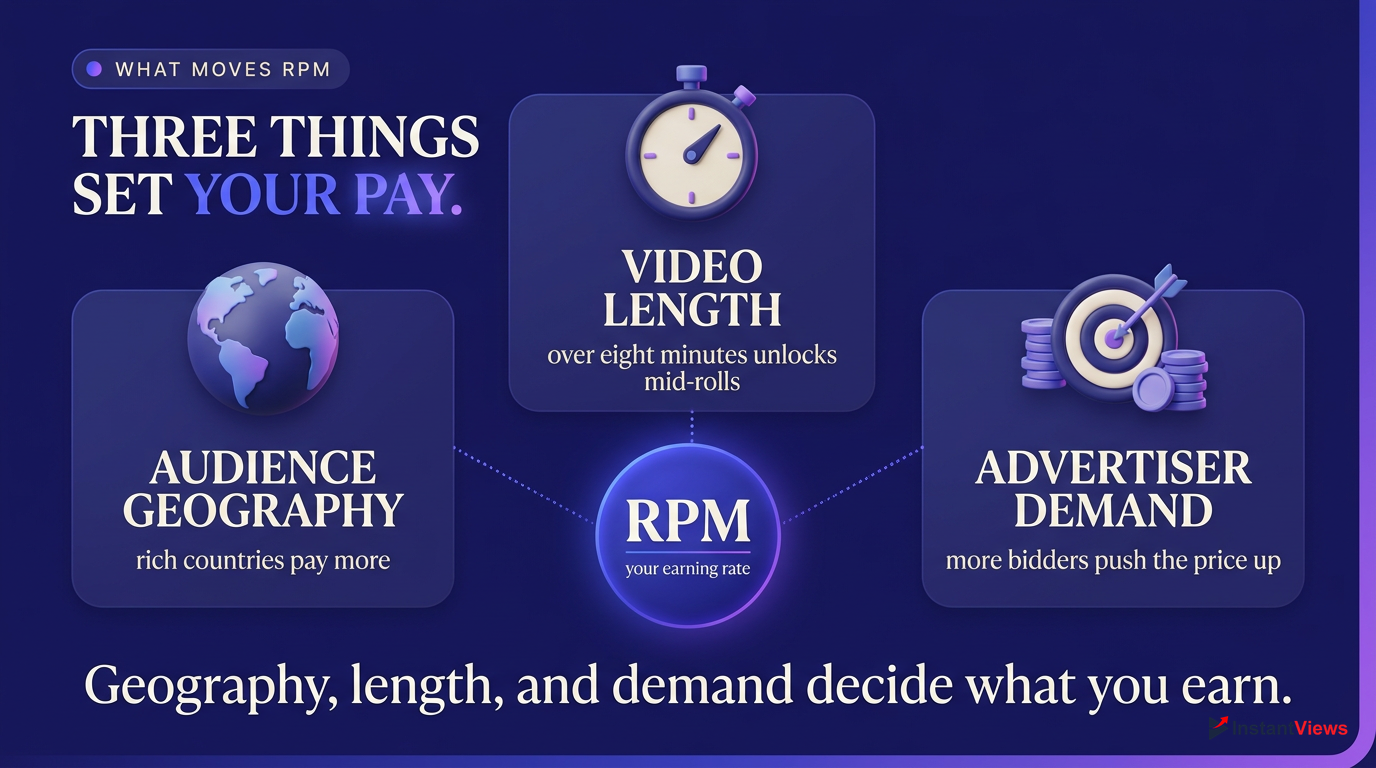
Audience Geography
Advertisers pay more to reach viewers in countries with higher purchasing power. Views from the US, UK, Canada, and Australia will generate significantly higher RPMs than views from India or Brazil.
Video Length
Videos longer than 8 minutes are eligible for mid-roll ads. Placing multiple ads throughout a longer video can easily double or triple your RPM compared to a 4-minute video with only pre-roll ads.
Advertiser Demand
This is the niche factor. If you make videos about software, dozens of SaaS companies are bidding against each other to show ads, driving the price up. If you make prank videos, advertiser demand is much lower.
To maximize your earnings and reduce the number of views needed to hit $1,000, you must optimize for these three factors. Create content that appeals to a Western demographic, make your videos longer than 8 minutes (while maintaining retention), and focus on topics that attract high-paying advertisers.
Even within a low-RPM niche like gaming, you can increase your RPM by reviewing expensive hardware (like $2,000 gaming PCs) rather than just posting let's play footage.
Maximizing RPM with Mid-Roll Ads
The fastest way to reduce how many views to make 1000 dollars on YouTube is to master mid-roll ad placement. If your videos are over 8 minutes long, YouTube allows you to place ads manually throughout the video.

- Can double or triple your RPM instantly.
- Allows you to monetize highly engaged viewers multiple times.
- You control the placement to minimize viewer disruption.
- Requires videos to be at least 8 minutes long.
- Too many ads can cause viewers to click away, hurting retention.
- Automatic placement by YouTube is often poorly timed.
Do not rely on YouTube's automatic mid-roll placement. The algorithm often places ads mid-sentence, frustrating viewers. Instead, place ads manually during natural pauses, scene transitions, or right before a "cliffhanger" moment to ensure the viewer stays through the ad.
Enable Mid-Rolls
In YouTube Studio, go to the Monetization tab for a specific video (over 8 mins) and check 'During video (mid-roll)'.
Place Manually
Click 'Manage mid-rolls'. Delete the automatic placements and add manual breaks during natural transitions or suspenseful moments.
Beyond AdSense: Hitting $1,000 Faster
Relying solely on AdSense is the slowest way to monetize. If you want to know how many views to make 1000 dollars on YouTube, the answer changes drastically when you factor in sponsorships, affiliate marketing, and digital products.

| Income Source | Views to $1k (Est) | Effort Level |
|---|---|---|
| AdSense (Avg Niche) | 500,000 | Low (Passive) |
| Affiliate Marketing | 50,000 | Medium |
| Sponsorships | 25,000 | High (Outreach) |
For example, if you have a tech channel with an $8 RPM, you need 125,000 views to make $1,000 from AdSense. However, if you include an affiliate link for a software product that pays a $50 commission, you only need 20 people to buy it to make $1,000. If 0.1% of your viewers convert, you only need 20,000 views to hit your goal.
You don't need millions of subscribers to get sponsorships. Micro-influencers (10k-50k subs) with highly engaged, niche audiences can often charge $500 to $1,000 per dedicated integration.
By diversifying your income streams, you drastically reduce your reliance on the YouTube algorithm and AdSense rates, allowing you to build a sustainable business with a fraction of the views.
Conclusion: Setting Realistic Expectations
To make $1,000 on YouTube, a finance channel needs ~80k views, a tech channel needs ~125k views, an entertainment channel needs ~500k views, and a Shorts channel needs ~20 million views.
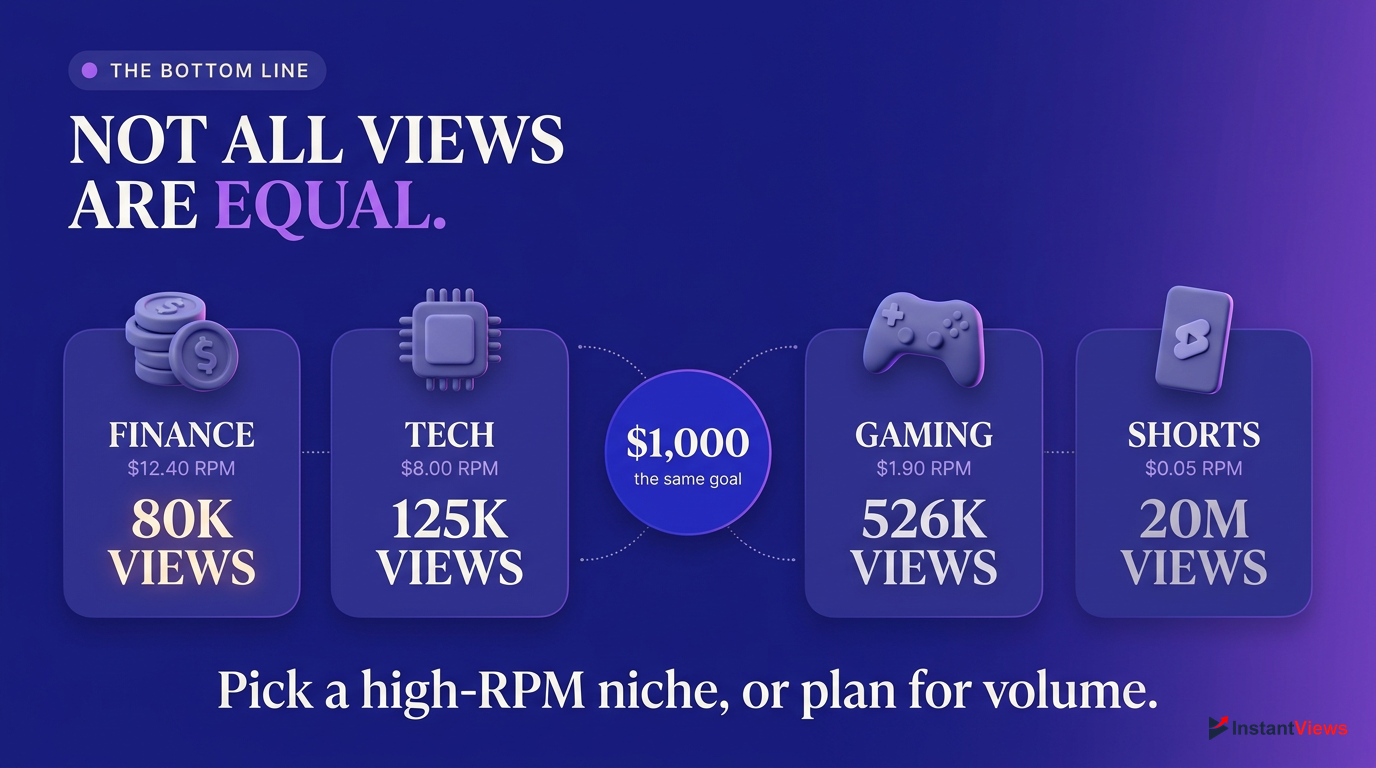
Calculating how many views to make 1000 dollars on YouTube reveals a stark reality: not all views are created equal. The 2026 data clearly shows that your niche, video format, and audience demographics dictate your earning potential far more than sheer view count.
If you are starting a channel today, choose your niche wisely. If your goal is purely financial, lean towards high-RPM topics like finance, software, or business. If your passion lies in low-RPM niches like gaming or vlogs, understand that you will need to generate massive view volume or heavily rely on external monetization like sponsorships and merch.
Stop obsessing over gross CPM and focus entirely on your take-home RPM. By creating longer videos, targeting high-value demographics, and diversifying your income, you can hit that $1,000 milestone much faster than relying on AdSense alone.
Frequently Asked Questions
Based on 2026 data, YouTube Shorts average an RPM of $0.01 to $0.07. At an average $0.05 RPM, you need approximately 20,000,000 views on Shorts to make $1,000.
CPM is the gross amount advertisers pay per 1,000 ad impressions. RPM is the net amount the creator actually takes home per 1,000 total video views, after YouTube takes its 45% cut.
Gaming channels have lower RPMs, averaging $1.90 globally. At this rate, a gaming creator needs roughly 526,000 views to make $1,000 from AdSense alone.
Finance channels average a $12.40 RPM because advertisers (banks, brokerages) sell high-value products and are willing to pay premium rates to reach audiences interested in investing and credit cards.
For traditional long-form videos, YouTube takes a 45% cut, leaving the creator with 55%. For YouTube Shorts, YouTube keeps 55% and the creator gets 45%.
Tech and software channels average an RPM of $8.00. At this rate, a tech creator needs approximately 125,000 views to earn $1,000.
Yes. If a viewer uses an ad-blocker, no ad is served, and you do not earn AdSense revenue for that view. This is why RPM is always lower than CPM.
You can increase your RPM by making videos longer than 8 minutes to include mid-roll ads, targeting viewers in high-income countries (US, UK), and covering topics with high advertiser demand.
For long-form videos in an average niche, 1 million views pays between $4,000 and $6,000. For YouTube Shorts, 1 million views only pays between $30 and $70.
Go to YouTube Studio, click on the 'Analytics' tab, and select 'Revenue'. Your overall channel RPM will be displayed there, and you can view per-video RPM in Advanced Mode.