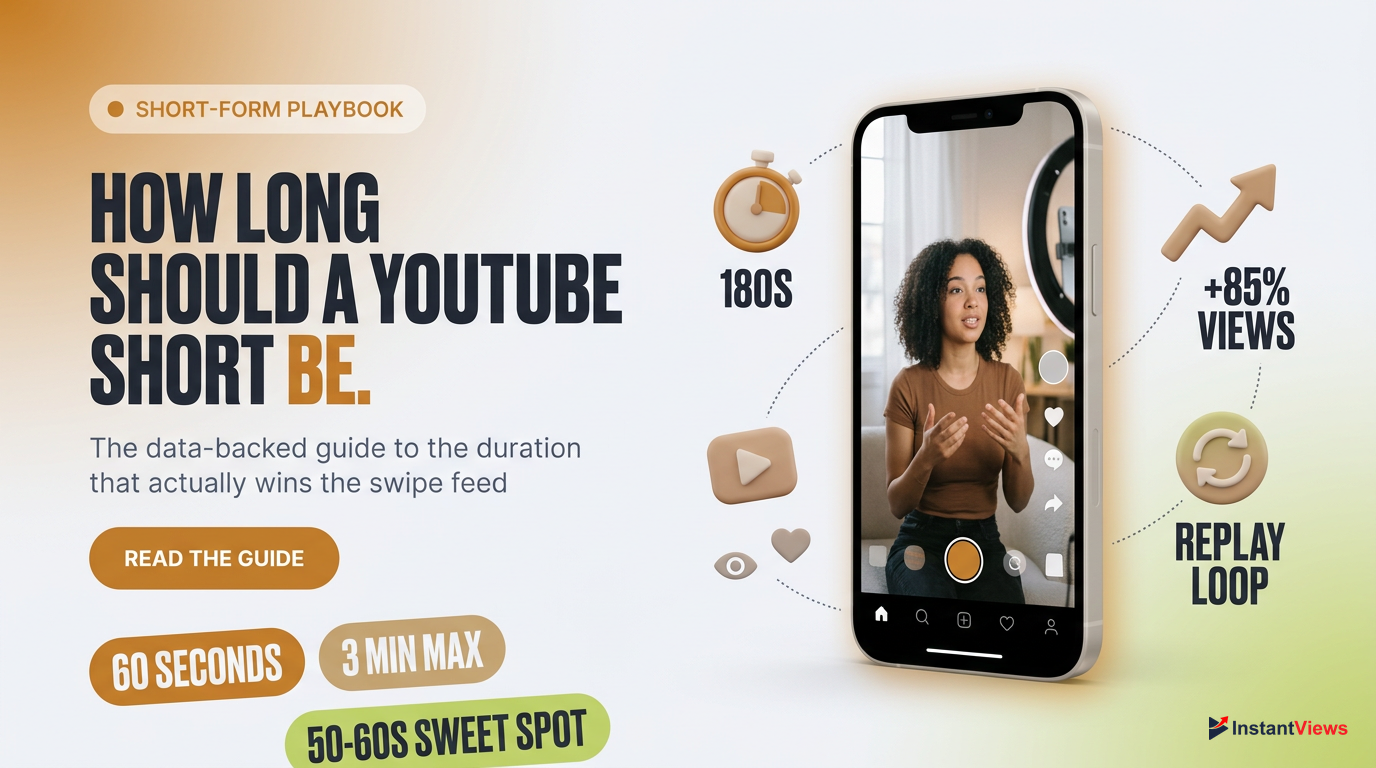
- YouTube officially extended the maximum Shorts length to 3 minutes (180 seconds) as of October 2024.
- Despite the 3-minute limit, the optimal length for maximum views is the 50-60 second sweet spot.
- Using copyrighted commercial music caps your Short at 60 seconds, requiring original audio for longer videos.
- The algorithm favors a bimodal distribution: either very short (13-15s) for loops, or long (50-60s) for total watch time.
- Shorts monetization pays between $0.01 and $0.07 per 1,000 views, making high-retention, longer Shorts crucial for revenue.
If you are trying to grow a channel in 2026, you are likely asking: exactly how long should a YouTube Short be? With the platform's recent massive update extending the maximum duration, the rules of the game have fundamentally changed. The days of simply keeping it under 60 seconds are over, and creators are now navigating a much more complex algorithm.
We analyzed the latest performance data, algorithm updates, and monetization metrics to determine the true optimal length for YouTube Shorts. The answer isn't just about making videos longer; it's about understanding how the algorithm balances completion rate against total watch time. What works for a quick comedy sketch will tank a detailed tutorial.
In this comprehensive, data-driven guide, we break down the verified 2026 statistics. We will explore the impact of the new 3-minute limit, the hidden music catch that could block your videos, and the exact "sweet spots" that generate up to 85% more views. Let's dive into the data to optimize your Shorts strategy.
- The 3-Minute Limit vs. The 60-Second Era
- The Music Catch: Why Your Short Might Be Capped at 60 Seconds
- Optimal Duration: Balancing Completion Rate and Total Views
- The 50–60 Second Sweet Spot: Maximizing Reach
- The 15–30 Second Sweet Spot: The Loop Strategy
- The Bimodal Distribution: Choose Your Path
- The 3-Minute Challenge: Navigating the Swipe Feed
- The Algorithm's Math: Winning the First 3 Seconds
- How Length Affects Monetization and RPM
- Verified Benchmarks: The 80% Rule for Virality
- FAQ
The 3-Minute Limit vs. The 60-Second Era
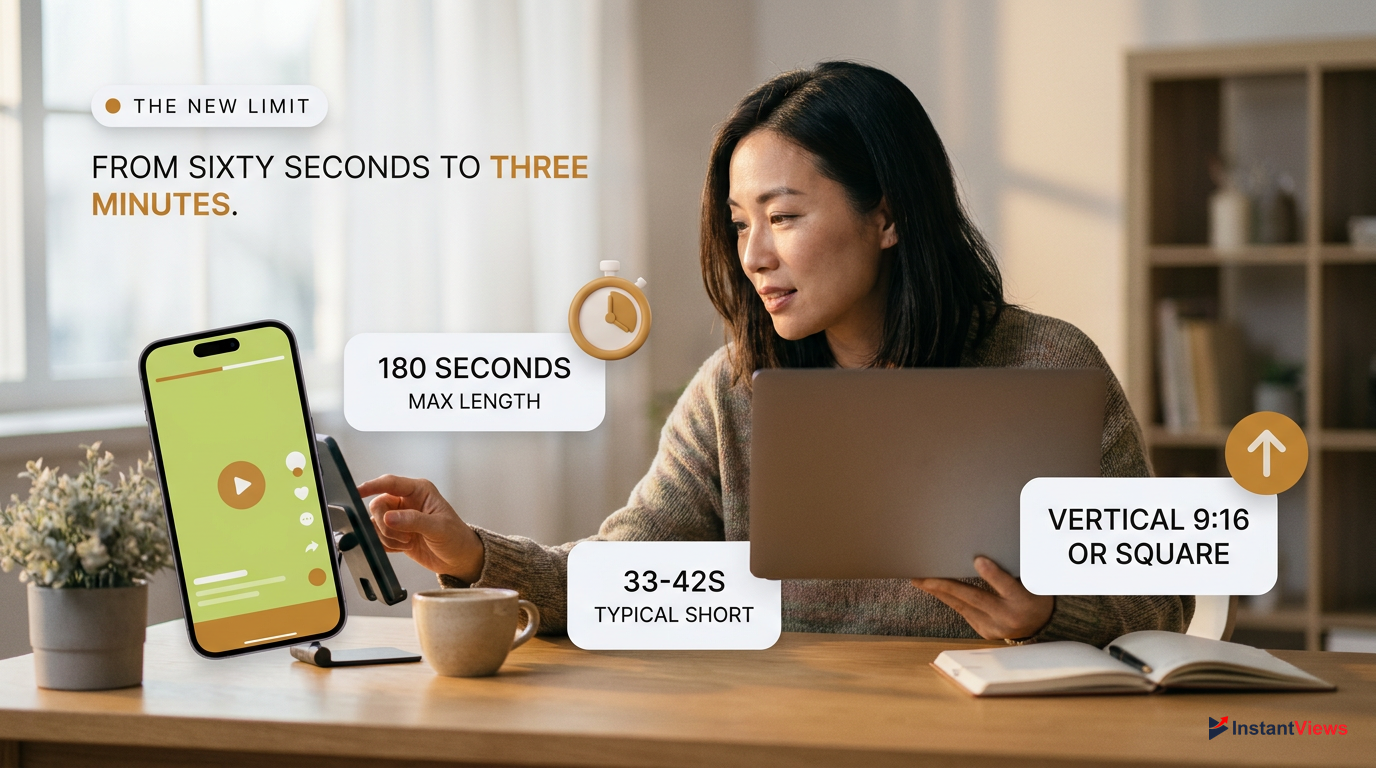
For years, the defining characteristic of a YouTube Short was its strict 60-second time limit. However, as of October 15, 2024, YouTube officially shifted the landscape by extending the maximum length for Shorts to 3 minutes (180 seconds). This change applies to any vertical (9:16) or square video uploaded after that date, fundamentally altering how creators approach short-form content.
This extension was designed to give creators more breathing room for storytelling, tutorials, and in-depth reviews without forcing them into the traditional long-form format. However, just because you can make a 3-minute Short doesn't mean you always should. The data reveals a significant gap between the maximum allowed length and what creators are actually producing.
Despite the new 3-minute ceiling, the average length of a YouTube Short in 2026 remains between 33 and 42 seconds. This indicates that while the option for longer content exists, the majority of the ecosystem is still optimized for rapid consumption. Creators are testing the waters with longer formats, but the core of Shorts remains quick, punchy content.
The 3-minute limit offers flexibility, but the average creator is still finding success in the sub-45-second range. Don't stretch a 30-second idea into a 3-minute video just because you can.
The Music Catch: Why Your Short Might Be Capped at 60 Seconds
While the 3-minute limit is officially live, there is a massive caveat that catches many creators off guard: copyrighted music. If you intend to use commercial music from the YouTube Audio Library, your video is still strictly capped at 60 seconds. In some cases, depending on the specific track's licensing, the app may even default to 15-second segments.
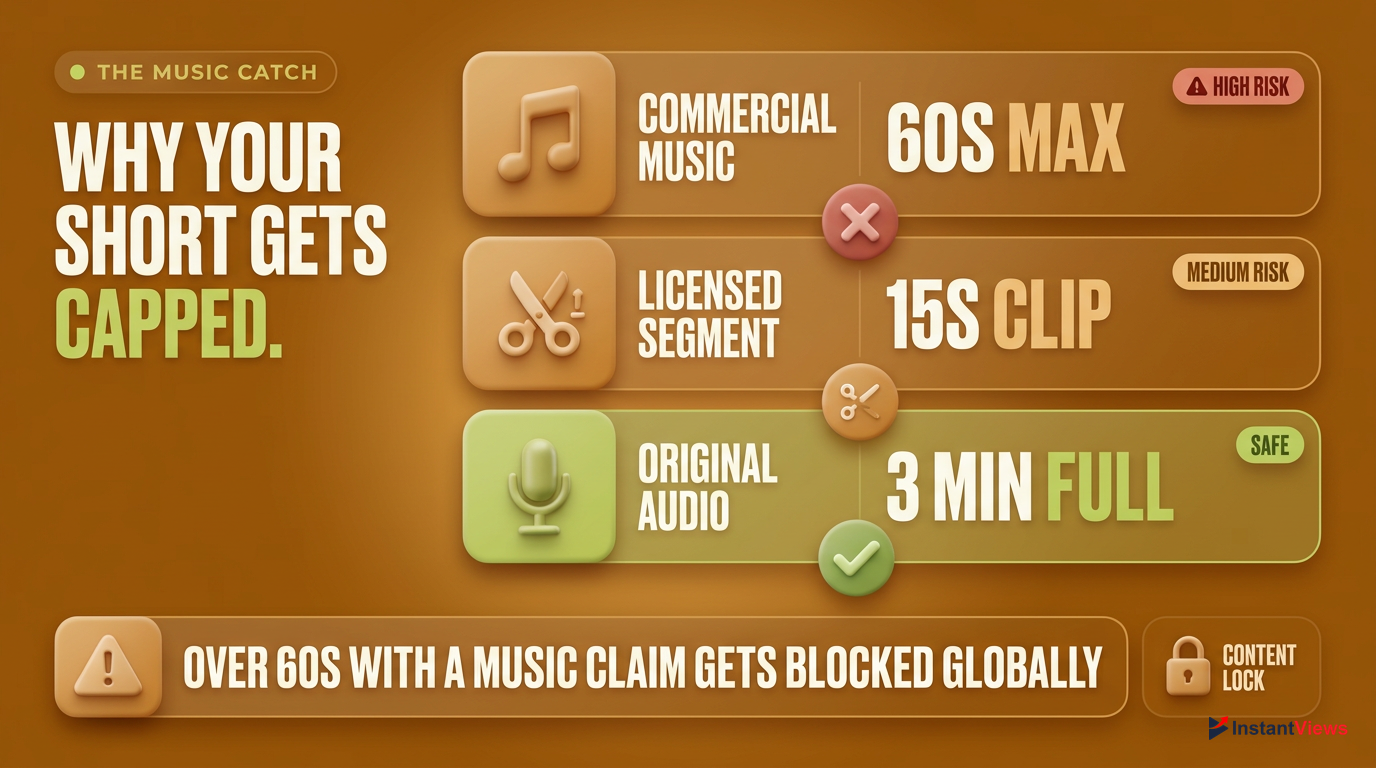
If a Short is over 1 minute and contains an active Content ID claim for commercial music, it will be blocked globally. You cannot monetize or distribute it.
To utilize the full 3-minute limit, creators must rely on original audio, voiceovers, or royalty-free music that does not trigger Content ID claims. This restriction forces a strategic choice: do you want the viral boost of a trending commercial sound, or do you need the extra time to deliver a comprehensive message?
| Audio Type | Max Length | Monetization Risk |
|---|---|---|
| Commercial Music (YT Library) | 60 Seconds (or 15s) | Low (Revenue Shared) |
| Original Audio / Voiceover | 3 Minutes (180s) | None |
| Royalty-Free Music | 3 Minutes (180s) | None |
| Uncleared Copyrighted Music | Blocked if >60s | High (Blocked/Demonetized) |
For creators focused on education, storytelling, or vlogging, the shift to original audio is essential. If you are building a strategy around the new 3-minute format, you must audit your audio sources before hitting publish.
If you need background music for a 3-minute Short, use platforms like Epidemic Sound or Artlist, and ensure your YouTube channel is properly linked to avoid automated Content ID claims.
Optimal Duration: Balancing Completion Rate and Total Views
When determining how long a YouTube Short should be, you must understand how the algorithm evaluates success. It's a delicate balance between two primary metrics: completion rate (the percentage of the video watched) and total watch time (the actual seconds spent watching). Shorter videos naturally achieve higher completion rates, but they don't always generate the most views.
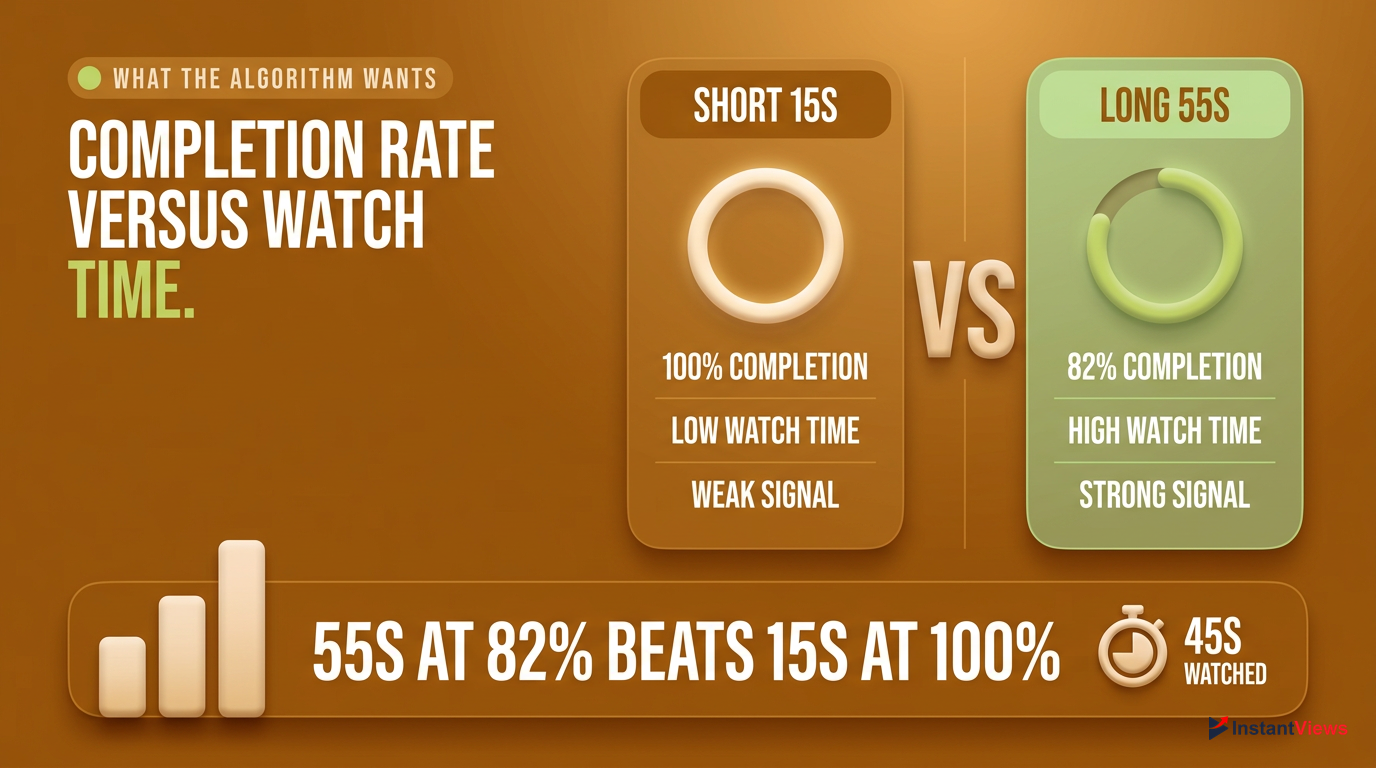
Short (15s)
- Completion Rate
- Low Total Watch Time
Long (55s)
- Completion Rate
- High Total Watch Time
The YouTube algorithm values total watch time heavily. A 55-second Short with an 82% completion rate yields roughly 45 seconds of watch time. This sends a much stronger positive signal to the algorithm than a 15-second Short with a 100% completion rate (only 15 seconds of watch time). This dynamic is why longer Shorts often outperform shorter ones in total reach.
However, this doesn't mean you should abandon short content entirely. The key is matching the length to the content type. If your video is a quick joke, stretching it will ruin the retention. If it's a tutorial, rushing it will leave viewers confused and likely to swipe away.
The 50–60 Second Sweet Spot: Maximizing Reach
If your primary goal is to maximize total views and reach the widest possible audience, the data points to a very specific duration. Multiple 2025–2026 studies reveal that Shorts in the 50 to 60-second range consistently pull in the highest average views across the platform.
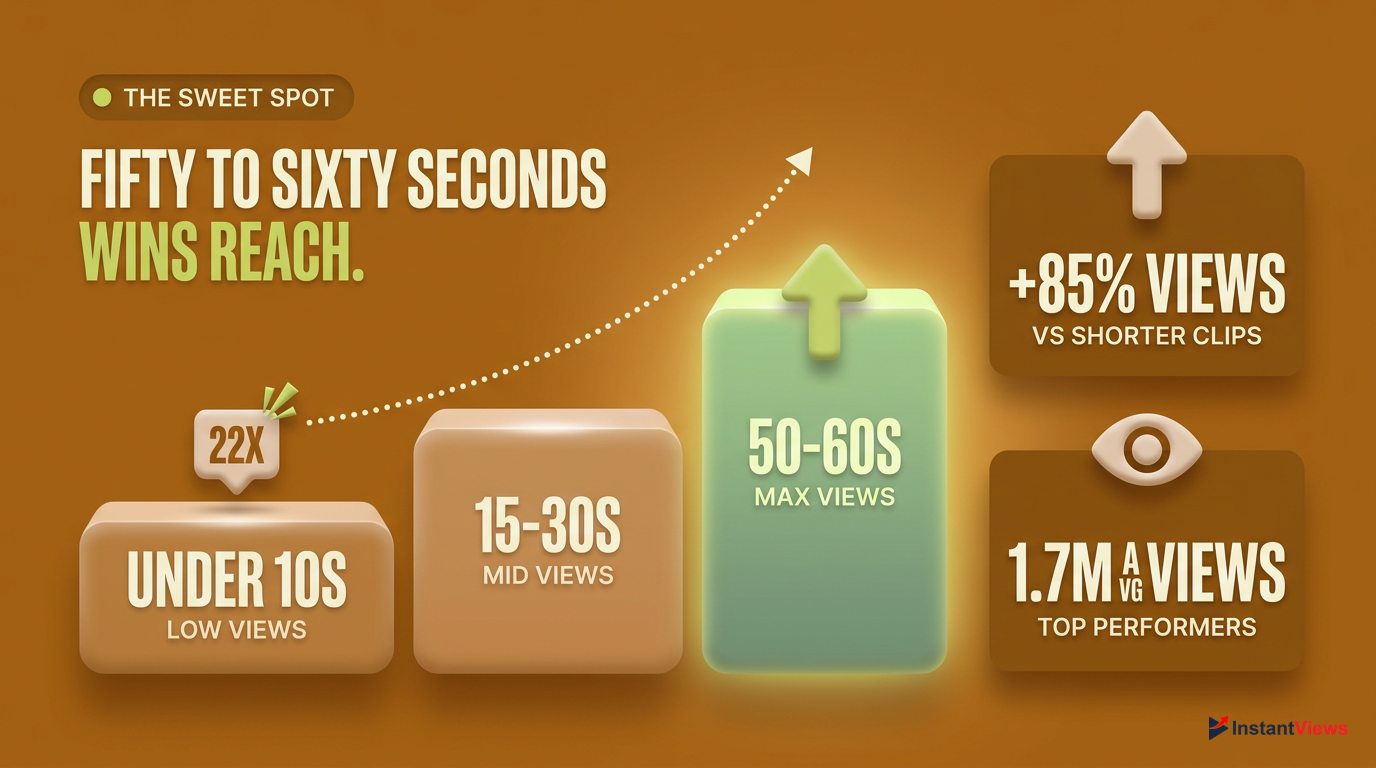
An extensive Inflow Network study analyzing 5,400 Shorts found that videos in this 50–60 second bracket generated up to 85% more views than average. Even more staggering, they generated nearly 22x more views than clips under 10 seconds. At the top end, these optimized Shorts averaged around 1.7 million views.
Why does this specific range perform so well? It provides enough time to deliver a complete narrative arc—a strong hook, valuable context, and a satisfying payoff—while still feeling "short" enough to prevent viewer fatigue. It maximizes total watch time without crossing the threshold where viewers typically lose patience in the swipe feed.
To succeed in the 50-60 second range, your pacing must be relentless. You cannot afford dead air or slow transitions; every second must retain the viewer's attention.
The 15–30 Second Sweet Spot: The Loop Strategy
While the 50-60 second range dominates total views, there is a secondary sweet spot that thrives on a completely different metric: the loop. For comedy sketches, quick tips, highly visual transitions, and hook-driven content, 15 to 30 seconds remains a highly effective duration.
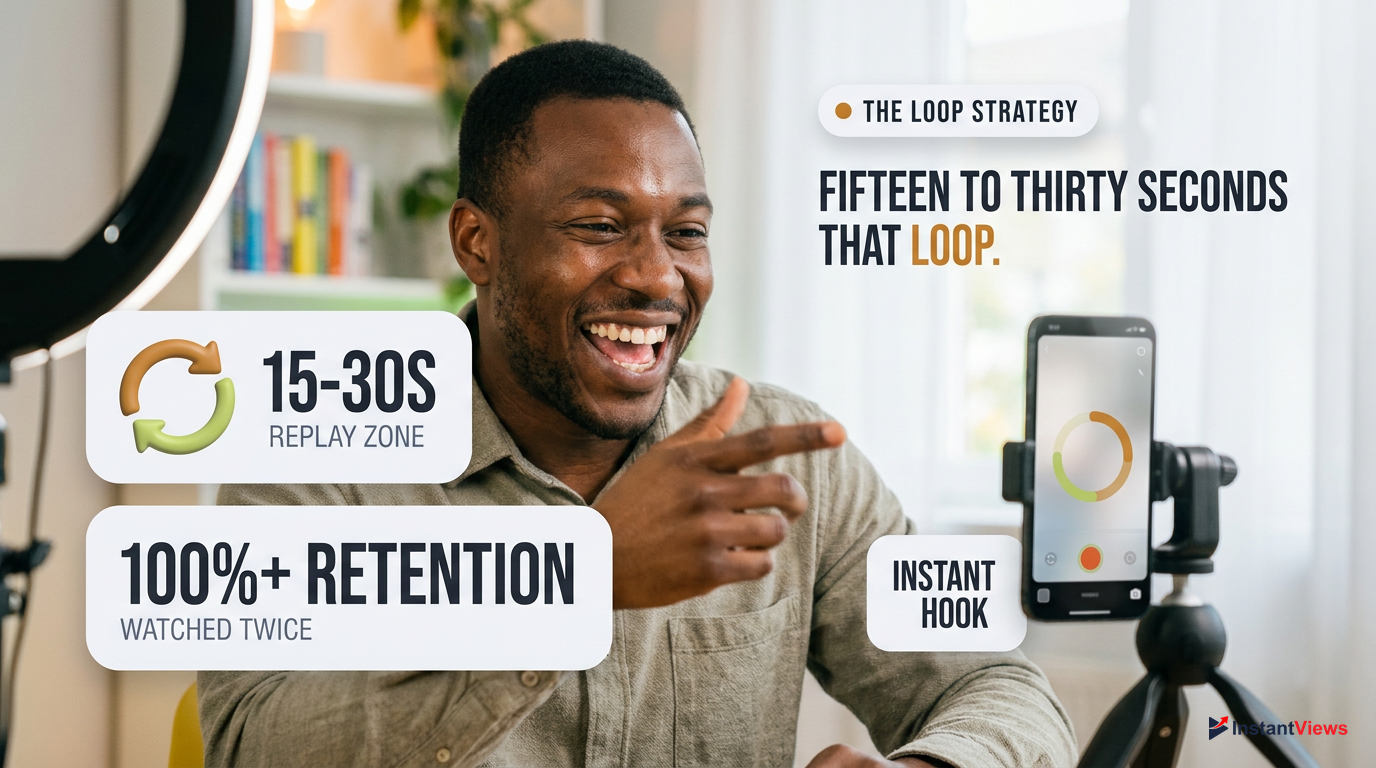
Videos under 30 seconds frequently achieve retention rates exceeding 100%. This happens because the content is so concise and engaging that viewers watch it multiple times before swiping. The algorithm registers these repeated views as a massive positive signal, pushing the video further into the Shorts feed.
- Extremely high completion rates.
- High probability of viewer looping.
- Faster production time for creators.
- Lower total watch time generated.
- Harder to convey complex information.
- Requires a flawless, immediate hook.
The loop strategy is particularly effective for trends and highly visual content. If your video relies on a punchline or a sudden reveal, keeping it under 30 seconds ensures the viewer reaches the payoff before they have a chance to lose interest. The goal here is rapid consumption and immediate satisfaction.
The Bimodal Distribution: Choose Your Path
When analyzing how long a YouTube Short should be, 2026 data clearly suggests a bimodal success rate. This means that the most successful Shorts tend to cluster at two distinct extremes, rather than in the middle. Creators are finding the most success by committing fully to either a very short or a relatively long format.
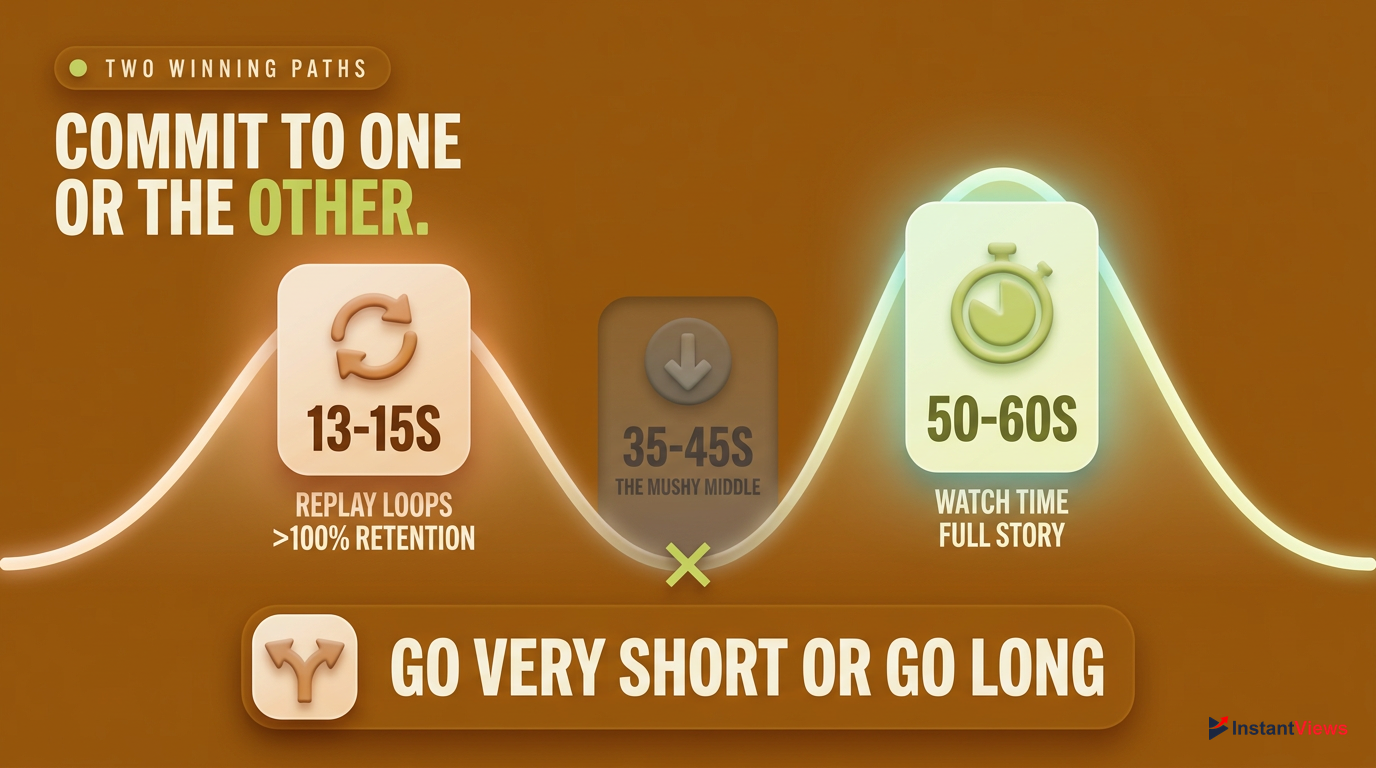
Avoid the "mushy middle" of 35-45 seconds. Either go very short for maximum replay loops, or use the full 50-60 seconds to rack up high total watch time.
The data indicates that you should either aim for the 13–15 second mark to maximize replay loops and achieve >100% retention, or push toward the 50–60 second mark to deliver a complete story that generates significant total watch time. Videos that fall in between often fail to achieve the looping benefits of short clips and lack the watch time benefits of longer ones.
| Duration Strategy | Primary Metric | Best Content Type |
|---|---|---|
| 13-15 Seconds | Replay Loops (>100% Retention) | Comedy, Trends, Visual Hooks |
| 35-45 Seconds | Mixed Signals | Avoid (The Mushy Middle) |
| 50-60 Seconds | Total Watch Time | Tutorials, Stories, Reviews |
By understanding this bimodal distribution, you can tailor your content strategy. Before filming, decide which path you are taking. Are you aiming for a rapid-fire loop, or a comprehensive mini-narrative? Commit to the duration that best serves that specific goal.
The 3-Minute Challenge: Navigating the Swipe Feed
With the introduction of the 3-minute limit, many creators rushed to upload longer content, assuming more time equals more value. However, early 2026 data highlights a significant hurdle: the swipe feed mentality. Viewers in the Shorts feed are conditioned for rapid context switching, and retaining their attention for 180 seconds is exceptionally difficult.
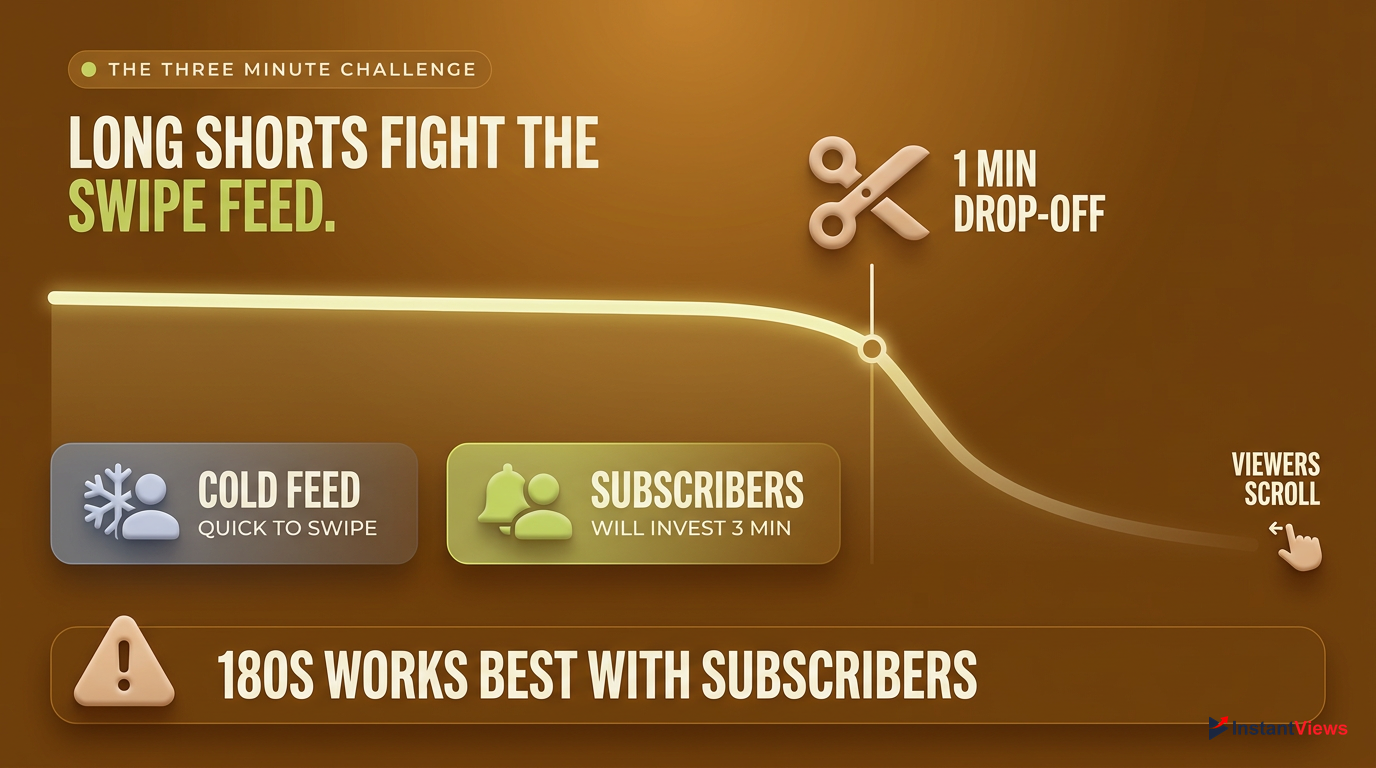
Retention drops off significantly after the 1-minute mark in the swipe feed. Viewers are quick to scroll if the pacing slows down even slightly.
Data shows that 3-minute Shorts perform fundamentally differently than their shorter counterparts. Instead of thriving on cold traffic in the Shorts feed, these longer videos perform best when pushed to existing subscribers. Subscribers already have a relationship with the creator and are more willing to invest 3 minutes of their time.
If you are utilizing the 3-minute format, you must treat it almost like a traditional YouTube video. It requires a strong intro, clear structure, and continuous visual changes to maintain engagement. Do not expect a 3-minute Short to go viral on the discovery feed with the same ease as a 15-second clip.
The Algorithm's Math: Winning the First 3 Seconds
Regardless of whether your Short is 15 seconds or 3 minutes, the YouTube Shorts algorithm heavily weights one specific metric above all others: the first 1 to 3 seconds. This critical window determines whether a viewer stays or swipes away, and it forms the foundation of your video's overall performance.
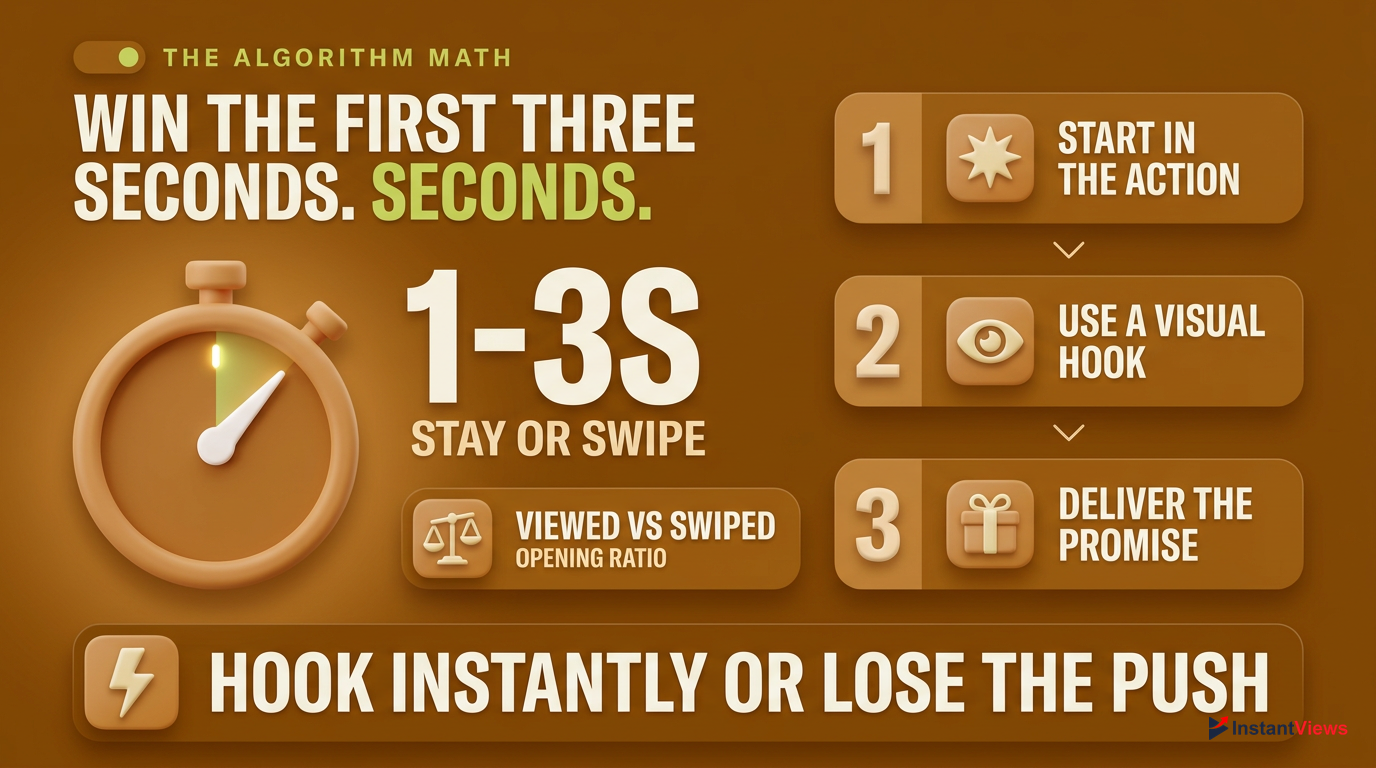
The algorithm calculates your "Viewed vs. Swiped Away" ratio based on these opening seconds. If a high percentage of users swipe away immediately, the algorithm assumes the content is unengaging and stops pushing it, regardless of how good the rest of the video might be. You must hook the viewer instantly.
Start in the Action
Cut out any introductory fluff. Begin speaking or showing the core action on frame one.
Use a Visual Hook
Incorporate dynamic movement, text on screen, or an unusual visual element immediately.
Deliver the Premise
Tell the viewer exactly what the video is about within the first 3 seconds (e.g., "Here is how to fix...").
Once you survive the first 3 seconds, the algorithm shifts its focus to completion rate and total watch time. But remember, a 55-second Short with incredible pacing is useless if everyone swipes away at second two. Master the hook before you worry about the total duration.
How Length Affects Monetization and RPM
Understanding how long a YouTube Short should be is directly tied to your earning potential. To qualify for the full YouTube Partner Program (YPP) ad revenue sharing via Shorts, creators must meet strict thresholds: 1,000 subscribers and 10 million public Shorts views in the past 90 days.
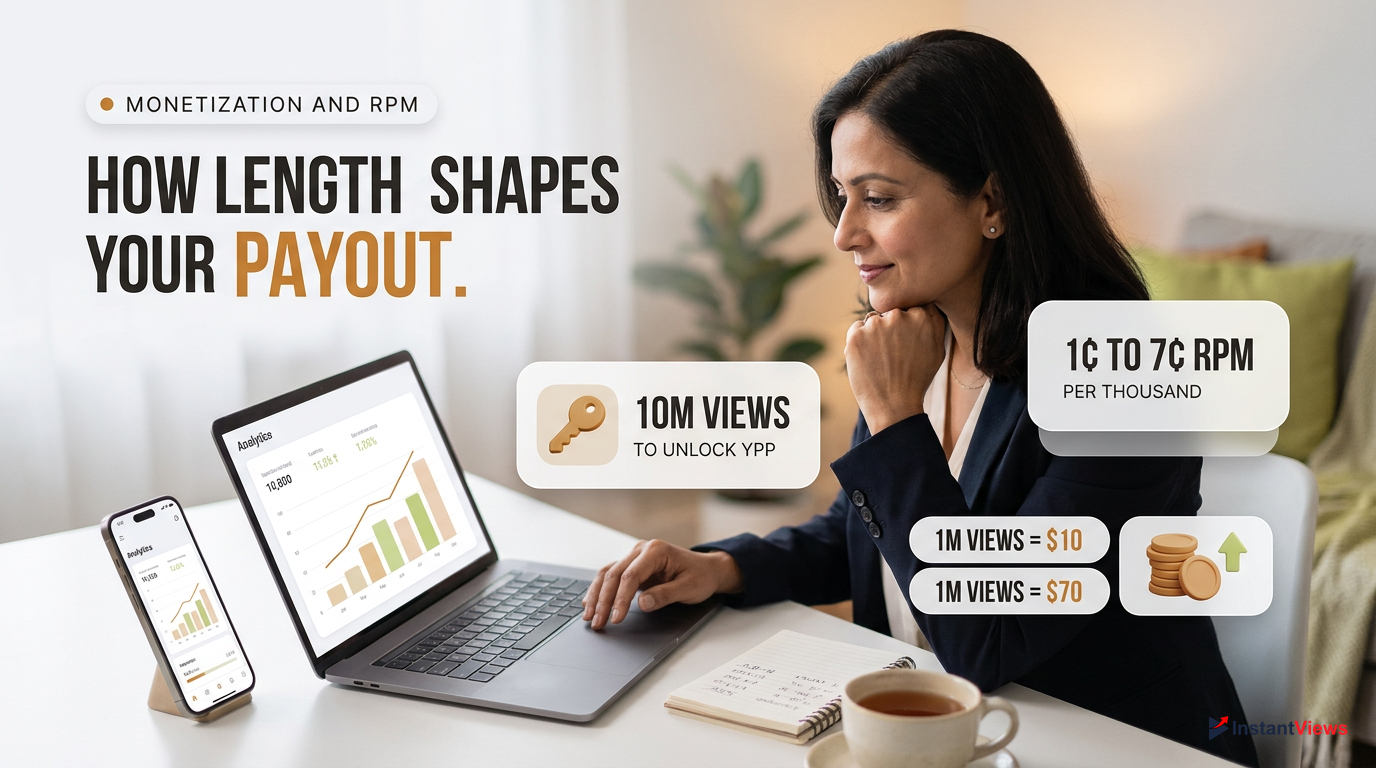
Once monetized, the reality of Shorts revenue can be sobering. Shorts monetization is pooled and pays significantly less than long-form content. In 2026, creators typically earn a Revenue Per Mille (RPM) between $0.01 and $0.07 per 1,000 views (1¢ to 7¢ RPM).
1 Million Views
- At $0.01 RPM (Low End)
1 Million Views
- At $0.07 RPM (High End)
Because the RPM is so low, volume is essential. This is where the 50-60 second sweet spot becomes crucial for monetized creators. Since longer Shorts generate higher total watch time and are favored by the algorithm for broader reach, they are more likely to hit the massive view counts needed to generate meaningful revenue. A 50-second Short that hits 1 million views will earn roughly $30 to $70, making consistent, high-reach content vital.
Don't rely solely on Shorts ad revenue. Use Shorts as a top-of-funnel discovery tool to drive viewers to your higher-RPM long-form videos or external sponsorships.
Verified Benchmarks: The 80% Rule for Virality
To truly master YouTube Shorts in 2026, you need to measure your performance against verified industry benchmarks. Shorts is currently the most engaging short-form platform, boasting an average engagement rate of 5.91% to 6.84%, edging out both TikTok (~5.75%) and Instagram Reels (~5.53%).
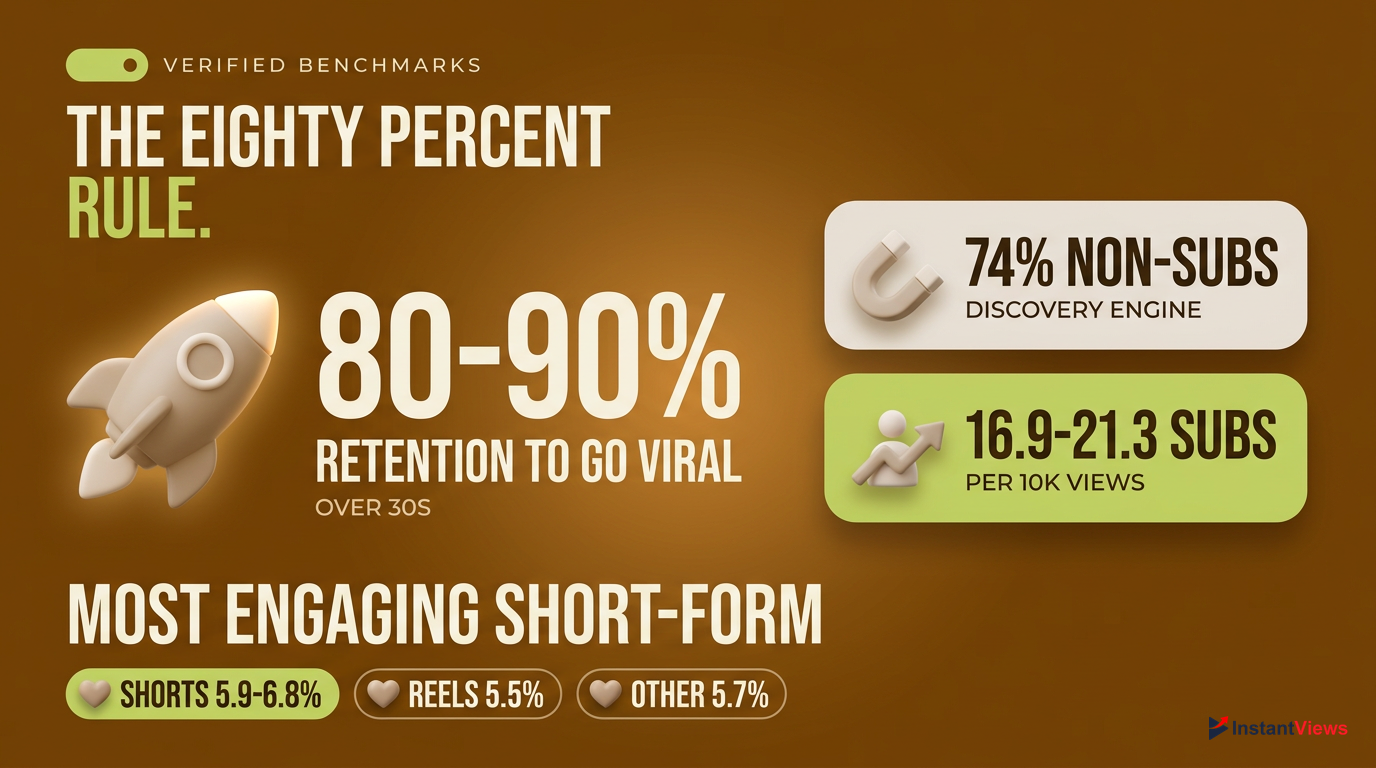
Shorts acts as a massive discovery engine, with 74% of views coming from non-subscribers. This makes it the ultimate top-of-funnel tool for channel growth. On average, creators are converting these views efficiently, gaining between 16.9 and 21.3 new subscribers for every 10,000 views.
The 80% Rule: To go viral, a Short over 30 seconds generally needs an average view duration (retention rate) of 80% to 90%.
If you are aiming for virality, particularly with videos in the 50-60 second range, you must adhere to the 80% Rule. Data shows that for a Short over 30 seconds to break out and achieve millions of views, it must maintain an average view duration of 80% to 90%. If your 60-second Short is dropping below 48 seconds of average watch time, the algorithm will likely cap its reach. Monitor your retention graphs obsessively to identify where viewers are dropping off.
Frequently Asked Questions
As of October 2024, the maximum length for a YouTube Short is 3 minutes (180 seconds). However, if you use copyrighted commercial music from the YouTube Audio Library, your Short is still capped at 60 seconds.
Data from 2026 shows that Shorts in the 50 to 60-second range generate the highest average views, up to 85% more than shorter clips, because they maximize total watch time while maintaining good completion rates.
If your Short is over 60 seconds and contains an active Content ID claim for commercial music, it will be blocked globally. You must use original audio or royalty-free music for Shorts longer than one minute.
It depends on the content. A 15-second Short is best for comedy and trends to maximize replay loops (>100% retention). A 50-60 second Short is better for tutorials and stories to maximize total watch time.
Early 2026 data shows that retention drops significantly after 1 minute in the swipe feed. Three-minute Shorts currently perform best when pushed to your existing subscribers rather than cold traffic.
Despite the new 3-minute limit, the average length of a YouTube Short in 2026 remains between 33 and 42 seconds, indicating most creators still favor quick, punchy content.
In 2026, the Revenue Per Mille (RPM) for YouTube Shorts typically ranges between $0.01 and $0.07 per 1,000 views. A Short with 1 million views will earn roughly $30 to $70.
According to the 80% Rule, a Short over 30 seconds generally needs an average view duration (retention rate) of 80% to 90% to achieve viral reach and millions of views.
The first 1 to 3 seconds are the most critical part of your Short. The algorithm heavily weights the "Viewed vs. Swiped Away" ratio; if viewers swipe immediately, the video will not be pushed.
Shorts are a powerful discovery tool. On average in 2026, creators gain between 16.9 and 21.3 new subscribers for every 10,000 Shorts views they generate.