- Drop-off points are critical indicators showing exactly where and why viewers leave your videos
- The first 30 seconds account for 30-40% of all drop-offs - fix your hook first
- Common causes include slow pacing, unfulfilled promises, technical issues, and repetitive content
- Each drop-off point has a specific fix - identify the cause to apply the right solution
- Use InstantViews Video Analyzer to predict drop-offs before publishing
Every second of your video is a decision point. Viewers constantly ask: "Is this still worth my time?" When the answer becomes "no," they leave - creating a drop-off point.
The difference between a video with 40% retention and 70% retention is often just 3-5 critical moments where you're losing viewers unnecessarily. Fix these moments, and your entire channel grows.
This guide shows you how to find your drop-off points, understand what's causing them, and implement specific fixes that keep viewers watching.
- Understanding Drop-Off Points
- Finding Your Drop-Off Points
- Common Cause #1: Weak Hook
- Common Cause #2: Unfulfilled Promise
- Common Cause #3: Slow Pacing
- Common Cause #4: Technical Issues
- Common Cause #5: Content Fatigue
- Common Cause #6: Predictable Structure
- Preventing Drop-Offs Before Publishing
- FAQ
Understanding Drop-Off Points
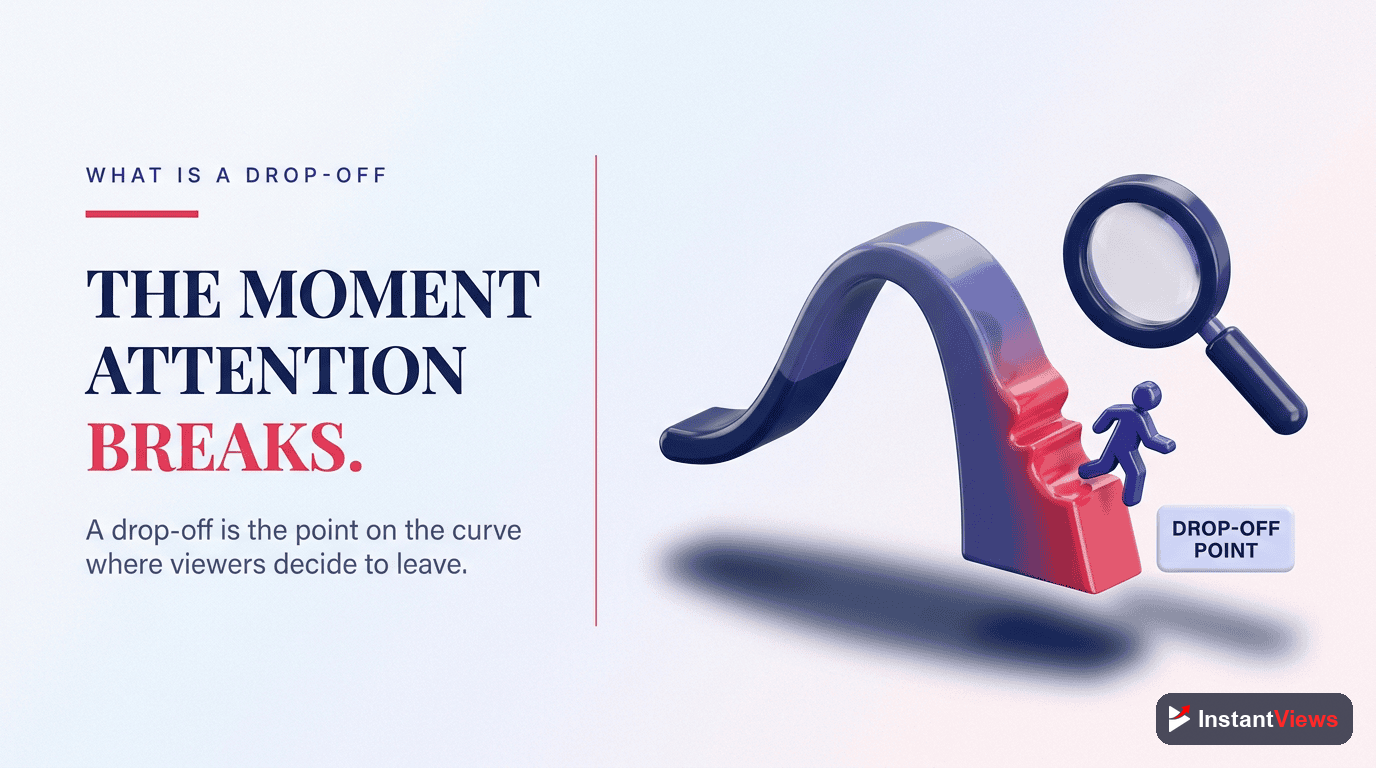
A drop-off point isn't just when people leave - it's when a significant percentage of viewers leave at the same moment. This pattern reveals something specific in your video that triggers exits.
Here's what normal vs. problematic retention looks like:
| Video Section | Healthy Retention | Problem Retention |
|---|---|---|
| 0-30 seconds | 70-80% retained | Below 50% |
| 30s-1 min | 60-70% retained | Below 40% |
| 1-2 minutes | 50-60% retained | Below 30% |
| Mid-video | Gradual decline | Sudden 15%+ drops |
| Final 30 seconds | 40%+ retained | Below 25% |
A gradual decline is normal. You're looking for SUDDEN drops where 10-20% of viewers leave within 10-20 seconds. These are your fixable problem areas.
Finding Your Drop-Off Points
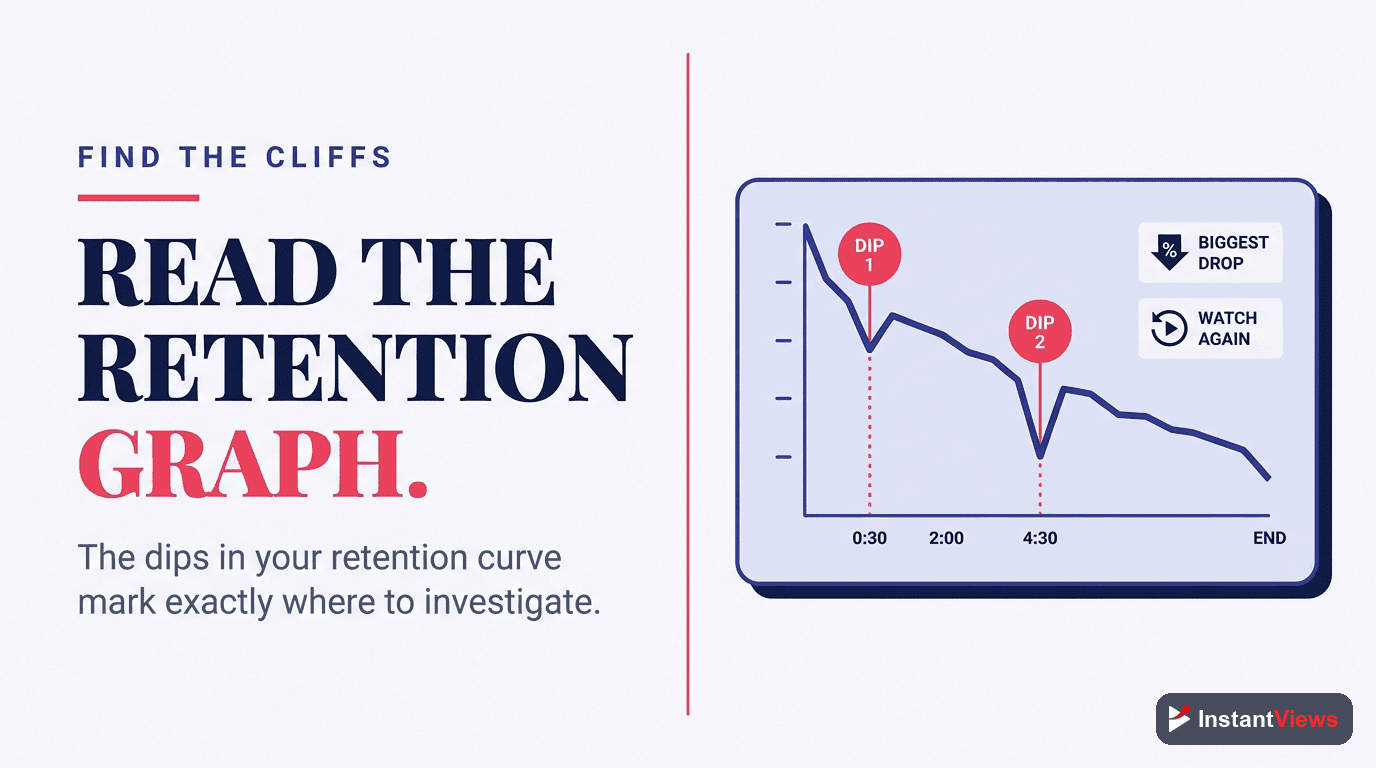
YouTube Analytics makes drop-offs easy to spot:
- Go to YouTube Studio > Analytics > Engagement tab
- Scroll to the Audience Retention graph
- Look for steep downward slopes in the line
- Click on these points to see the exact timestamp
- Watch your video at each timestamp to identify the trigger
Common Cause #1: Weak Hook (0-30 seconds)
Weak or Slow Hook
If you're losing 30%+ of viewers in the first 30 seconds, your hook isn't strong enough. Viewers clicked on your thumbnail/title expecting something specific - and your intro didn't deliver it fast enough.
Start with the payoff, not the setup. Show your best moment, result, or revelation in the first 5 seconds. Never start with "Hey guys, welcome back..." - get straight to value.
Specific fixes:
- Open with a bold statement or result preview
- Match your hook to your title/thumbnail promise immediately
- Use pattern interrupts - visual or verbal surprises
- Create an open loop: tease something you'll reveal later
- Remove all greetings and channel introductions
"If viewers don't understand why they should stay in 8 seconds, they won't. The hook is everything." - Paddy Galloway, YouTube strategist

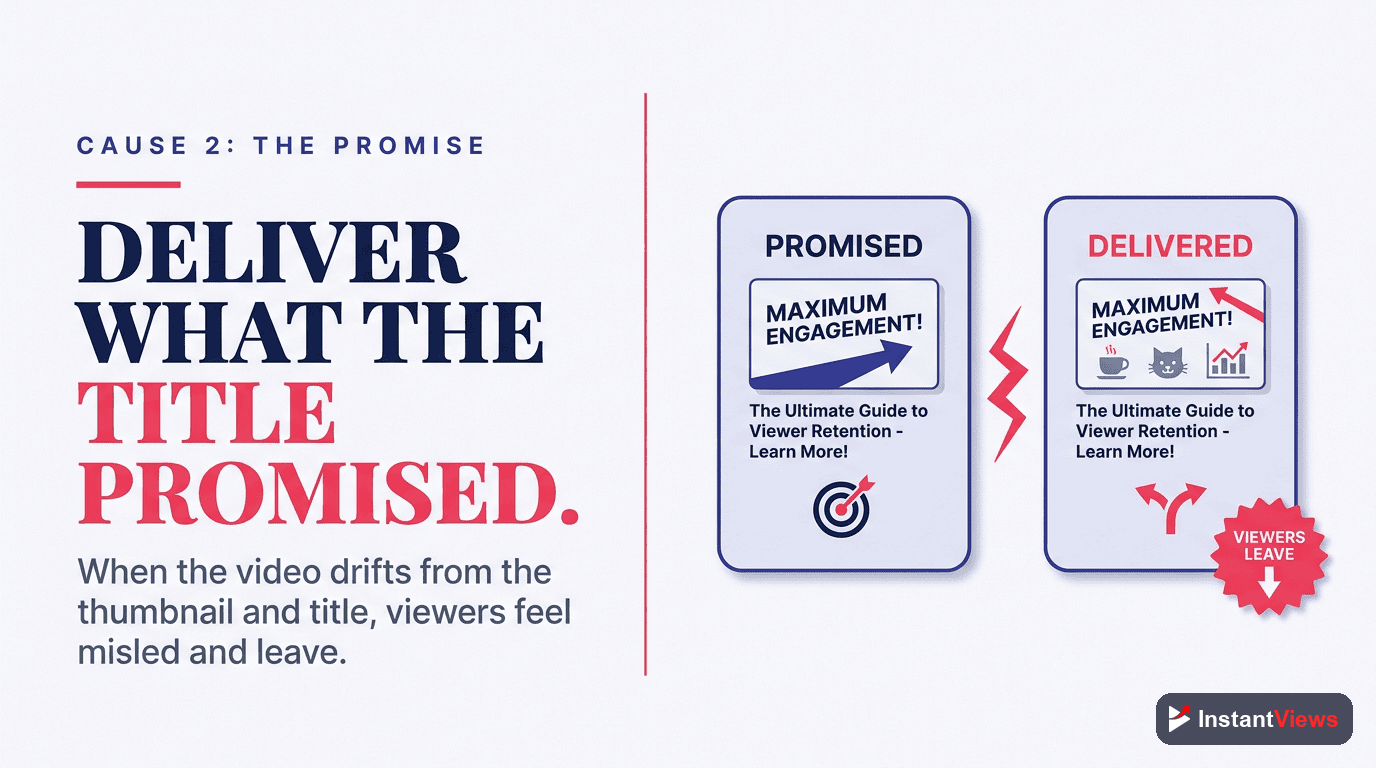
Common Cause #2: Unfulfilled Promise
Title/Thumbnail Doesn't Match Content
Sudden drop-offs 1-3 minutes in often mean viewers realized your content isn't what they expected. Your title promised one thing, but your video is delivering something else.
Address the title promise in the first 60 seconds. If your title is "How to Get 1000 Subscribers Fast," you must start explaining the strategy immediately - not after 5 minutes of backstory.
How to fix this:
- State your main promise in the first 30 seconds
- Immediately show proof or preview the result
- Outline what you'll cover (quickly) so viewers know it's coming
- Avoid long intros that delay the main content
Common Cause #3: Slow Pacing
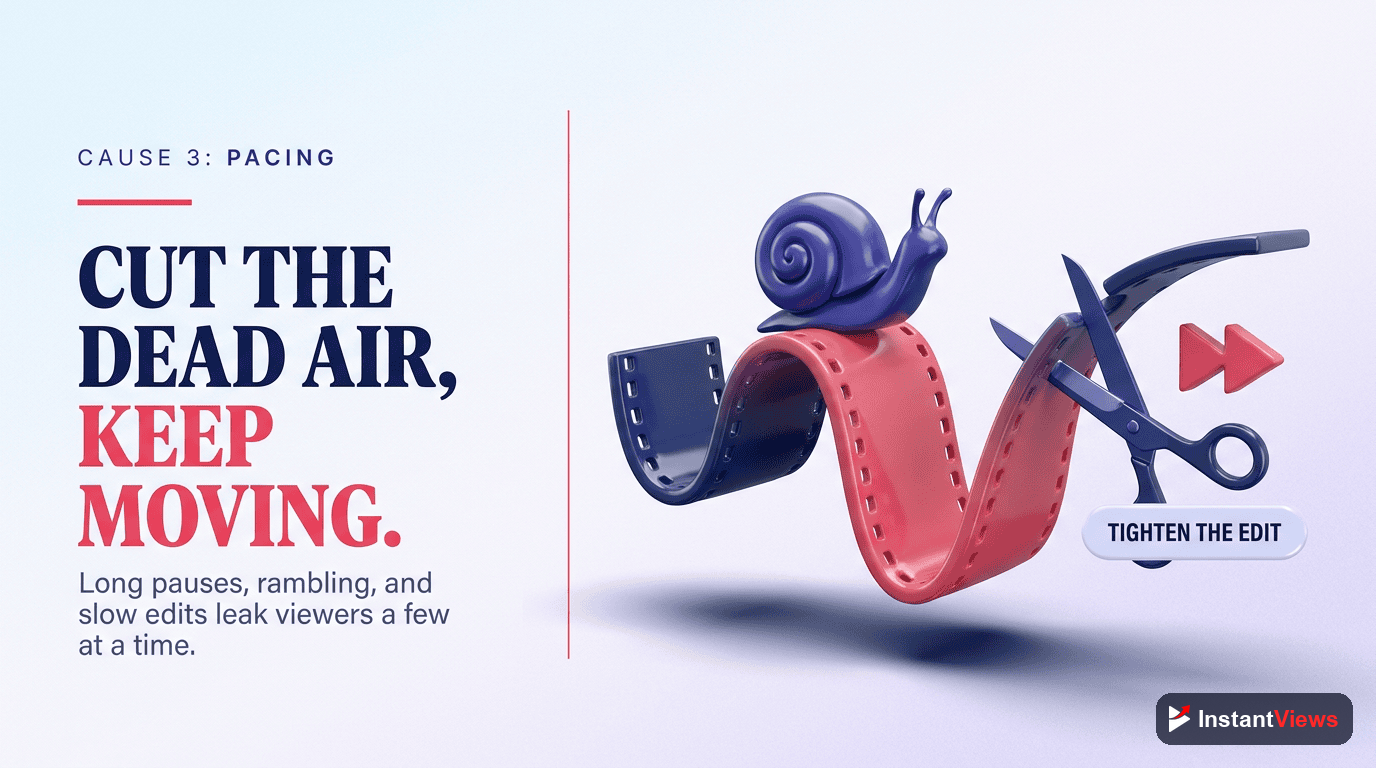
Dead Air and Repetition
Drop-offs during your main content often indicate pacing problems. You're spending too long on one point, repeating yourself, or including unnecessary tangents.
Tighten your editing. Remove pauses longer than 2 seconds, cut redundant explanations, and maintain momentum with visual changes every 3-5 seconds.
Pacing fixes:
- Cut every word that doesn't add value
- Use B-roll to cover longer explanations
- Add motion graphics to visualize abstract concepts
- Break long sections into chapters
- Increase playback speed during editing to find slow parts
Common Cause #4: Technical Issues
Audio/Visual Quality Problems
Sudden drops that correlate with audio issues, poor lighting, or visual distractions indicate viewers are leaving due to production quality - not content quality.
Invest in consistent audio quality above all else. Bad audio causes more drop-offs than bad video. Use color correction to maintain visual consistency throughout your video.
Technical drop-off fixes:
- Monitor audio levels - keep them consistent (-12dB to -6dB)
- Remove background noise with noise reduction tools
- Ensure proper lighting throughout - no dark sections
- Check for buffering issues (compress video properly)
- Test on mobile - 70% of viewers watch on phones

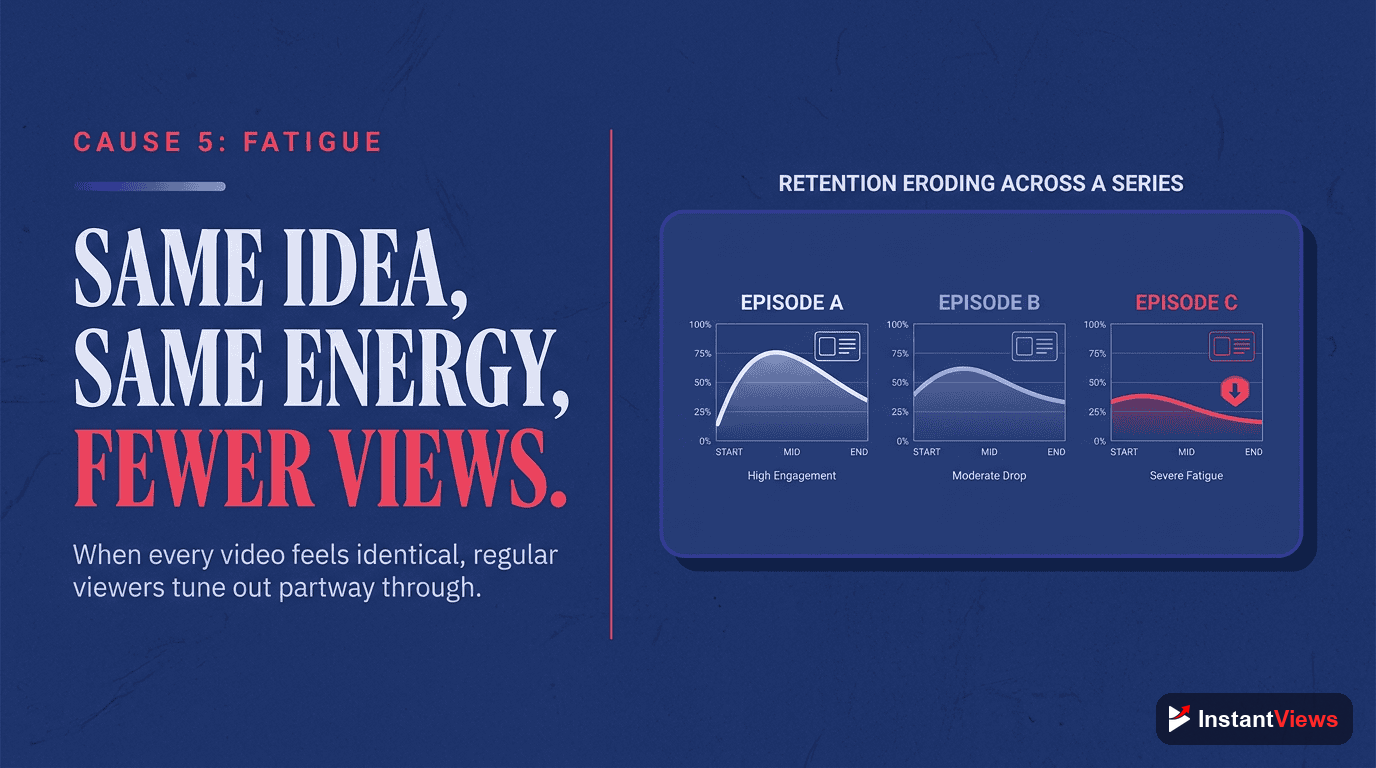
Common Cause #5: Content Fatigue
Overstaying Your Welcome
If drop-offs happen near your planned endpoint, your video is simply too long. You've exhausted the topic, and viewers are leaving before you finish.
End your video 20% earlier than you planned. If retention drops at 8 minutes, your video should be 6-7 minutes. Quality over length always wins.
How to combat content fatigue:
- Make every point once - don't summarize excessively
- End when you've delivered your promise, not when you run out of content
- Save "bonus tips" for a Part 2 video
- Use pattern interrupts every 90-120 seconds to reset attention
Common Cause #6: Predictable Structure
Viewers Know What's Coming
If you use the same structure in every video (intro, point 1, point 2, point 3, outro), viewers learn when to leave. They drop off when they predict the valuable content is over.
Vary your structure. Sometimes start with the conclusion. Other times, interrupt your list with a story. Keep viewers guessing what comes next.
Structure variations to try:
- Non-linear storytelling (start at the end)
- Mystery format (pose a question, reveal answer at end)
- Reverse chronology (countdown instead of count-up)
- Breaking the fourth wall mid-content
- Strategic cliffhangers before transitions
Predict Drop-Offs Before Publishing
Use our Video Analyzer to identify potential drop-off points in your content before you upload. Get specific timestamps and fixes.
Analyze Your Video →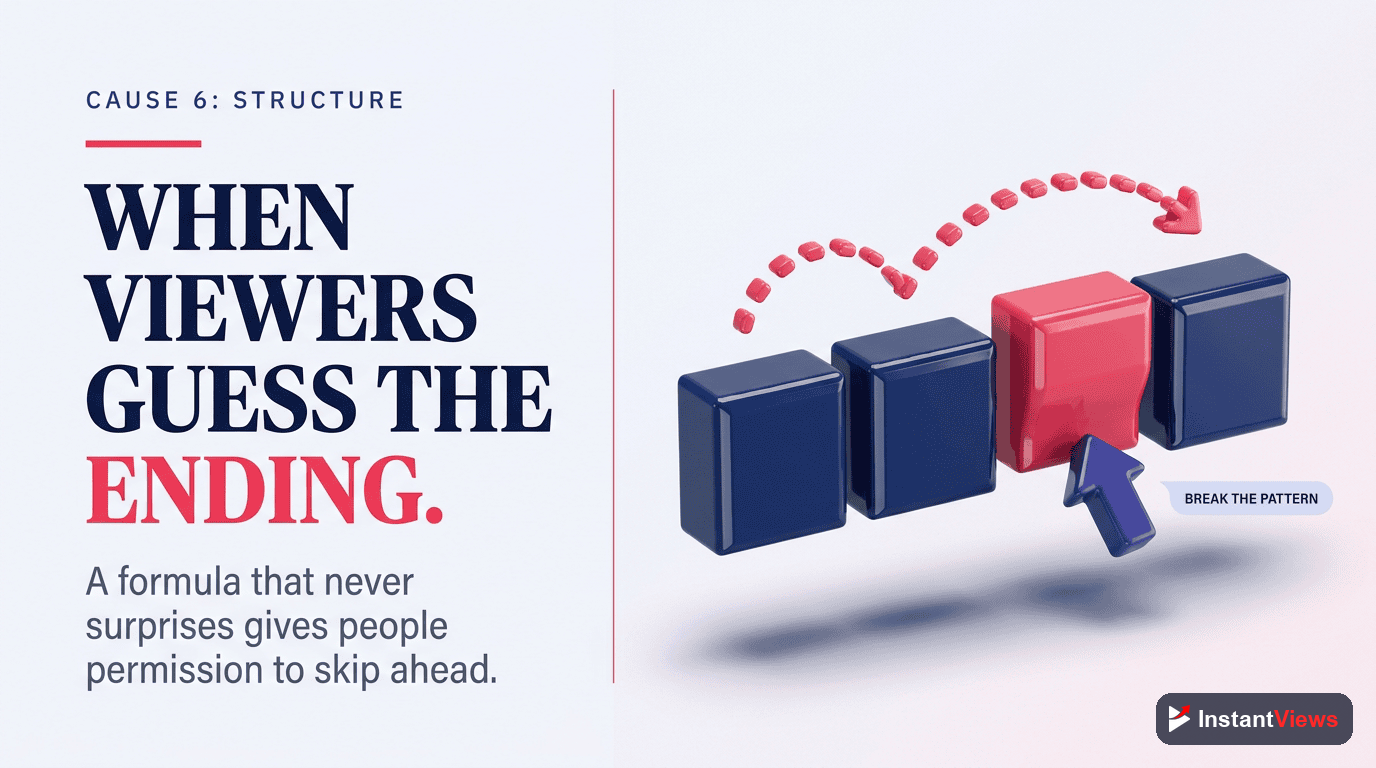
Preventing Drop-Offs Before Publishing
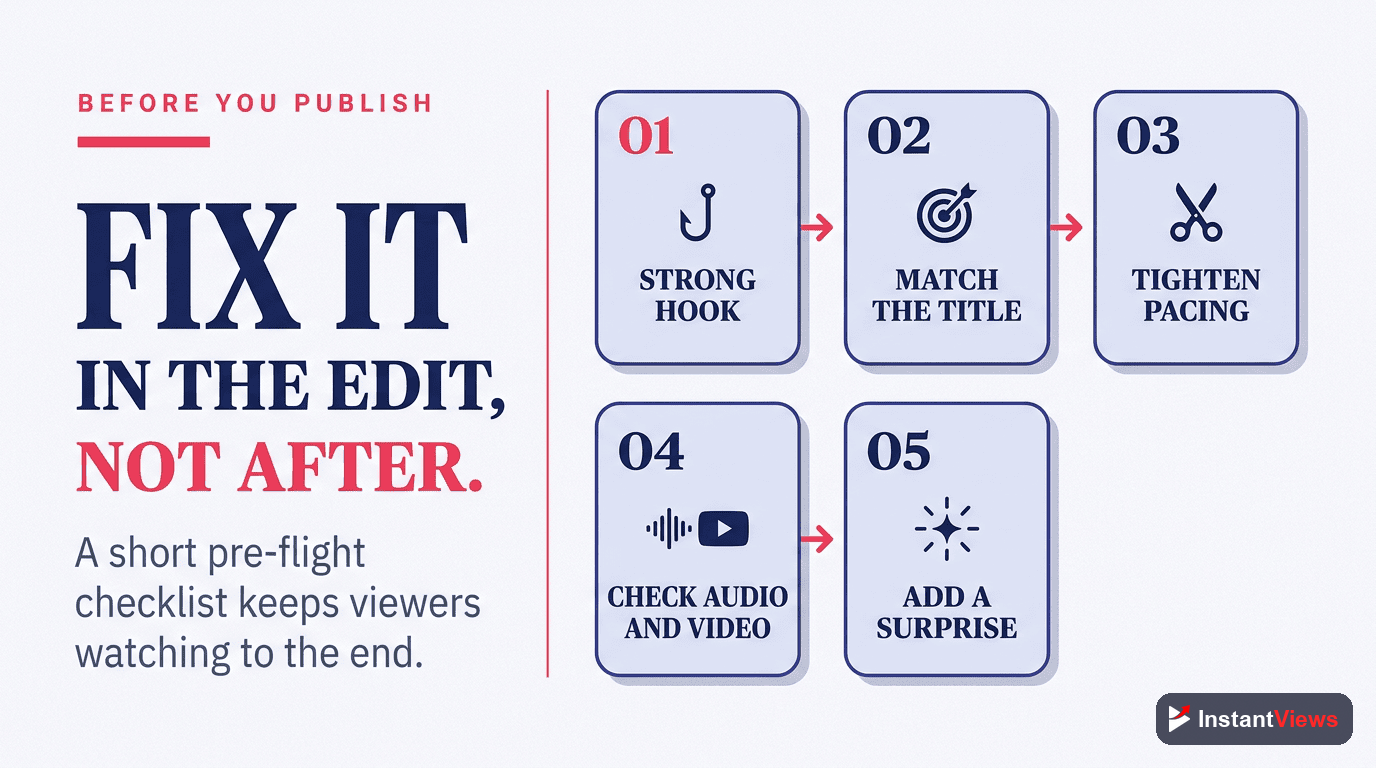
The best way to fix drop-offs is to prevent them. Here's your pre-publish checklist:
- Script your first 30 seconds separately - This section deserves its own dedicated script
- Watch your video at 1.5x speed - Mark every moment that feels slow or boring
- Test with a cold audience - Show it to someone unfamiliar with your channel
- Remove the first 10% - Seriously. Cut your intro shorter than you think it should be
- Add pattern interrupts every 90 seconds - Visual changes, questions, examples
- Use the InstantViews analyzer - Get AI predictions of where viewers might drop off
Advanced Retention Tactics
Once you've fixed the basics, try these advanced techniques:
| Technique | How It Works | When to Use |
|---|---|---|
| Strategic Chapters | Break content into labeled sections viewers can skip to | Long tutorials (10+ minutes) |
| Mid-Roll Hooks | Tease upcoming content before potential drop-offs | Before difficult/boring sections |
| Visual Callbacks | Reference earlier moments to reward long-time viewers | Final third of video |
| Parallel Stories | Weave two narratives together, alternating between them | Documentary-style content |
| Negative Space | Strategic silence for emphasis (2-3 seconds max) | After major reveals |
The 48-Hour Post-Upload Strategy
After publishing, monitor retention in real-time:
- Hour 1: Check initial retention to spot catastrophic drop-offs
- Hour 6: If retention is below 40%, add a pinned comment addressing the main promise
- Hour 24: Analyze the retention graph for patterns
- Hour 48: Document learnings for your next video
Never try to fix everything at once. Focus on your single biggest drop-off point first. Fixing that one moment can improve overall retention by 10-20%.
Final Checklist: Drop-Off Prevention
- Hook delivers on title promise within 15 seconds
- No section longer than 90 seconds without a pattern interrupt
- Audio quality is consistent throughout
- Every sentence adds new value (no repetition)
- Visual changes every 3-5 seconds
- Video is 20% shorter than you originally planned
- Tested with someone who doesn't know the topic
- Pre-analyzed with InstantViews Video Analyzer
"Retention is the only metric that matters. Views get you discovered, but retention gets you recommended." - Roberto Blake, YouTube expert
Frequently Asked Questions
A drop-off point is a specific moment in your video where a significant number of viewers stop watching and leave. YouTube Analytics shows these as sudden dips in your audience retention graph, indicating problem areas in your content.
Most YouTube videos lose 10-20% of viewers in the first 30 seconds, 30-40% by the 1-minute mark, and 50% by the 2-minute mark. Videos with excellent retention keep 60-70% of viewers watching past 2 minutes.
Go to YouTube Studio > Analytics > Engagement tab > Audience retention graph. Look for steep downward slopes in the graph - these indicate where viewers are leaving. Hover over the graph to see exact timestamps and percentage drops.
While you cannot re-edit published videos, you can use end screens, cards, and pinned comments to redirect viewers past problem sections. More importantly, analyze the drop-offs to improve your future content.
The most common causes are: slow or weak intros (first 30 seconds), unfulfilled promises from the title/thumbnail, repetitive or boring sections, technical issues (bad audio/video), and failing to deliver value quickly enough.
The InstantViews Video Analyzer predicts potential drop-off points before you publish by analyzing your pacing, hooks, and content structure. It provides specific timestamps where retention issues might occur and actionable suggestions to fix them.