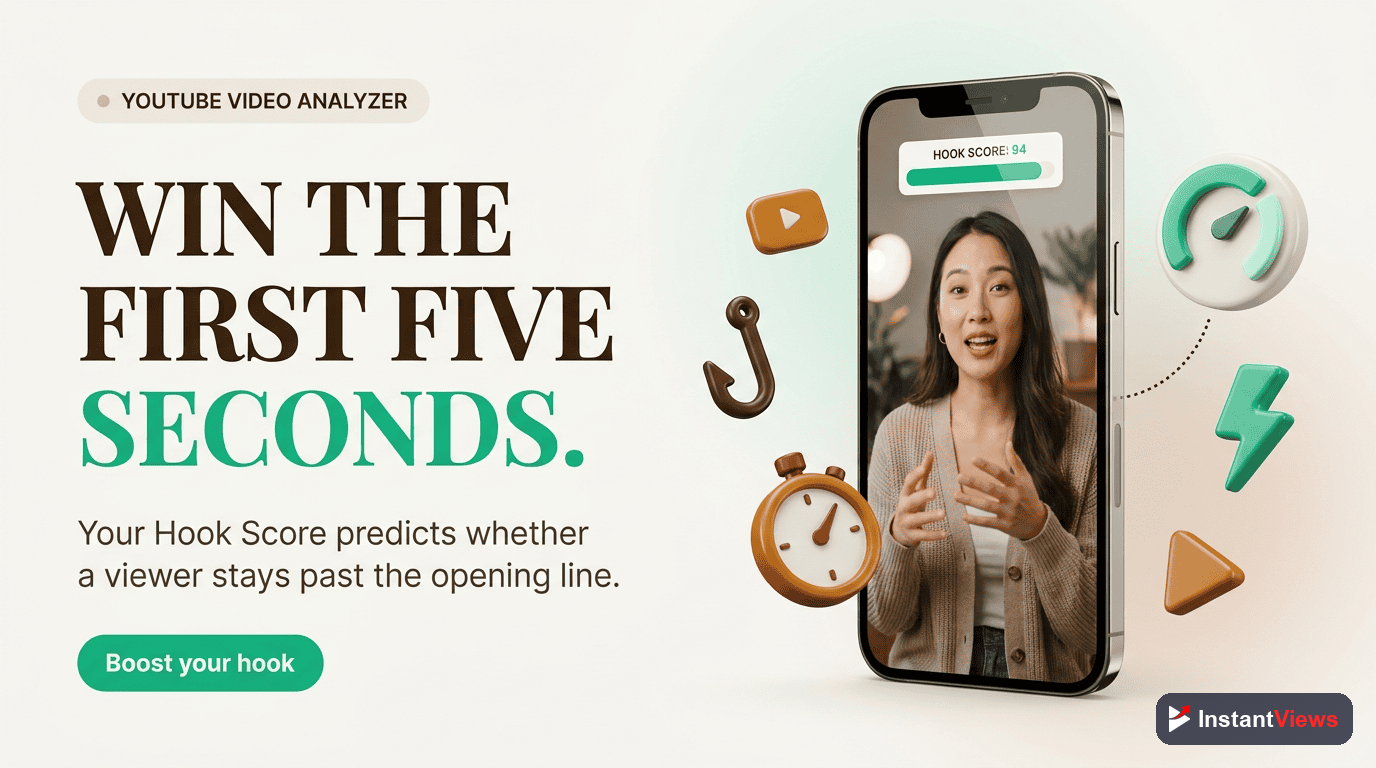
- Hook score measures your video opening's effectiveness - aim for 75+ for algorithmic success
- Five core factors determine your score: pacing (25%), value clarity (30%), curiosity triggers (20%), visual engagement (15%), audio quality (10%)
- Videos with hook scores above 80 get 2-3x more algorithm promotion
- Use InstantViews Video Analyzer to score and optimize hooks before publishing
- The first 3 seconds are critical - 40% of drop-offs happen in this window
Your hook score is the single most important metric you're probably not tracking. While you obsess over CTR and watch time, the first 30 seconds of your video determines whether YouTube promotes it or buries it.
Here's the reality: a video with a mediocre thumbnail but a hook score of 85 will outperform a video with a perfect thumbnail and a hook score of 60. Every. Single. Time.
This comprehensive guide breaks down exactly what hook score is, what affects it, and most importantly - how to optimize yours to 75+ consistently.
What is Hook Score?
Hook score is a quantitative measure of how effectively your video opening captures and maintains viewer attention in the critical first 30 seconds. It's calculated using multiple data points:
- Audience retention rate at 5, 10, 15, and 30 seconds
- Engagement triggers - replays, likes, comments within the first minute
- Relative performance compared to your channel average and niche benchmarks
- Quality signals - pacing, visual changes, audio clarity
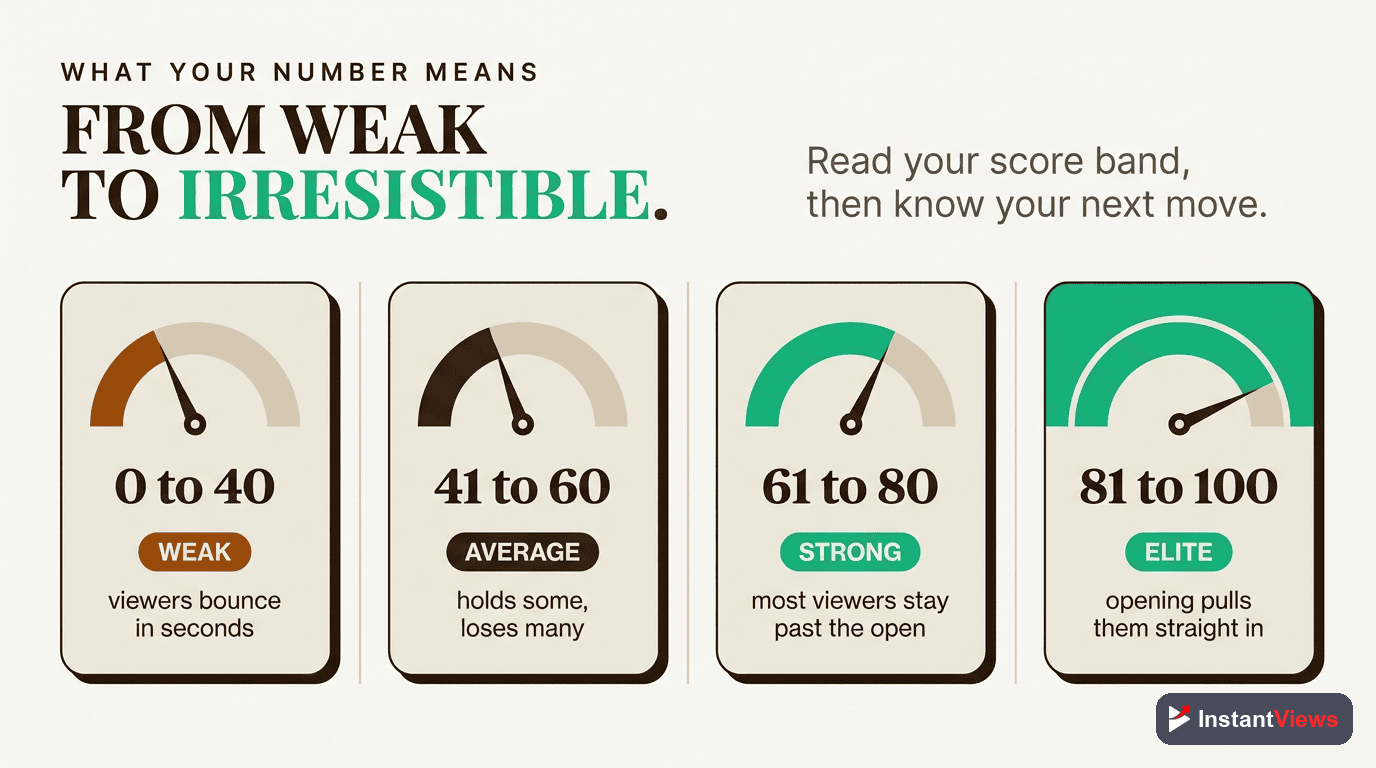
The InstantViews Video Analyzer calculates hook scores on a 0-100 scale, where:
| Score Range | Rating | Expected Performance |
|---|---|---|
| 90-100 | Exceptional | Maximum algorithm promotion, 85%+ 30s retention |
| 80-89 | Very Good | Strong promotion, 75-85% 30s retention |
| 70-79 | Good | Moderate promotion, 65-75% 30s retention |
| 60-69 | Below Average | Limited promotion, 50-65% 30s retention |
| Below 60 | Poor | Minimal promotion, under 50% 30s retention |

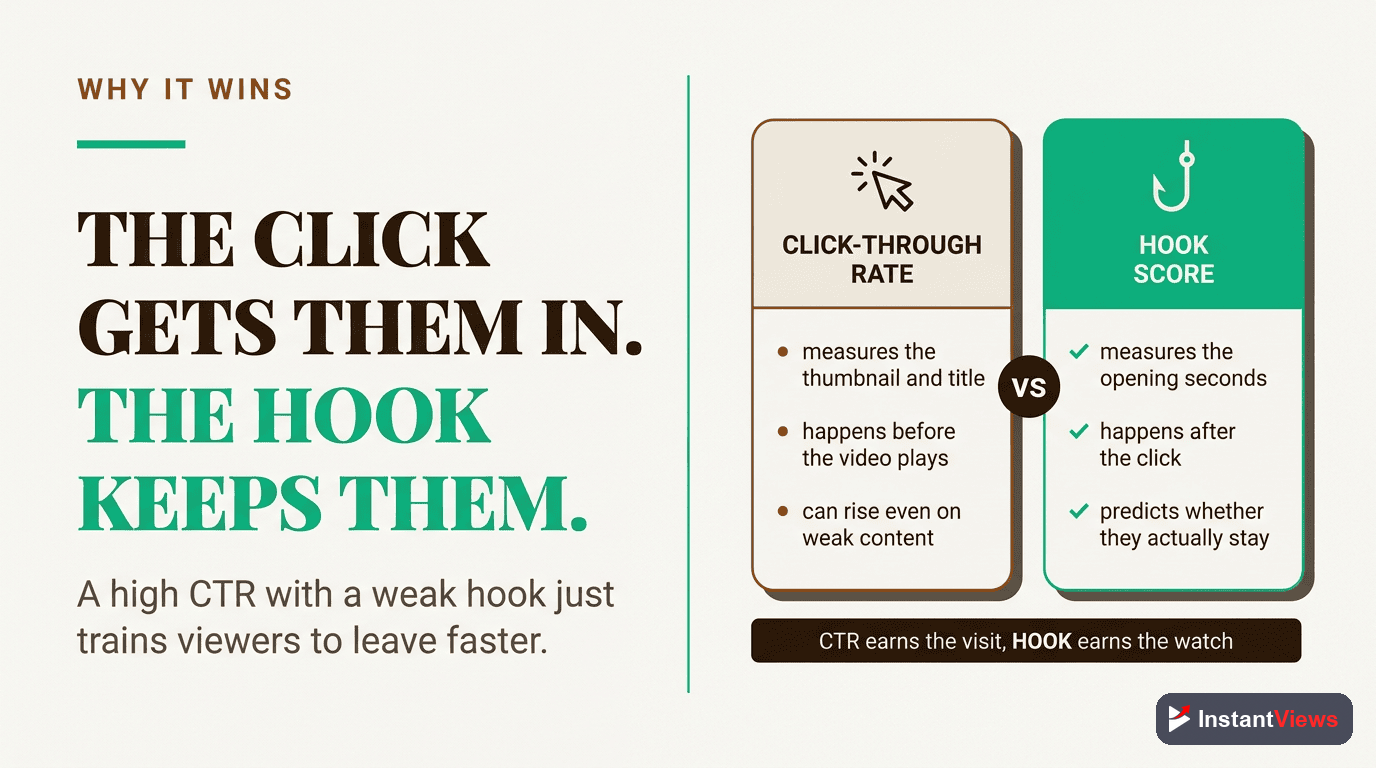
Why Hook Score Matters More Than CTR
Here's what most creators don't understand: YouTube cares more about what happens after the click than the click itself.
You can have a 15% CTR, but if your hook score is below 65, YouTube sees this pattern:
- Viewers click (good signal)
- Viewers immediately leave (terrible signal)
- YouTube thinks: "This video is clickbait"
- Your impressions get throttled
Meanwhile, a video with 8% CTR but an 85 hook score shows:
- Fewer clicks, but qualified viewers
- Viewers stay and watch
- YouTube thinks: "This video delivers value"
- Your impressions multiply
"We spend 80% of our optimization time on the first 30 seconds. The hook score predicts total watch time better than any other metric." - Top 1% YouTube Creator
Understanding Score Ranges
Each score range has distinct characteristics. Here's what they mean:
Exceptional Hook
Your hook is in the top 5% of all YouTube content. Viewers are immediately engaged, curious, and committed to watching. These hooks create viral potential.
Very Good Hook
Your hook effectively captures attention and sets clear expectations. Most viewers stay engaged through the opening. Consistent scores in this range lead to sustainable channel growth.
Good Hook
Your hook is solid but has room for improvement. Viewers generally stay, but you're losing a meaningful percentage in the first 15 seconds. Small optimizations yield significant gains.
Below Average Hook
Your hook needs significant work. Too many viewers are clicking away within the first 10 seconds. Focus on immediate value communication and faster pacing.
5 Factors That Affect Hook Score
Understanding what affects your hook score is the first step to improving it. Here are the five critical factors, ranked by impact:
1. Value Clarity (30% of Score)
Does your viewer immediately understand what they'll get from watching?
The fastest way to lose viewers is confusion. Within 5 seconds, viewers need to know:
- What this video is about
- Why it matters to them
- What value they'll receive
Good: "In the next 8 minutes, I'll show you how I got 50,000 subscribers using this exact strategy."
Bad: "Hey guys! Welcome back to my channel. Today's video is going to be interesting..."
2. Pacing and Energy (25% of Score)
Is your opening dynamic enough to compete with infinite scroll?
Slow = death on YouTube. Successful hooks average:
- 8-12 scene changes in the first 30 seconds
- Matching energy to content type (high for entertainment, controlled for education)
- Zero dead air - every second serves a purpose
Long intros kill hook scores. Every second before your actual hook drops your score by 2-3 points. Start with your hook, always.
3. Curiosity Triggers (20% of Score)
Are you creating open loops that viewers need to see closed?
The brain hates incompleteness. Effective curiosity triggers:
- Pattern interrupts - unexpected visuals or statements
- Incomplete information - "But there's one problem..."
- Teased results - showing outcomes without explaining how
- Controversial takes - challenging common beliefs
4. Visual Engagement (15% of Score)
Is there enough visual interest to prevent autopilot scrolling?
Even with sound off, your hook should be engaging. Elements that boost scores:
- B-roll variety - multiple visual angles/content types
- Text overlays - reinforcing key points visually
- Visual proof - screenshots, data, results shown on screen
- Dynamic camera work - movement, not static shots
5. Audio Quality (10% of Score)
Is your audio clear, balanced, and professional?
Poor audio is an instant trust killer. Requirements:
- Clear vocal audio - no echo, background noise, or distortion
- Balanced music - enhances without overpowering
- Intentional sound design - strategic use of sound effects
Get Your Hook Score Now
Analyze your video's hook and get specific optimization recommendations in under 60 seconds.
Analyze Your Hook →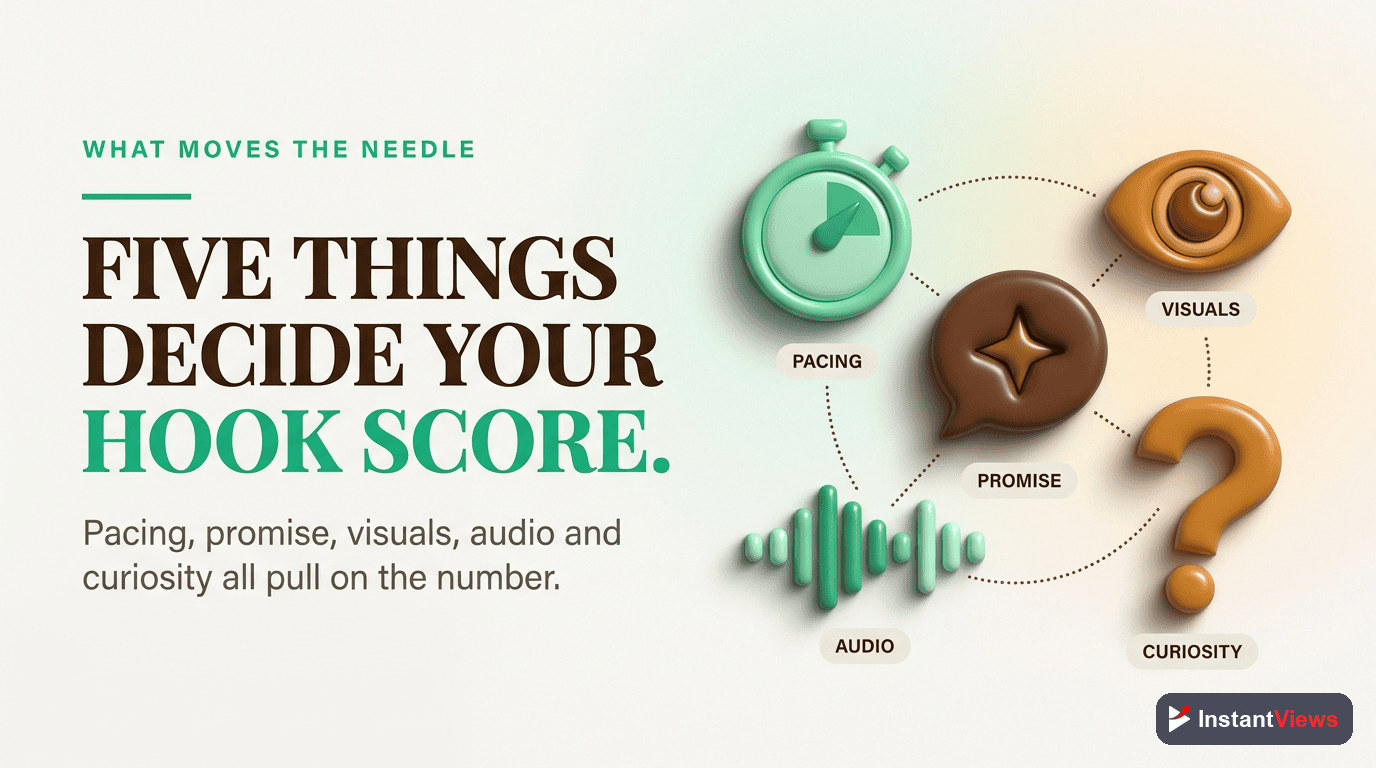
How to Measure Your Hook Score
There are two ways to measure your hook score:
Method 1: YouTube Analytics (Published Videos)
For videos already published:
- Go to YouTube Studio → Analytics → Engagement
- Find "Audience retention" graph
- Note the percentage at the 30-second mark
- Compare to your channel average and niche benchmarks
Quick estimation formula:
- 30s retention above 80% = Hook score ~85+
- 30s retention 70-80% = Hook score ~75-84
- 30s retention 60-70% = Hook score ~65-74
- 30s retention below 60% = Hook score below 65
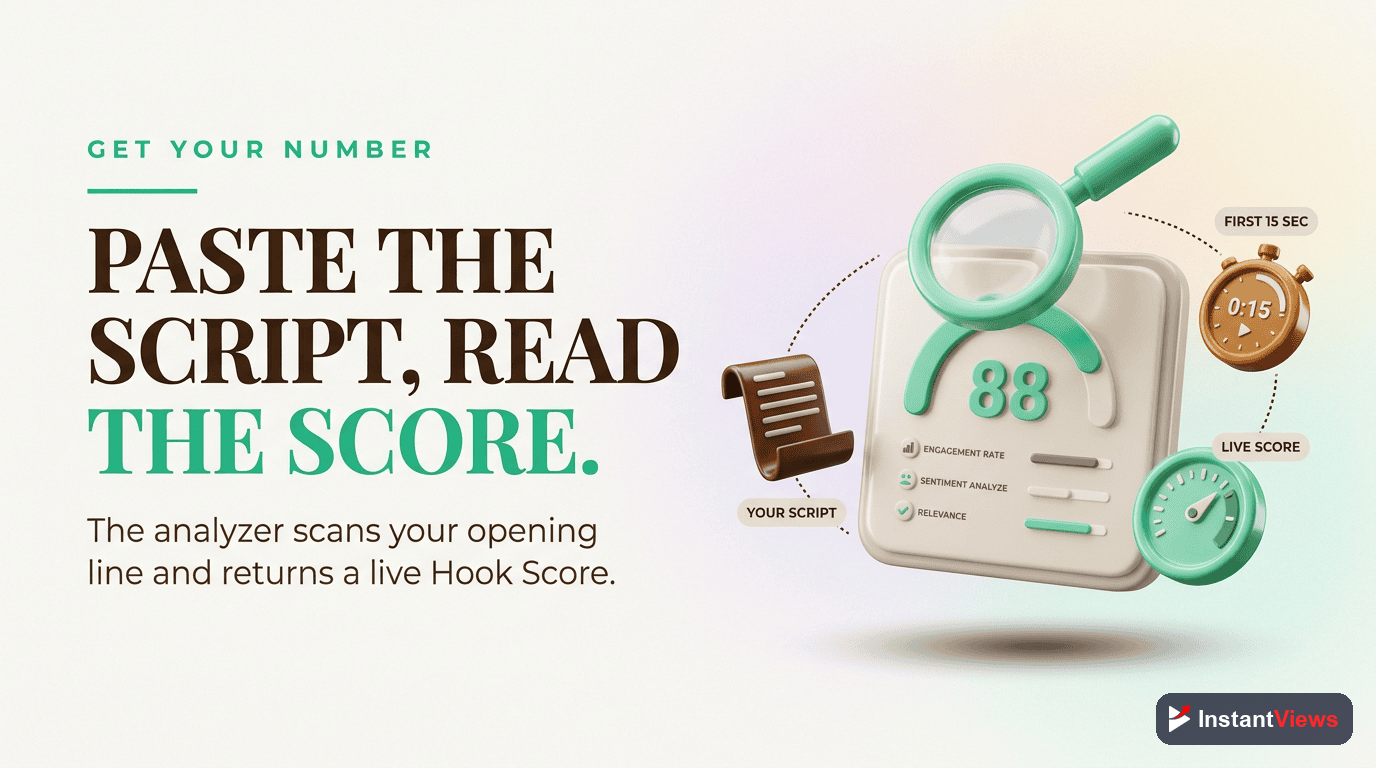
Method 2: InstantViews Video Analyzer (Before Publishing)
For videos before you publish:
- Upload your video file or paste YouTube URL
- Get instant hook score analysis with breakdown of all 5 factors
- Review specific recommendations for improvement
- Re-test after making changes
- Publish when you hit 75+
Hook Score Optimization Strategies
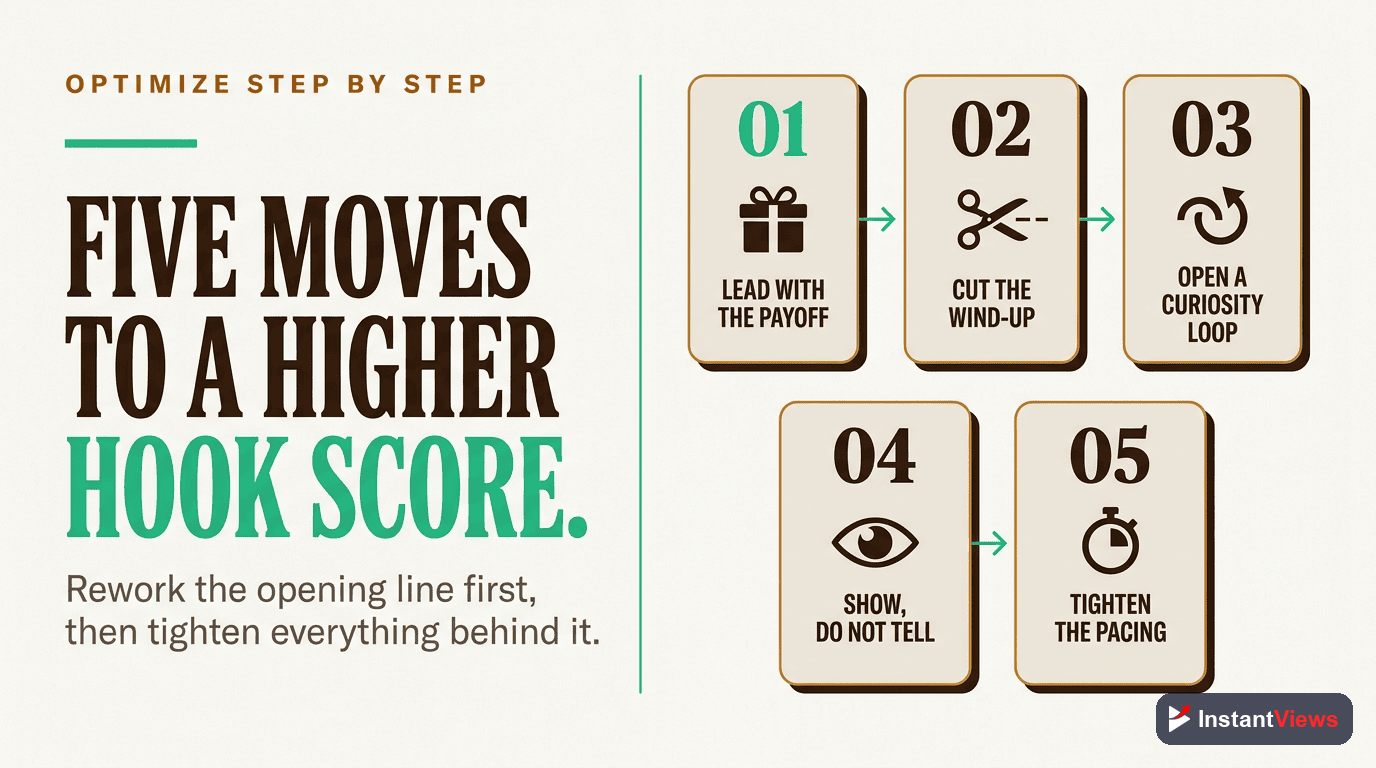
Here are proven strategies to improve your hook score, organized by the factor they impact:
Improve Value Clarity (+5-15 Points)
Strategy 1: The First-Sentence Test
Your first sentence must answer: "What will I learn/get/experience?" If it doesn't, rewrite it.
Before: "Hey everyone, thanks for watching!"
After: "This one change increased my retention by 40%."
Strategy 2: Specific Over Generic
Replace vague promises with specific outcomes:
- "Get more views" → "Get 10,000 views in your first month"
- "Make money on YouTube" → "Monetize at 500 subscribers using this loophole"
- "Improve your videos" → "Cut editing time from 4 hours to 45 minutes"
Improve Pacing (+5-12 Points)
Strategy 3: The 3-Second Rule
Make a visual or informational change every 3 seconds. Count your current cuts - most struggling creators average 1 cut every 7-10 seconds.
Strategy 4: Kill All Fluff
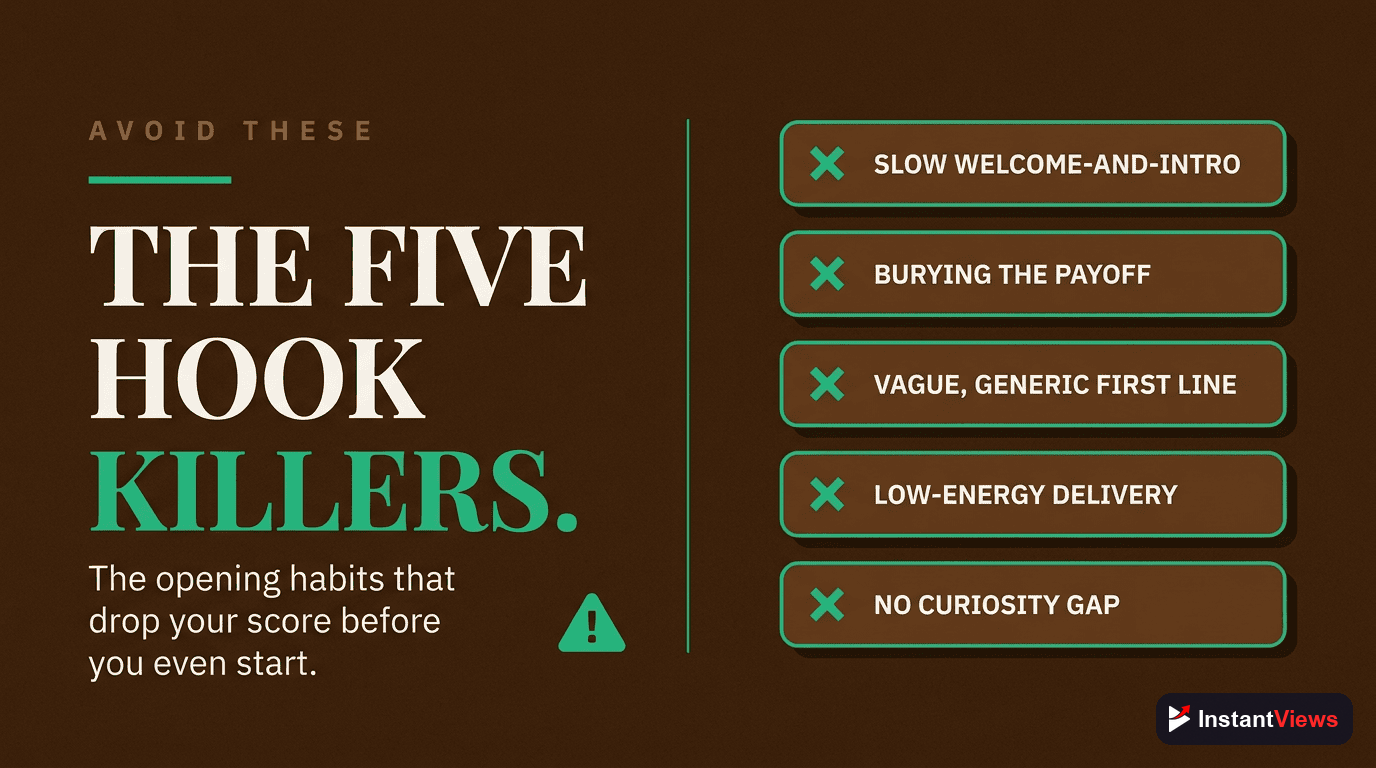
Remove these hook killers entirely:
- "Hey guys, welcome back..."
- "Before we start, quick reminder to subscribe..."
- "In today's video, we're going to talk about..."
- Long channel intros (over 2 seconds)
Improve Curiosity (+4-10 Points)
Strategy 5: The Open Loop Formula
Tease information you'll reveal later:
"I'll show you this strategy, but first you need to understand why everyone else is teaching it wrong."
Strategy 6: Pattern Interrupts
Do something unexpected in the first 5 seconds:
- Bold statement: "Everything you know about [topic] is backwards"
- Unexpected visual: Show result before process
- Question that challenges assumptions: "What if getting views was easier than getting subscribers?"
Improve Visual Engagement (+3-8 Points)
Strategy 7: Visual Proof Points
Show, don't just tell:
- Analytics screenshots within first 10 seconds
- Before/after comparisons
- Physical demonstrations
- Screen recordings of results
Strategy 8: Text Overlay Emphasis
Reinforce key points with on-screen text. Use it for:
- Numbers and statistics
- Key phrases
- Important words for emphasis
Common Mistakes That Kill Hook Scores
Avoid these devastating mistakes:
Mistake 1: The Greeting Start
Impact: -10 to -15 points
Starting with "Hey guys, welcome back..." wastes the most valuable seconds. Viewers don't care about your greeting - they care about value.
Mistake 2: Slow Build-Up
Impact: -8 to -12 points
Building tension slowly works in movies, not YouTube. Start with your climax, then explain context.
Mistake 3: Explaining Instead of Showing
Impact: -5 to -10 points
"I'm going to show you..." is weaker than actually showing. Talk less, demonstrate more.
Mistake 4: Generic Value Propositions
Impact: -6 to -9 points
"In this video you'll learn..." sounds like every other video. Be specific about unique value.
Mistake 5: Low Energy Delivery
Impact: -7 to -11 points
Your energy in the first 10 seconds sets viewer expectations. Low energy signals boring content ahead.
| Common Mistake | Score Impact | Quick Fix |
|---|---|---|
| Starting with greeting | -10 to -15 | Cut entirely, start with hook |
| Slow pacing | -8 to -12 | Cut every 3 seconds, remove pauses |
| No visual proof | -5 to -10 | Add screenshots/data in first 10s |
| Generic promises | -6 to -9 | Use specific numbers and outcomes |
| Low energy | -7 to -11 | Re-record with 2x energy |
| Poor audio quality | -4 to -8 | Invest in proper microphone |
Testing and Iterating
Optimization is a continuous process. Here's how top creators systematically improve:
The 3-Version Testing Method
- Create your initial hook - Your first instinct
- Create variation A - Different hook style (e.g., question vs. bold statement)
- Create variation B - Different pacing/structure
- Test all three in InstantViews Video Analyzer
- Use the highest scorer - Usually 8-15 points difference
Post-Publish Analysis
After publishing, track these metrics weekly:
- 30-second retention rate - Your real-world hook score
- Average view duration - Strong hooks boost overall watch time
- Impressions/CTR ratio - Better hooks = more impressions
- Traffic sources - Algorithm picks up high hook scores
Continuous Improvement Framework
Apply this monthly:
- Review your last 10 videos' 30s retention
- Identify your top 3 hooks
- Analyze what they have in common
- Apply those patterns to future videos
- Abandon patterns from low-scoring hooks
"I increased my average hook score from 68 to 82 in 3 months by testing 3 versions of every hook before publishing. My channel went from 500 to 50,000 subscribers in that same period." - InstantViews User
Optimize Your Hook Score Today
Stop guessing. Get instant hook scoring with specific recommendations to reach 75+.
Try Video Analyzer Free →
Frequently Asked Questions
A hook score measures how effectively your video opening (first 30 seconds) captures and retains viewer attention. It's calculated based on audience retention data, click-through rates, and engagement metrics. A score of 80+ indicates a strong hook that keeps most viewers watching.
A good hook score is 70-79, very good is 80-89, and excellent is 90+. Most successful YouTube videos score above 75. Videos below 60 typically struggle with retention and algorithm promotion. The InstantViews Video Analyzer provides benchmarks specific to your niche.
Use YouTube Analytics to check your 30-second retention rate, or use the InstantViews Video Analyzer for instant hook scoring. The analyzer evaluates pacing, engagement triggers, value clarity, and emotional impact to give you a comprehensive hook score with improvement suggestions.
You cannot change a published video's opening without re-uploading, which resets all metrics. However, you can use the data to improve future videos. Test different hooks before publishing using the InstantViews analyzer to optimize before going live.
The top factors are: immediate value communication (30%), pacing and energy (25%), curiosity triggers (20%), visual engagement (15%), and audio quality (10%). The first 3 seconds are critical - losing viewers here dramatically impacts your overall score.
Test every video before publishing. Successful creators analyze their hook in the InstantViews tool, make adjustments, and re-test until they achieve 75+. Also review your published videos monthly to identify patterns in what works for your audience.