- Ad revenue is a useful base layer, but it is unpredictable — treat it as one stream, not your whole income
- There are at least nine distinct ways to monetize a channel, and many work before you ever qualify for the Partner Program
- Fan funding (memberships, Super Thanks, Super Chat) turns your most loyal viewers into recurring support
- Sponsorships, affiliate links, and your own products often out-earn ads because you set the terms
- Diversify by stacking streams that reuse content you already make, and add a new one only when the last is stable
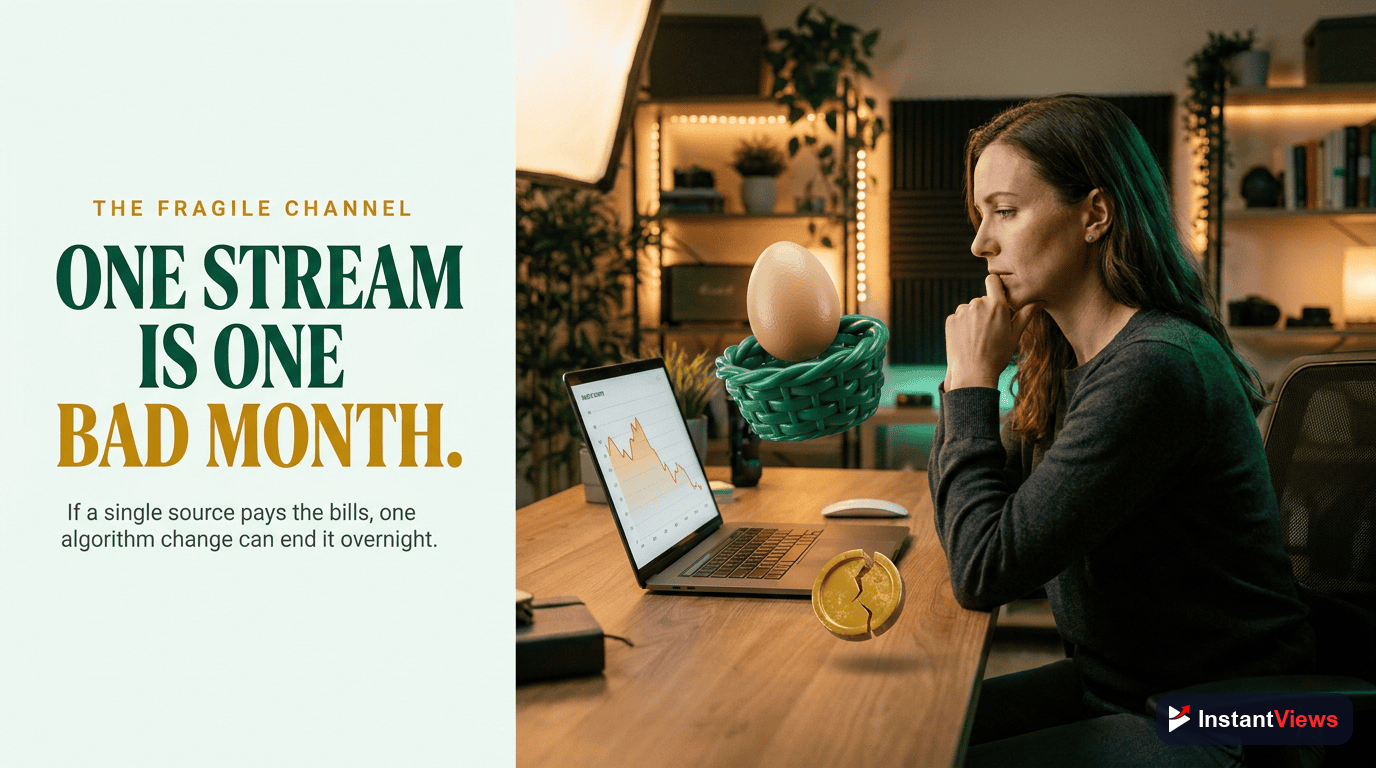
YouTube has paid creators more than $100 billion over the past four years, and with over 2.7 billion monthly active users it remains the single largest paid-creator economy on the planet. Yet a striking number of channels still rely on one thing for income: the ad money that appears in YouTube Studio each month. That is a fragile way to run a business.
Ad revenue swings with the season, the niche, advertiser demand, and the algorithm. A great month can be followed by a quiet one for reasons entirely outside your control. The creators who build something durable do the opposite of putting all their eggs in one basket — they layer several income streams on top of the same audience, so that when one dips, the others hold them up.
Industry reporting in 2026 points to the same conclusion: the creators who earn the most tend to draw income from several streams rather than a single one. The good news is that most of these streams reuse content and relationships you already have. You do not need a second job; you need a second, third, and fourth way to be paid for the work you are already doing.
This guide is a complete tour of the ways to monetize a YouTube channel in 2026 — what each one is, who it suits, the upside and the catch, and a clear sense of when to add it. By the end you will be able to map a personal monetization plan that fits your audience size and niche.
- Why One Revenue Stream Is a Risk
- Ad Revenue: The Base Layer
- Fan Funding: Memberships, Super Thanks & Super Chat
- Sponsorships and Brand Deals
- Affiliate Marketing
- Your Own Products, Services & Courses
- Merch, Licensing & Crowdfunding
- Every Revenue Stream Compared
- Building Your Stack: Step by Step
- Diversification Mistakes to Avoid
- FAQ
Why One Revenue Stream Is a Risk
Imagine a channel that earns comfortably from ads, then watches its income halve overnight because advertisers pulled back for the quarter, or because a format change quietly reduced its reach. Nothing about the videos got worse — but the single pipe carrying the money got narrower. This is the core problem with monetizing through one channel only.
Each revenue stream behaves differently. Some are passive and scale automatically with views. Others are active and require negotiation or fulfillment, but pay far more per viewer. Some depend on the YouTube Partner Program; others work the day you upload your first video. When you combine them, you smooth out the bumps and stop being at the mercy of any one system.
There is a second, subtler benefit. Different streams reward different things. Ads reward raw views; memberships reward loyalty; sponsorships reward a tight, well-defined niche; products reward trust and expertise. Building several streams forces you to serve your audience in several ways — which tends to make the whole channel stronger.
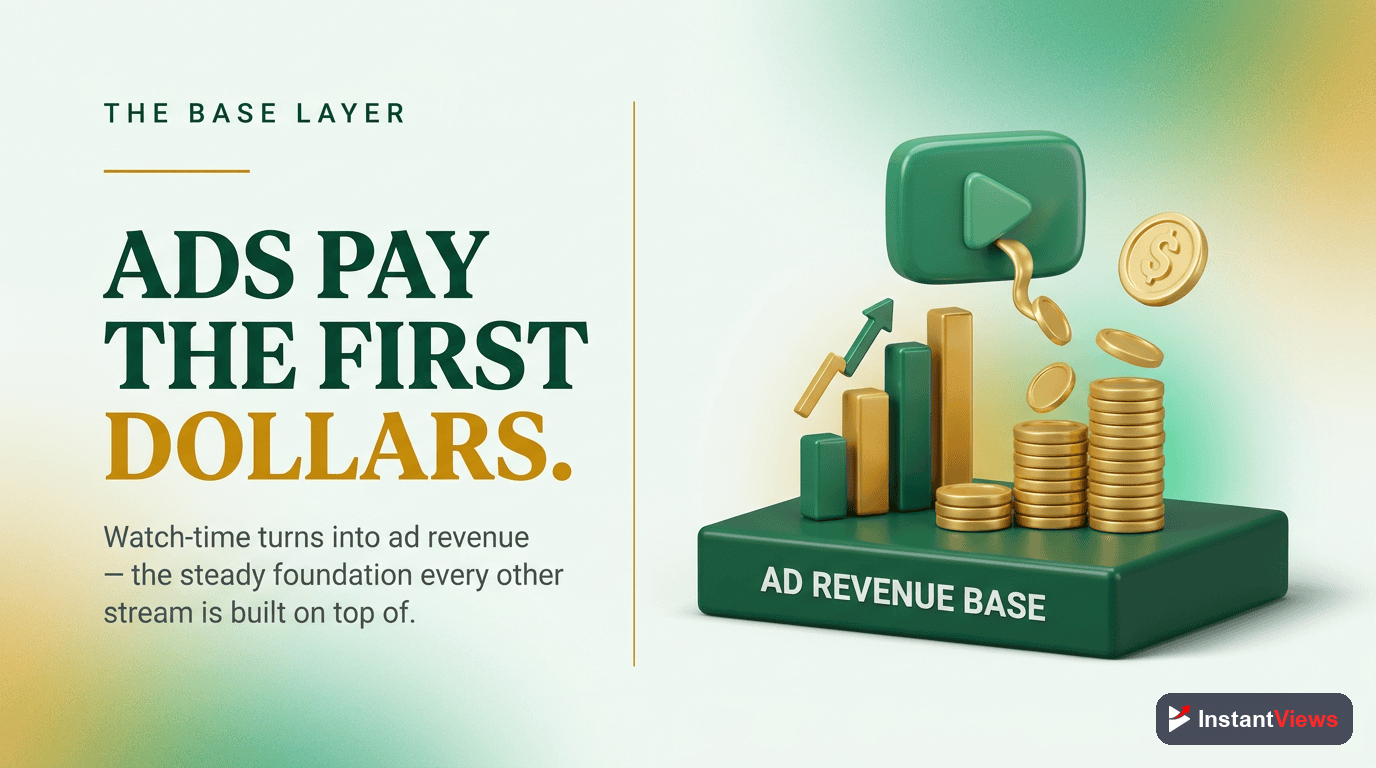
Ad Revenue: The Base Layer
How it works: Once you join the YouTube Partner Program, YouTube places ads on your videos and shares the income with you. On long-form videos, creators receive 55% of the associated ad revenue while YouTube keeps 45%. For Shorts, ad money from the Shorts feed is pooled and distributed to creators based on their share of total Shorts views, after music licensing costs are accounted for.
In 2026 the entry points are tiered. An early-access tier opens fan-funding features at around 500 subscribers with lighter thresholds, while full ad-revenue monetization generally requires 1,000 subscribers plus 4,000 valid public watch hours in the past 12 months or 10 million Shorts views in the past 90 days. Always confirm the live numbers in YouTube Studio, as requirements evolve.
Best for: Every monetized channel, as a hands-off base layer. The catch: It is the most unpredictable stream. Earnings per view vary enormously by niche, audience country, season, and advertiser demand, so it should anchor your income, not be the whole of it.
Be wary of any source that promises a fixed payout per thousand views. Real ad earnings depend on your niche, where your viewers are, the time of year, and advertiser competition — figures that genuinely cannot be predicted in advance. Plan around ranges and trends, never a single guaranteed number.
Fan Funding: Memberships, Super Thanks & Super Chat
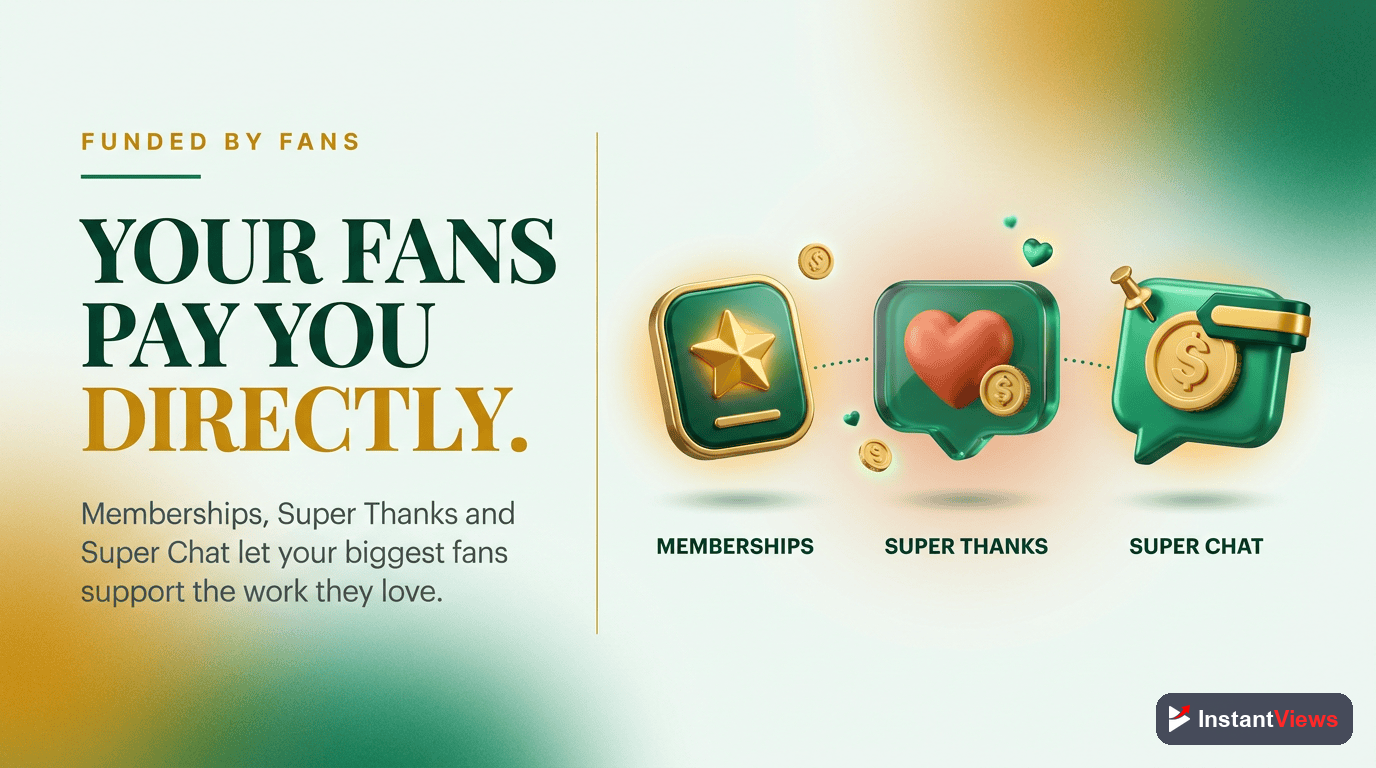
Fan funding is money your audience pays you directly through native YouTube tools. It rewards loyalty rather than reach, which makes it powerful even for smaller channels with a devoted following.
Channel Memberships
Members pay a recurring monthly fee — available across a range of price points from roughly a dollar up to around a hundred dollars a month — in exchange for perks like badges, custom emoji, members-only posts, and exclusive videos. It is recurring revenue, which makes it far more stable than one-off payments. YouTube takes a platform share of membership income, so your net is lower than the sticker price.
Super Thanks, Super Chat & Super Stickers
These are tipping tools. Super Thanks lets viewers tip on regular uploads; Super Chat and Super Stickers let viewers pay to highlight their messages during live streams. They shine for creators who livestream or build a strong personal connection, though for most channels they are a modest supplement rather than a core income source.
Sponsorships and Brand Deals
How it works: A brand pays you to feature its product or service in your video — a dedicated segment, an integration, or a full review. Crucially, you negotiate directly with the brand, which means you set the price and keep all of it. There is no platform cut.
This is often where serious creator income lives, because a single well-matched deal can dwarf a month of ad revenue. And it does not require the Partner Program at all — brands work with channels of every size. What they care about most is relevance and engagement: a small, tightly focused audience that trusts you is more valuable to the right sponsor than a huge, scattered one.
- Best for: Channels with a clear niche and an engaged, well-defined audience, at almost any size.
- The upside: High pay per video, no platform fee, and full creative and pricing control.
- The catch: It is active work — finding brands, negotiating, and delivering — and you must disclose paid promotions clearly to stay compliant and keep audience trust.

Affiliate Marketing
How it works: You recommend a product using a special tracking link, and you earn a commission whenever a viewer buys through it. The product can be anything you genuinely use — software, gear, books, courses — and the links live in your description and pinned comments. YouTube Shopping also lets eligible creators tag products directly in videos and Shorts.
Affiliate marketing is arguably the most accessible stream of all: it works from day one, with no subscriber minimum, and it scales quietly in the background as your back catalogue keeps earning. A tutorial that mentions a tool can generate commissions for years after you publish it.
- Best for: Review, tutorial, and recommendation channels — and brand-new creators who are not yet monetized.
- The upside: Zero barrier to entry, passive once published, and naturally fits content you already make.
- The catch: Commissions on any single sale are usually small, so it relies on trust and volume. Only ever recommend things you actually stand behind.

Your Own Products, Services & Courses
The streams above all share your audience with someone else — YouTube, a brand, or an affiliate merchant. Selling your own products flips that: you keep the full margin and own the customer relationship outright. This is where many creators eventually earn the most.
Digital Products and Courses
If your channel teaches anything, you can package that expertise into an online course, template pack, preset, ebook, or membership community. Digital products cost almost nothing to deliver after they are made, so the margins are excellent, and your videos act as a continuous, free top-of-funnel that demonstrates your knowledge.
Services and Coaching
For creators with specialised skills, the channel becomes a portfolio. Consulting, freelancing, done-for-you services, and one-to-one coaching can command premium prices precisely because viewers have already watched you prove your competence for hours.

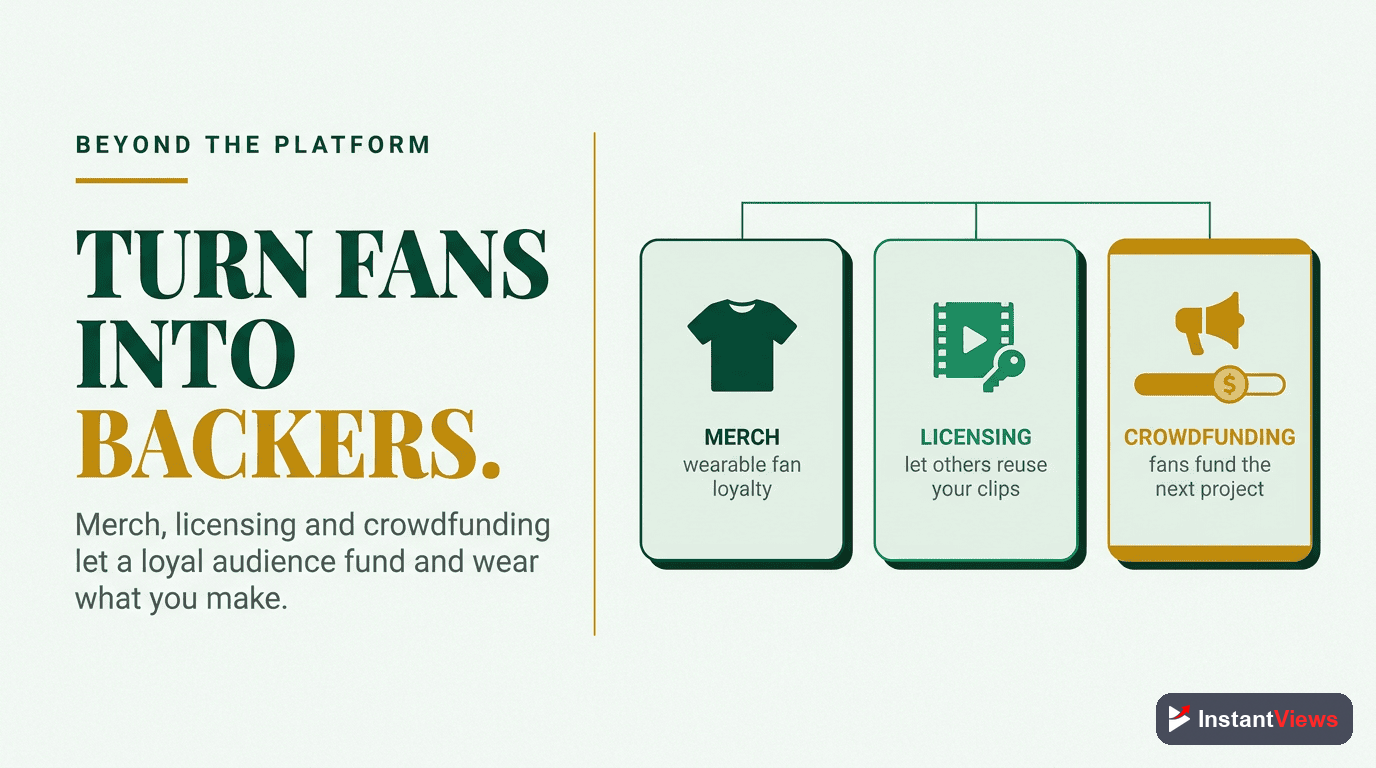
Merch, Licensing & Crowdfunding
Three more streams round out the picture, each suited to a particular kind of channel.
Merchandise
Branded apparel and physical goods work best for creators with a strong personal brand or community identity that fans want to wear. Print-on-demand and YouTube's merch shelf make it low-risk to start, but merch only sells when your audience feels a genuine sense of belonging — it rewards community, not just views.
Content Licensing
If you produce footage that others want — viral clips, stock-quality b-roll, or original music — media outlets and brands will pay to license it. It is occasional rather than steady, but it is essentially free money for content you have already created.
Crowdfunding (Patreon and Similar)
Off-platform membership services let your audience support you directly, with tiers and perks you define. The advantage over native fan funding is ownership: you control the relationship and are less exposed to platform changes. The trade-off is that you are asking viewers to leave YouTube, and the host platform still takes a fee.
Every Revenue Stream Compared
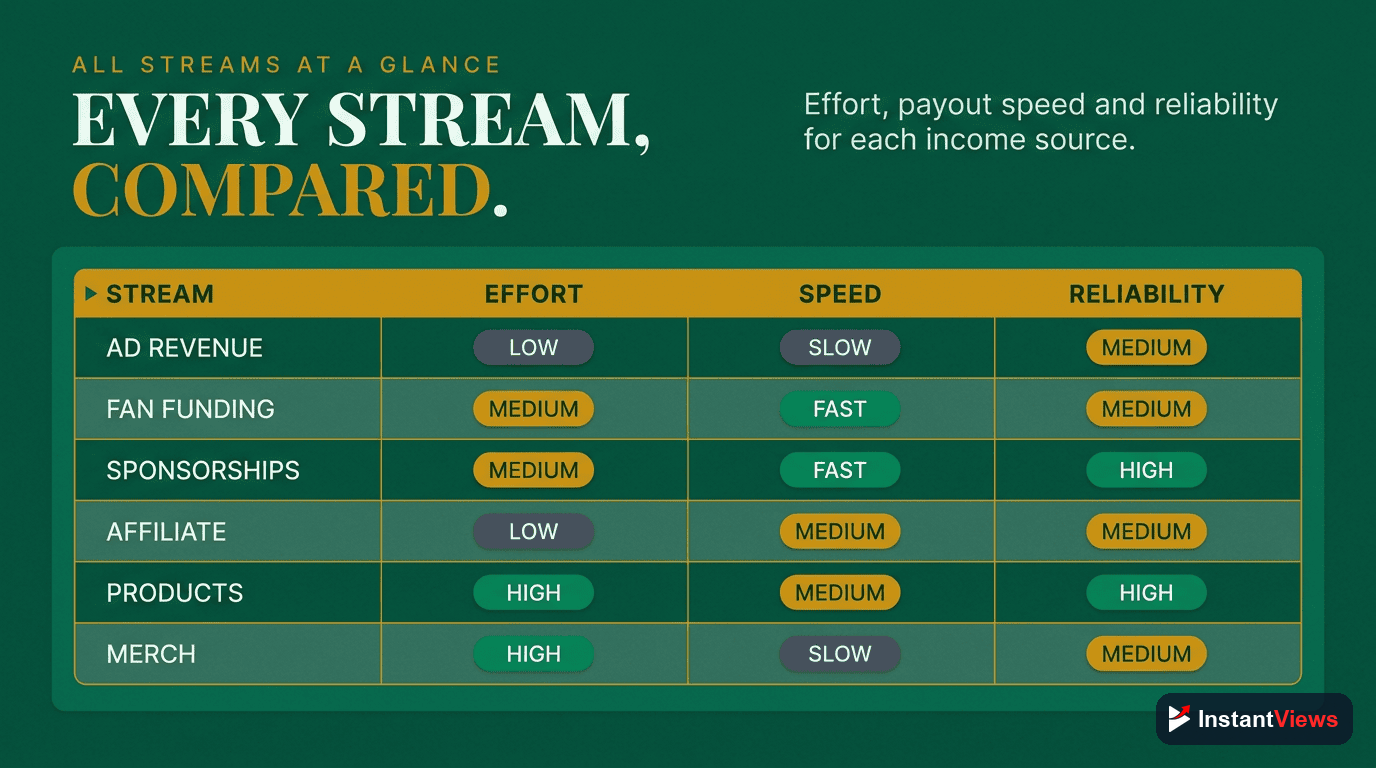
Use this table to see at a glance how the streams differ — how each one works, who it suits best, and how much ongoing effort it demands once it is running.
| Revenue Stream | How It Works | Best For | Effort |
|---|---|---|---|
| Ad Revenue | YouTube runs ads and shares income (55% on long-form; pooled share on Shorts) | Every monetized channel, as a base layer | Low — passive once enabled |
| Channel Memberships | Recurring monthly fee for perks; YouTube takes a share | Loyal communities and recurring engagement | Medium — ongoing perks to deliver |
| Super Thanks / Super Chat | Viewers tip on videos or during live streams | Livestreamers and personality-led channels | Low — works inside content you already make |
| Sponsorships | Brands pay you directly to feature a product; no platform cut | Niche channels with engaged audiences | High — outreach, negotiation, delivery |
| Affiliate Marketing | Commission on sales made through your tracking links | Review and tutorial channels; brand-new creators | Low — passive after links are placed |
| Your Own Products / Courses | You sell what you make and keep the full margin | Educators and experts with a clear skill | High to create, low to sustain |
| Merchandise | Branded goods via print-on-demand or merch shelf | Strong personal brands and fan communities | Medium — design and fulfillment |
| Licensing | Media and brands pay to reuse your footage or music | Creators of viral or stock-quality content | Low — occasional, on existing work |
| Crowdfunding | Off-platform memberships with your own tiers and perks | Creators wanting to own the fan relationship | Medium — perks and community upkeep |
Notice the pattern: the passive, low-effort streams (ads, affiliate, licensing) make a great foundation, while the higher-effort streams (sponsorships, products, memberships) are where you control your pricing and tend to earn the most per viewer. A healthy income mixes both kinds.
Building Your Stack: Step by Step
You do not launch nine streams at once. You stack them in a sensible order, letting each one stabilise before adding the next.
Audit Where You Are
List your current income and study your audience — size, niche, location, and engagement. This tells you which streams are realistic now and which to grow toward. A small but devoted audience points to fan funding; a niche audience points to sponsorships.
Lock In a Passive Base
Enable ad revenue if you qualify, and add affiliate links to content where recommendations fit naturally. Both run quietly in the background and require almost no ongoing effort once set up, giving you a foundation to build on.
Add a Stream You Control
Pursue your first sponsorship or set up channel memberships. These pay more per viewer and are not at the mercy of the ad market. Start with whichever fits your audience: brand deals for niche channels, memberships for loyal communities.
Productize Your Expertise
Once you have an audience that trusts you, package your knowledge into a course, product, or service. This is usually the highest-margin stream because you own it end to end and your videos market it for free.
Measure and Rebalance
Track what each stream earns relative to the effort it costs. Double down on the strongest performers, quietly retire the ones that are not worth the work, and revisit your mix every few months as your channel evolves.
Grow the Audience That Powers Every Stream
Every revenue stream rides on the same thing: an audience that finds and trusts you. Use our free suite of YouTube tools to research topics, sharpen your titles, and analyze what is working.
Explore Free YouTube Tools →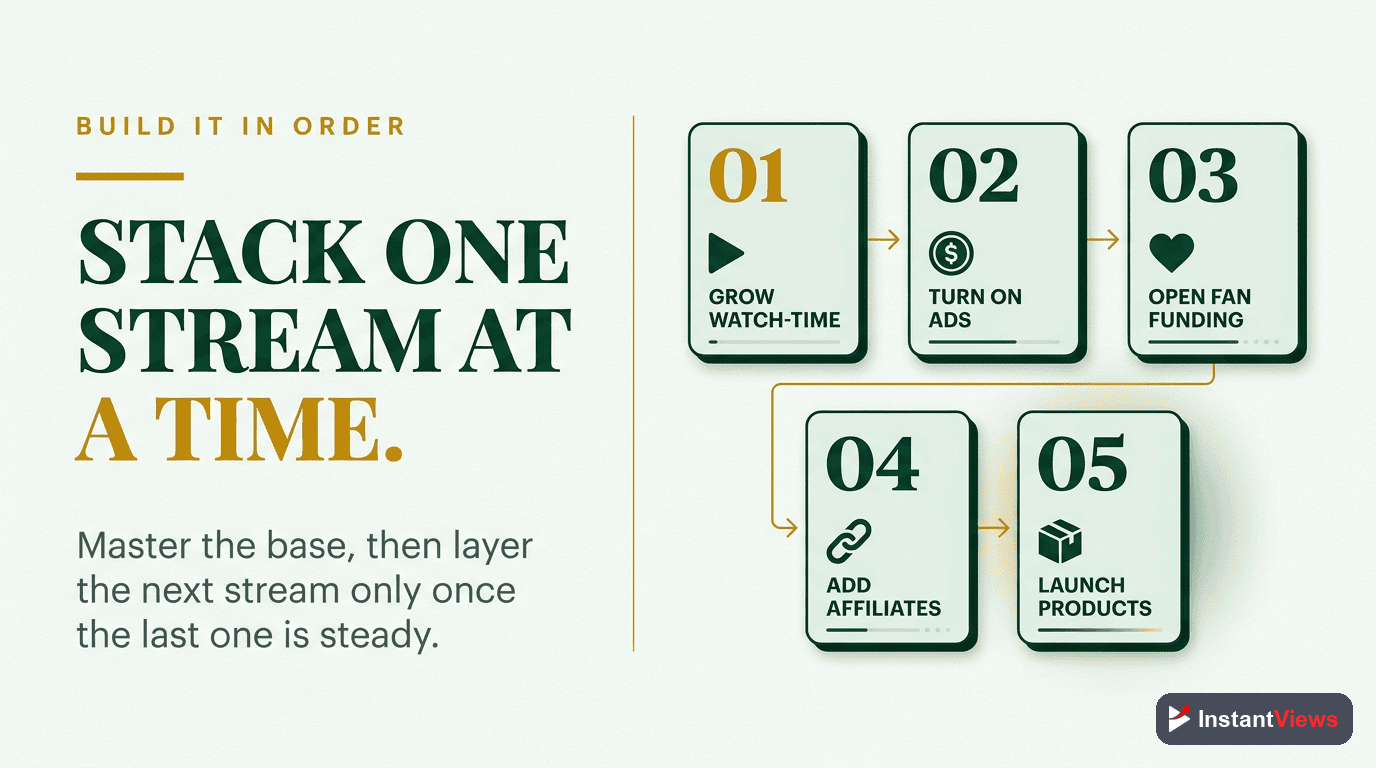
Diversification Mistakes to Avoid
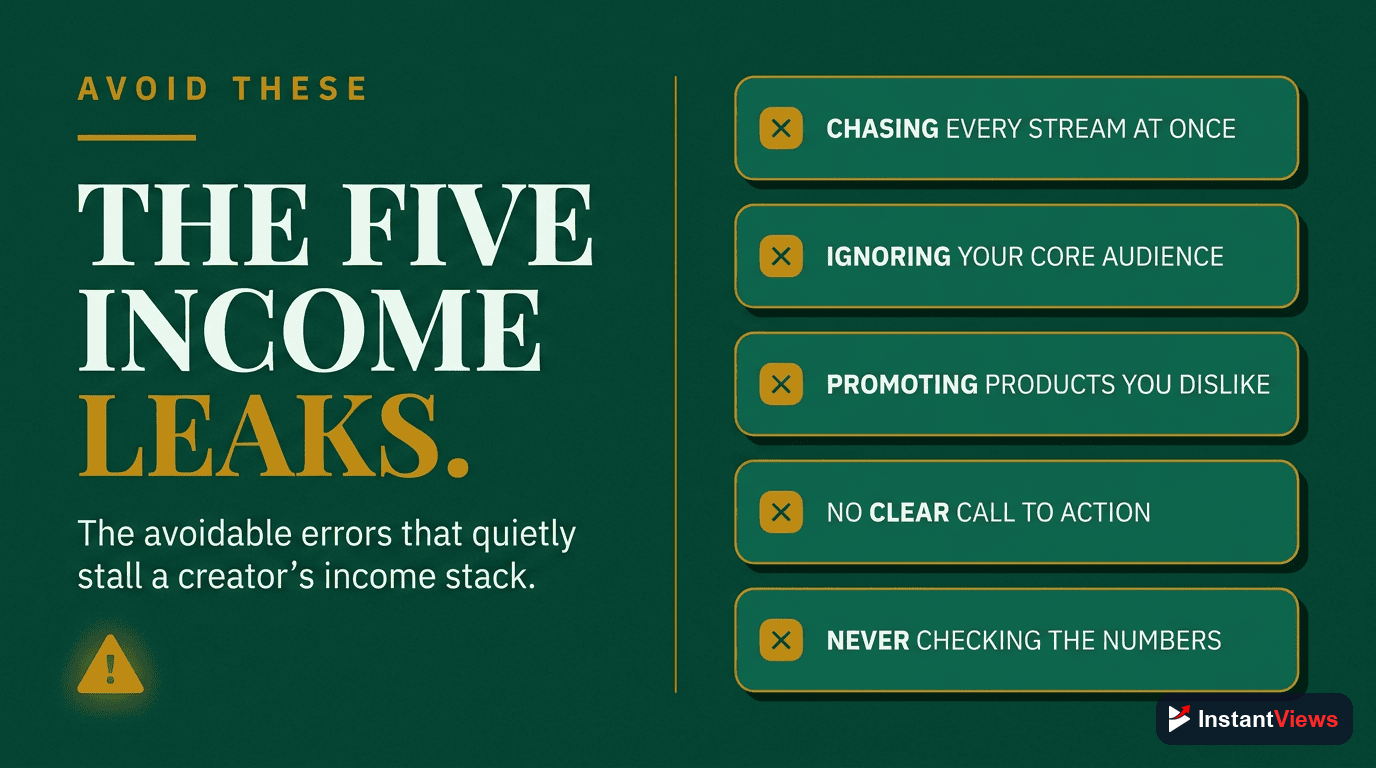
Diversifying is powerful, but it is easy to do badly. Watch for these traps:
- Chasing every stream at once: Launching memberships, merch, a course, and sponsorships in the same month spreads you thin and usually means none of them is done well. Add one at a time.
- Adding streams that do not fit: Merch on a channel with no community identity, or a course on a topic your audience does not trust you to teach, will quietly fail. Match the stream to your audience.
- Over-monetizing too early: Stacking aggressive sales pitches onto a young channel erodes the trust you are still building. Earn the audience first; monetize as a natural next step.
- Treating ad revenue as the goal: Hitting the Partner Program is a milestone, not a finish line. The creators who plateau are often the ones who stop adding streams after their first ad payment.
- Ignoring the numbers: Without tracking what each stream earns against the time it takes, you cannot tell which deserve more attention. Review the mix regularly.
- Forgetting disclosure: Sponsorships and affiliate links must be disclosed clearly. Hiding them risks both platform penalties and the audience trust your whole income depends on.
Done well, diversification is not about doing more — it is about getting paid in more ways for the same body of work. Each new stream should feel like a natural extension of what your channel already does, not a separate business bolted on the side.
"The platform pays you for attention, but your own products and direct fan support let you get paid for trust — and trust is the thing a YouTube channel is uniquely good at building. Stop renting your income from one source; own as much of it as you can."
Frequently Asked Questions
There is no fixed number, but relying on a single source — especially ad revenue — leaves you exposed to algorithm shifts and seasonal swings in advertiser demand. Industry reporting in 2026 suggests that successful creators tend to earn from several streams rather than one. A practical approach is to add streams gradually as your audience grows, starting with the ones that fit your niche and audience size.
Not for every stream. Affiliate marketing, sponsorships, selling your own products, and crowdfunding all work without YouTube monetization features. The Partner Program is what unlocks ad revenue, channel memberships, Super Thanks, and Super Chat. In 2026 there is an early-access tier at 500 subscribers for fan-funding features and full monetization at 1,000 subscribers for ad revenue.
For ad revenue and Shorts revenue sharing you generally need 1,000 subscribers plus 4,000 valid public watch hours in the past 12 months or 10 million Shorts views in the past 90 days. An early-access tier unlocks fan-funding features such as memberships and Super Thanks at 500 subscribers with lighter watch-time or Shorts-view thresholds. Requirements can change, so always confirm the current numbers in YouTube Studio.
On long-form videos, YouTube pays creators 55% of the associated ad revenue and keeps 45%. For Shorts, ad revenue from the Shorts feed is pooled and creators receive a share based on their portion of total Shorts views, after music licensing costs. Channel memberships and other fan-funding tools also carry a platform fee, so your net is always less than the gross figure shown.
Affiliate marketing is one of the most accessible starting points because it works from day one with no subscriber minimum and requires only that you recommend products you genuinely use. Sponsorships are also possible early if you have an engaged, well-defined audience, since brands often value relevance over raw reach. Both let you earn before you qualify for the Partner Program.
Yes. Ad revenue is passive, scales automatically with views, and requires no extra work once monetization is enabled, which makes it a useful base layer. The caution is to treat it as one layer rather than the whole roof. Earnings vary widely by niche, audience location, season, and advertiser demand, so pair it with streams you control directly.
Add streams that reuse work you already do. A tutorial channel can attach affiliate links to gear it already features, then later package the same expertise into a paid course. Stack streams that share the same content rather than launching unrelated projects, and add a new one only once the previous stream is running smoothly.
Fan funding refers to on-platform tools such as channel memberships, Super Thanks, and Super Chat that live inside YouTube and follow its rules and fees. Crowdfunding usually means off-platform memberships through services like Patreon, where you own the relationship, set your own tiers, and are less exposed to platform changes — though you still pay that platform a fee.
Conclusion
Ad revenue is a fine place to start, but it is a poor place to stop. It is unpredictable, it is controlled by forces outside your channel, and on its own it leaves your income exposed to every shift in the algorithm and the advertising market. The creators who build something lasting treat it as one layer in a stack — not the whole structure.
The encouraging part is how little extra work real diversification requires. Affiliate links ride along on content you already make. Memberships and Super Thanks turn existing loyalty into recurring support. Sponsorships and your own products let you set your own price on the trust your videos have already earned. Each stream reuses the same audience in a different way.
Start by locking in a passive base, add one stream you control, then productize your expertise as your audience grows — reviewing the mix as you go. Do that, and your channel stops being a single fragile pipe and becomes a resilient, diversified business that keeps paying you no matter which way any one platform turns.