- Brand deals can generate 10-100x more revenue than AdSense for creators with engaged audiences
- You don't need millions of subscribers - brands value engagement rate over raw subscriber count
- A professional media kit and proven metrics are essential for landing your first sponsorship
- Charge $10-$50 per 1,000 views depending on your niche, with tech and B2B commanding premium rates
- Use the InstantViews Video Analyzer to showcase detailed performance metrics brands want to see
Brand deals are the fastest path to serious YouTube income. While AdSense might earn you $3-$5 per 1,000 views, a single brand sponsorship can pay $500-$10,000+ for the same video.
But landing your first brand deal feels impossible. You send pitch after pitch with no response. You watch smaller creators get sponsored while brands ignore your emails. You wonder what they have that you don't.
The truth? Getting brand deals isn't about luck or connections. It's about presenting yourself professionally, proving your value with data, and pitching the right brands in the right way.
This complete guide shows you exactly how to land paid YouTube sponsorships - from building your media kit to negotiating contracts and delivering results that turn one-time deals into long-term partnerships.
Understanding YouTube Brand Deals
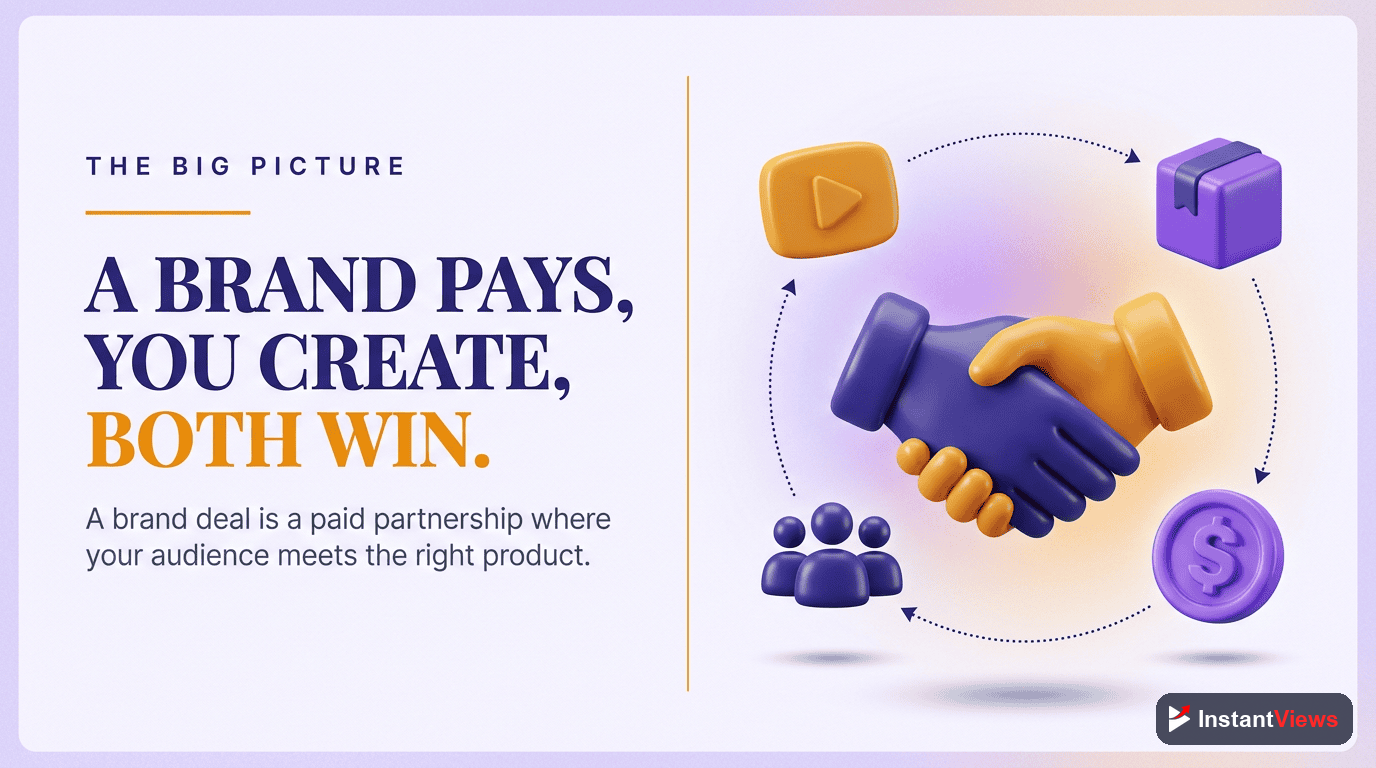
A brand deal (or sponsorship) is when a company pays you to feature their product or service in your content. This can range from a quick 30-second mention to an entire video dedicated to their brand.
Common types of brand deals:
- Dedicated videos - Entire video about the brand's product ($1,000-$50,000+)
- Integrated sponsorships - 30-90 second segment within your video ($500-$10,000)
- Product placements - Subtle product appearance without verbal mention ($200-$2,000)
- Affiliate partnerships - Earn commission on sales you drive (10-30% per sale)
- Long-term ambassadorships - Ongoing relationship with multiple videos ($5,000-$100,000+/year)
When You're Ready for Brand Deals
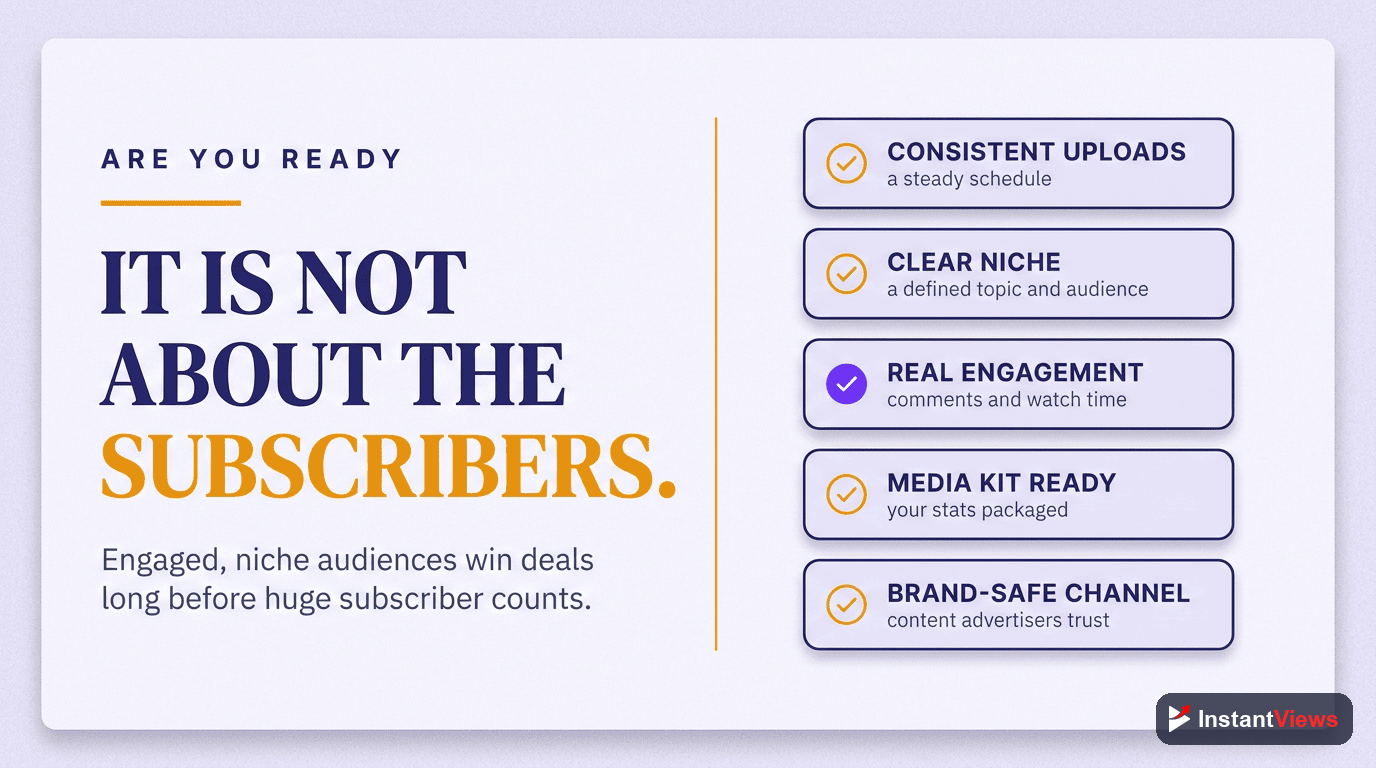
You don't need a million subscribers. Brands care more about engagement and audience fit than raw numbers.
You're ready when you have:
Consistent Viewership
Your videos consistently get 5,000-10,000+ views within the first week. Brands want guaranteed exposure, not viral lottery tickets.
High Engagement Rate
Your engagement rate (likes + comments / views) is 3-5% or higher. This proves your audience actually watches and cares about your content.
Defined Niche
You create content in a specific niche that brands target: tech, fitness, beauty, finance, gaming, productivity, etc. Generalist channels are harder to sponsor.
Quality Production
Your videos have good audio, lighting, and editing. Brands won't sponsor content that looks unprofessional.
| Channel Size | Typical Deal Value | What Brands Expect |
|---|---|---|
| 1,000-10,000 subs | $50-$500 | Product reviews, affiliate links, micro-influencer campaigns |
| 10,000-50,000 subs | $500-$2,500 | Integrated sponsorships, dedicated reviews, brand mentions |
| 50,000-100,000 subs | $2,500-$7,500 | Dedicated videos, series partnerships, product launches |
| 100,000-500,000 subs | $7,500-$25,000 | Brand ambassadorships, exclusive launches, long-term deals |
| 500,000+ subs | $25,000-$100,000+ | Major campaigns, TV-style commercials, brand partnerships |
Building Your Media Kit
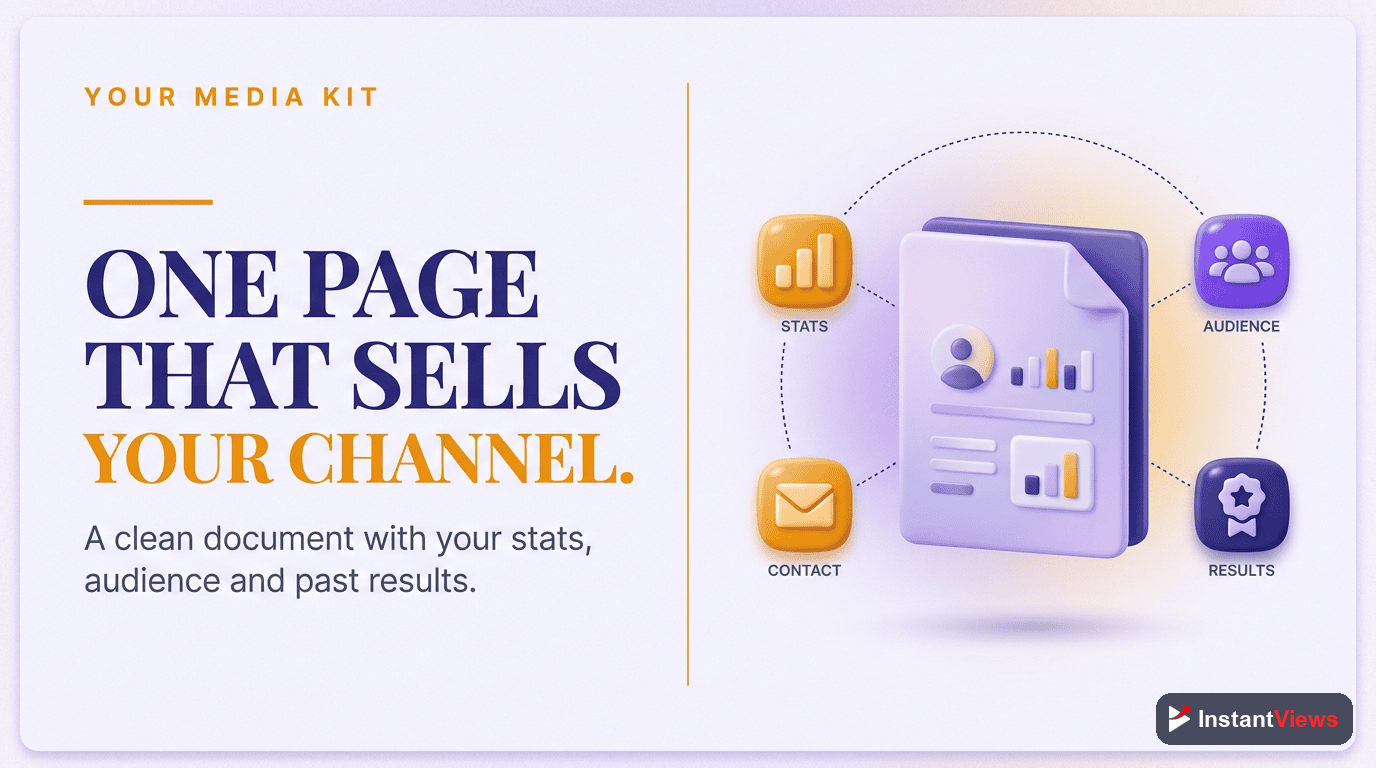
Your media kit is your professional portfolio. It's what brands review when deciding whether to work with you.
Essential Media Kit Components
1. Channel Overview
- Channel name and tagline
- Your niche and content focus
- What makes your channel unique
- Upload schedule (e.g., "New videos every Tuesday and Friday")
2. Key Statistics
- Total subscribers
- Average views per video (last 10 videos)
- Average watch time percentage
- Engagement rate (likes + comments / views)
- Total channel views
3. Audience Demographics
- Age breakdown (from YouTube Analytics)
- Gender split
- Top geographic locations
- Average income level (if known)
- Interests and behaviors
4. Content Examples
- Thumbnails and links to your top 5-10 performing videos
- View counts and engagement metrics for each
- Show variety in content types
5. Previous Brand Collaborations
- List past sponsorships (if any)
- Results you delivered (views, clicks, conversions)
- Testimonials from brands (if available)
6. Sponsorship Packages
- Your different sponsorship options and pricing
- What's included in each package
- Add-ons available (social media posts, blog features, etc.)
7. Contact Information
- Professional email address
- Social media handles
- Website (if you have one)
Finding Brands to Pitch
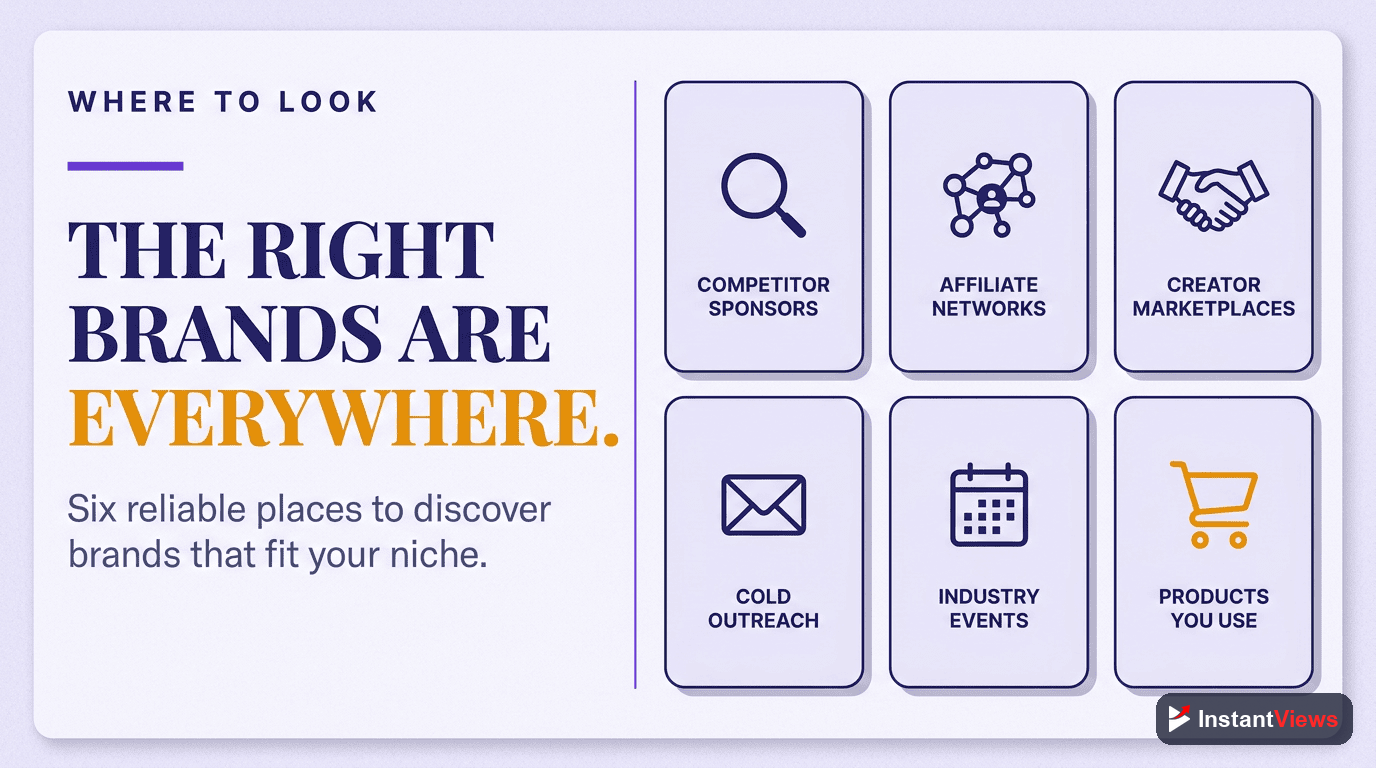
The biggest mistake creators make is waiting for brands to find them. You need to proactively pitch brands that align with your content.
1. Influencer Marketing Platforms
These platforms connect creators with brands actively looking for sponsorships:
- AspireIQ (Aspire) - High-quality brand partnerships for established creators
- Grapevine (now Klear) - Great for beginners, lower minimum requirements
- Creator.co (formerly Tribe) - Quick campaign matching
- FameBit (by YouTube) - Direct integration with YouTube, easy to use
- Channel Pages - Marketplace for brand collaborations
2. Direct Outreach Strategy
The highest-paying deals come from pitching brands directly:
Make a List of 50 Brands
Identify brands you already use and love in your niche. Look at what competitors are sponsored by. Research companies advertising in your space.
NordVPN, Squarespace, Skillshare, Audible, Ridge Wallet, Brilliant, Grammarly, Adobe, Logitech, Anker, dbrand, etc.
Find the Right Contact
Look for marketing managers, influencer marketing coordinators, or brand partnership leads on LinkedIn. Check the brand's website for partnership or sponsorship pages.
Research Each Brand
Understand their products, target audience, marketing style, and current campaigns. Reference specific details in your pitch to show you've done your homework.
3. Network and Connect
- Join creator communities and Discord servers in your niche
- Attend industry conferences and networking events
- Collaborate with other creators who have brand relationships
- Engage with brands on social media (Twitter, LinkedIn, Instagram)
Crafting the Perfect Pitch
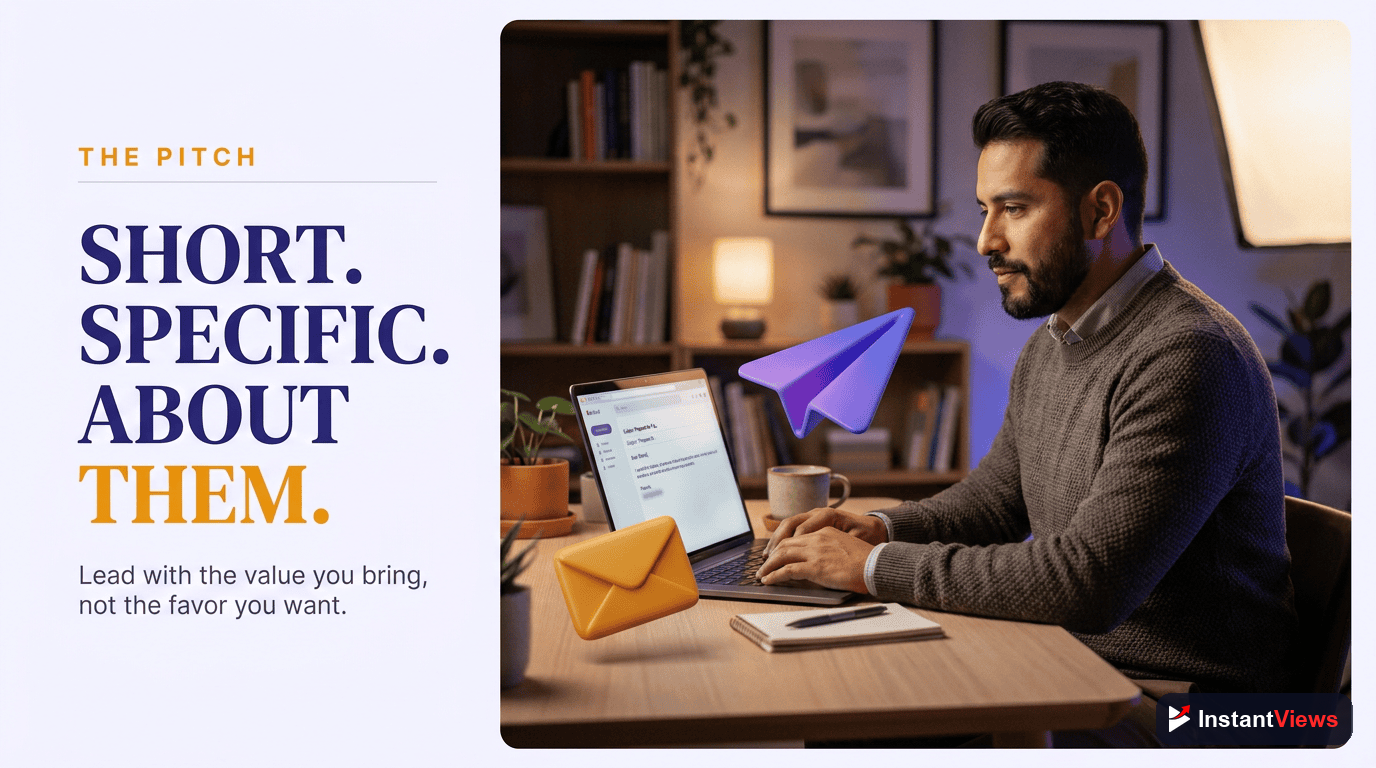
Your pitch email determines whether a brand replies or deletes. Here's how to write one that gets responses:
The Perfect Pitch Email Structure
Subject: [Your Channel Name] x [Brand Name] Partnership Opportunity

Hi [Contact Name],

I'm [Your Name], creator of [Your Channel Name], a YouTube channel focused on [your niche] with [X subscribers] and averaging [Y views] per video.

I've been using [Brand Product] for [time period] and genuinely love it because [specific benefit]. My audience is primarily [demographic] who are actively interested in [relevant interest], which aligns perfectly with your target market.

I'd love to create a sponsored video featuring [Brand Product]. Here's what I'm proposing:

• [60-second integrated sponsorship / Dedicated 8-minute review video]
• Authentic demonstration of [key product features]
• Clear call-to-action with custom discount code/affiliate link
• Estimated reach: [X views] based on my recent performance
• Video will remain public indefinitely for long-term brand exposure

My recent videos on similar products averaged:
- [Video 1 Title]: [X views], [Y]% engagement rate
- [Video 2 Title]: [X views], [Y]% engagement rate
- [Video 3 Title]: [X views], [Y]% engagement rate

I've attached my media kit with detailed analytics and audience demographics. I'd be happy to discuss how we can create content that delivers real value for [Brand Name].

Are you available for a quick call this week?

Best regards,
[Your Name]
[Your Email]
[Your Channel Link]
[Your Media Kit Link]
Why this pitch works:
- Shows you already use and understand their product
- Specific numbers and metrics (not vague promises)
- Clear deliverables (brand knows exactly what they're getting)
- Proof of past performance
- Professional but personal tone
- Easy call-to-action
Don't: Send generic mass emails. Ask for free products without offering value. Lie about your stats. Be overly aggressive or desperate. Send your pitch to info@ email addresses. These kill your chances instantly.
Pricing Your Services
Underpricing is the biggest mistake new creators make. Here's how to price confidently:
The CPM Pricing Method
CPM (Cost Per Mille) = price per 1,000 views. This is industry standard.
Formula: (Average Views × CPM) / 1,000 = Your Rate
| Niche | Typical CPM Range | Example (50K views) |
|---|---|---|
| Tech Reviews | $40-$100 | $2,000-$5,000 |
| Finance/Business | $50-$100 | $2,500-$5,000 |
| B2B/SaaS | $60-$150 | $3,000-$7,500 |
| Health/Fitness | $25-$50 | $1,250-$2,500 |
| Beauty/Fashion | $20-$40 | $1,000-$2,000 |
| Gaming | $10-$30 | $500-$1,500 |
| Lifestyle/Vlog | $15-$35 | $750-$1,750 |
| Educational | $30-$60 | $1,500-$3,000 |
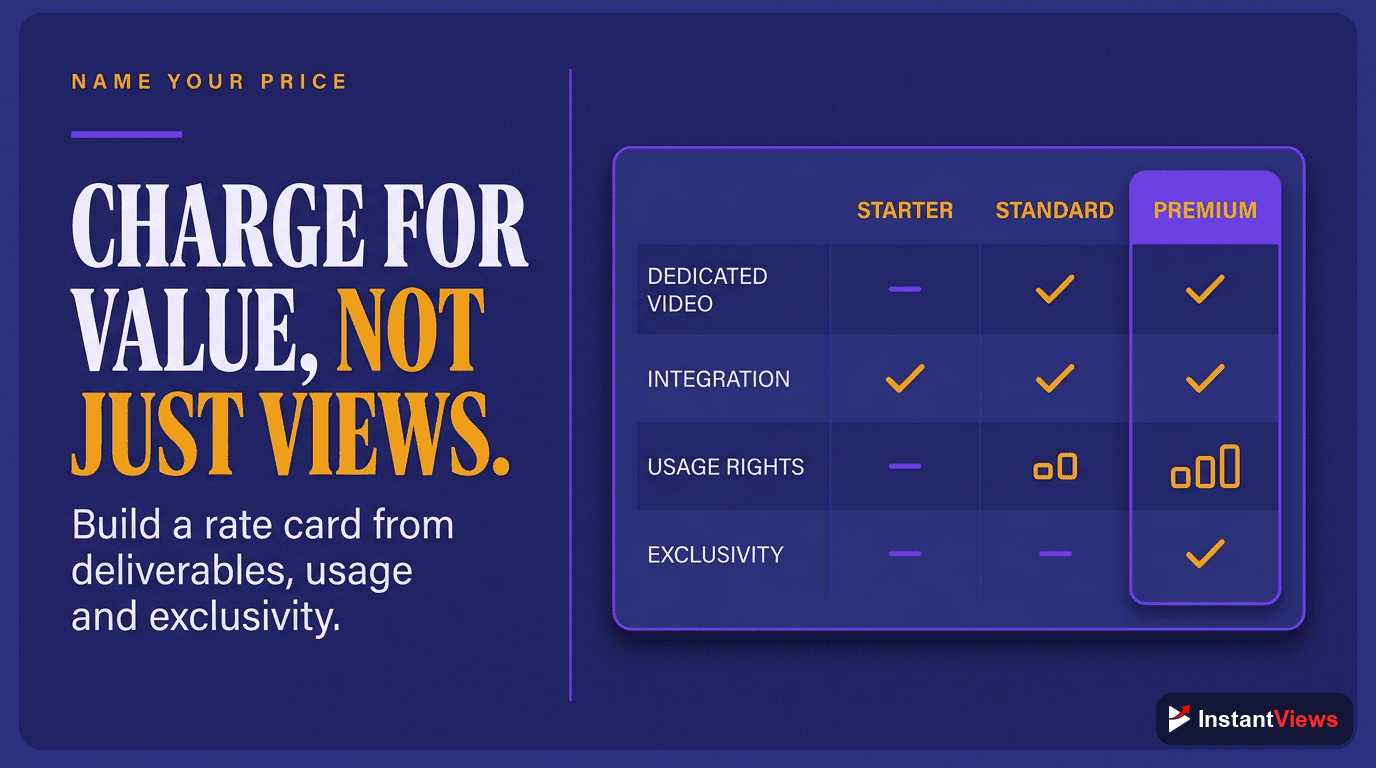
Factors That Increase Your Rate
- High engagement rate (4%+) - Add 20-50% to base CPM
- Valuable audience demographics - High income, decision-makers, specific profession
- Dedicated video vs. integration - Dedicated videos cost 2-3x more
- Exclusivity clauses - Add 30-50% for category exclusivity
- Usage rights - Charge extra if brand can use content in their ads
- Social media amplification - Add $200-$1,000 per platform promotion
Negotiating Contracts
Once a brand is interested, you'll negotiate terms. Here's what to watch for:
Essential Contract Terms
1. Payment Terms
- How much you'll be paid (fixed fee vs. performance-based)
- Payment schedule (50% upfront, 50% after delivery is common)
- Net payment terms (Net-30 means 30 days after invoice)
- Late payment penalties
2. Deliverables
- Exactly what you're creating (video length, format, style)
- Number of revisions included
- Social media posts required
- Delivery deadline
3. Creative Freedom
- How much control you have over content
- Approval process (how many rounds, who approves)
- Script requirements
- Can you give honest opinions/criticism?
4. Usage Rights
- Can the brand repost your content on their channels?
- Can they use it in paid advertising?
- For how long? (6 months, 1 year, perpetual?)
- Charge extra for extended usage rights
5. Exclusivity
- Are you prevented from working with competitors?
- For how long? (30 days, 90 days, 1 year?)
- How broadly is "competitor" defined?
- Charge 30-50% more for exclusivity
6. Performance Guarantees
- Are you guaranteeing a minimum number of views?
- What happens if you don't hit the target?
- Be very careful with performance guarantees - you can't control the algorithm
Watch out for: Full script control (you're a puppet, not a creator), no payment until video hits X views (you take all the risk), perpetual worldwide usage rights without extra pay, extremely broad exclusivity (blocks too many future deals), no termination clause (you're stuck even if brand becomes problematic).
Negotiation Tips
- Always negotiate - First offer is rarely the final offer
- Ask for 20-30% more than you expect - Leave room to negotiate down
- Bundle add-ons - "I can add Instagram Stories for an extra $500"
- Get everything in writing - Email confirmations count if you don't have formal contracts
- Know your walk-away point - Don't take bad deals just because you're eager
Prove Your Value to Brands
Show brands exactly what they're getting with detailed video analytics, audience retention graphs, and engagement metrics from our Video Analyzer.
Analyze Your Videos →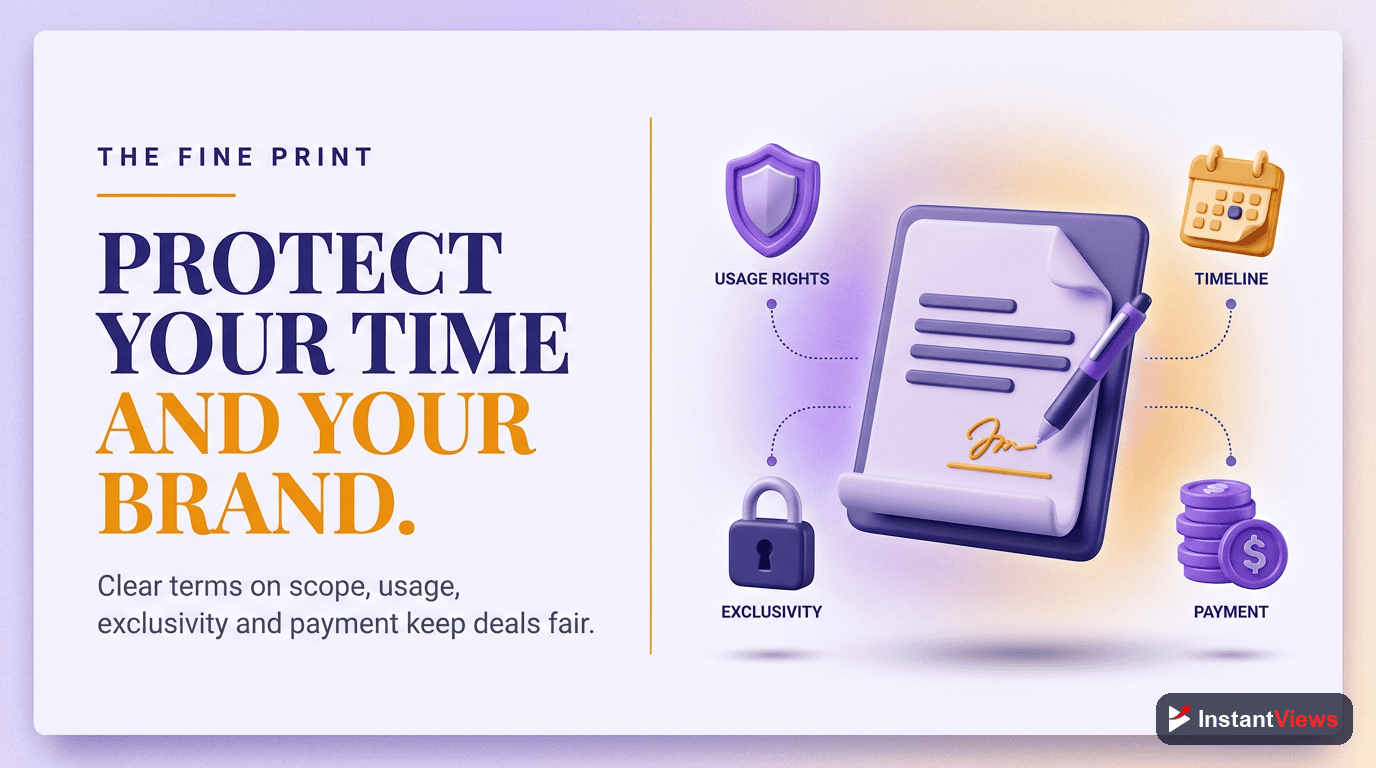
Delivering Results for Brands
Landing the deal is just the beginning. Delivering exceptional results gets you repeat deals and referrals.
Creating Effective Sponsored Content
1. Stay Authentic
Your audience can smell fake enthusiasm. Only promote products you genuinely believe in or can honestly review. Share both pros and cons - your credibility is worth more than one sponsorship.
2. Integrate Naturally
The best sponsorships don't feel like ads. Weave the brand into your content naturally:
- "I'm editing this video in Premiere Pro, but I use [Sponsor Tool] for quick social media clips..."
- "Before we get to the main tutorial, I want to show you how I organize my workflow with [Sponsor]..."
- "This entire setup runs on [Sponsor Product], which I've been using for 6 months..."
3. Provide Clear Value
Don't just say "This product is great!" Show viewers:
- Real use cases and demonstrations
- How it solved a specific problem for you
- Comparisons to alternatives (if allowed)
- Who it's perfect for (and who it's NOT for)
4. Strong Call-to-Action
Make it easy for viewers to take action:
- Clear discount code or special offer
- Link in description and pinned comment
- Mention the CTA at least twice (beginning and end)
- Create urgency if there's a limited-time offer
Post-Campaign Reporting
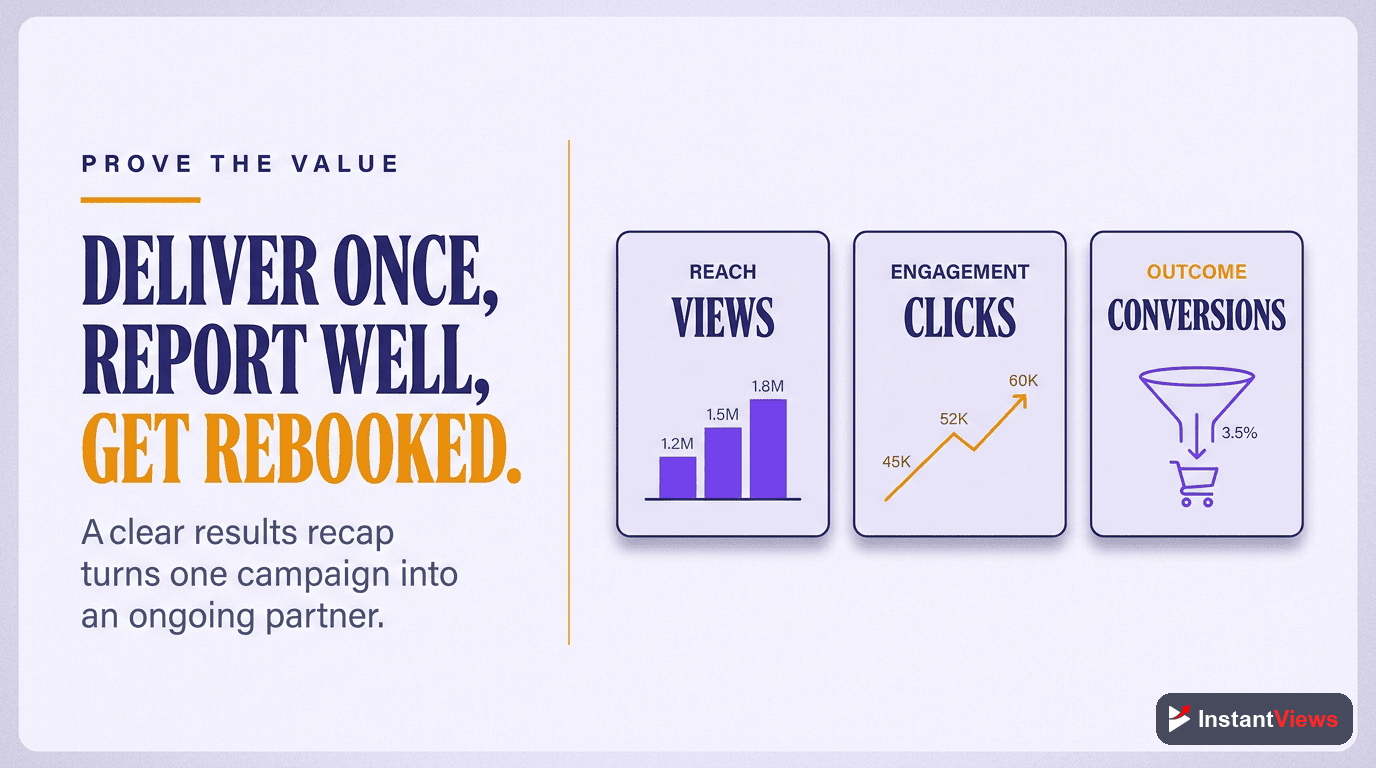
Send brands a detailed performance report 7-14 days after publishing:
Include these metrics:
- Total views and view velocity
- Average watch time percentage
- Engagement rate (likes, comments, shares)
- Click-through rate on sponsored links (if trackable)
- Conversions or sales (if you have affiliate data)
- Screenshots of YouTube Analytics
- Positive comments about the product
Over-Deliver on Value
Exceed expectations to turn one deal into a long-term partnership. Promote on extra social platforms for free. Create bonus content (photos, quotes). Share the video in relevant communities. Tag the brand in posts.
Brands will come back for repeat deals at higher rates, refer you to other brands, and post about working with you (free social proof).
Using InstantViews Video Analyzer for Brand Deals
The InstantViews Video Analyzer gives you the professional metrics brands want to see when evaluating creators.
How Video Analyzer Helps You Land More Deals
1. Detailed Audience Retention Data
Brands want to know if viewers actually watch your content or click away after 30 seconds. Show them:
- Exact retention graphs for your videos
- Where viewers drop off and where they stay engaged
- Proof that your audience watches sponsored segments
- Comparison data showing you outperform competitors
2. Engagement Analytics
Export engagement metrics that prove your audience is active and responsive:
- Engagement rate breakdowns
- Comment sentiment analysis
- Like-to-view ratios
- Share and save rates
3. Content Quality Scores
The Video Analyzer evaluates your content quality across multiple dimensions:
- Hook effectiveness (first 30 seconds)
- Pacing and content flow
- Retention patterns
- Viewer satisfaction indicators
4. Competitor Benchmarking
Show brands why you're a better investment than other creators:
- How your retention compares to niche averages
- Your engagement rate vs. competitors
- Content quality benchmarks
5. Campaign Performance Tracking
After a sponsored video goes live, use Video Analyzer to create professional performance reports:
- Detailed analytics showing exact sponsor segment performance
- Retention during sponsored content vs. rest of video
- Engagement on sponsored videos vs. your average
- Professional graphs and charts for brand reports
Adding Video Analyzer Data to Your Media Kit
Enhance your media kit with these Video Analyzer exports:
- Retention graphs - Visual proof your content keeps viewers engaged
- Performance trends - Show growth and consistency over time
- Audience insights - Demographics and viewing behaviors
- Content quality scores - Third-party validation of your production value
"Brands don't just buy views - they buy engaged, attentive audiences. The data from InstantViews Video Analyzer proves you deliver both."
Building Long-Term Brand Partnerships
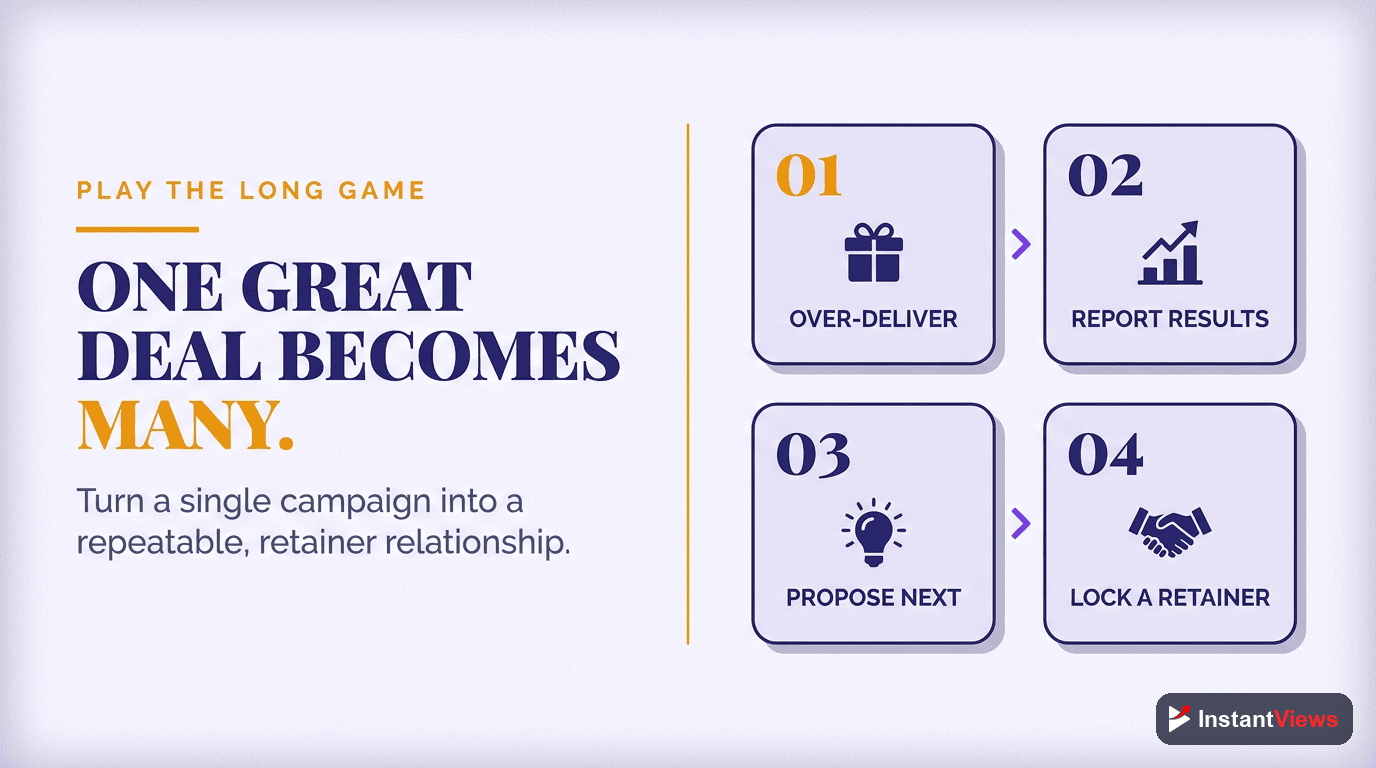
One-off deals are good. Long-term partnerships are life-changing.
How to turn sponsors into ongoing relationships:
- Deliver exceptional results - Every single time, no exceptions
- Communicate proactively - Send updates before they ask
- Share ideas - Pitch new campaign concepts, formats, collaborations
- Be reliable - Hit deadlines, respond quickly, stay professional
- Grow together - As your channel grows, negotiate rate increases
Long-term partnerships often include:
- Monthly retainer fees ($2,000-$20,000+/month)
- Quarterly campaign packages
- Exclusive product launches
- Affiliate commission on top of flat fees
- Speaking opportunities at brand events
Become a Brand Ambassador
After 2-3 successful campaigns with a brand, pitch a formal ambassador program. Offer to create monthly content, attend events, and represent the brand exclusively in your niche.
12-month contract: 1 dedicated video per month, 4 social media posts per month, 2 live event appearances, exclusive category partnership. Total: $50,000-$150,000/year depending on channel size.
Frequently Asked Questions
While there's no strict minimum, most brands start considering creators with 10,000+ subscribers. However, micro-influencers (1,000-10,000 subscribers) can land deals if they have high engagement rates and a niche audience. Focus on engagement rate, audience demographics, and content quality rather than just subscriber count.
A common formula is $10-$50 per 1,000 views, depending on your niche and engagement. For example, if your videos average 50,000 views, charge $500-$2,500 per sponsored video. Tech, finance, and B2B niches command higher rates ($30-$100 CPM), while entertainment niches are typically $10-$30 CPM. Always factor in video production time, usage rights, and exclusivity clauses.
Start with influencer marketing platforms like AspireIQ, Grapevine, and Creator.co. Join brand deal communities on Discord and Facebook. Reach out directly to brands you genuinely use via email or LinkedIn. Create a media kit and sponsorship page on your website. Network at industry conferences and creator events. Many creators find their first deals by pitching brands they already feature organically in their content.
Your contract should specify: payment amount and schedule, deliverables (number of videos, social posts, etc.), content requirements and brand guidelines, creative freedom and approval process, usage rights and exclusivity period, performance guarantees (if any), FTC disclosure requirements, termination clauses, and payment terms. Always have a lawyer review contracts for deals over $5,000 or with complex terms.
FTC guidelines require clear disclosure. Include "#ad" or "#sponsored" in the video title or first line of description. Verbally disclose the sponsorship in the first 30 seconds of the video. Use YouTube's "Paid Promotion" checkbox in video settings. Be transparent and specific - "This video is sponsored by [Brand]" is better than vague terms like "partner" or "collaboration." Disclosure must be impossible to miss.
The Video Analyzer provides detailed metrics that brands want to see: exact audience retention graphs, engagement rate breakdowns, demographic insights, and content performance data. Use these analytics in your media kit to prove your content quality and viewer engagement. The tool helps you optimize videos for maximum watch time and retention - key metrics brands evaluate when choosing creators to sponsor.