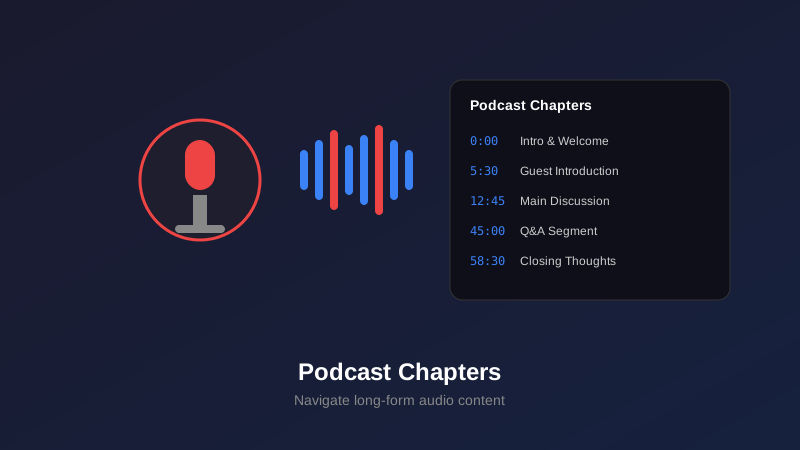
- Podcast chapters increase listener retention by 45-60% through improved navigation
- Chapters boost YouTube podcast discoverability by appearing as Google Key Moments
- Interview podcasts need 6-10 topic-based chapters, solo podcasts 8-12 narrative chapters
- Strategic chapter titles targeting keywords improve search rankings by 40-60%
- Long-form podcasts (2+ hours) benefit most from detailed chapter breakdowns
YouTube has become the second-largest podcast platform after Spotify, with over 455 million people watching podcasts on YouTube every month. But here's the problem: most podcasters upload hour-long episodes without chapters, forcing listeners to scrub through endless content to find the moments they care about.
Chapters solve this. They transform your podcast from a monolithic audio wall into a navigable, searchable, discoverable piece of content that serves both algorithm and audience.
This guide covers everything you need to know about podcast chapters on YouTube—from basic implementation to advanced SEO strategies that get your episodes discovered by thousands of new listeners.
Why Podcasts Need Chapters on YouTube
YouTube treats podcasts differently than traditional video content. Viewers watch podcasts for information, not entertainment—which fundamentally changes how the algorithm evaluates performance.
Podcast episodes with chapters see 45-60% higher retention rates because listeners can:
- Skip to relevant sections: Jump directly to topics they care about
- Return to key moments: Bookmark specific timestamps for later reference
- Sample before committing: Preview different sections before watching the full episode
- Share specific moments: Link friends to exact discussions rather than full episodes
The Discoverability Advantage
Chapters dramatically improve how podcasts appear in search results:
Google displays podcast chapters as "Key Moments" in search results, giving your episode multiple entry points instead of one. A single episode can rank for 8-12 different search queries simultaneously.
This is massive for podcasters. Traditional episodes compete for one keyword. Chaptered episodes compete for every topic discussed—exponentially increasing discoverability.
Podcast Chapters vs Video Chapters
Podcast chapters require different strategy than standard video chapters. Here's why:
| Aspect | Video Chapters | Podcast Chapters |
|---|---|---|
| Primary Goal | Guide viewers through visual segments | Enable topic-based navigation |
| Chapter Length | 2-5 minutes average | 5-10 minutes average |
| Naming Style | Action-based ("How to Setup") | Topic-based ("Marketing Strategies") |
| SEO Focus | Tutorial keywords | Question keywords |
| Viewer Behavior | Linear watching | Jump to specific topics |
Podcast listeners treat chapters as a table of contents. They want to know "what topics are covered" not "what happens next." Your chapter structure should reflect this search-and-consume behavior.
Interview Podcast Chapter Structure
Interview podcasts have natural chapter breaks built into the conversation. Here's how to structure them effectively:
Interview Podcast Chapter Framework
Optimal Structure for 45-60 minute interviews:
- 0:00 - Guest Introduction (2-4 min) — Include guest name and expertise in title
- 3:30 - [Guest] Background & Journey (6-8 min) — How they got started
- 11:00 - Main Topic #1 (8-12 min) — Biggest discussion point
- 22:30 - Main Topic #2 (8-12 min) — Second major theme
- 34:00 - Key Lessons Learned (6-10 min) — Actionable takeaways
- 43:00 - Rapid Fire Questions (4-6 min) — Quick insights
- 48:30 - Where to Find [Guest] (2-3 min) — Links and CTAs
Why this works:
- Listeners can skip intros and jump straight to main topics
- Each chapter title includes searchable keywords
- Background section lets new listeners learn context
- Rapid fire section provides highlight-reel moments for clips
Question-Based Chapter Titles
For interview podcasts, consider structuring chapters as questions. This matches how users search:
| Generic Title | Question-Based Title | Why Better |
|---|---|---|
| Marketing Discussion | How to Scale Marketing on a Budget | Matches actual search queries |
| Career Advice | How [Guest] Built a 7-Figure Business | Specific, intriguing, keyword-rich |
| Industry Trends | Is AI Replacing [Industry] Jobs? | Addresses viewer concerns directly |
| Personal Story | Why [Guest] Quit Their $500K Job | Curiosity-driven with authority signal |
Don't name chapters "Part 1, Part 2, Part 3." This provides zero context and zero SEO value. Every chapter should clearly communicate what's discussed in that segment.
Solo Podcast Chapter Structure
Solo podcasts (monologue format) need narrative-driven chapters that follow your teaching structure:
Solo Podcast Chapter Framework
Structure for 30-45 minute solo episodes:
- 0:00 - Episode Overview (1-2 min) — What you'll cover
- 2:00 - Why This Matters (3-5 min) — Problem statement
- 6:30 - Key Concept #1 (6-8 min) — First main teaching point
- 14:00 - Key Concept #2 (6-8 min) — Second main point
- 22:00 - Key Concept #3 (6-8 min) — Third main point
- 30:00 - Real-World Example (5-7 min) — Case study or story
- 36:30 - Common Mistakes to Avoid (4-6 min) — What not to do
- 42:00 - Action Steps & Recap (3-5 min) — Implementation guide
Why this structure works:
- Creates a clear learning path listeners can follow
- Each concept stands alone for topic-specific searches
- Examples and mistakes sections are highly shareable
- Recap chapter increases completion rate
Storytelling Podcast Chapters
For narrative or story-driven solo podcasts, use arc-based chapters:
- The Setup: Introduce the situation or story context
- The Problem: What went wrong or what's at stake
- The Journey: How you navigated the challenge (2-3 chapters)
- The Turning Point: Critical moment or revelation
- The Resolution: How things ended
- The Lesson: What listeners can learn from your experience
This narrative structure keeps listeners engaged while providing clear navigation points for those who want to skip ahead to specific story beats.
Generate Podcast Chapters Instantly
Our AI tool creates optimized chapter timestamps for podcast episodes in seconds. Perfect for interview and solo podcasts.
Try Free Podcast Chapter Generator →Timestamping Podcast Highlights
Beyond structural chapters, podcasts benefit from highlight timestamps—key moments worth calling out specifically.
Types of Podcast Highlights to Timestamp
Golden Nuggets
Controversial Takes
Personal Stories
Specific Tactics
Funny Moments
Highlight Timestamp Strategy
Mix structural chapters with highlight timestamps:
0:00 Introduction
2:45 Sarah's Background in E-commerce
8:20 Why Most Dropshippers Fail
15:30 The Product Research Framework
19:45 🔥 HIGHLIGHT: How to Find Winning Products in 20 Minutes
27:10 Scaling From $1K to $100K/Month
35:50 Common Mistakes to Avoid
40:15 💎 GOLDEN NUGGET: The One Metric That Matters
48:00 Where to Find Sarah
Using emoji markers (🔥, 💎, ⚡) helps highlights stand out in the description, increasing click-through rates on those specific moments.
Chapters for Long-Form Podcasts (2+ Hours)
Long-form podcasts (Joe Rogan style) absolutely require chapters. Without them, you're asking listeners to commit 2+ hours blind.
Long-Form Chapter Strategy
For 2-3 hour podcasts, use 12-20 chapters with these principles:
- Major topic changes: New subjects deserve new chapters (5-10 min sections)
- Conversation pivots: When discussion shifts direction significantly
- Segment markers: Debates, stories, rapid-fire sections, Q&As
- Time-based breaks: Hourly summary chapters for ultra-long episodes
Example: 2-Hour Interview Podcast
| Timestamp | Chapter Title | Duration |
|---|---|---|
| 0:00 | Introduction & What to Expect | 3 min |
| 3:15 | Guest Background & Origin Story | 12 min |
| 15:30 | Early Career Mistakes & Lessons | 18 min |
| 33:45 | The Breakthrough Moment | 8 min |
| 41:20 | Building a Team From Zero | 14 min |
| 55:10 | Scaling to 8 Figures | 16 min |
| 1:11:30 | Industry Predictions for 2025 | 11 min |
| 1:22:40 | Controversial Opinion on [Topic] | 9 min |
| 1:31:25 | Work-Life Balance Reality | 13 min |
| 1:44:50 | Rapid Fire Round | 7 min |
| 1:51:35 | Final Advice for Beginners | 6 min |
| 1:57:20 | Where to Connect & Resources | 3 min |
Notice how chapter lengths vary based on content importance. Critical topics get 15-20 minutes, transitional segments get 3-8 minutes.
Don't create 40+ micro-chapters just because your podcast is long. Too many chapters overwhelms viewers and dilutes keyword focus. Aim for 8-10 minute average chapter length regardless of total runtime.
Podcast Chapter Tools & Automation
Creating chapters manually for every podcast episode is time-consuming. Here are tools that automate the process:
AI-Powered Chapter Generation Tools
Top Podcast Chapter Tools (2025)
1. InstantViews Timestamp Generator (Free)
- AI analyzes your podcast audio and generates chapters automatically
- Optimizes chapter titles for YouTube SEO
- Exports in YouTube-ready format
- Works for podcasts up to 4 hours long
2. Descript ($12-24/month)
- Transcription + automatic chapter markers
- Edit chapters by editing transcript
- Export timestamps directly to YouTube description
- Best for video podcasts with visual editing needs
3. OpusClip ($9-29/month)
- AI finds viral moments and creates chapters around them
- Generates short clips from long episodes
- Good for highlight-based chapter strategy
4. Headliner (Free-$19/month)
- Audiogram creation + chapter timestamps
- Social media optimization for podcast clips
- Works well for audio-only podcasts
Manual vs Automated Chapters
Best workflow: Use AI to generate initial chapters, then manually refine titles for SEO and clarity. This combines speed with quality.
SEO Optimization for Podcast Chapters
The difference between chapters that get discovered and chapters that don't comes down to SEO optimization.
Keyword Research for Podcast Chapters
Use YouTube Search Autocomplete
Check "People Also Ask" on Google
Analyze Competitor Podcast Chapters
Target Long-Tail Keywords
Chapter Title SEO Formula
Use this formula for maximum searchability:
[Action Word] + [Specific Topic] + [Qualifier]
Examples:
- "How to Build an Email List From Scratch"
- "Best Podcast Equipment Under $500"
- "Why Most Content Marketing Fails"
- "5 Ways to Monetize Your Podcast in 2025"
| Weak Title | SEO-Optimized Title | Why Better |
|---|---|---|
| Marketing Tips | 3 Marketing Strategies That Generated $100K | Specific, result-oriented, keyword-rich |
| Guest Background | How [Name] Built a 7-Figure SaaS | Includes achievement and industry keyword |
| Q&A Session | Answering Your Top Productivity Questions | Targets question-based searches |
| Final Thoughts | Action Steps to Implement Today | Action-oriented with immediacy |
Placement in Description
Where you place chapters in your description matters for SEO:
- Top 3 lines: Brief episode summary with target keywords
- Lines 4-6: Guest bio or episode context
- Line 7+: Chapter timestamps (starting with 0:00)
- Below chapters: Links, CTAs, social media
YouTube reads the first 150 characters for SEO ranking. Put your most important keywords there, then follow with chapters.
Optimize Your Podcast for Search
Get AI-generated, SEO-optimized chapter titles that improve discoverability and search rankings. Free for all podcasters.
Generate SEO Chapters Now →Frequently Asked Questions
Yes, chapters benefit every podcast format. They help listeners jump to specific topics, increase discoverability through search, and significantly improve audience retention. Even short 15-20 minute episodes benefit from 3-5 strategic chapters.
For a 60-minute podcast, aim for 8-12 chapters. Interview podcasts work best with 6-10 topic-based chapters, while solo podcasts benefit from 8-12 chapters breaking down your narrative. Each chapter should be 3-8 minutes long for optimal navigation.
Chapters create multiple entry points in search results through Google Key Moments. Each chapter title is indexed as searchable content, allowing your episode to rank for various topics covered. This can increase search visibility by 40-60% compared to episodes without chapters.
Yes. Interview podcasts should use topic-based chapters highlighting questions and discussion points. Solo podcasts work better with narrative-driven chapters that break down your teaching points or story arc. Both should include timestamps for key moments and highlights.
Yes, AI tools can analyze your podcast audio and generate chapters automatically. However, manually refining chapter titles for SEO and clarity produces better results. Hybrid approach works best: auto-generate timestamps, then optimize titles for search and engagement.
Keep chapter titles between 30-50 characters. This ensures they display fully in search results and on mobile devices. Front-load important keywords while maintaining natural readability. Example: "SEO Strategies for Podcasters" not "Discussion About Various Different SEO Strategies."
Absolutely. Long-form podcasts benefit most from chapters. For 2+ hour episodes, use 12-20 chapters to break content into digestible sections. This is critical for audience retention and allows listeners to bookmark specific moments for later viewing.
Yes, but use strategic labeling. Mark sponsor segments clearly (e.g., "Sponsor: BrandName") so listeners can skip if desired. Always include an outro chapter to capture full watch time. Transparency builds trust and improves overall user experience.
Final Thoughts
Podcast chapters are no longer optional—they're essential infrastructure for YouTube podcast success. They improve retention, boost discoverability, and multiply your search ranking opportunities.
Key implementation points:
- Interview podcasts: 6-10 topic-based chapters with question titles
- Solo podcasts: 8-12 narrative-driven chapters following your teaching arc
- Long-form content: 12-20 chapters breaking 2+ hour episodes into digestible segments
- SEO optimization: Use keyword-rich titles that match search intent
- Highlight timestamps: Mark golden nuggets, stories, and tactical advice
Start by adding chapters to your next 3 episodes and monitor the analytics. You'll see improved retention, increased search traffic, and better audience engagement within 2-4 weeks.
The podcasters winning on YouTube aren't just creating great content—they're making that content accessible, searchable, and navigable. Chapters are how you do all three simultaneously.
Related guides:
- How to Add Chapters to YouTube Videos (Complete Guide)
- YouTube Chapters SEO Benefits: How Timestamps Improve Rankings
- Best YouTube Chapter Length Guide


