- View count is an output of the algorithm choosing your video, not the main input it ranks on
- View velocity — how fast views arrive in the first hours — helps a video earn a wider audience
- Click-through rate, retention, and satisfaction signals matter far more than raw view count
- A view count works mainly as social proof that can nudge a few extra human clicks
- Buying views backfires: fake traffic crushes retention, gets purged, and suppresses reach
Every creator watches the view counter. It is the most visible number on YouTube, the first thing a stranger sees under your title, and the metric we instinctively treat as the scoreboard of success. With more than 2.7 billion monthly active users and roughly a billion hours of video watched every day, the platform makes that number feel like the whole game. So a reasonable question follows: does a high view count make YouTube recommend your video more?
The honest answer is more subtle than yes or no. View count does influence recommendations — but mostly indirectly, and far less than most creators assume. The algorithm cares about whether people who see your video click it, stay for it, and feel satisfied afterward. View count is the visible shadow those deeper signals cast, not the thing being measured directly.
This guide untangles the relationship. You will learn what view count and view velocity actually signal to YouTube in 2026, why click-through rate, retention, and satisfaction carry far more weight, and why the popular shortcut of buying views does the exact opposite of what people hope.
By the end you will know which numbers to chase, which to ignore, and how to grow a view count that rises because the underlying signals are healthy — not because you forced it.
- View Count Is an Output, Not an Input
- Where View Count Genuinely Helps: Social Proof
- View Velocity: Why Early Momentum Matters
- The Signals That Matter More Than Views
- How Much Each Signal Matters
- A Worked Example: Two Videos, Same Views
- The Buy-Views Myth: Why Fake Views Hurt
- How to Earn the Signals That Drive Views
- View-Count Mistakes to Avoid
- FAQ
View Count Is an Output, Not an Input
The single most useful mental shift you can make is this: a high view count is a result of the algorithm liking your video, not a reason it likes your video. YouTube does not sort a recommendation queue by who has the most views and serve those first. Instead, for every potential viewer, it predicts how satisfied that specific person is likely to be with your video, then shows the videos with the highest predicted satisfaction.
The recommendation system runs on personalization. Two people opening YouTube at the same moment see almost entirely different home feeds, because the algorithm is matching each individual to videos it believes they will enjoy. Within that system, your view count is one of many features — and a weak one compared to what people actually do when they see your video.
Think of it the way a restaurant works. A long line outside hints that the food might be good, and it may tempt a passerby to join. But the line does not make the food taste better, and a restaurant that pays actors to stand outside still serves empty tables once people walk in and leave. YouTube watches what happens after the click far more closely than the crowd at the door.
This is why videos with millions of views can quietly stop being recommended, while a video with a few thousand views keeps climbing. The counter measures history; the algorithm is busy predicting the next viewer's experience.

Where View Count Genuinely Helps: Social Proof
None of this means view count is worthless. It carries real weight in one specific place: the human decision to click. When a viewer scans a row of thumbnails, a healthy view count acts as social proof — a signal that other people found this video worth their time. That can tip a hesitant viewer into clicking, which lifts your click-through rate.
Notice the chain of cause and effect, though. View count influences the human, the human's click influences the algorithm, and the algorithm influences distribution. View count never speaks to the algorithm directly here; it works through your CTR. That is a crucial distinction, because it means the benefit is real but capped: social proof can win a few extra clicks, but it cannot rescue a video that fails to hold the viewers it earns.
When Social Proof Helps Most
- Crowded niches: When many similar videos compete, a stronger view count can be the tiebreaker that earns the click.
- Search results: Viewers comparing options often gravitate toward the result that looks most validated.
- Authority topics: For tutorials, reviews, and how-to content, viewers use view count as a rough proxy for trustworthiness.
When Social Proof Barely Matters
- The home feed: Personalized suggestions are driven by predicted satisfaction, where your own retention history outweighs a raw count.
- Brand-new uploads: A fresh video has little or no view count to lean on, so packaging and the first 30 seconds carry the load.
- Loyal-audience content: When your subscribers already trust you, the count adds little to their decision.
View Velocity: Why Early Momentum Matters
If raw view count is a weak signal, view velocity is a more interesting one. Velocity is the rate at which a video gathers views relative to the impressions it receives, especially in the opening hours and days after publishing. It is less about the total and more about the slope of the curve.
When you publish, YouTube shows the video to a small test audience — often a slice of your subscribers and a handful of suggested-video and search placements. It then watches closely. If that early audience clicks at a healthy rate and keeps watching, the algorithm reads strong velocity and expands the test to a larger group. Repeat that a few times and a video snowballs. Fail the early test and distribution quietly tapers off.
This is why the launch window feels so consequential, and why momentum is a recurring theme in channel growth. But it is important to be precise about what velocity actually rewards. The algorithm is not impressed by views arriving quickly for their own sake. It is reading the quality of those early views: are people clicking, and are they staying? Velocity is a useful shorthand for early CTR and retention working together — not a separate number you can game.
What Drives Healthy Velocity
- An engaged core audience: Subscribers and notification-bell viewers who reliably click early give the algorithm clean, fast signal.
- Packaging that earns the click: A strong title and thumbnail convert the first impressions into the views that start the snowball.
- A hook that holds: Early viewers who stay past the first 30 seconds confirm the video is satisfying, so YouTube widens the audience.
One reassuring nuance: a slow start is not a death sentence. YouTube continues testing videos for weeks and can revive an older upload whose retention and satisfaction are strong once a new audience discovers it through search or suggestions. Velocity opens the door faster, but durable performance comes from the signals underneath it.

The Signals That Matter More Than Views
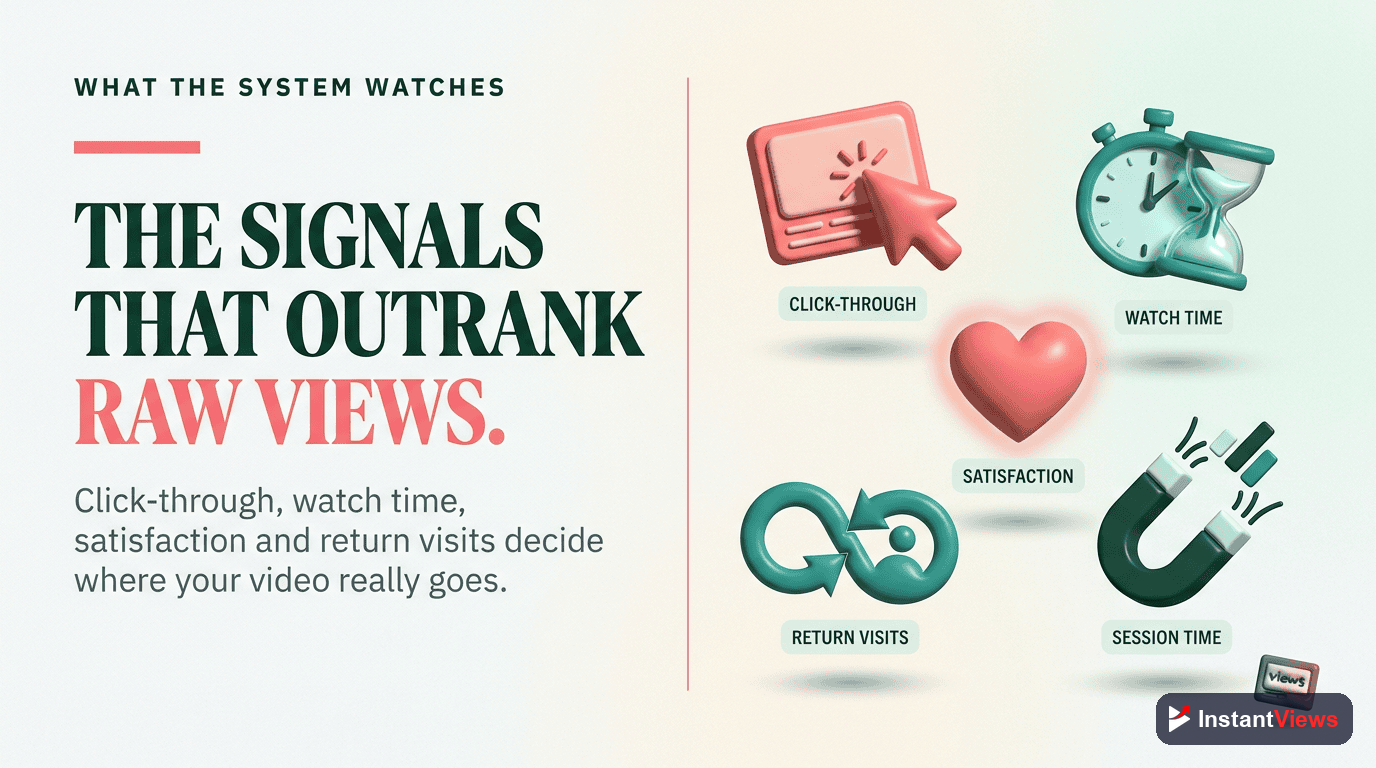
So if view count is a weak input and velocity is really a proxy, what does the algorithm weigh most heavily in 2026? The platform optimizes for predicted viewer satisfaction, and a handful of measurable signals feed that prediction.
Click-Through Rate (CTR)
CTR answers a simple question: of the people who saw your thumbnail, how many clicked? It is the first gate every video must pass. If nobody clicks, no other signal gets a chance to fire. A strong title-and-thumbnail combination earns the click; a confusing or misleading one wastes the impression.
Audience Retention and Average View Duration
Once a viewer clicks, retention measures whether they stay. This is the heaviest gate of all. In 2026, retention matters more than raw watch time — a shorter video that holds attention to the end can outperform a longer one viewers abandon. First-30-second retention in particular has been promoted from a diagnostic metric to a core ranking input, because viewers who stay engaged early are far more likely to finish, share, and rate the video well.
Satisfaction Signals
The biggest shift in recent years is the rise of explicit satisfaction. YouTube now leans on signals such as returning-viewer rate, shares, and post-watch survey responses to judge whether people genuinely valued a video — not just whether they tolerated it. A video can rack up watch time and still score poorly if viewers would not recommend it. Satisfaction now outweighs raw watch time as a primary ranking input.
Do not optimize a single signal at the expense of the others. Clickbait can spike CTR while torching retention as disappointed viewers bail. The algorithm reads the whole picture, and an unbalanced video — great at one signal, poor at the rest — almost always stalls.
How Much Each Signal Matters
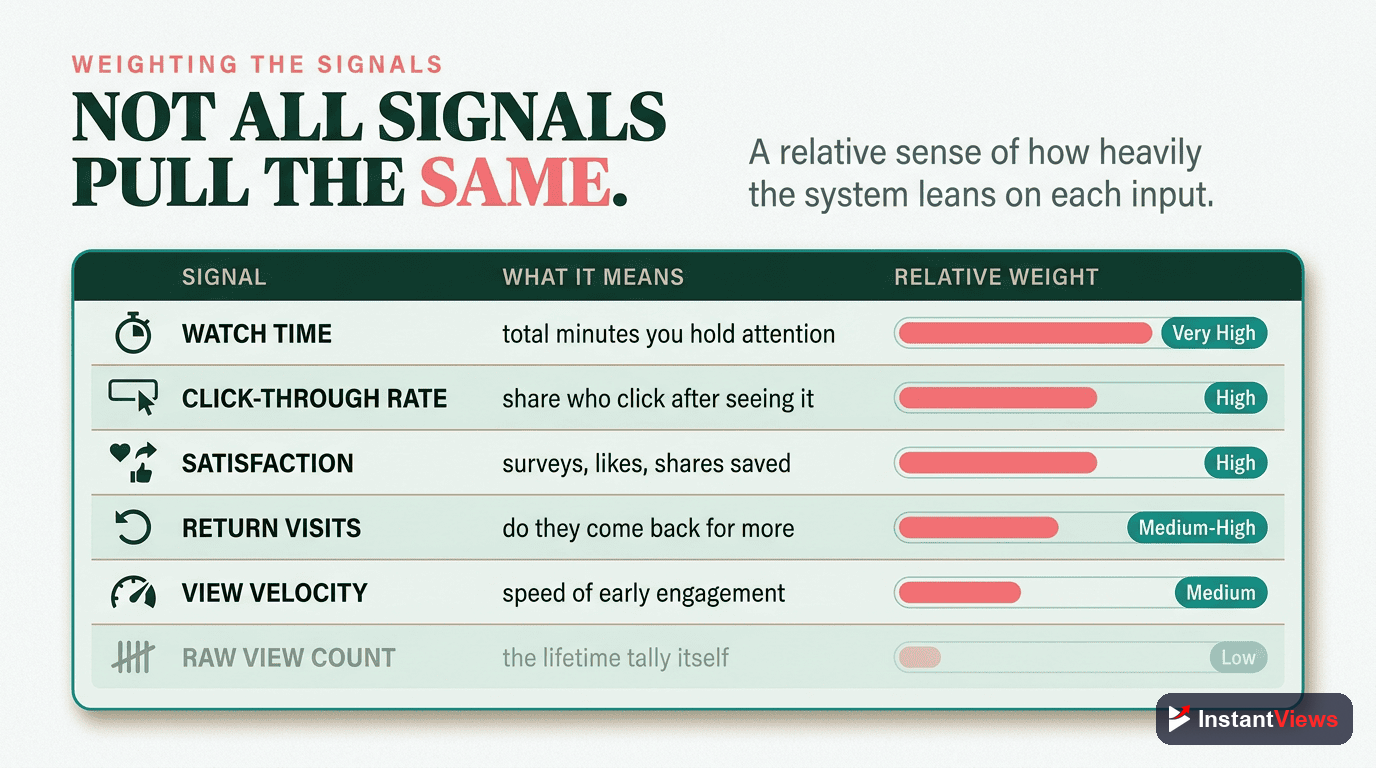
The exact weights inside YouTube's models are private and shift over time, but the platform's public guidance and creator-facing tools point to a clear hierarchy. The table below summarizes how much each factor tends to influence recommendations in 2026 — and where view count actually sits.
| Signal | How much it matters |
|---|---|
| Audience retention (incl. first 30 seconds) | Very high — the heaviest gate; a core ranking input |
| Viewer satisfaction (returns, shares, surveys) | Very high — now outweighs raw watch time |
| Click-through rate | High — the first gate; no clicks means no distribution |
| View velocity (early CTR + retention) | Moderate — accelerates testing, but reflects deeper signals |
| Raw view count | Low (direct) — mainly social proof that nudges human CTR |
| Fake / bought views | Negative — collapses retention, gets purged, suppresses reach |
Read top to bottom, the message is consistent: what viewers do with your video governs its fate, and the count is a downstream reflection of that behaviour. Chase the rows at the top, and the view count takes care of itself.
A Worked Example: Two Videos, Same Views
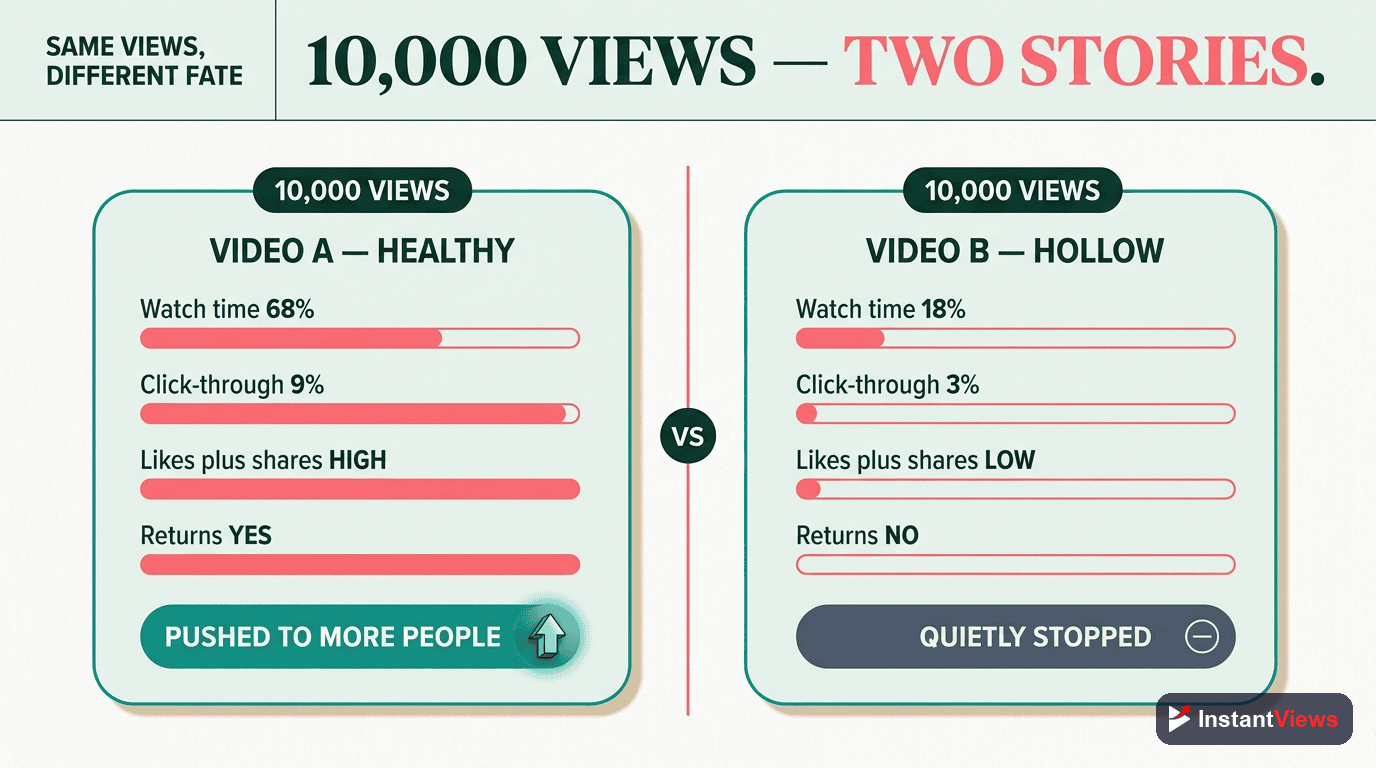
Numbers make this concrete. Imagine two videos that both reach exactly 10,000 views in their first week. On the surface they look identical. Under the hood, the algorithm sees two very different stories.
Video A: Strong Signals
- CTR: a healthy click-through rate that turns impressions into views efficiently.
- Retention: most viewers stay well past the 30-second mark and a large share finish.
- Satisfaction: viewers share it, return for more, and rate it well in surveys.
- Result: YouTube keeps widening the audience. Week two brings more impressions than week one, and the 10,000 becomes 40,000.
Video B: Weak Signals
- CTR: a clickbait thumbnail earned the same early clicks.
- Retention: viewers feel misled and drop off fast, so average view duration is poor.
- Satisfaction: few shares, few returns, lukewarm survey responses.
- Result: impressions shrink within days. The video stalls near 10,000 and stops being recommended.
Same headline number, opposite trajectories. The view count told you almost nothing about which video the algorithm would back. The signals underneath told you everything. This is exactly why two creators can post videos with identical view counts and watch one snowball while the other flatlines.
"The view counter records where a video has been. The algorithm is busy predicting where the next viewer will go — and it reads retention and satisfaction, not the scoreboard, to make that call."
The Buy-Views Myth: Why Fake Views Hurt
Once you understand that view count is mostly social proof, the temptation to simply buy some is obvious. If a bigger number nudges human clicks, why not inflate it? Because fake views do the opposite of what you want, and the damage outlasts the brief vanity bump.
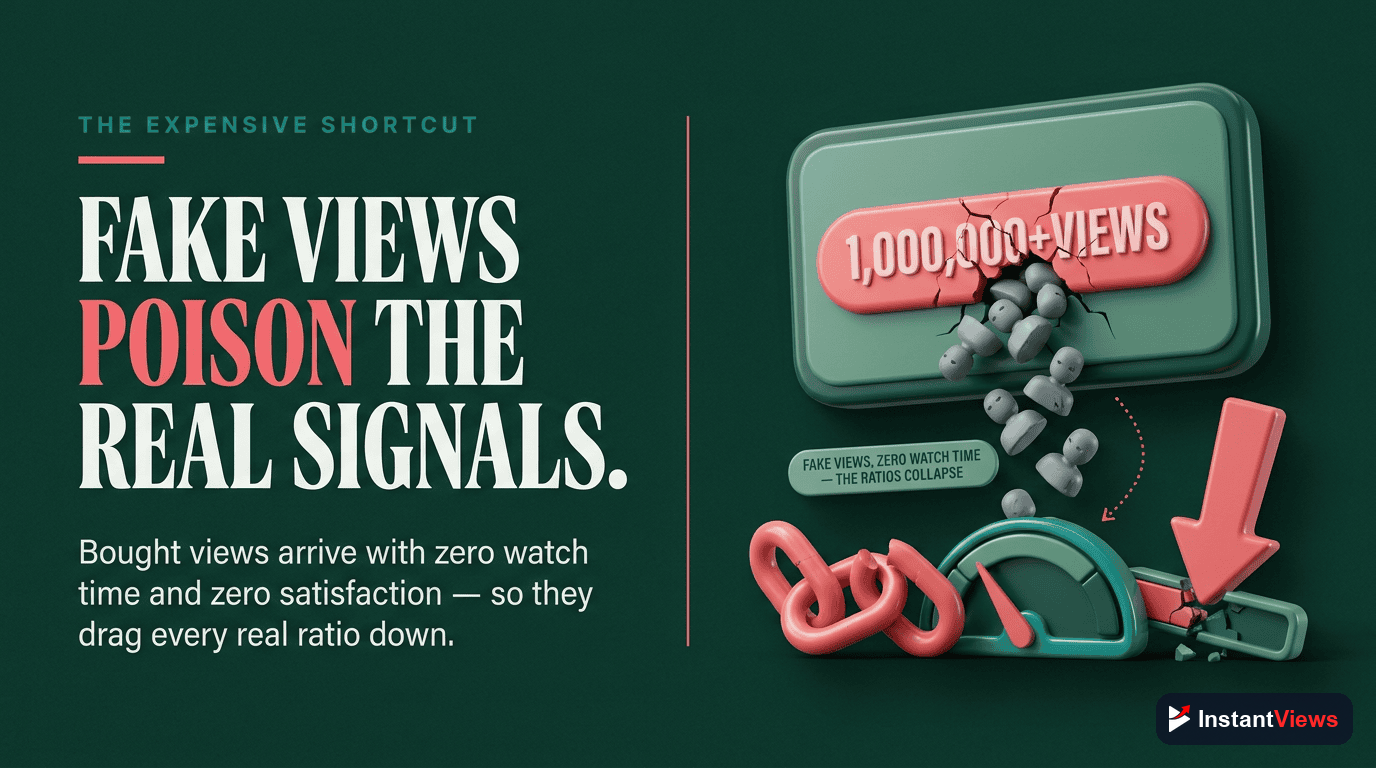
Bought and bot views do not behave like real people. They typically drop off within seconds, which means they pour ice water on your retention — the very signal that matters most. The algorithm sees a video that suddenly gained views but cannot hold attention, and it reads that as a video viewers do not enjoy. So it pulls back distribution exactly when you wanted more.
YouTube also actively hunts artificial traffic. Its systems detect fake engagement with very high accuracy, and the platform purges artificial views continuously — so the count you paid for often evaporates anyway. Worse, a channel flagged for inflated metrics can see future uploads limited in reach automatically, lose monetization, or face suspension under the fake-engagement policy.
What Actually Happens When You Buy Views
- The count spikes briefly and looks impressive for a day or two.
- Retention craters as fake viewers bail in seconds, dragging down your average view duration.
- Impressions fall as the algorithm concludes the video is not satisfying.
- Views get purged as detection systems strip out the artificial traffic.
- Trust erodes — in the worst case the whole channel is flagged for suspicious activity.
The parallel platform trend reinforces the point. YouTube has been reducing the spread of low-value, mass-produced content and purging billions of artificial views, signalling clearly that it rewards genuine human satisfaction and punishes anything engineered to fake it. Inflating a counter swims directly against that current.
How to Earn the Signals That Drive Views
The productive path is to grow a view count that rises because the real signals are healthy. Here is a simple sequence that improves the metrics the algorithm actually rewards.
Earn the Click With Honest Packaging
Design a clear, curiosity-driven title and thumbnail that promise something specific. Strong packaging lifts CTR and turns impressions into views — without the bait-and-switch that wrecks retention.
Hook Viewers in the First 30 Seconds
Open by confirming the promise of the title and removing any reason to click away. First-30-second retention is a core ranking input, so the opening seconds do disproportionate work.
Hold Attention to Protect Retention
Keep the pacing tight and deliver real value throughout. High average view duration is the heaviest gate, so cut filler and earn every minute the viewer gives you.
Earn Satisfaction and Return Visits
Give viewers a reason to like, share, and come back. Returning-viewer rate, shares, and positive survey responses now drive distribution as much as anything else.
Review Early Performance and Iterate
Watch CTR and retention in the first hours and days. Find the weakest signal, improve it on your next upload, and let the view count rise as a by-product.
Optimize the Signals That Matter
Use our free suite of YouTube tools to research topics, sharpen your titles and thumbnails, and analyze the click-through and retention metrics that actually move recommendations.
Explore Free YouTube Tools →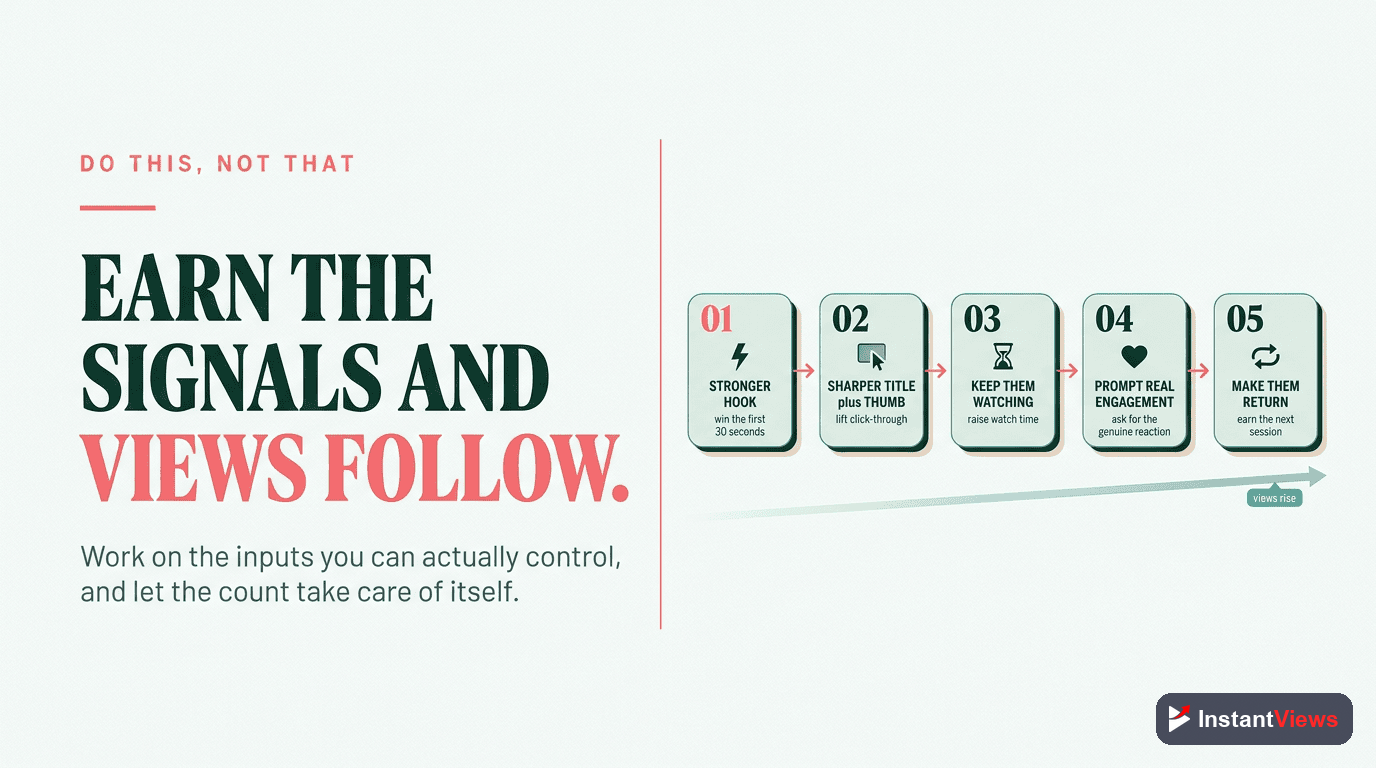
View-Count Mistakes to Avoid
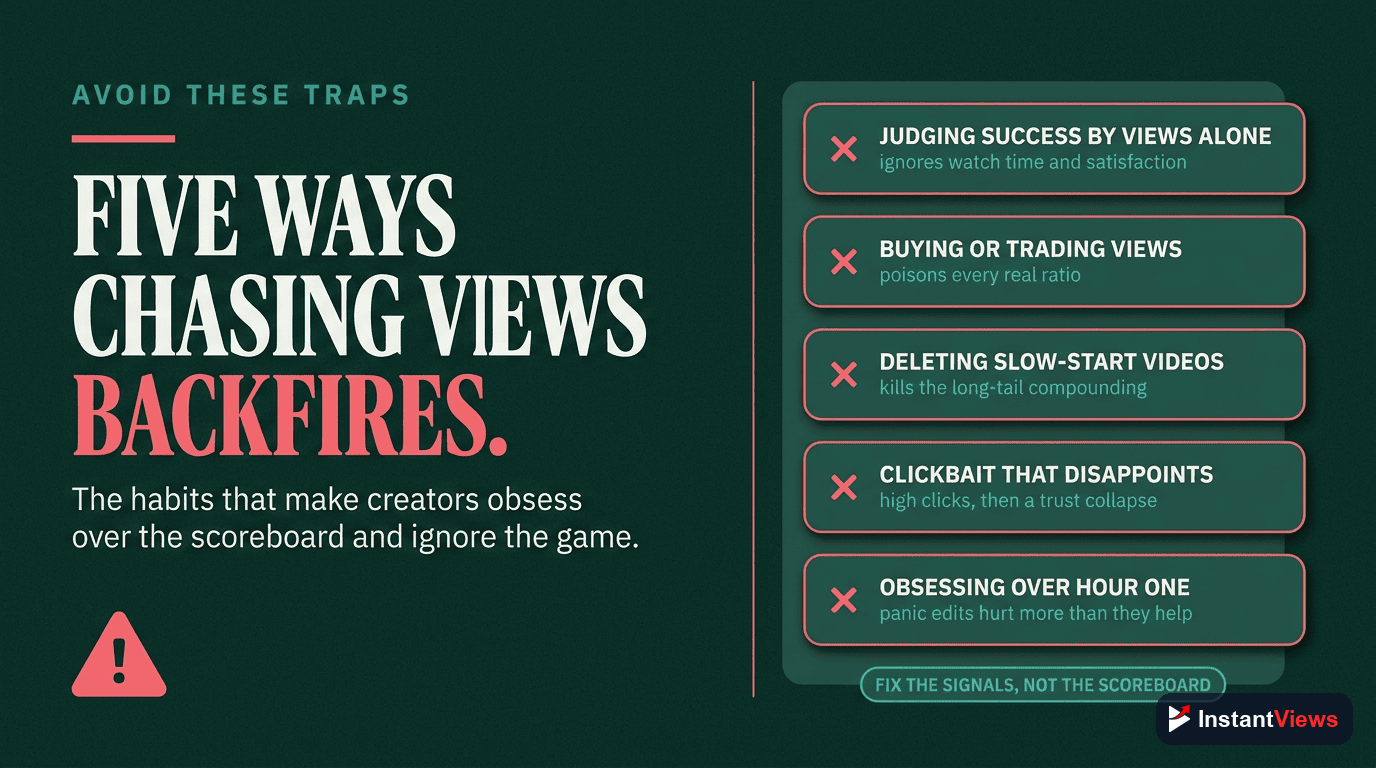
Even experienced creators misread the view counter. Watch out for these traps:
- Treating views as the goal: Views are a by-product of satisfied viewers. Optimize the experience and the number follows; optimize the number and you usually break the experience.
- Buying views for social proof: The short-lived bump is dwarfed by the retention collapse, purges, and reach suppression that follow.
- Panicking over a slow start: Velocity helps, but YouTube keeps testing for weeks. Strong retention can revive an older video at any time.
- Ignoring retention to chase CTR: Clickbait wins the click and loses the viewer, leaving you with high views and dying distribution.
- Comparing raw counts across videos: Two videos with the same views can have opposite futures. Compare retention and satisfaction instead.
- Forgetting the human: Social proof still matters to the person deciding whether to click — just remember it works through CTR, not directly on the algorithm.
"Stop asking how to get more views. Start asking how to satisfy more viewers. The first question chases a number; the second earns it."
Frequently Asked Questions
Not directly. View count is an output of the algorithm choosing to show your video, not the main input it ranks on. The algorithm decides who to recommend a video to based on predicted satisfaction — click-through rate, retention, and post-watch behaviour. A high view count can add social proof that nudges a few more clicks, but it never overrides weak retention.
View velocity is how quickly a video gathers views relative to its impressions, especially in the first hours and days. The algorithm watches early performance closely: if a freshly shown video earns strong clicks and watch time, it expands the test audience. That momentum matters — but it is the underlying CTR and retention driving it, not the raw count itself.
It hurts. Bought or bot views behave nothing like real viewers — they drop off within seconds, crushing your retention. YouTube detects artificial traffic with very high accuracy, purges those views, and can suppress reach or suspend the channel. A spike in count with collapsing retention tells the algorithm the video is not satisfying, so it stops recommending it.
Click-through rate, average view duration and retention, and viewer satisfaction signals (returning-viewer rate, shares, and survey responses) all outweigh raw view count. In 2026 YouTube optimises for predicted viewer satisfaction, with retention mattering more than raw watch time and first-30-second retention treated as a core ranking input.
Because the algorithm scores the experience, not the scoreboard. A video with modest views but excellent retention and a high satisfaction score signals that viewers love it, so YouTube keeps widening its audience. Meanwhile a video with many views but poor retention stalls, because the metrics say people are not satisfied.
A slow start is not fatal. YouTube continues testing videos over weeks and can revive an older upload if its retention and satisfaction are strong and a new audience finds it through search or suggestions. Focus on packaging that earns the click and content that holds attention, rather than chasing an early view count.
Yes, as social proof. A healthy view count signals to human viewers that a video is worth their time, which can lift click-through rate slightly. It also reflects that the underlying signals are working. Treat view count as a thermometer that reads the health of your real metrics, not a dial you can turn directly.
Earn the click with a clear, honest title and thumbnail; hook viewers in the first 30 seconds; deliver on the promise so retention stays high; and give people a reason to return, share, and rate the video well. Strong CTR, retention, and satisfaction produce a rising view count as a by-product.
Conclusion
View count is the loudest number on YouTube and one of the quietest signals in its recommendation system. It influences the human who decides whether to click — valuable social proof — but it speaks to the algorithm only through the click-through, retention, and satisfaction it helps produce. In 2026, the platform optimizes for predicted viewer satisfaction, and those deeper signals decide which videos keep getting recommended.
View velocity adds a layer worth respecting: strong early clicks and watch time accelerate how fast YouTube widens your audience. But velocity is just early CTR and retention working together — not a number you can buy or fake. The moment fake views enter the picture, retention collapses, the views get purged, and reach is suppressed, leaving you worse off than if you had done nothing.
So watch the counter, but do not chase it. Earn the click with honest packaging, hold attention from the first 30 seconds, and give viewers a reason to return, share, and rate you well. Do that consistently and your view count will climb — not because you forced the number, but because you finally satisfied the people behind it.