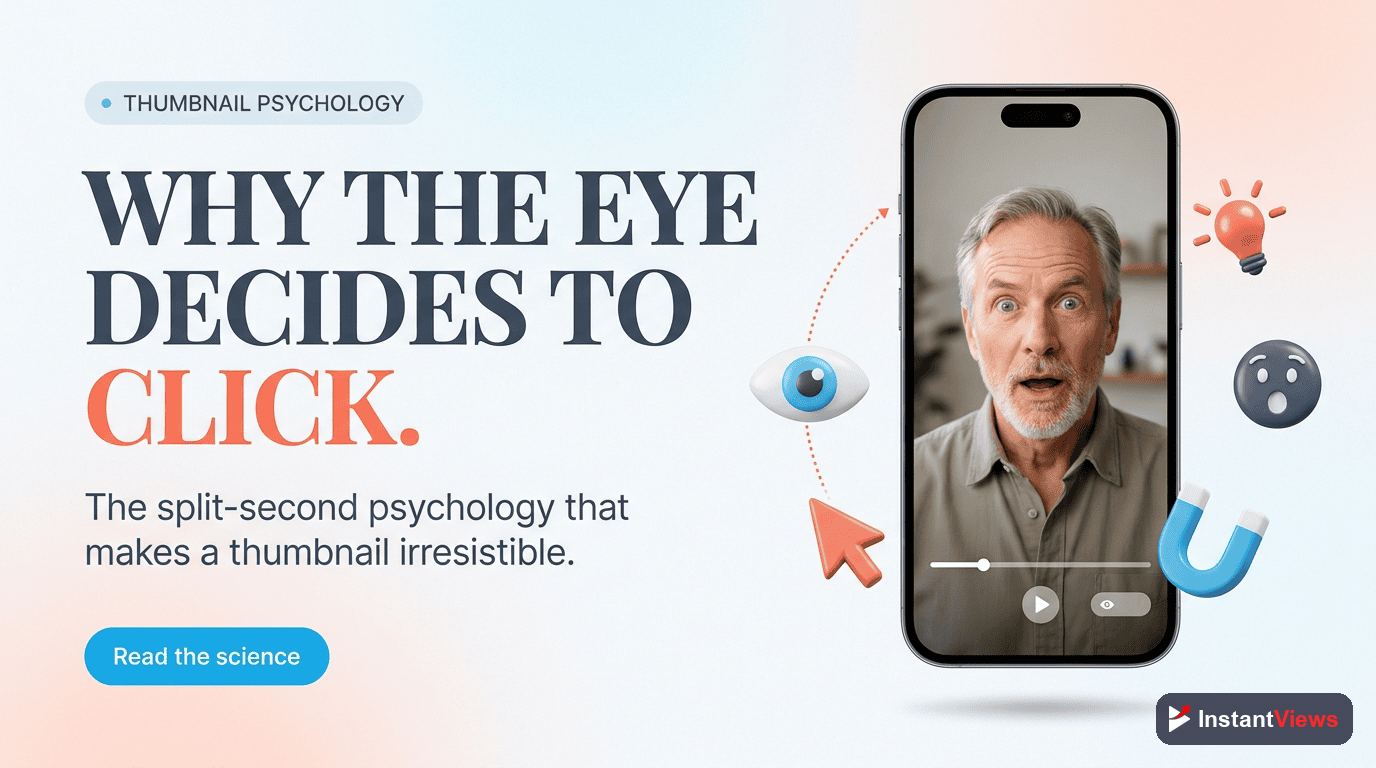
- The click is a split-second, mostly subconscious decision — the brain reads an image far faster than text
- Human faces and visible emotion trigger instant recognition and emotional contagion, making the viewer feel a connection
- Contrast and color work as pattern interrupts that break the scroll and pull the eye to your thumbnail first
- The curiosity gap creates a tension the brain is wired to resolve — and the only way to resolve it is to click
- In 2026 a click is only half the job: Quality CTR means the thumbnail must make a promise the video then keeps
Every day, billions of hours of video compete for attention on YouTube, a platform with more than 2.7 billion monthly active users. In that ocean of content, the single image that decides whether anyone watches your video is the thumbnail. It is the storefront, the handshake, and the first impression all at once — and it is judged in a fraction of a second.
Most advice about thumbnails focuses on the how: use big text, add a bright border, put your face on the left. Those rules can help, but they only work because of something deeper. They tap into the way the human brain perceives, feels, and decides. If you understand why a thumbnail gets clicked — the cognition and the emotion underneath the click — you stop guessing and start designing on purpose.
This guide is about that why. We will look at how fast the brain processes images, why faces and emotion are so magnetic, how contrast and simplicity guide the eye, and how the curiosity gap pulls a finger toward the screen. For the practical design rules that put these ideas to work, see our companion guide on thumbnail designs that get more views. Here, we focus on the psychology that makes those designs effective in the first place.
- The Click Is a Snap Decision
- Why the Brain Reads Images Before Words
- Faces: The Brain’s First Priority
- Emotion and Emotional Contagion
- Contrast, Color, and Pattern Interrupts
- The Curiosity Gap
- Why Simplicity Wins
- The Psychological Triggers at a Glance
- Putting the Psychology to Work
- The 2026 Catch: Quality CTR
- FAQ
The Click Is a Snap Decision
When a viewer opens YouTube, they are not carefully comparing options like a shopper reading nutrition labels. They are scrolling, fast, scanning a grid of competing thumbnails while their attention is already half-committed to something else. The decision to click or keep scrolling happens almost instantly and almost entirely below the level of conscious thought.
This matters because it reframes the whole problem. You are not persuading someone with an argument. You are triggering a fast, intuitive, emotional reaction before the rational mind ever gets involved. The thumbnail that wins is not the one that explains the most — it is the one that feels the most relevant, the most intriguing, or the most human in the half-second it has.
Psychologists describe two modes of thinking: a fast, automatic, emotional system and a slow, deliberate, logical one. Thumbnails live almost entirely in the fast system. Everything that follows in this guide is really about one thing — how to speak to that fast, instinctive part of the brain before the viewer scrolls on.

Why the Brain Reads Images Before Words
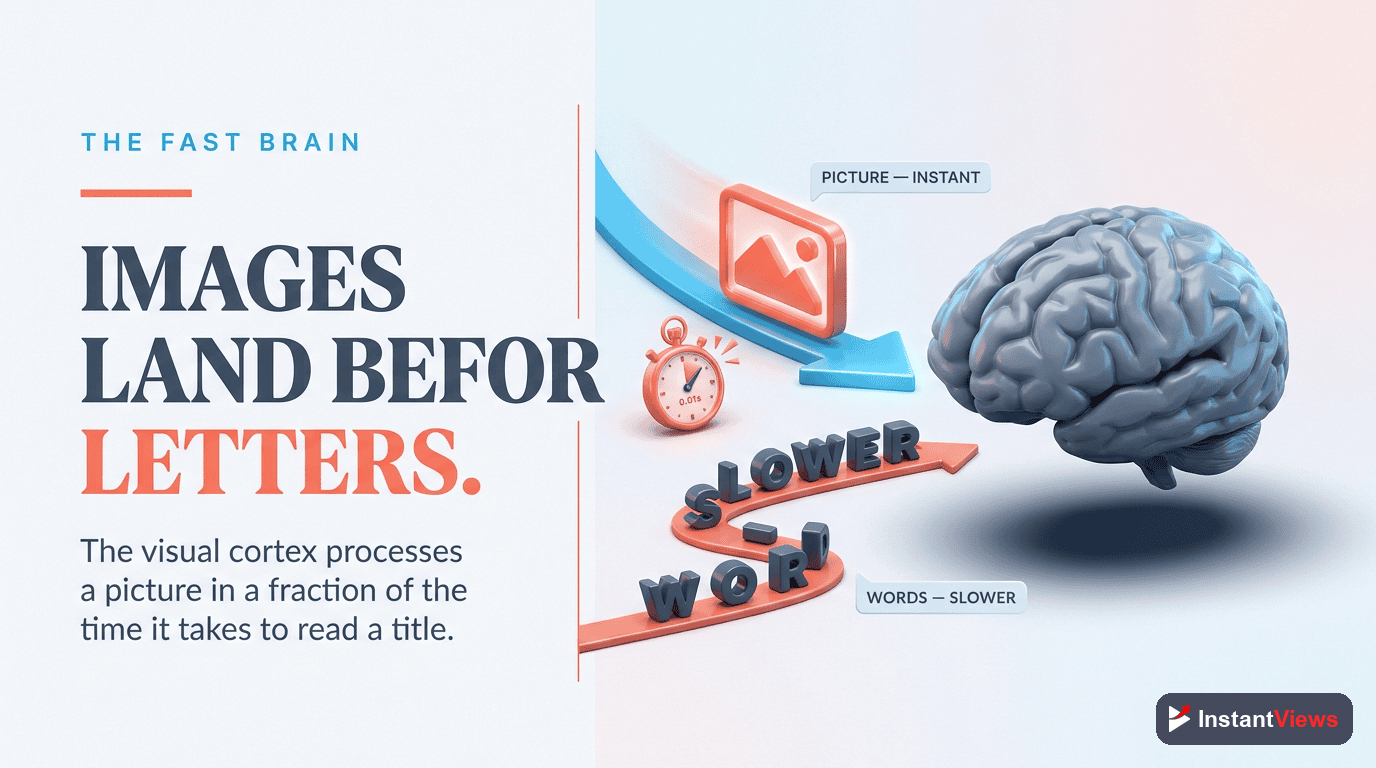
The brain processes visual information remarkably quickly. While the popular claim that images are processed “60,000 times faster than text” is a myth with no scientific basis, the underlying truth is real and well supported: people grasp the gist of an image far faster than they can read a sentence. Studies of visual cognition show the brain can register the meaning of a complex scene within a fraction of a second — fast enough to know what a photo contains before you could finish reading three words of a title.
For thumbnails, the implication is direct. The image does the heavy lifting; the title is a supporting actor. By the time a viewer has read your carefully crafted title, they have already reacted to your thumbnail and decided whether they care. This is why a brilliant title attached to a flat, confusing thumbnail underperforms, while a strong thumbnail can earn the click almost on its own.
It also explains why every element you add has a cost. Each extra object, word, or color the brain must decode slows down comprehension. In a medium where the entire decision happens in milliseconds, anything that delays understanding is working against you.
Faces: The Brain’s First Priority
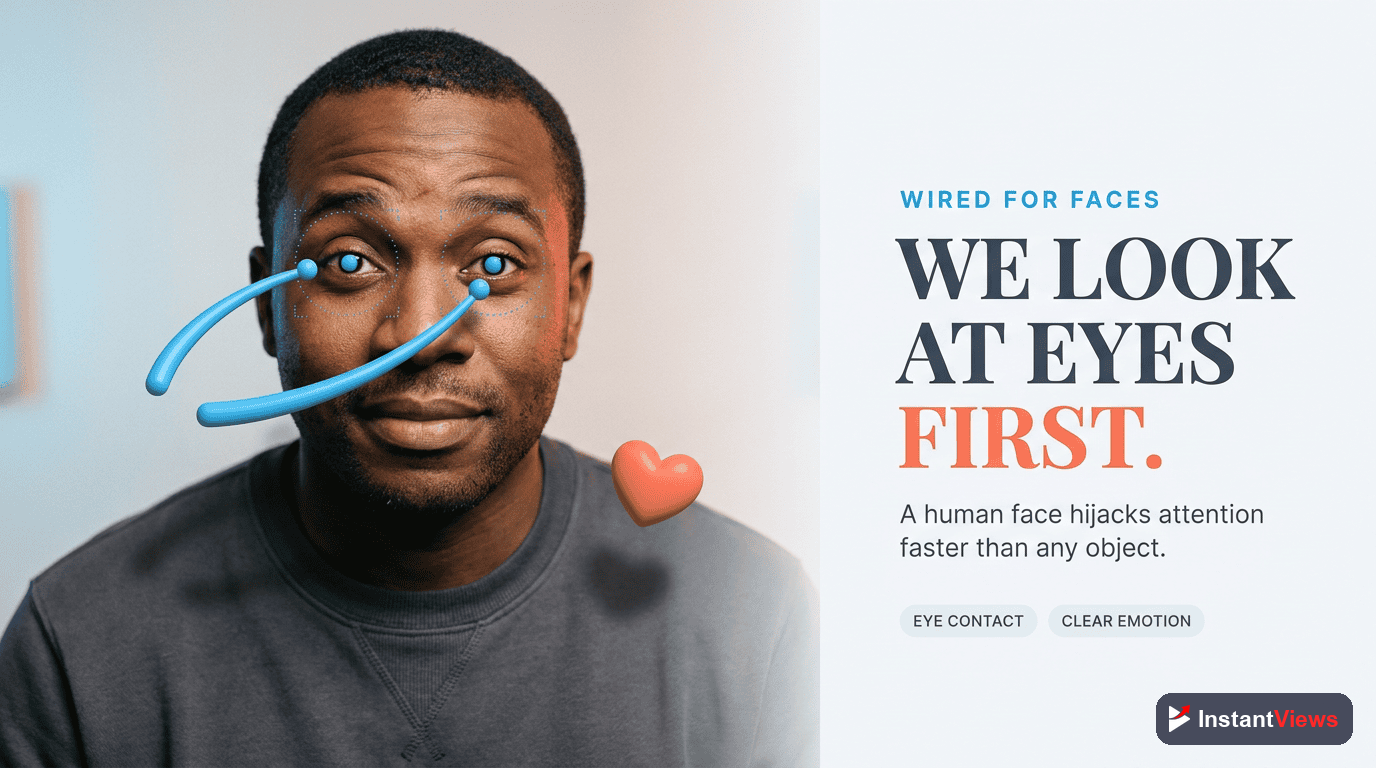
If there is one thing the human brain is hardwired to notice, it is a face. We have a dedicated region — the fusiform face area — devoted to recognising faces, and it fires faster and with more resources than almost any other visual processing. Babies orient toward faces within days of being born. Evolution made reading faces a survival skill, and that ancient wiring still drives where our eyes go on a YouTube feed.
This is why thumbnails with clear human faces tend to outperform those without. A face is a magnet for attention, and it does something a product shot or a landscape cannot: it signals that there is a person and a story behind the video. That signal makes the content feel more relatable and more worth a viewer’s time.
Eye Contact and the Sense of Connection
Direct eye contact amplifies the effect. When a face in a thumbnail appears to look straight at the viewer, it creates a fleeting but real sense of being addressed personally. The brain treats eye contact as social engagement, and that small jolt of connection is enough to slow the scroll and earn a second of consideration — which, in thumbnail terms, is everything.
Expression Carries the Meaning
A face alone is good; a face mid-emotion is far better. A neutral, posed expression communicates nothing and is easy to scroll past. An expressive face — surprised, delighted, alarmed, focused — tells a story in an instant and invites the viewer to wonder what caused it. The expression is not decoration; it is information.
Emotion and Emotional Contagion
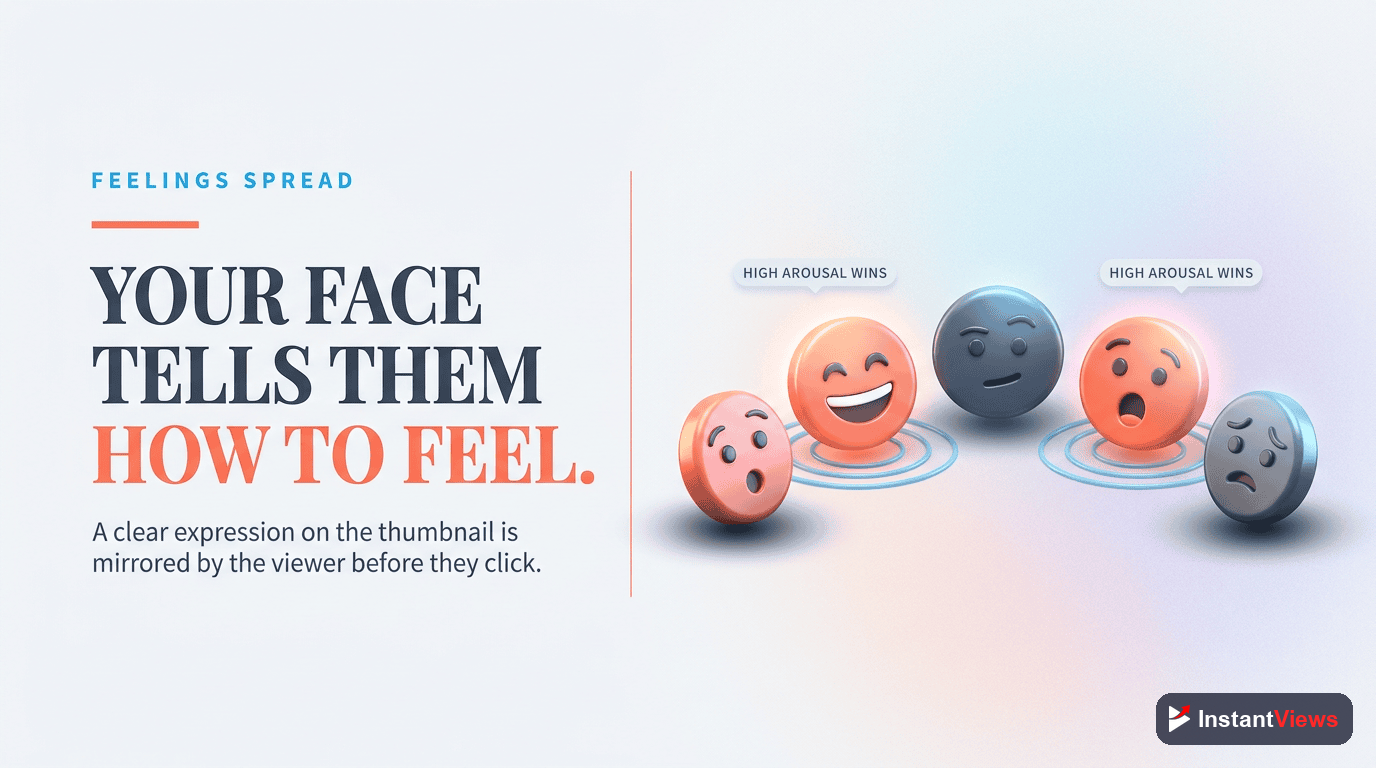
Emotion is the engine underneath almost every click. We like to think we choose videos rationally, but the first and strongest pull is how a thumbnail makes us feel. The mechanism has a name: emotional contagion. When we see an emotion on a face, we unconsciously begin to mirror it. A surprised expression sparks a flicker of surprise in us; an excited grin nudges us toward excitement. That borrowed feeling is what pulls attention toward the thumbnail.
Not all emotions are equal here. High-arousal emotions — ones that energise rather than calm — consistently grab more attention than neutral or low-energy expressions. A few that reliably work:
- Surprise: Wide eyes and an open mouth signal that something unexpected just happened, and the brain wants to know what.
- Curiosity: A puzzled or intrigued look invites the viewer to wonder alongside the subject.
- Excitement and joy: Genuine enthusiasm is contagious and signals a rewarding, positive payoff.
- Concern or tension: A worried or alarmed face hints at stakes, conflict, or a problem worth understanding.
The crucial word is genuine. Audiences have grown sharp at spotting manufactured shock, and a forced expression that the video never pays off reads as fake. Emotional contagion only helps when the feeling is believable and the content actually delivers on it.
Contrast, Color, and Pattern Interrupts
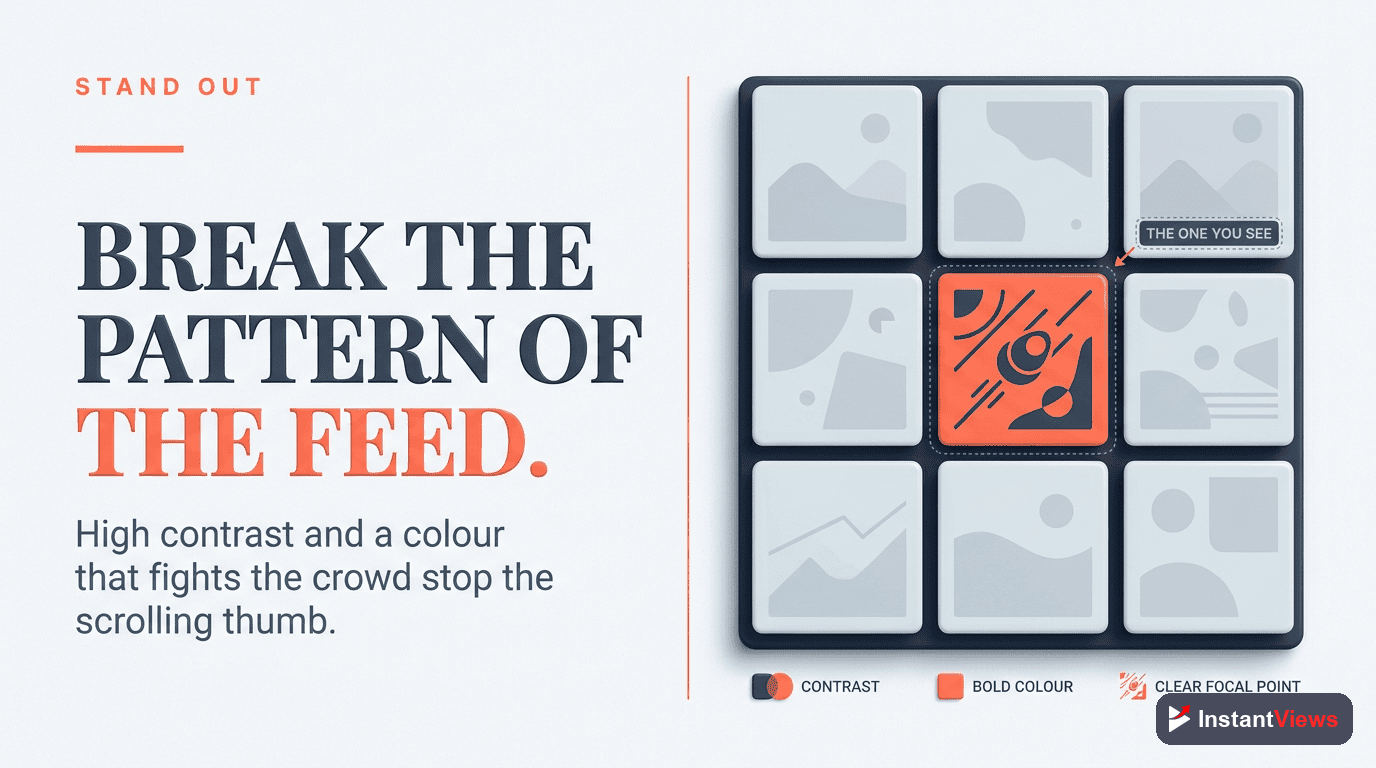
Attention is fundamentally drawn to difference. The brain is a prediction machine that filters out the expected and snaps to whatever breaks the pattern. Psychologists call this a pattern interrupt, and it is the core reason contrast works so powerfully in thumbnails.
Picture the YouTube feed as a grid of competing images. If most of them are dim, busy, and similar, a thumbnail that is bright, clean, and high-contrast pops out and gets seen first. Color contrast in particular — a warm subject against a cool background, a bright element against a dark field — is one of the most impactful levers you have, because it operates before the viewer has consciously registered anything else.
How Contrast Guides the Eye
Contrast does two jobs at once. First, it makes your thumbnail stand out against its neighbours so it gets noticed in the lineup. Second, contrast within the thumbnail directs the eye to the most important element — the face, the key object, the few words that matter. Good thumbnails use light, color, and separation to tell the eye exactly where to look first.
Color Carries Feeling
Color is not just about visibility; it carries emotional association. Warm reds and oranges feel urgent and energetic, cool blues feel calm and trustworthy, and bright saturated tones feel playful and high-energy. The right palette reinforces the feeling the thumbnail is trying to create, while a muddy or low-contrast palette lets the image disappear into the feed.
Contrast and color get you noticed, but they cannot carry a thumbnail alone. A loud, neon image with no clear subject, emotion, or idea reads as noise — and the brain learns to filter out noise just as fast as it snaps to meaning. Use contrast to spotlight a clear idea, never as a substitute for one.
The Curiosity Gap
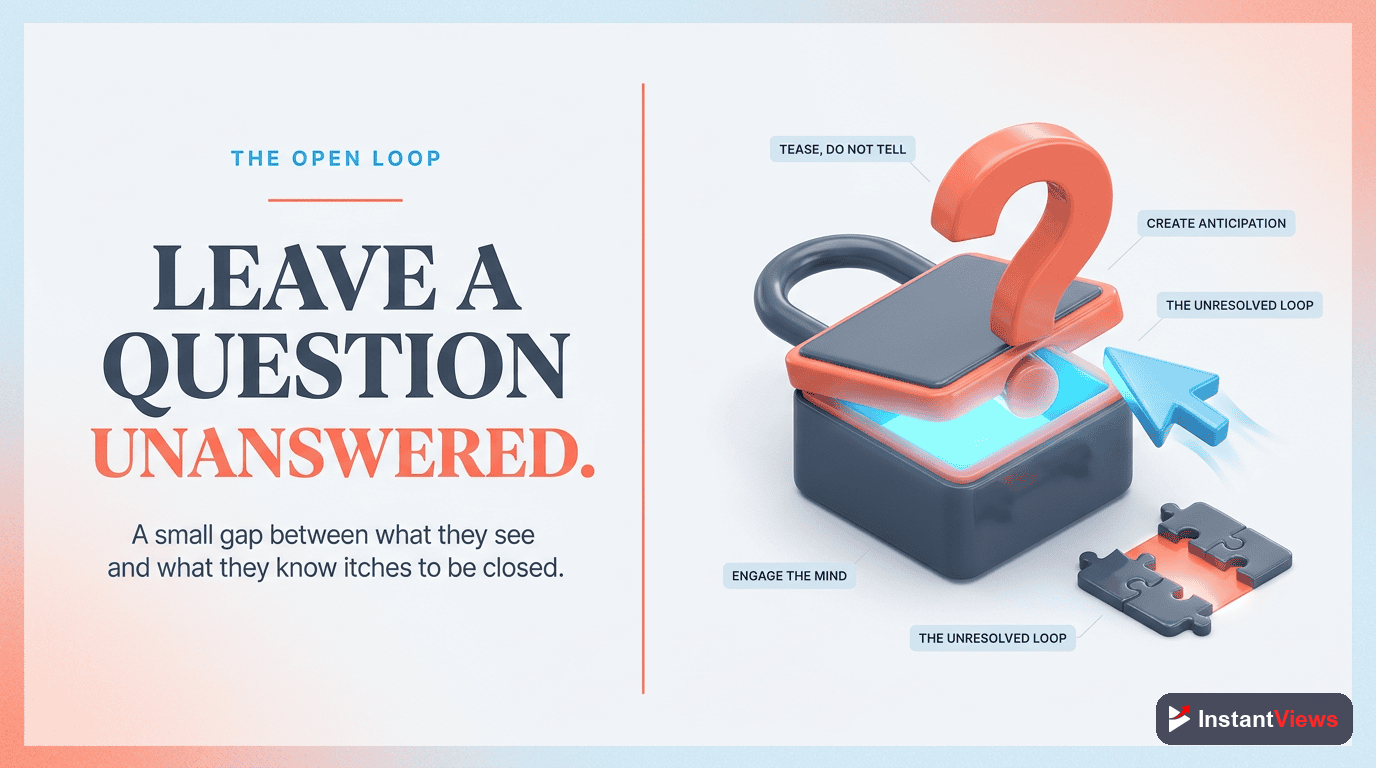
Of all the triggers, the curiosity gap may be the most powerful — and the most misused. The principle, drawn from the work of behavioural economists on information theory, is simple: when we become aware that there is a specific piece of information we are missing, we feel a small, genuine discomfort, and the brain is wired to want to close that gap. Curiosity is not a luxury; it feels like an itch.
A great thumbnail manufactures that itch on purpose. It shows just enough to raise a question while deliberately withholding the answer. The viewer sees a result without the cause, a reaction without the event, or an object that does not belong — and the only way to resolve the tension is to click.
Ways Thumbnails Open a Gap
- Show the outcome, hide the method: An astonishing result with no explanation makes the viewer need to know how.
- Capture a reaction mid-moment: A strong expression implies an event the viewer did not see and now wants to.
- Introduce the unexpected: An object or pairing that does not seem to fit creates a question the title cannot fully answer.
- Imply a before-and-after: A contrast or transformation hints at a story with a missing middle.
There is a fine line here. A curiosity gap invites; clickbait deceives. A gap built on a real, satisfying answer rewards the click and builds trust. A gap built on a promise the video never keeps wins one click and loses a viewer forever — and, as we will see, increasingly loses the algorithm too.
“You are not designing a picture. You are designing a question the viewer cannot leave unanswered — and then making sure your video is the answer worth clicking for.”
Why Simplicity Wins
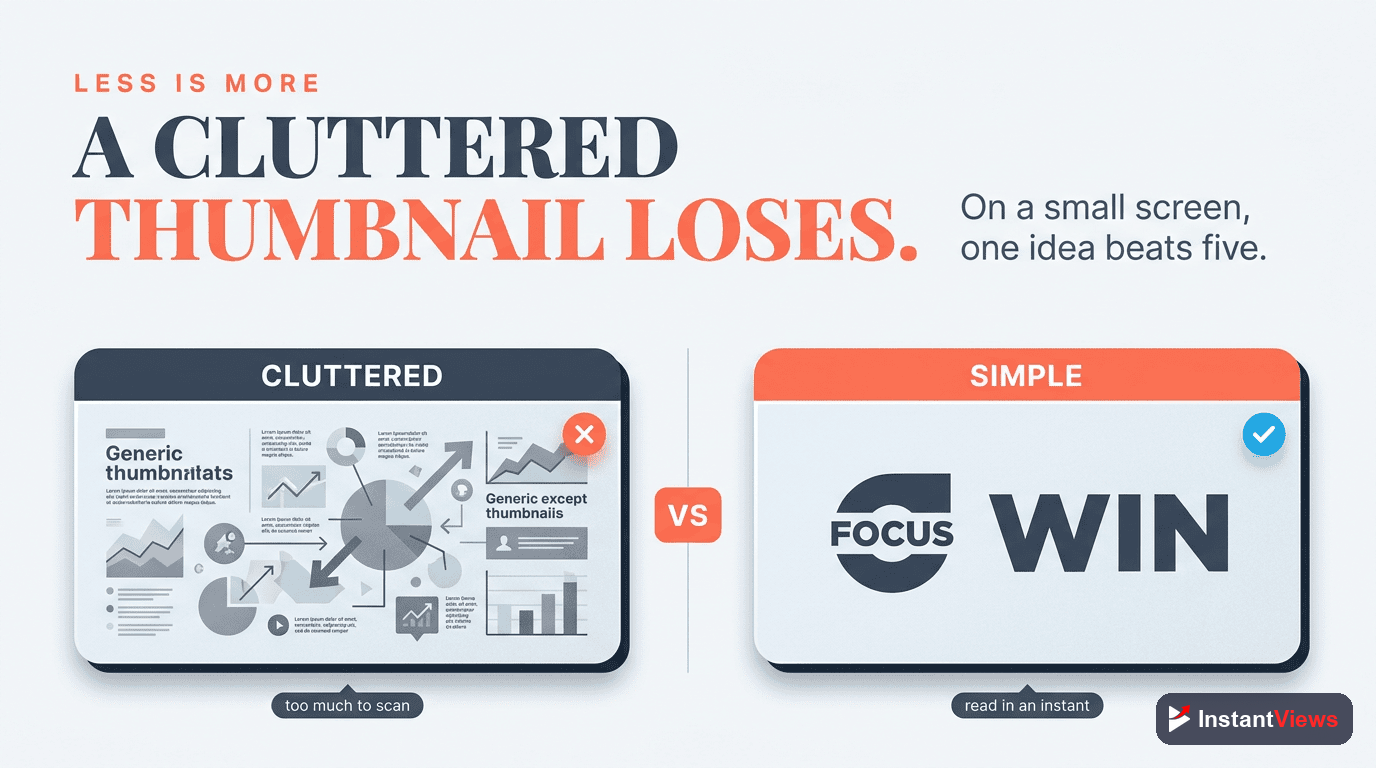
Given how fast and crowded the click decision is, simplicity is not an aesthetic preference — it is a cognitive necessity. Every thumbnail is shown at a small size, often on a phone screen, glimpsed for a fraction of a second among many others. The brain has a strict limit on how much it can take in at once, and a cluttered image blows past that limit instantly.
When a thumbnail is busy — multiple subjects, paragraphs of text, competing focal points — the brain has to work to decode it, and a busy brain in a fast-scroll context simply moves on. When a thumbnail is clean, with one clear subject, one emotion, and at most a few large words, comprehension is effortless and instant. Effortless understanding is what creates the click.
The One-Idea Rule
The most reliable test is to ask whether your thumbnail communicates a single idea at a glance. If a viewer would need more than a second to figure out what they are looking at, it is too complex. One subject, one feeling, one question. That constraint feels limiting, but it is exactly what the fast, instinctive part of the brain is built to reward.
The Psychological Triggers at a Glance
Each trigger we have covered maps to a specific way the brain works and a specific way to apply it on a thumbnail. This table summarises how the psychology translates into practice:
| Psychological Trigger | Why It Works | Thumbnail Application |
|---|---|---|
| Face recognition | The brain has dedicated wiring that notices and prioritises faces faster than almost anything else | Feature one clear human face, large enough to read at small sizes |
| Eye contact | Direct gaze registers as social engagement and creates a sense of being addressed personally | Have the subject look toward the camera or lens |
| Emotional contagion | Viewers unconsciously mirror the emotion they see, borrowing the feeling | Show a genuine, high-arousal expression that matches the content |
| Pattern interrupt | Attention snaps to whatever breaks the surrounding pattern | Use high contrast and color that stand apart from the feed |
| Curiosity gap | An obvious missing piece of information creates tension the brain wants to resolve | Show a result or reaction while withholding the cause |
| Cognitive ease | The brain prefers and rewards information it can process effortlessly | Keep one subject, one emotion, and minimal large text |
| Visual primacy | Images are understood far faster than the text beside them | Let the image carry the message; treat the title as support |
Test What Actually Gets Clicked
Use our free suite of YouTube tools to research topics, refine titles, and analyze what is earning attention — so your thumbnails are built on data, not guesswork.
Explore Free YouTube Tools →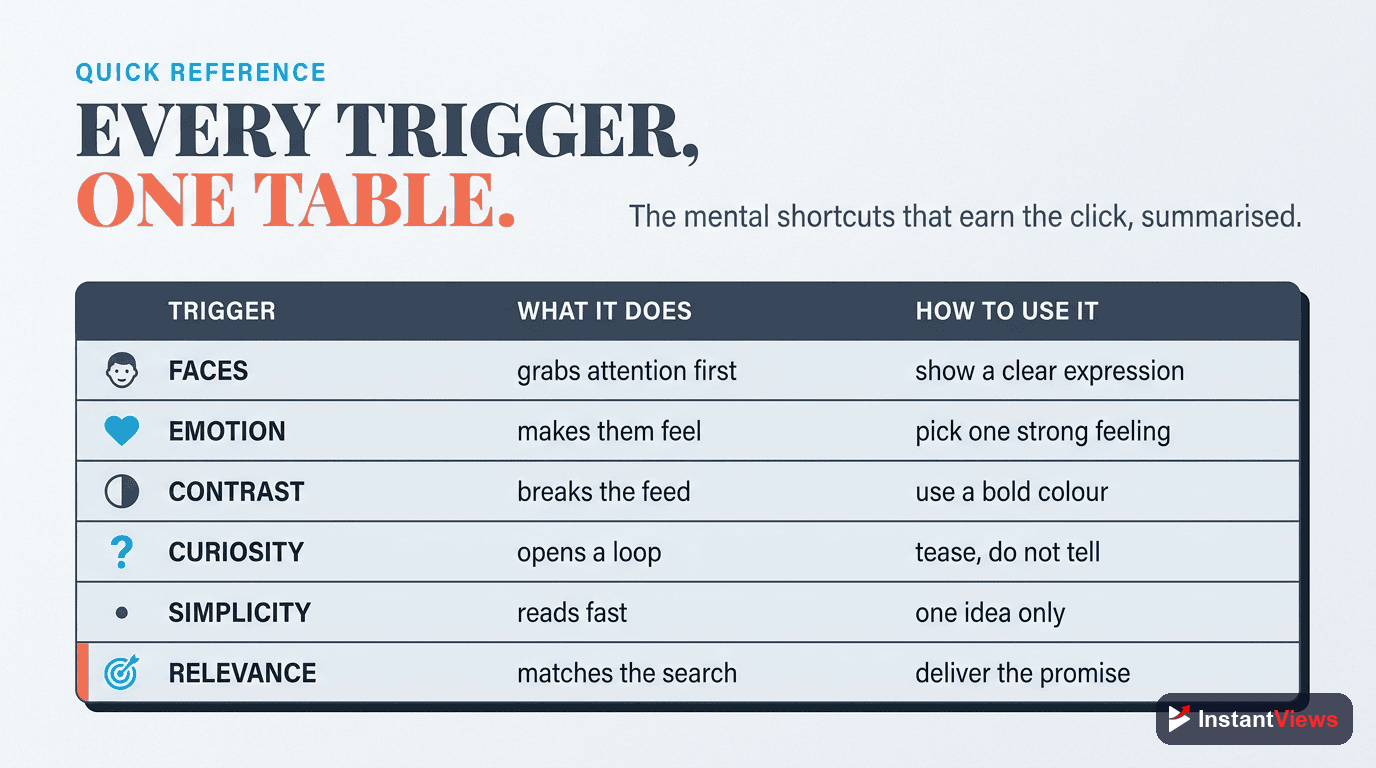
Putting the Psychology to Work
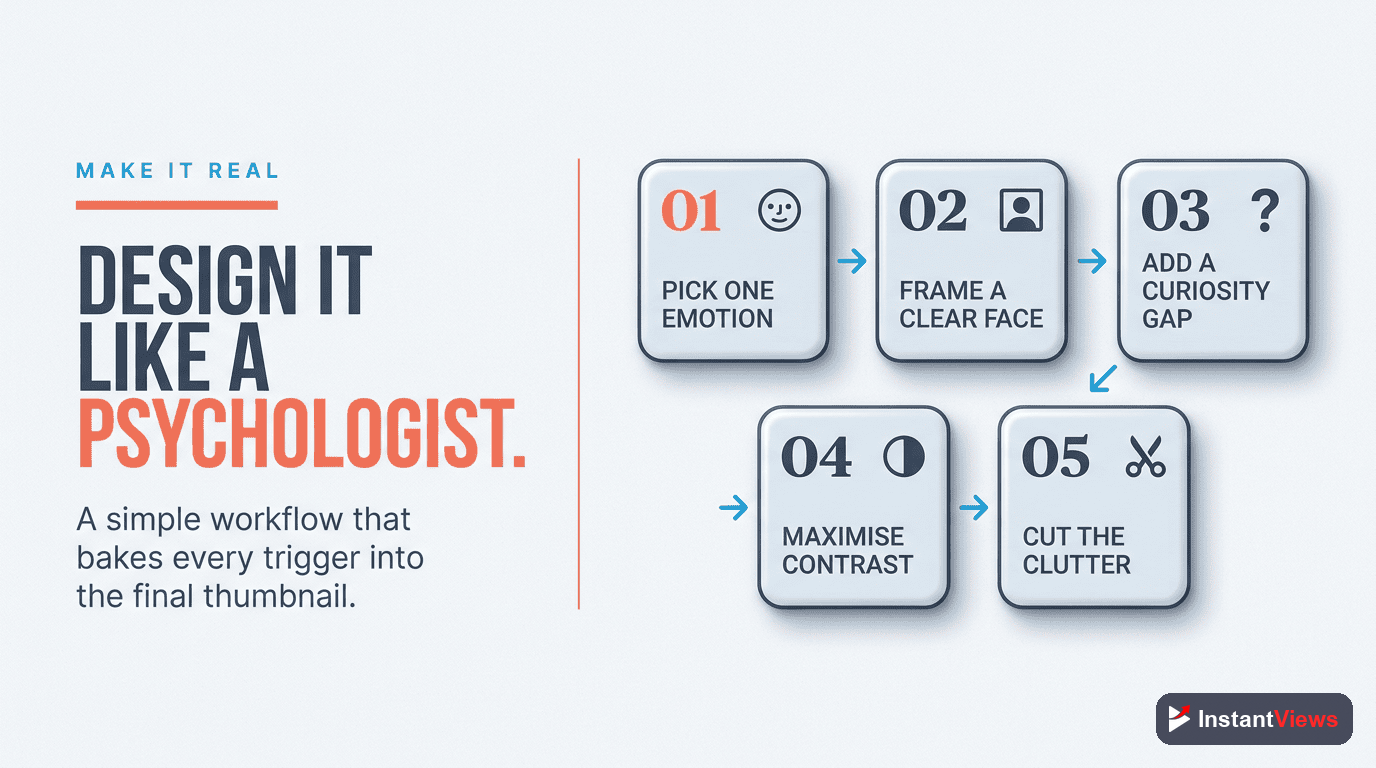
Understanding the triggers is one thing; applying them deliberately is another. Here is a simple sequence for building a thumbnail that speaks to the fast, instinctive brain — the psychology check that comes before any design polish.
Decide the One Feeling
Before choosing an image, name the single emotion you want the viewer to feel in the first half-second — surprise, curiosity, excitement, concern. That feeling becomes the brief for everything else.
Lead With a Face and Expression
Make an expressive human face the focal point where it fits, ideally with eye contact, so face recognition and emotional contagion do their work the instant the thumbnail loads.
Open a Curiosity Gap
Ask what question the image raises. If it answers everything, there is no reason to click. Withhold the resolution so the viewer has to watch to close the gap.
Break the Pattern
Check your thumbnail against a mock feed of similar videos. If it blends in, raise the contrast or shift the color until it pops out as the obvious place to look first.
Strip It Down
Remove every element that does not serve the one feeling or the one question. Shrink the thumbnail to phone size and confirm it reads instantly. If you hesitate, simplify again.
The 2026 Catch: Quality CTR
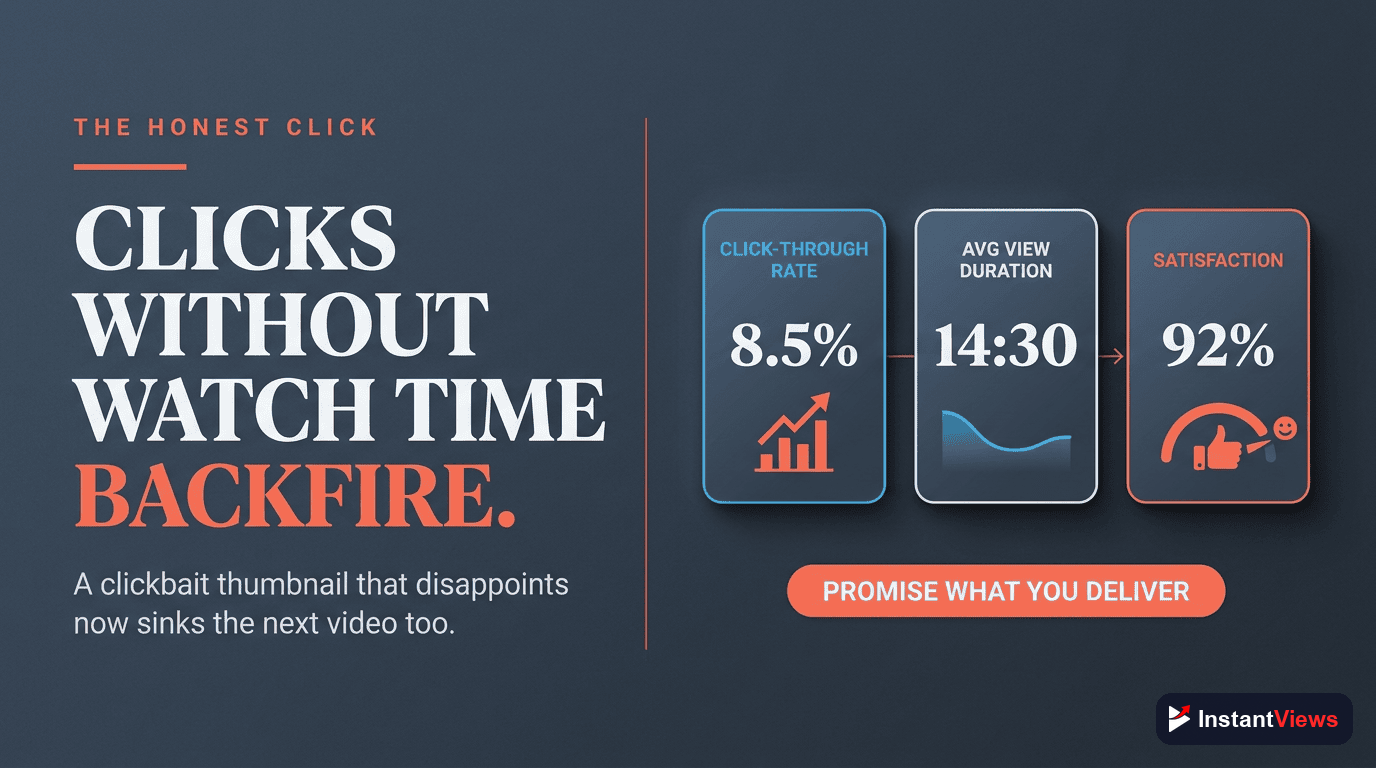
There is a reason this guide keeps returning to honesty, and in 2026 it is no longer just an ethical point — it is an algorithmic one. YouTube’s system now evaluates what engineers describe as Quality CTR: the click-through rate weighed against what happens immediately after the click. A thumbnail that earns a high click rate but fails to satisfy viewers in the first 15 to 30 seconds is now actively demoted.
This changes how you should think about every trigger above. Faces, emotion, contrast, and the curiosity gap are still the levers that earn the click — but the click is only the down payment. The thumbnail makes a promise, and the opening of the video has to keep it. The same algorithm that rewards a magnetic thumbnail will punish one that wrote a cheque the video could not cash. YouTube has been deliberately reducing the reach of low-value, mass-produced content, and misleading thumbnails fall squarely in that crosshair.
The healthiest way to read this is as an alignment of incentives. The psychology that gets the click and the psychology that keeps the viewer are the same psychology — relevance, emotion, and a satisfied curiosity. A thumbnail built on a real, payable promise wins twice: it earns the click, and it earns the retention that turns a single view into lasting reach.
Frequently Asked Questions
The human brain has a region dedicated to recognising faces, so a face is one of the first things a viewer notices and processes in a feed. A clear human face — especially one making eye contact and showing a strong emotion — creates an instant sense of connection and signals that there is a person and a story behind the video, which makes the thumbnail feel more relevant and worth clicking.
The curiosity gap is the uncomfortable tension we feel when we sense there is a piece of information we are missing. Our brains are wired to want to close that gap. A thumbnail creates one by showing just enough to raise a question — an unexpected object, a reaction mid-moment, or a result without the cause — so the viewer clicks to resolve the tension and find the answer.
Extremely fast. The brain processes images far faster than text, recognising the gist of a scene within a fraction of a second. On YouTube, viewers scroll past dozens of thumbnails and make near-instant, largely subconscious decisions about which ones to click, so a thumbnail has only a tiny window to register before attention moves on.
Attention is drawn to whatever breaks a pattern. In a grid of similar thumbnails, a high-contrast image — bright against dark, warm against cool, simple against busy — pops out and gets noticed first. Contrast acts as a pattern interrupt that pulls the eye, which is why color and brightness choices are among the most impactful psychological levers in thumbnail design.
Simple almost always wins. Thumbnails are viewed at small sizes, often on a phone, in a fraction of a second. A cluttered image forces the brain to work to decode it, and a busy brain moves on. One clear subject, one emotion, and at most a few large words let the viewer understand the thumbnail instantly, which is exactly what drives the click.
No. In 2026 YouTube evaluates what engineers describe as Quality CTR — clicks weighed against what happens after the click. A thumbnail that wins clicks but the video fails to satisfy viewers in the first 15 to 30 seconds is actively demoted. A click-worthy thumbnail must make an honest promise the video then keeps, or high CTR works against you.
High-arousal emotions tend to outperform neutral expressions because of emotional contagion — viewers unconsciously mirror the feeling they see on a face. Surprise, curiosity, excitement, and even concern catch attention more reliably than a flat, posed look. The key is that the emotion is genuine and matches the actual content of the video.
They are two sides of the same coin. Psychology explains why certain things get clicked — how the brain and emotions respond to faces, contrast, and curiosity. Design rules are the practical how: the layout, sizing, color, and text choices that put those triggers to work. Understanding the why makes the how far more effective.
Conclusion
A thumbnail is not a decoration bolted onto a finished video — it is a tiny, high-stakes conversation with the fastest, most instinctive part of the human brain. In the half-second before a viewer scrolls on, faces pull the eye, emotion borrows their feeling, contrast breaks the pattern, and a curiosity gap leaves a question they cannot quite ignore. Understanding why those triggers work turns thumbnail creation from a guessing game into a craft.
None of it requires a bigger budget or a design degree. It requires intention: deciding the one feeling, leading with a readable face and expression, opening an honest gap, breaking the surrounding pattern, and stripping away everything that slows comprehension. Each of those choices is just psychology applied on purpose.
And in 2026, the click is only half the story. Quality CTR rewards the thumbnails that make a promise the video keeps, so the most powerful thing you can do is align the feeling on the thumbnail with the value inside the video. Get that alignment right and your thumbnail does not just win the click — it earns the trust, the retention, and the reach that compound long after the upload.