- Do not wait for YouTube discovery alone — send your own traffic from every platform you already use
- Repurpose one long-form video into many native pieces instead of recreating content from scratch
- Use other platforms as trailers that point to the full video; never post the entire video elsewhere
- Make clips native: vertical 9:16 with on-screen captions, not letterboxed horizontal snippets
- Email is the only audience you fully own and drives the early views that boost a fresh upload
With more than 2.7 billion monthly active users and over a billion hours of video watched every single day, YouTube is the largest video discovery engine on the internet. But here is the uncomfortable truth that holds most channels back: the algorithm does not owe you reach. Upload a great video and you might get recommended widely — or you might watch it stall at a few dozen views while you refresh the analytics page in disbelief.
The creators who grow fastest in 2026 do not gamble everything on YouTube discovery. They treat YouTube as the destination and every other platform — TikTok, Instagram Reels, Reddit, X, LinkedIn, email, and their own website — as a road that leads to it. They send their own traffic instead of waiting to be found.
The secret is not to be everywhere with original content for each platform, which is exhausting and unsustainable. The secret is repurposing: taking one long-form video you already made and reshaping it into many native pieces that each act as a trailer pointing back to the full thing on YouTube.
This guide walks through exactly how cross-platform promotion works, how to repurpose one video into a week of content, which platforms deserve your effort, how to funnel each one back to YouTube, and how to measure what is actually driving views so you can stop wasting time on what is not.
- Why Cross-Platform Promotion Works
- The Trailer Mindset: Tease, Do Not Give Away
- Repurpose One Video Into Many Pieces
- The Best Platforms and What Each Does
- Make Clips Native, Not Letterboxed
- Funnel Each Platform Back to YouTube
- Email and Niche Communities: Your Owned Reach
- A Real Walkthrough: One Video, One Week
- Measuring Which Platforms Actually Work
- Common Cross-Platform Mistakes to Avoid
- FAQ
Why Cross-Platform Promotion Works
Every platform you already use has an audience that does not yet know your YouTube channel exists. TikTok and Instagram Reels reach people scrolling for entertainment. Reddit gathers communities obsessed with specific topics. X and LinkedIn host professionals looking for commentary and insight. Each one is a pool of potential viewers who will never stumble onto your channel through YouTube’s suggested feed on their own.
Cross-platform promotion connects those pools to your channel. Instead of hoping the algorithm surfaces your video to the right people, you go to where those people already spend their attention and hand them a reason to click through. You are not competing with YouTube’s recommendation system — you are feeding it.
That feeding matters more than ever. The 2026 algorithm optimizes for viewer satisfaction and retention, and early signals tell YouTube how widely to recommend a fresh upload. When you drive a wave of interested viewers in the first hours after publishing, you send a strong message that the video deserves more reach. External traffic does not just add views — it can unlock the organic distribution you were waiting for.
There is a defensive reason too. YouTube has been reducing the spread of low-value, mass-produced content, and reach can shift overnight as the platform tunes for quality. A channel that depends entirely on YouTube discovery is one algorithm update away from a crisis. A channel that pulls traffic from five sources is resilient.

The Trailer Mindset: Tease, Do Not Give Away
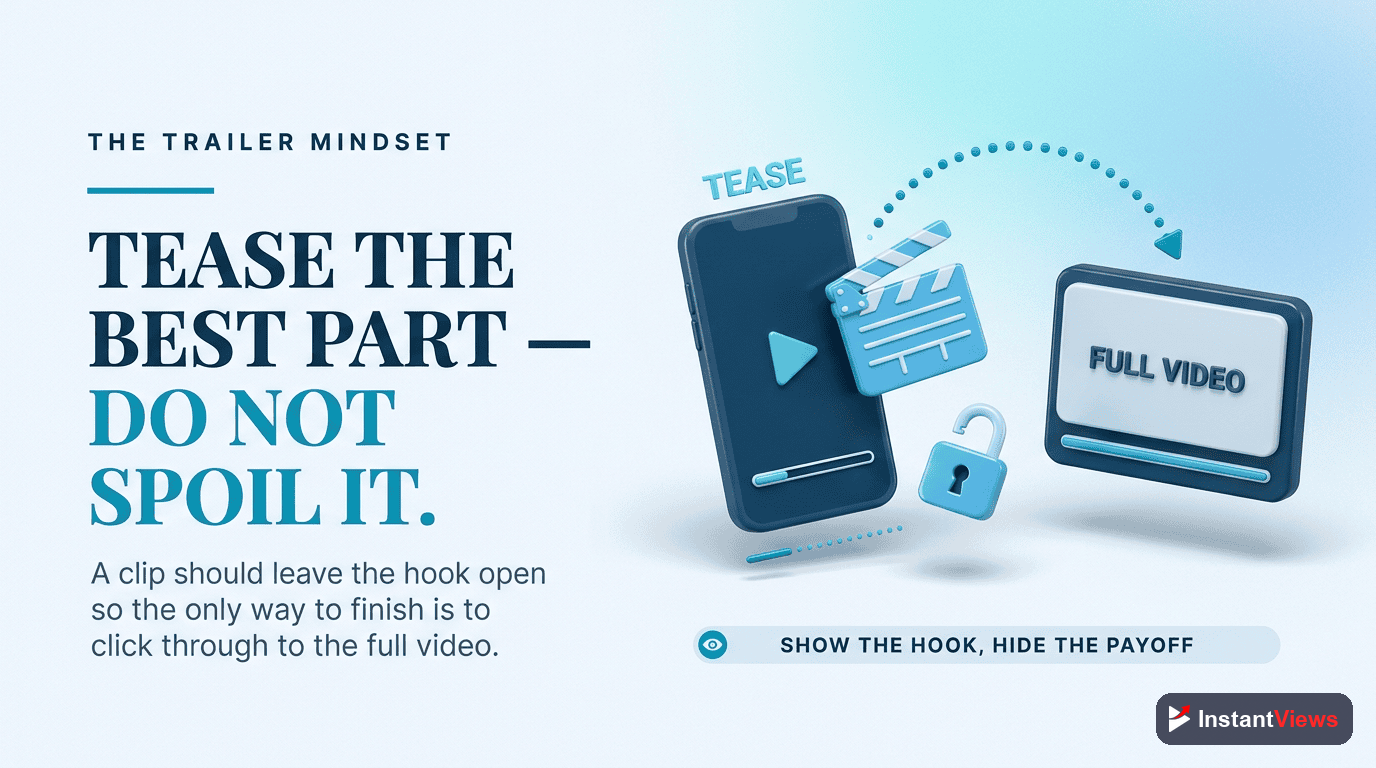
The single most important idea in this entire guide is this: other platforms are trailers, not theaters. A movie trailer shows you the best moments to make you buy a ticket — it does not play the whole film in the lobby. Your cross-platform clips should work the same way.
When you post an entire video to TikTok or Reels, you remove every reason to visit YouTube. The audience gets the full payoff for free, in-feed, and scrolls on. You have spent your best material building someone else’s platform instead of your own channel. Worse, you train your followers to expect everything off-YouTube, so they never form the habit of clicking through.
A trailer clip does the opposite. It delivers a complete, satisfying hook — a surprising claim, a quick win, a cliffhanger — and then points to the full video for the rest. The viewer feels they got value, but they also feel curiosity. That gap between satisfaction and curiosity is exactly what makes someone tap your link.
What a Good Trailer Clip Contains
- A strong hook in the first second that stops the scroll and states what they will learn or feel.
- One complete idea — enough value to be worth watching on its own, not a confusing fragment.
- An open loop — a promise that the full breakdown, the proof, or the next step lives on YouTube.
- A clear pointer to the full video, in the caption and ideally spoken or shown on screen.
Repurpose One Video Into Many Pieces
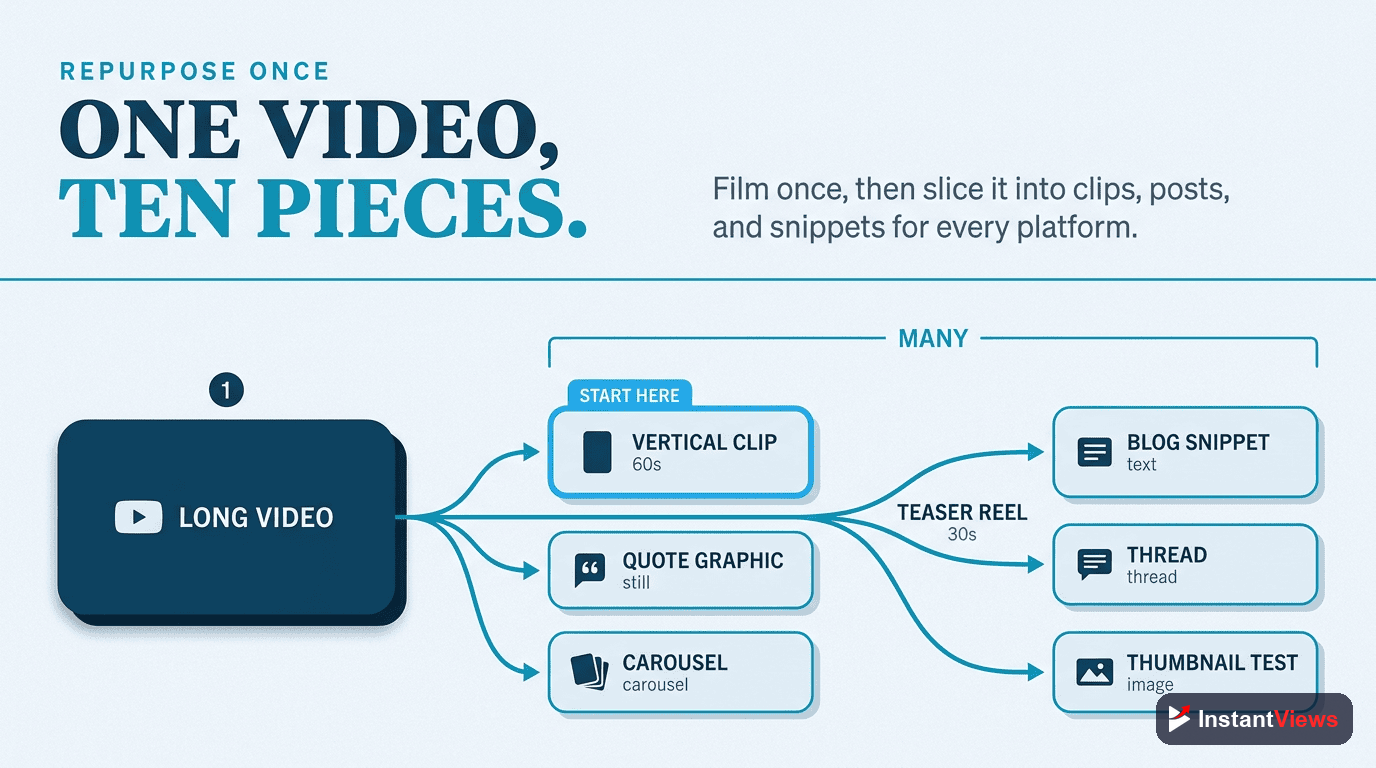
Repurposing is the engine that makes cross-platform promotion sustainable. The goal is not to recreate your content for every platform — that path leads to burnout. The goal is to reshape one long-form video into many native pieces, each tailored to where it will live.
From a single video of, say, ten to twenty minutes, you can reasonably produce:
- Three to five short clips — the strongest hooks, tips, and payoff moments, cut for vertical feeds.
- A handful of quote graphics — your best lines turned into simple, readable images for Instagram, X, or LinkedIn.
- One or two text posts or a thread — the core argument written out for Reddit, X, or LinkedIn discussion.
- An email summary — a short note to your list explaining what the video covers and why it is worth their time.
Notice that none of this requires filming anything new. You are mining one asset for everything it contains. A 90-minute editing session can produce a full week of cross-platform content, all of it pointing back to the same video.
The Best Platforms and What Each Does
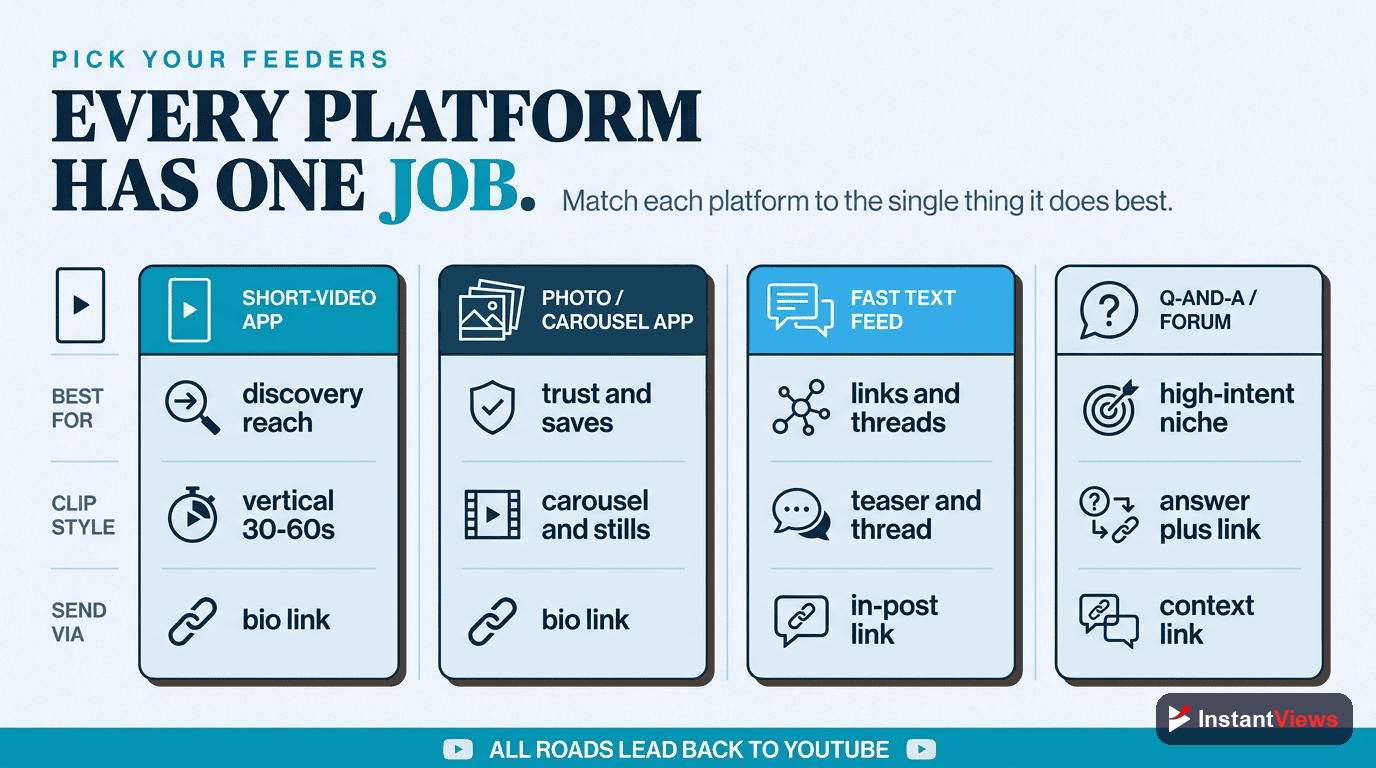
Not every platform plays the same role. Some are built for raw reach, some for engaged niches, some for keeping viewers inside YouTube’s own world. Matching the right repurposed piece to the right platform is what separates effective promotion from noise.
| Platform | Strength | What to Post | Links Back? |
|---|---|---|---|
| TikTok | Widest reach to brand-new viewers | Vertical clips with trending audio and captions | Bio link and on-screen pointer |
| Instagram Reels | Strong reach plus polished, visual audience | Clean vertical clips, quote graphics, Stories | Bio link, Stories link sticker |
| YouTube Shorts | Keeps viewers inside the YouTube ecosystem | Vertical clips that tease the long-form video | Direct link to the related video |
| Reddit & niche communities | Highly engaged, topic-obsessed audiences | Helpful answers and the video where it adds value | In-context links where allowed |
| X / LinkedIn | Commentary, professionals, and B2B reach | Threads, quote graphics, takeaways | Link in post or first reply |
| Your blog | Search traffic and full control | Articles with the video embedded | Native embed of the player |
Reach Platforms vs. Ecosystem Platforms
TikTok and Instagram Reels are your reach engines: they put clips in front of people who have never heard of you. YouTube Shorts is different — it keeps the discovery inside YouTube, so a viewer who likes your Short is one tap from your channel and your long-form library. Use Shorts to convert curiosity into subscribers, and use TikTok and Reels to find that curiosity in the first place.
Engagement Platforms
Reddit, niche forums, X, and LinkedIn trade reach for depth. The audiences are smaller but far more invested. A thoughtful comment in the right community can send a small number of genuinely interested viewers who watch to the end — exactly the retention signal YouTube rewards.
Make Clips Native, Not Letterboxed
Here is where most channels sabotage themselves. They take a horizontal clip straight from their YouTube video, drop it into a vertical feed with black bars above and below, and wonder why it gets skipped. A letterboxed horizontal snippet screams “reposted from somewhere else” and viewers scroll past instantly.
Native content respects the platform it lives on. On TikTok, Reels, and Shorts, that means:
- Vertical 9:16 framing that fills the whole screen, with the speaker or focus reframed to the center.
- Bold on-screen captions, because most short-form viewers watch with the sound off and will not turn it on for a stranger.
- A tight length, often around 30 to 60 seconds — long enough to deliver one idea, short enough to hold attention.
- A hook in the first second, since the opening frame decides whether anyone watches the rest.
The encouraging news is that modern editing tools make reframing fast. You can crop to vertical, auto-generate captions, and trim to the best moment in minutes. The effort of making a clip native is small, and it is the difference between a clip that reaches thousands and one that reaches no one.
Resist the urge to automate so aggressively that quality slips. YouTube and the short-form platforms are actively reducing the spread of low-value, mass-produced content. A flood of lazy, identical reposts can hurt you. Repurpose efficiently, but make every clip something a real person would actually want to watch.
Promote Smarter, Not Harder
Explore our free suite of YouTube tools to research clip-worthy topics, sharpen your titles, and analyze which traffic sources are actually driving views to your channel.
Explore Free YouTube Tools →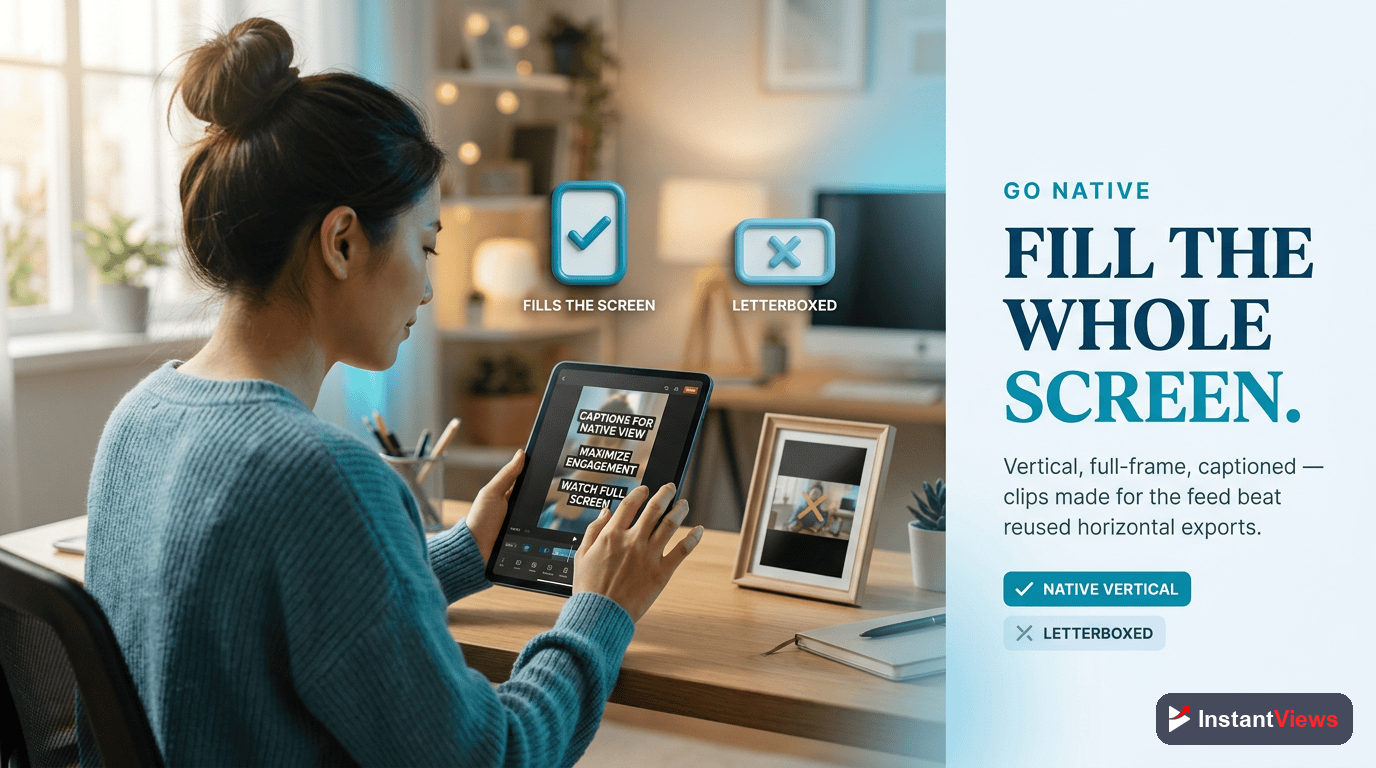
Funnel Each Platform Back to YouTube
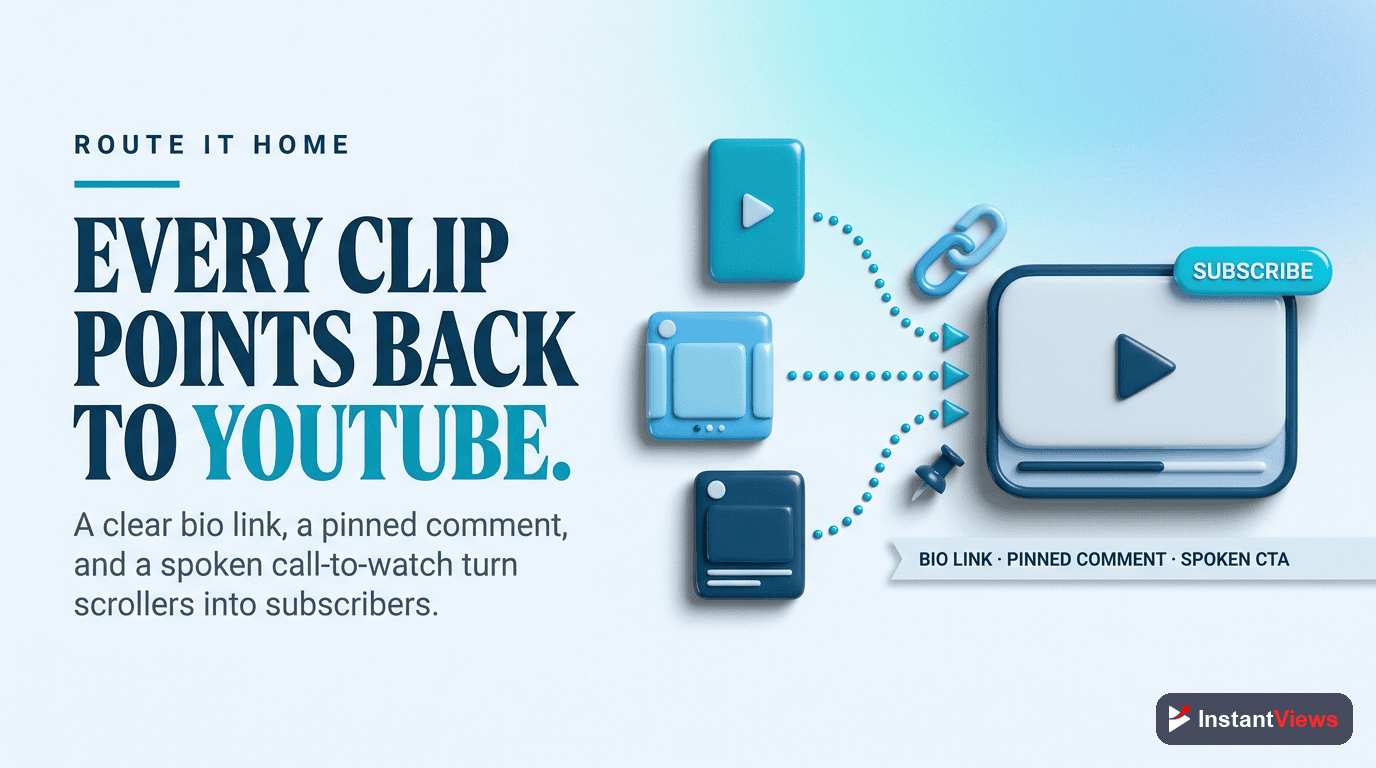
Reaching people on other platforms is only half the job. The other half is giving them a frictionless path to your channel. A clip that goes viral but never mentions YouTube is entertainment, not promotion. Build the funnel deliberately.
Make YouTube the Clear Destination
Decide that every repurposed piece exists to send someone to one specific video or to your channel. Before you post anything, know exactly where you want the viewer to end up.
Open a Loop the Full Video Closes
End each clip or post on a promise — the full breakdown, the proof, the step-by-step — that only the long-form video delivers. Curiosity, not a hard sell, is what earns the click.
Place the Link Where the Platform Allows
Use bio links on TikTok and Instagram, the related-video link on Shorts, in-context links on Reddit and X, and native embeds on your blog. Tell viewers in plain words where to find the full video.
Match the Message to the Audience
Keep TikTok casual, LinkedIn professional, and Reddit genuinely helpful. The same video can be framed differently for each crowd so the click feels natural rather than forced.
Reduce Every Bit of Friction
One clear link, one clear next step. The fewer taps between a curious viewer and your video, the more of them actually arrive and start watching.
Email and Niche Communities: Your Owned Reach
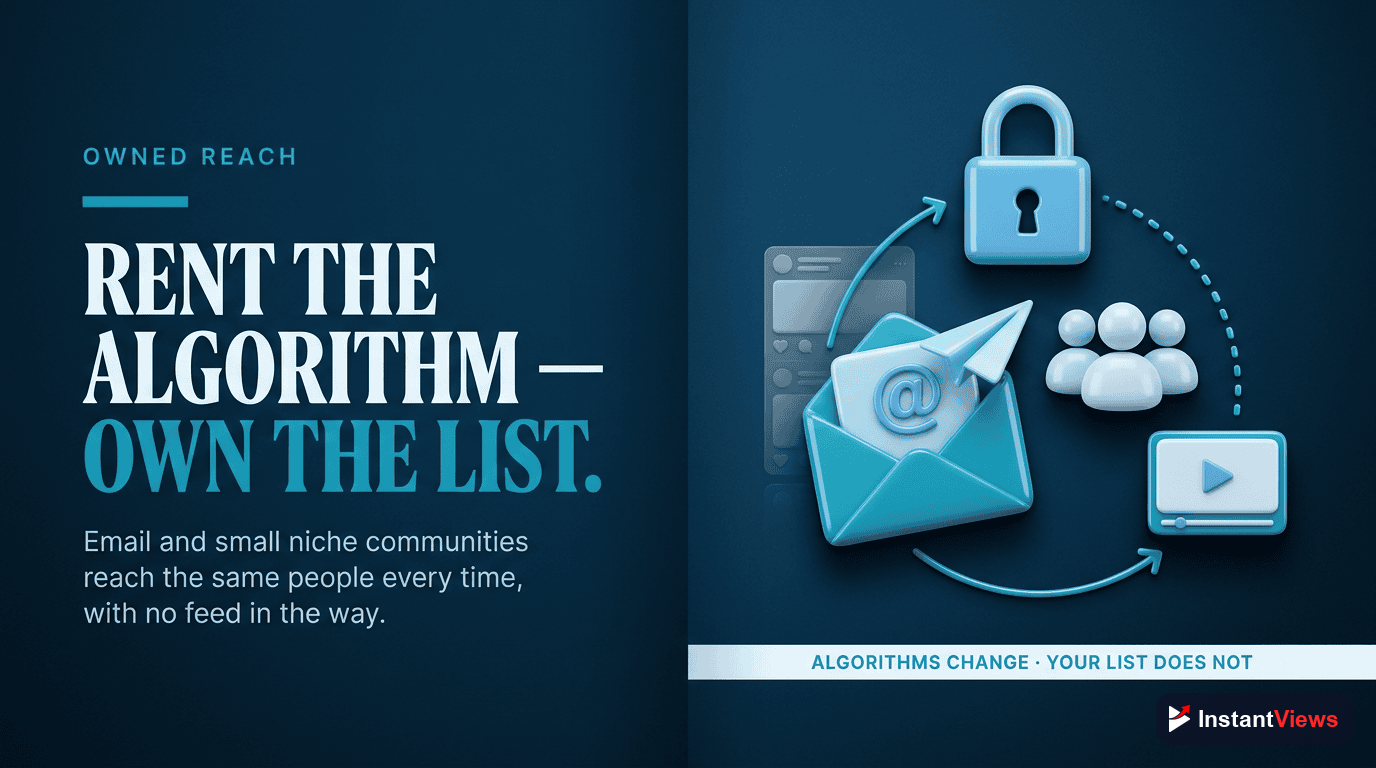
Social platforms lend you an audience; they can take it back at any time. Email is the one audience you fully own. No algorithm decides who sees your message — it lands in the inbox of everyone who asked to hear from you. That makes email the most reliable traffic source you will ever build.
It is also the fastest. A short email the moment a video goes live drives a burst of early views from people who already trust you. Those early views are a powerful freshness signal, telling YouTube the video is resonating and nudging it toward wider recommendation. No social post is as dependable for that crucial first-hour push.
How to Use Email for YouTube
- Send a brief, friendly note when a new video publishes — what it covers and why it is worth their time.
- Lead with curiosity, not a wall of text. One or two lines and a clear link to watch.
- Build the list from your videos themselves: offer a free resource and capture emails so the cycle keeps feeding itself.
Niche Communities Done Right
Reddit, Discord servers, Facebook groups, and specialist forums are gold mines of engaged viewers — if you respect them. These communities punish drive-by self-promotion and reward genuine contribution. Share where you add value: answer the question fully, join the discussion, and link your video only when it directly helps and the rules allow. Earn the right to share, and a small, highly interested audience will follow you home.
A Real Walkthrough: One Video, One Week
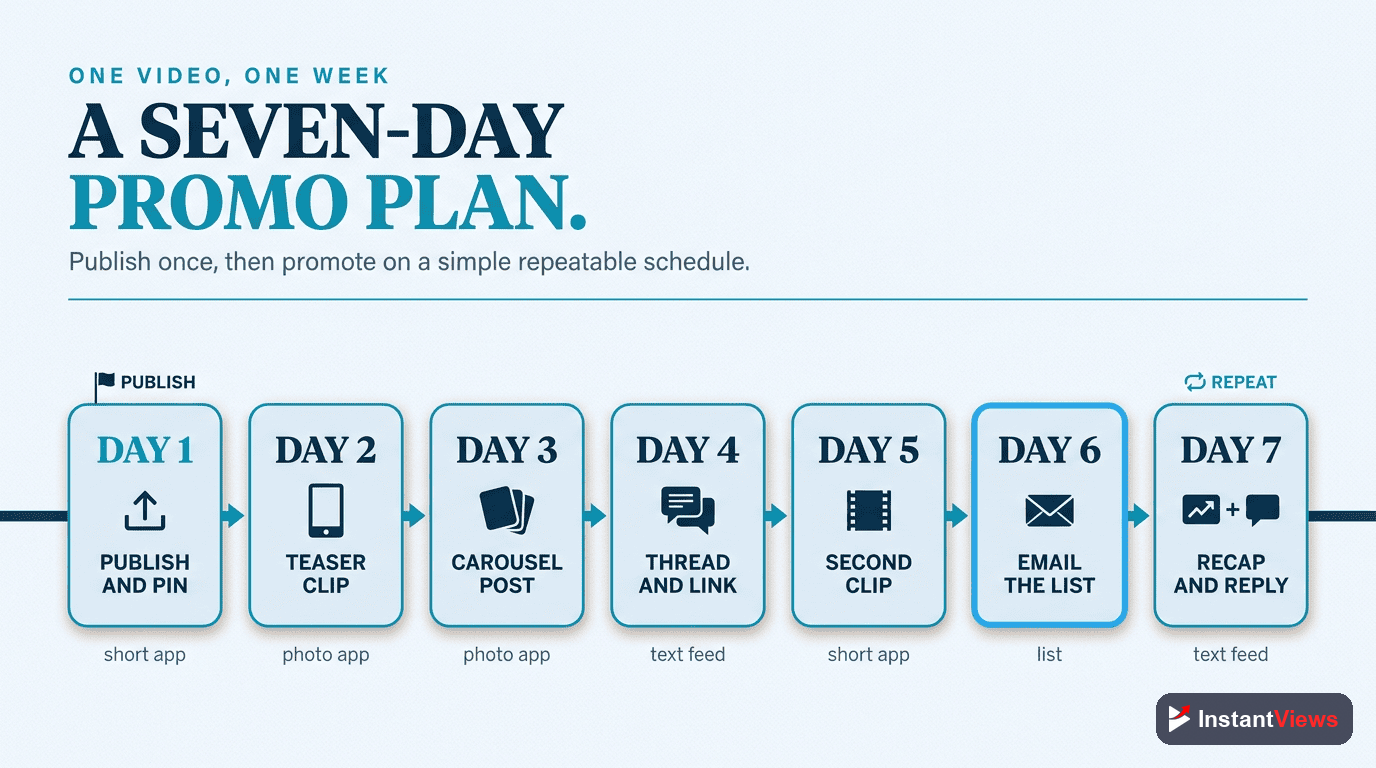
Theory is easy; here is what the workflow actually looks like. Imagine you publish a fifteen-minute tutorial on Monday. Here is how one video becomes a week of cross-platform promotion without any new filming.
- Monday — Launch. The full video goes live on YouTube. You email your list the same day with a short, curiosity-driven note and a link. Those early views start the momentum.
- Tuesday — First clip. You post the strongest 45-second hook as a vertical, captioned clip on TikTok, Reels, and as a YouTube Short, each pointing to the full tutorial.
- Wednesday — Quote graphic. You turn the video’s best line into a clean graphic for Instagram and LinkedIn, with a caption that teases the full breakdown on YouTube.
- Thursday — Community value. You find a relevant question on Reddit or a niche forum, write a genuinely helpful answer, and link the video where it directly adds to the discussion.
- Friday — Second clip and thread. A different moment becomes a second short clip, and you write an X or LinkedIn thread laying out the core argument, ending with a link to watch the whole thing.
By the end of the week, one video has appeared across five or six surfaces, each one a trailer aimed at the same destination. You did not create six pieces of content — you reshaped one. That is the leverage that makes cross-platform promotion realistic for a solo creator or a small team.
Measuring Which Platforms Actually Work
Effort without measurement is guesswork. Some platforms will quietly drive real viewers; others will eat hours and return nothing. The only way to know is to look at the data — and YouTube hands it to you directly.
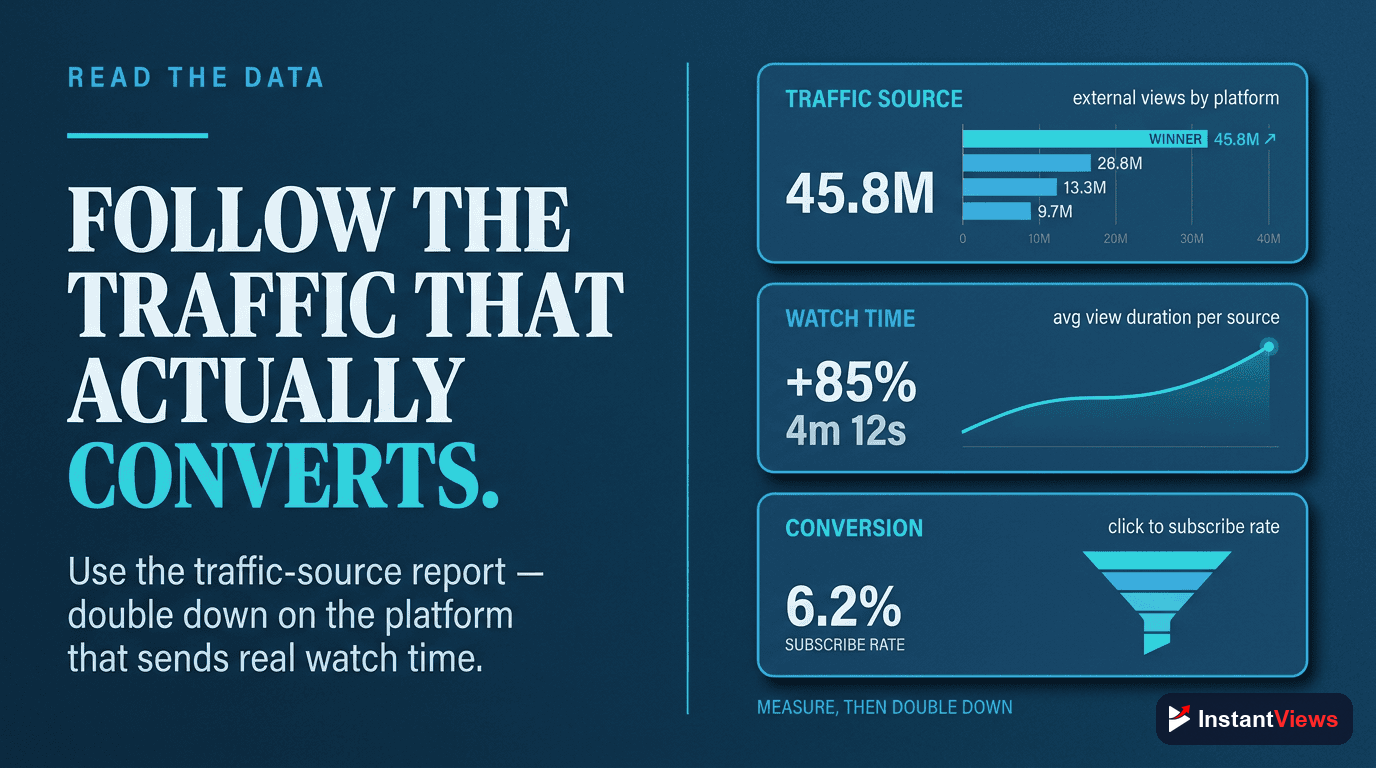
Open the Traffic Sources report in YouTube Analytics. The “External” category shows exactly how much watch time comes from outside YouTube and which sites send it. If TikTok and your email list show up strongly while a platform you have poured hours into barely registers, you have your answer.
- Watch the External traffic source breakdown to see which platforms send real, watching viewers — not just clicks that bounce.
- Cross-reference each platform’s own analytics to see which clips earn engagement and link taps.
- Track subscribers and returning viewers, since the best external traffic does not just visit once — it converts to your channel.
Then act on it: do more of what works and quietly retire what does not. You do not have to win on every platform. Two or three that reliably send engaged viewers will outperform a half-hearted presence on eight. Let the data, not the hype, decide where your time goes.
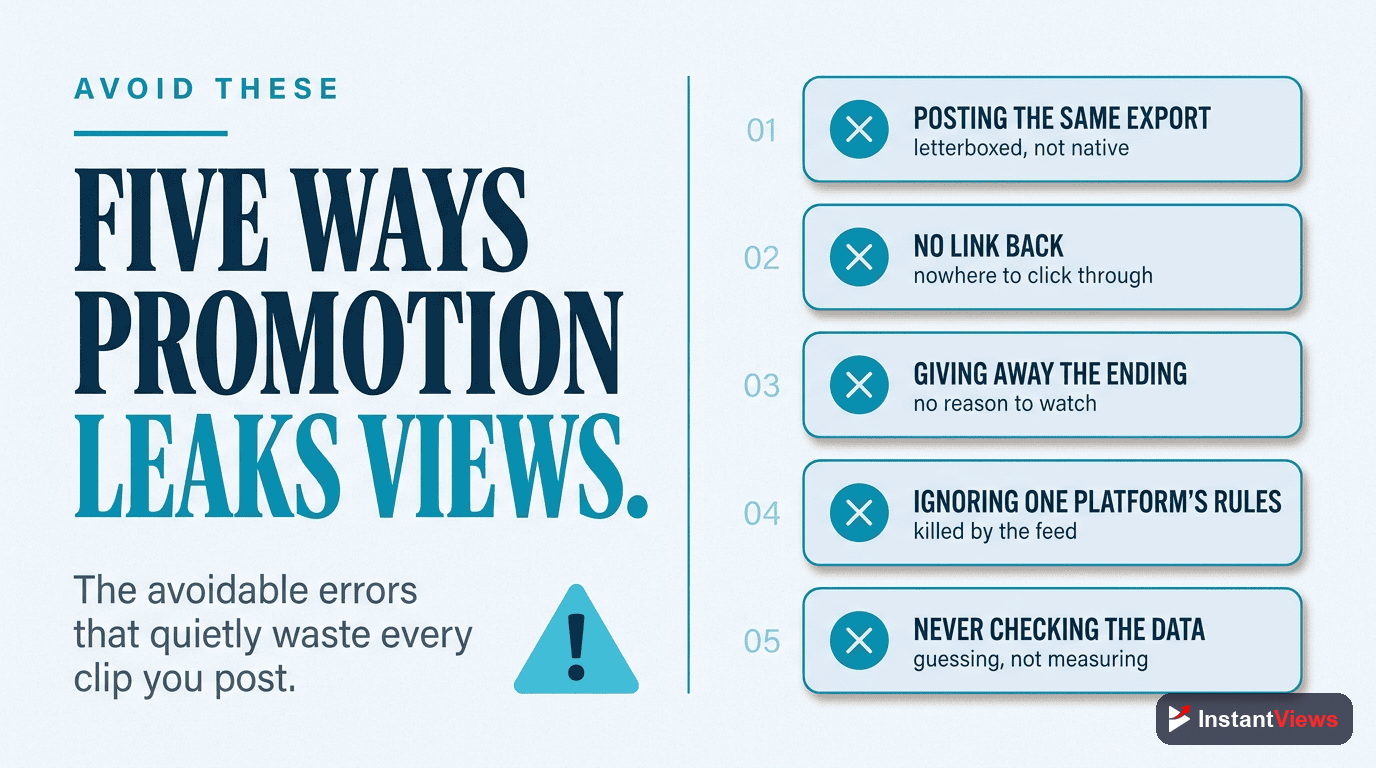
Common Cross-Platform Mistakes to Avoid
Most cross-platform efforts fail for the same handful of reasons. Avoid these and you are ahead of nearly everyone:
- Posting the whole video off-YouTube: You give away the payoff and remove every reason to click through to your channel.
- Letterboxed, lazy clips: Horizontal snippets with black bars and no captions get skipped instantly in vertical feeds.
- Forgetting the link: A clip that never tells people where the full video lives is entertainment, not promotion.
- Spamming communities: Drive-by link drops on Reddit and in groups get removed and damage your reputation. Add value first.
- Recreating content for every platform: Trying to make original content everywhere leads straight to burnout. Repurpose instead.
- Ignoring the data: Spreading thin across every platform without checking traffic sources wastes time on channels that send no one.
- Skipping email: Neglecting the one audience you own means missing the most reliable source of early views you have.
"You do not need to be everywhere — you need to be everywhere that points home. One video, reshaped into native trailers across a few platforms, will always beat fresh content scattered with no destination."
Frequently Asked Questions
Cross-platform promotion means using other platforms — TikTok, Instagram Reels, Reddit, X, LinkedIn, email, and your own website — to send viewers to your YouTube channel. Instead of relying on YouTube discovery alone, you repurpose pieces of your videos into native content on each platform that points people back to the full video on YouTube.
No. Other platforms work best as trailers, not as a second home for the full video. Post short, native clips that tease the most interesting moment and leave the payoff on YouTube. Uploading the entire video elsewhere removes the reason to click through and trains the audience to stay off your channel.
A single long-form video can usually become three to five short clips, a few quote graphics, one or two text posts, and an email summary — without filming anything new. The point is to reshape what you already made into native formats for each platform rather than to create entirely fresh content for each one.
TikTok and Instagram Reels offer the widest reach for new viewers, YouTube Shorts keeps people inside the YouTube ecosystem, Reddit and niche communities reach highly engaged audiences, and X and LinkedIn suit commentary and B2B. Your own blog and email list let you embed videos and reach the audience you fully own.
Email is the only audience you fully own — no algorithm decides who sees it. A short email when a video goes live drives early views, and those early views are a strong freshness signal that helps YouTube decide how widely to recommend the video. No social platform gives you that level of direct, reliable reach.
Yes. Native clips should be vertical 9:16 with clear on-screen captions, because most short-form viewers watch on their phones with the sound off. A letterboxed horizontal snippet dropped into a vertical feed looks lazy and gets skipped, so reframe the clip and add captions before posting.
Open the Traffic Sources report in YouTube Analytics. It shows how much of your watch time comes from external sites and which ones. Combine that with each platform’s own analytics, then do more of what sends real viewers and quietly retire the platforms that drain time without results.
It can be if you only drop links. Reddit and niche communities reward people who add genuine value first. Answer questions, join discussions, and share your video only where it directly helps and the community allows it. Treat each subreddit as a place to contribute, not a billboard, and links will be welcomed.
Conclusion
YouTube discovery is powerful, but waiting passively for the algorithm to find your video is the slowest way to grow. The creators who win in 2026 send their own traffic. They treat YouTube as the destination and every other platform — TikTok, Reels, Shorts, Reddit, X, LinkedIn, the blog, and the inbox — as a road that leads straight to it.
The system is simple and sustainable: publish one strong long-form video, repurpose it into a handful of native trailers, point every one back to the full video, and lean on email and engaged communities for the early views that unlock wider reach. You are not creating six pieces of content — you are reshaping one for maximum leverage.
Start with your next upload. Pull three clips, write one email, and check your traffic sources a week later. Do more of what works, drop what does not, and let every platform you already use quietly funnel viewers to the channel you are building. That is how cross-platform promotion turns scattered attention into steady, compounding YouTube growth.