- Shorts win raw views and reach — the feed serves over 200 billion views a day to anyone, even people who do not subscribe
- Long-form wins watch time, trust, and revenue — deeper videos earn far more per view and build a loyal audience
- A view is not a unit of value: a few seconds in the Shorts feed is not the same as ten minutes of focused attention
- The 2026 algorithm rewards satisfaction and retention in both formats, and recommends each on its own separate surface
- The winning play is to use both together — Shorts for discovery, long-form for depth — not to pick one and ignore the other
It is the question almost every creator asks at some point: should I be making Shorts or long-form videos? One side promises explosive reach and millions of views with sixty seconds of footage. The other promises a real audience, real watch time, and real income. With YouTube serving over a billion hours of long-form video every day and the Shorts feed pushing more than 200 billion views a day, both formats are clearly enormous — so which one actually gets you more views, and which one actually grows your channel?
The honest answer is that the question itself is slightly wrong. Shorts and long-form do not compete for the same prize. Shorts are built to win the view count contest, and they win it easily. Long-form is built to win the watch time, trust, and revenue contest, and it wins that one just as decisively. Asking which gets more views is a bit like asking whether a billboard or a sit-down dinner is better marketing — they do completely different jobs.
By 2026 the most successful channels have stopped treating this as an either-or decision. They use both formats as two different tools in the same growth plan: Shorts to be discovered by strangers, and long-form to turn those strangers into subscribers, fans, and customers. This guide breaks down exactly how each format performs on views, watch time, monetization, and growth — with a full head-to-head comparison table — and then gives you a simple framework for deciding how much of each to make.
By the end, you will not be picking a winner. You will know how to make Shorts and long-form work together so the whole channel grows faster than either could alone.
- Which Format Gets More Views?
- Why a View Is Not a Unit of Value
- Watch Time, Trust, and Loyalty
- Monetization: Where the Money Really Is
- How the 2026 Algorithm Treats Each Format
- Head-to-Head Comparison Table
- The Winning Play: Use Both Together
- A Simple Recommendation Framework
- A Worked Example: One Idea, Two Formats
- Common Mistakes to Avoid
- FAQ
Which Format Gets More Views?
If the only thing you care about is the number under the video, Shorts win — and it is not close. The reason is structural. The Shorts feed is a discovery machine: it serves content to anyone scrolling, regardless of whether they have ever heard of you, subscribed to you, or watched a single one of your videos before. A well-made Short can reach tens of thousands of strangers overnight without you having any audience at all.
Long-form is different. A new long-form video is shown first to a slice of your existing audience and a test pool of suggested-video slots. If those viewers watch and stay, YouTube expands the reach; if they do not, it pulls back. That means a brand-new channel can post a long video to almost nobody, while the same channel can post a Short and reach a stadium full of people the same afternoon.
So for raw reach and view count, especially when you are starting out, Shorts are the fastest path. This is exactly why Shorts feel so addictive to make: the feedback is immediate and the numbers are big. But before you swear off long-form forever, you need to understand what those big numbers actually mean.
Why a View Is Not a Unit of Value
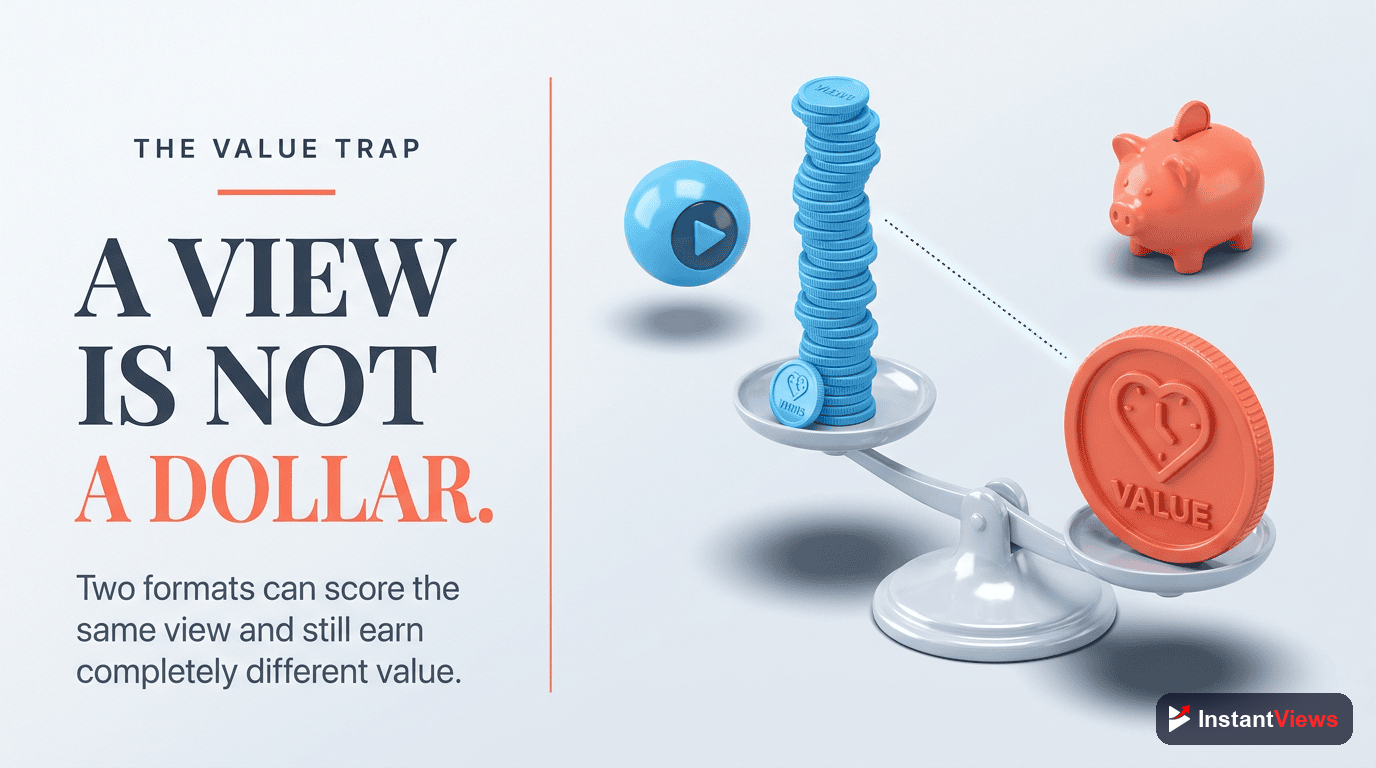
Here is the trap that catches thousands of creators: they assume that a view is a view. It is not. A view is a unit of attention, and the amount of attention behind a Shorts view and a long-form view is wildly different.
Think about what each view actually represents. Someone scrolling the Shorts feed gives you a few seconds, often while half-distracted, before flicking to the next clip. Someone who clicks a ten-minute tutorial has made a deliberate choice to spend real time with you and is far more likely to subscribe, click a link, or come back tomorrow.
A simple comparison makes the gap obvious:
- Five Shorts watched fully: five sixty-second clips watched to completion produce about five minutes of total watch time — spread across five quick, shallow impressions.
- One long video watched most of the way: a single ten-minute video watched to roughly seventy percent produces about seven minutes of watch time — from one focused, engaged viewer.
The long video produced more watch time from one person than five Shorts did from five. And watch time, not view count, is what YouTube uses to decide whether your channel is worth promoting. This is why a channel can have millions of Shorts views and still feel like it is not growing — the views are real, but the value behind them is thin.
Watch Time, Trust, and Loyalty
Views get you noticed. Watch time gets you trusted. And trust is what turns a passing viewer into a subscriber who actually shows up for your next video.
Long-form is the format where trust is built. When someone watches eight or twelve minutes of your content, they hear your voice, follow your thinking, and start to feel like they know you. That familiarity is what makes them subscribe with intent, join your email list, and eventually buy what you offer. It is very hard to build that kind of relationship in sixty seconds.
Shorts Subscribers vs Long-Form Subscribers
Not all subscribers are equal either. A subscriber gained from a viral Short is often a low-intent follower — they tapped subscribe in a fast scroll and may never watch you again. A subscriber gained from a long-form video is usually high-intent: they chose to spend real time with you and are far more likely to return. This is why channels that grow only on Shorts often see huge subscriber counts but disappointing views on everything they post afterward.
The Loyalty Loop
Long-form also fuels the loyalty loop that keeps a channel alive: a viewer watches a full video, gets value, subscribes, gets recommended your next video, watches that, and so on. Each loop deepens the relationship. Shorts rarely create that loop on their own — they are brilliant at the first introduction, but they need long-form to carry the relationship forward.

Monetization: Where the Money Really Is
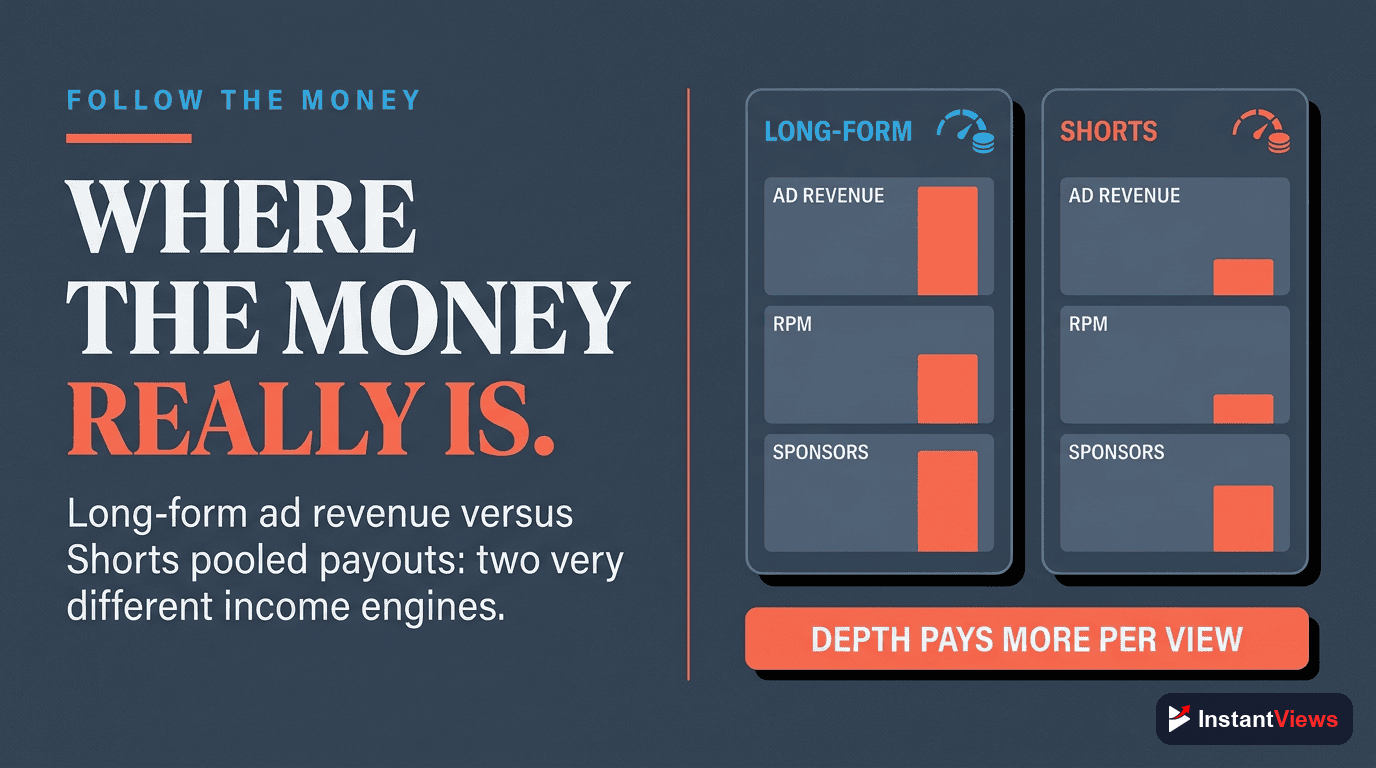
If views are where Shorts dominate, revenue is where long-form dominates — just as decisively. The difference comes down to how each format is monetized.
A long-form video over eight minutes can carry multiple ad placements: a pre-roll before it starts, mid-rolls during the video, and a post-roll at the end. Each of those is a chance to earn. Shorts, by contrast, are monetized from a shared revenue pool tied to the Shorts feed, using a single lightweight ad format that simply cannot generate as much per view.
The practical result, widely reported across the industry in 2026, is that long-form earns dramatically more per view than Shorts — often many times more for the same number of views. A creator can rack up a million Shorts views and earn a modest amount, while a long-form video with a fraction of those views can earn considerably more. That is not a knock on Shorts; it is simply the math of how the two formats are built.
There is also the matter of qualifying for monetization in the first place. Reaching the YouTube Partner Program can be done through either Shorts views or long-form watch hours, but the long-term earning ceiling on Shorts alone is low. This is the single biggest reason serious creators treat Shorts as a way to grow the audience and long-form as the way to earn from it.
Do not build a business plan on Shorts ad revenue alone. The per-view payout is low and volatile, and a single algorithm change can cut a Shorts-only channel off at the knees. Use Shorts to attract people, then earn through long-form ads, sponsorships, and your own products — income sources you control.
How the 2026 Algorithm Treats Each Format
A common worry is that posting Shorts will somehow "hurt" your long-form videos, or vice versa. The good news is that YouTube recommends each format mainly on its own separate surface: Shorts live in the Shorts feed, while long-form lives on the home page, search, and suggested videos. They are not fighting each other for the same slots.
In 2026, the algorithm in both surfaces has converged on one priority: viewer satisfaction and retention. It is no longer enough to simply rack up watch time — YouTube wants to know that viewers actually enjoyed what they watched and feel good about the time they spent. For Shorts, that means holding attention all the way to the loop. For long-form, it means keeping viewers engaged minute after minute rather than padding for length.
Two more things matter in 2026. First, retention now counts for more than raw length, so a tight eight-minute video that holds people often beats a bloated twenty-minute one that loses them. Second, YouTube is actively reducing the spread of low-value, mass-produced content in both formats — which rewards creators who make something genuinely worth watching, no matter the length.
What This Means for Your Strategy
- You can post both freely. Shorts will not cannibalize your long-form, because they are served separately.
- Quality beats quantity in both. A satisfying Short and an engaging long video are both rewarded; filler in either is not.
- Retention is the shared currency. Whether sixty seconds or sixteen minutes, the videos that hold attention win.

Head-to-Head Comparison Table
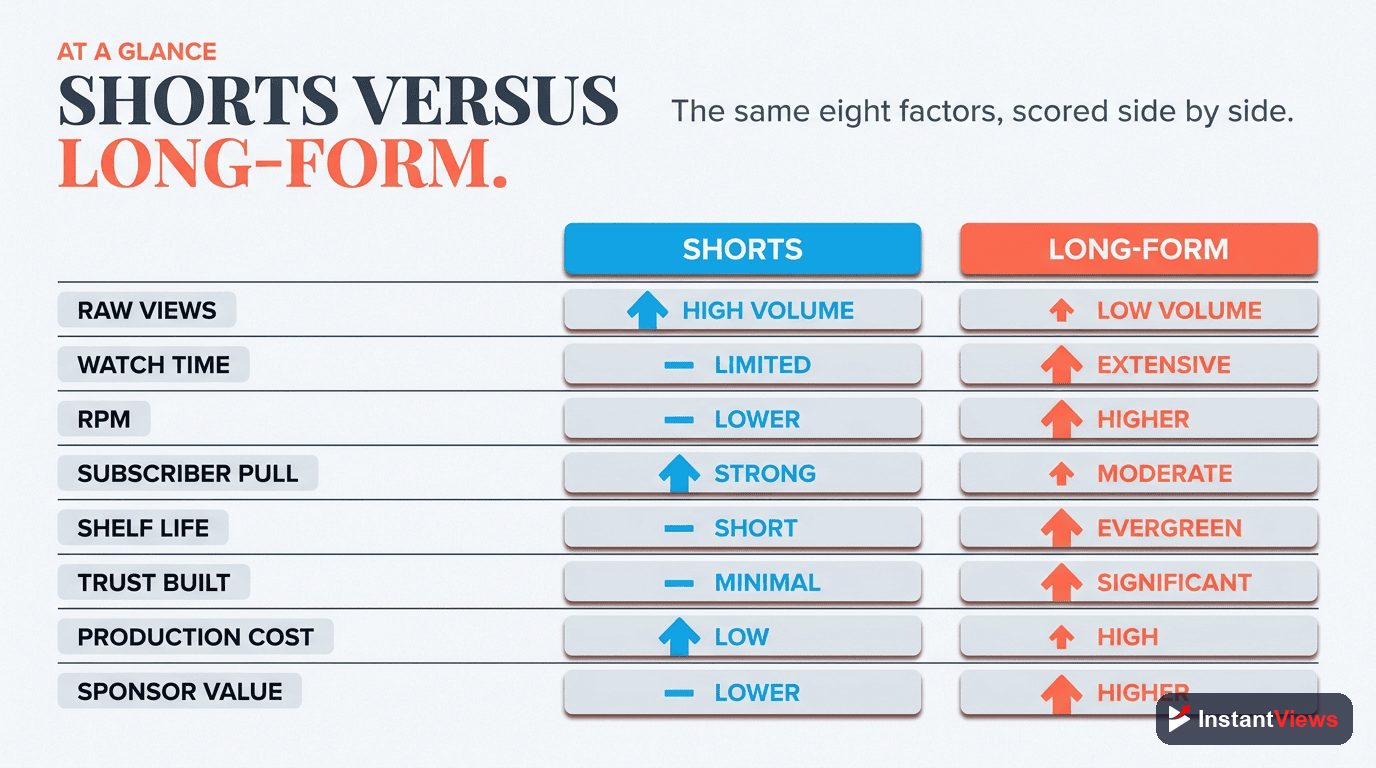
Here is how Shorts and long-form stack up across the dimensions that actually decide growth. Notice that there is no overall "winner" — each format dominates the column it was built for.
| Dimension | YouTube Shorts | Long-Form Video |
|---|---|---|
| Raw views & reach | Very high — served to anyone, even non-subscribers | Lower — shown mainly to your audience and suggested slots |
| Reach to new viewers | Excellent — the fastest way to be discovered | Moderate — grows steadily as trust builds |
| Watch time per view | Low — seconds of shallow attention | High — minutes of focused attention |
| Trust & loyalty built | Limited — hard to bond in 60 seconds | Strong — viewers get to know you |
| Subscriber quality | Often low-intent, may not return | Often high-intent, more likely to come back |
| Revenue per view | Low — shared Shorts ad pool | High — pre-roll, mid-roll, and post-roll ads |
| Production effort | Low to moderate — quick to make | Higher — scripting, filming, editing |
| Best job in your funnel | Discovery — attract strangers | Depth — convert and monetize |
Read down the table and the strategy writes itself. If you only make Shorts, you win the top two rows and lose the rest. If you only make long-form, you win the bottom rows but struggle to be discovered. The channels that win every row are the ones that run both.
The Winning Play: Use Both Together
The real insight of 2026 is that Shorts and long-form are not rivals — they are the two halves of a single growth engine. Shorts are the top of the funnel, pulling in a flood of new viewers who have never heard of you. Long-form is the depth, turning a fraction of that flood into subscribers, fans, and customers.
The standard recipe creators describe looks like this: a Short gets attention, the viewer gets curious about who made it, they click into a long video, they get hooked, and they subscribe. The Short opened the door; the long video closed the deal. Neither step works as well alone. This is why channels that publish both formats consistently tend to grow faster than channels that commit to only one.
How the Two Reinforce Each Other
- Shorts feed long-form ideas. A Short that goes viral is proof that a topic resonates — turn it into a full video.
- Long-form feeds Shorts. The best moments of a long video can be clipped into Shorts that point back to the original.
- Shorts widen the top; long-form deepens it. One brings the crowd, the other keeps the right people.
- Together they cover every dimension. Reach from Shorts, revenue and trust from long-form, growth from the loop between them.
"Stop asking which format wins. Shorts win attention and long-form wins trust — the creators who grow fastest in 2026 are the ones who use Shorts to open the door and long-form to invite people in."

A Simple Recommendation Framework
So how much of each should you make? It depends on your goal right now. Use this five-step framework to build a mix that fits your channel instead of copying someone else's.
Name Your Current Goal
Decide what you need most right now: raw reach and new viewers, or watch time, trust, and revenue. Reach leans Shorts; depth and income lean long-form. Everything else follows from this one choice.
Set a Realistic Mix
A common starting rhythm is several Shorts a week to stay visible plus one or two strong long-form videos. If you need reach, post more Shorts; if you need revenue, protect time for long-form. Pick a mix you can actually sustain.
Build the Bridge Between Them
Make sure every Short has a path into your long-form world: a pinned comment linking the full video, an end-of-Short callout, and playlists that group related Shorts and long videos so curious viewers can go deeper.
Judge Each Format by the Right Metric
Measure Shorts by reach and new viewers. Measure long-form by average view duration, returning viewers, and revenue. Never judge a Short by revenue or a long video by raw view count — you will draw the wrong conclusion.
Review and Rebalance Monthly
Once a month, look at where your growth and revenue actually came from, then shift your mix toward whatever is working. Goals change — a launch month leans long-form, a slow month might lean Shorts for reach.
Grow Faster With Free Tools
Research topics, write titles that get clicks, and analyze what is working across your Shorts and long-form videos with our free suite of YouTube tools.
Explore Free YouTube Tools →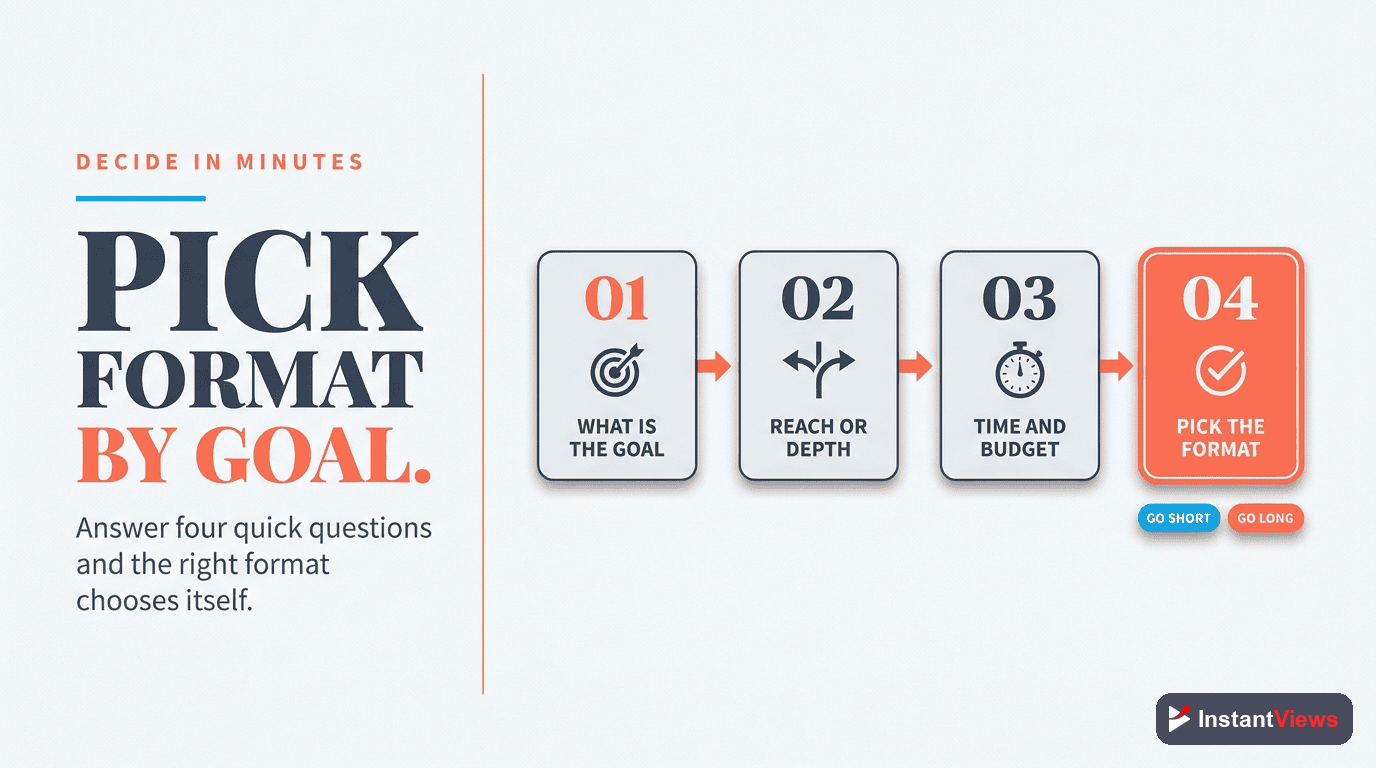
A Worked Example: One Idea, Two Formats
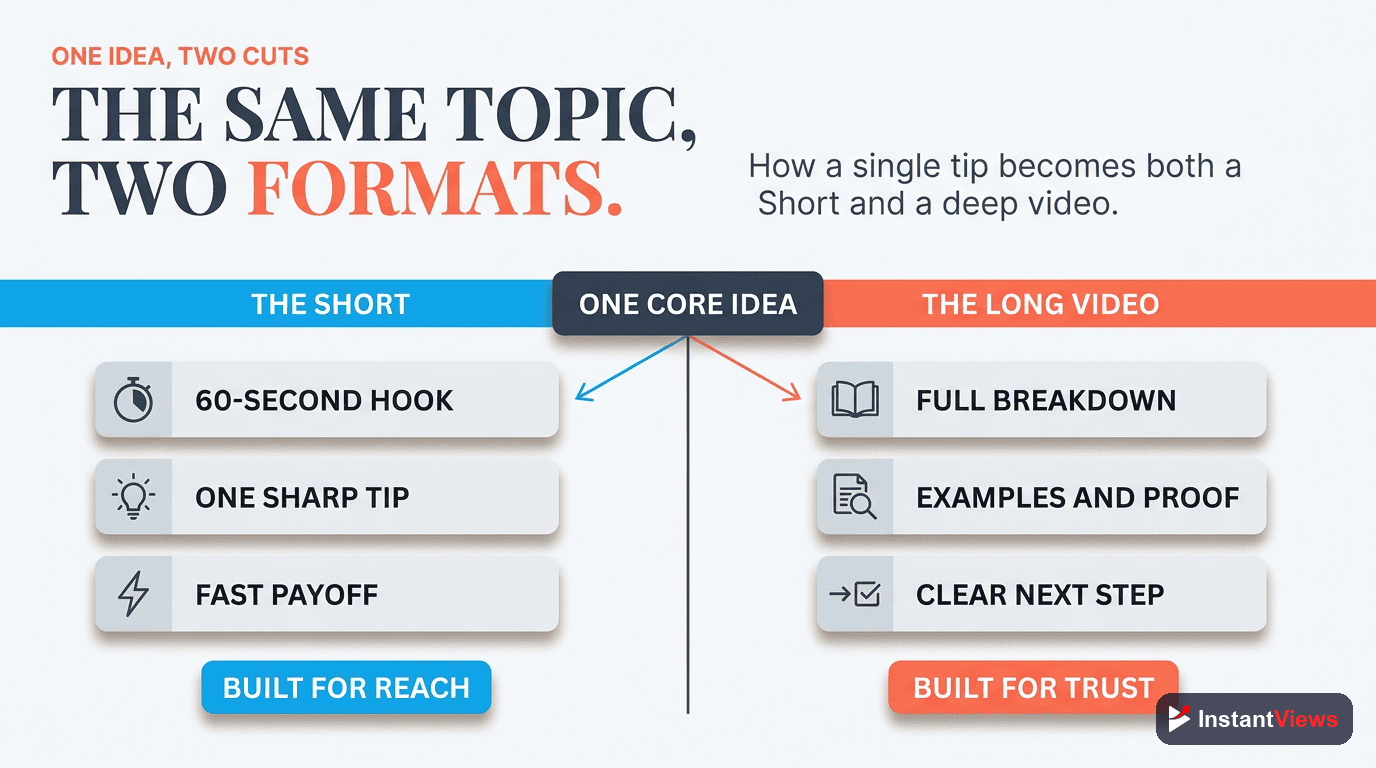
Let us make this concrete. Imagine you run a channel about home coffee and you have one strong idea: "the mistake that ruins most home espresso." Here is how a creator who understands both formats would run that single idea through the whole engine.
Step 1: Test the Idea as a Short
You film a thirty-second Short that names the mistake and shows the bad result, ending on a hook: "here is what to do instead." Because it lives in the Shorts feed, it reaches thousands of strangers fast. The view count tells you instantly whether the topic resonates — this is cheap, quick market research.
Step 2: The Short Validates Demand
The Short takes off. That spike is a signal: people care about this problem. You have now confirmed the topic is worth a much bigger investment, without having to gamble a full production day on a guess.
Step 3: Build the Long-Form Video
You produce a ten-minute video that fully solves the problem — the why, the fix, the demonstration, and a few advanced tips. This is where viewers spend real minutes with you, build trust, and decide to subscribe. It is also where the ad revenue lives.
Step 4: Connect the Two
You pin a comment on the Short linking the full video, add an end-of-Short callout, and drop both into a "home espresso" playlist. Now every new viewer the Short attracts has an obvious next step into your deeper content — and the loop begins.
One idea, two formats, one engine. The Short found the audience and proved the demand; the long-form turned that audience into subscribers and revenue. That is the entire strategy in miniature, and it is repeatable for almost any topic.
Common Mistakes to Avoid
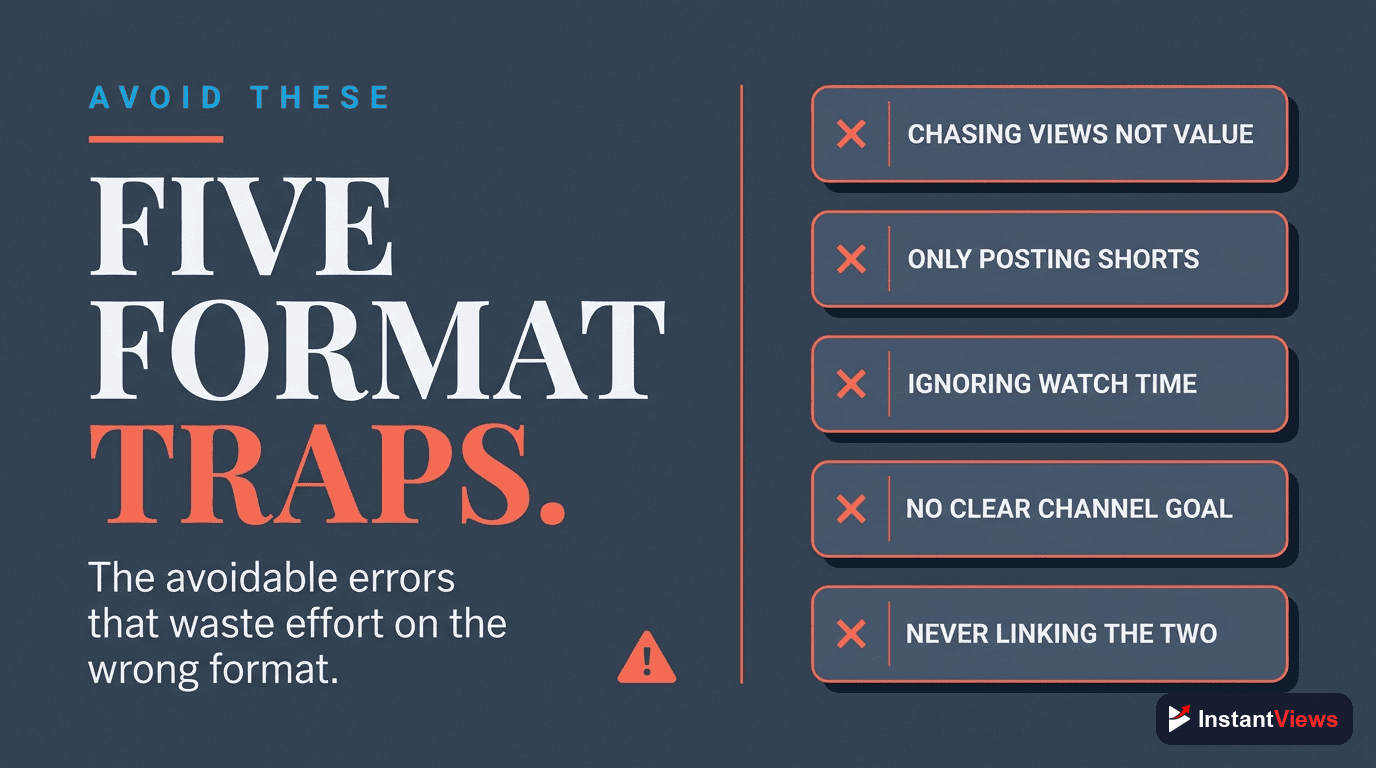
Even creators who understand the theory trip over the same execution mistakes. Watch out for these:
- Chasing Shorts views as the only metric. Millions of Shorts views with no watch time, subscribers, or revenue is a vanity trap, not growth.
- Posting Shorts with no bridge to long-form. If a Short does not point anywhere, the attention it earns evaporates the moment the viewer scrolls on.
- Abandoning long-form because it is slower. Long-form feels slow because trust and revenue take time — but that is exactly where the durable growth lives.
- Judging both formats by the same number. Holding a long video to Shorts-level view counts, or expecting Shorts to pay like long-form, leads to quitting the wrong format.
- Sacrificing quality for volume. The 2026 algorithm rewards satisfaction in both formats, so a flood of forgettable clips or padded videos works against you.
- Treating it as a permanent either-or. Your ideal mix changes with your goals; locking into "only Shorts" or "only long-form" forever leaves growth on the table.
Frequently Asked Questions
Shorts almost always win on raw view count. The Shorts feed serves content to anyone, regardless of whether they subscribe to you, so a single Short can reach tens of thousands of strangers overnight. Long-form videos usually earn fewer total views, but those views are longer, deeper, and far more likely to come from people who already trust your channel.
Because a view is not the same as value. A Short view can last a few seconds, while a long-form view can last many minutes, which builds the watch time, trust, and ad revenue that actually grow a business. Long-form is where viewers get to know you, join your email list, and buy, so most creators use Shorts to attract attention and long-form to convert it.
Long-form earns far more per view. Long videos over eight minutes can carry pre-roll, mid-roll, and post-roll ads, while Shorts are monetized from a shared pool in the Shorts feed at a much lower rate per view. That is why creators treat Shorts as a discovery tool that feeds a long-form channel, rather than as a standalone income source.
You can grow a subscriber count quickly with Shorts alone, but those subscribers often do not convert into watch time, loyalty, or revenue. Without long-form content there is nowhere for an interested viewer to go deeper, so growth tends to be wide but shallow. The strongest play is to use Shorts to attract viewers and long-form to keep and monetize them.
YouTube recommends each format mainly within its own surface: Shorts in the Shorts feed, long-form on the home and suggested feeds. In 2026 the algorithm rewards viewer satisfaction and retention in both, so a Short that holds attention to the end and a long video that keeps people watching are both promoted. Retention matters more than raw length.
There is no single rule, but many growing channels publish several Shorts a week to stay visible while shipping one or two strong long-form videos. Let your goal decide the mix: lean into Shorts when you need reach and new viewers, and protect time for long-form when you need watch time, trust, and revenue.
Make Shorts that tease a bigger idea, then point viewers to the full video using pinned comments, end-of-Short callouts, and playlists that group related Shorts and long videos together. The goal is to give a curious Shorts viewer one obvious next step into your deeper content where the real relationship begins.
No. YouTube has confirmed that posting Shorts does not hurt your long-form performance, because the two are recommended on separate surfaces. Channels that publish both formats often grow faster than single-format channels, since Shorts widen the top of the funnel while long-form deepens it.
Conclusion
So which gets more views — Shorts or long-form? Shorts, almost every time. The Shorts feed is the most powerful discovery machine YouTube has ever built, and nothing beats it for raw reach to people who have never heard of you. But views are only the first step, and a view in the Shorts feed is not the same unit of value as ten minutes of focused attention.
Long-form wins everything that comes after the first impression: watch time, trust, loyal subscribers, and the ad revenue that actually pays the bills. That is why the question was never really "which one wins." Shorts win attention; long-form wins the relationship. Each dominates the column it was built for, and the comparison table makes that impossible to miss.
The creators who grow fastest in 2026 have internalized this. They use Shorts to open the door and long-form to invite people in, running one idea through both formats so reach and depth reinforce each other. Pick your goal, set a mix you can sustain, build the bridge between the two, and measure each format by the right metric — do that consistently, and you stop choosing between Shorts and long-form and start using both to grow faster than either could alone.