- Almost every strategy that grows YouTube views is free — it costs time and attention, not cash
- Better titles and thumbnails are the cheapest, fastest way to turn the reach you already have into clicks
- Shorts, playlists, and the community tab keep viewers in your ecosystem and lengthen sessions the algorithm rewards
- Repurposing and collaborations multiply the value of every video at zero media cost
- Consistency compounds: a steady cadence in a clear niche beats occasional bursts, and paid ads are optional
YouTube reaches more than 2.7 billion monthly active users and serves around a billion hours of video every day. That is an enormous audience, and the good news for anyone on a tight budget is simple: the platform does not charge you to be discovered. The creators who quietly grow without a marketing budget are not buying their way in — they are working the free levers that YouTube hands every channel.
It is easy to assume that growth requires money: ads, expensive gear, paid promotion, agencies. In reality, the strategies that move the needle most are things like sharper packaging, smarter keywords, Shorts, playlists, and consistency. Each one is free to apply. What they cost is thought and follow-through, which is exactly why so few channels do them well.
This guide is a practical roundup of the highest-leverage, low-cost and no-cost ways to boost your views in 2026. We will work through search optimization, thumbnails, Shorts, playlists, the community tab, repurposing, collaborations, and the quiet superpower of consistency — then look at where a small amount of paid spend fits in, if you ever want it.
None of this is theoretical. By the end you will have a clear order of operations: what to fix first for the biggest free win, and how each tactic feeds the next so your channel compounds instead of stalling.
- Why You Do Not Need a Big Budget
- Master Free YouTube SEO
- Titles and Thumbnails: Your Cheapest Win
- Use Shorts to Reach New Viewers
- Playlists and Sessions That Compound
- The Community Tab and Engagement
- Repurpose Everything You Make
- Collaborate to Borrow Audiences
- Cost vs Impact: A Strategy Table
- A Worked Example: 30 Days, Zero Budget
- FAQ
Why You Do Not Need a Big Budget
The biggest myth in creator culture is that views are bought. They are not. YouTube's recommendation system is built to surface content that satisfies viewers, regardless of who made it or how much they spent. A first-time creator with a great video and a clear niche can out-perform a well-funded channel with thin content, because the 2026 algorithm optimizes for viewer satisfaction and retention rather than raw production budget.
That shift works in your favor. YouTube is actively reducing the spread of low-value, mass-produced content, which means genuinely useful videos — the kind a solo creator can make — are favored over churned-out filler. Money cannot manufacture the one thing the algorithm cares about most: people watching, staying, and coming back.
So the question is not "how much should I spend?" but "where is my free attention best invested?" Every tactic in this guide answers that. They fall into three buckets: getting found (SEO, Shorts), getting the click (titles, thumbnails), and keeping the session going (playlists, community, consistency). Master those and paid ads become a nice-to-have, not a requirement.
Master Free YouTube SEO
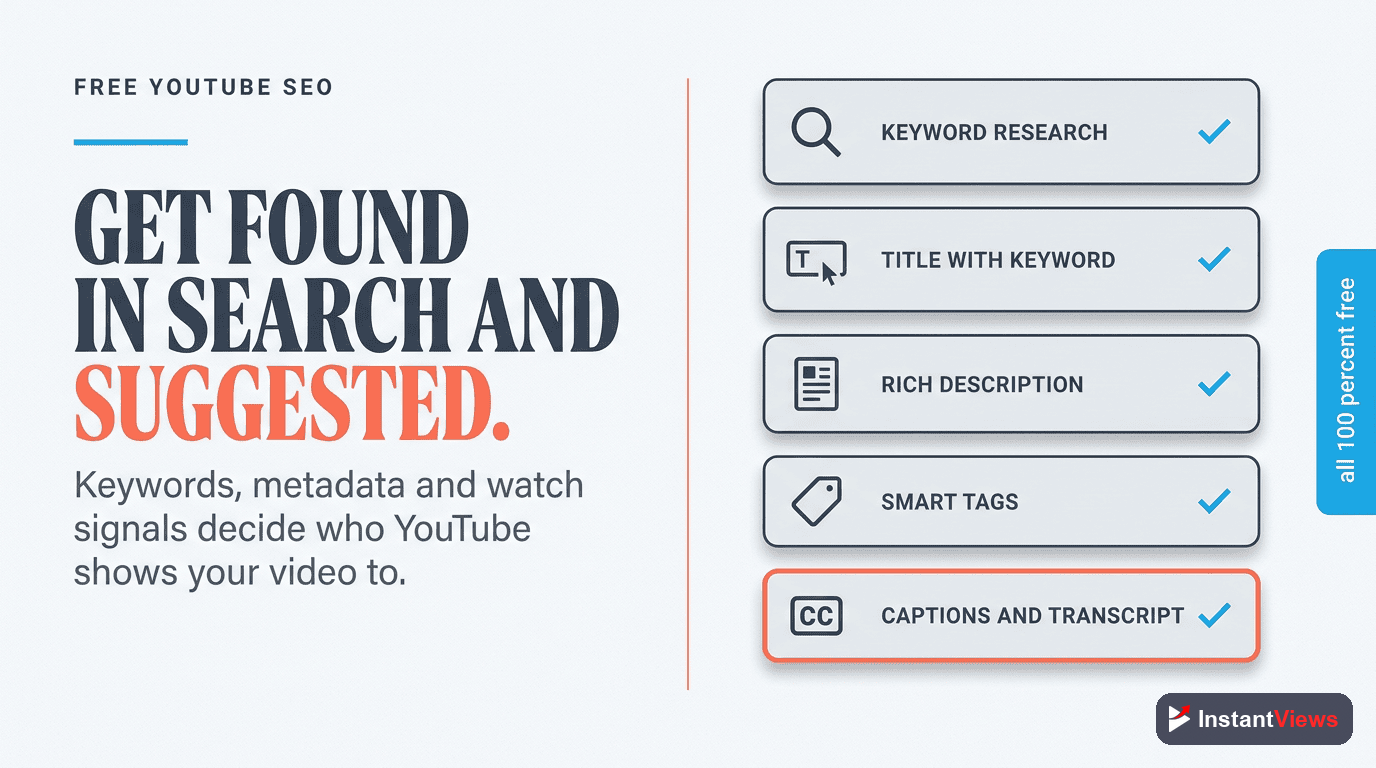
Search and suggested videos are the two largest free traffic sources on the platform, and both run on relevance signals you fully control. YouTube SEO is simply telling the algorithm and your audience, clearly, what your video is about and who it is for.
Start With Keyword Intent
Before you film, find the phrases real people type. Free tools — including YouTube's own search autocomplete — reveal what your audience is looking for. Build two separate keyword lists: intent-based, specific phrases for long-form videos, and trendier, hashtag-friendly terms for Shorts. They behave differently and deserve different targeting.
Optimize the Three Fields That Matter
- Title: Place your primary keyword naturally near the front, where it carries the most weight, while keeping the title compelling enough to earn the click.
- Description: Write a substantial description and front-load the main keyword in the first sentence or two. Add useful context, timestamps, and relevant links so it helps viewers and search at once.
- Tags and chapters: Use a few accurate tags and add chapters so YouTube understands the structure of longer videos and can surface specific moments.
Consistent, modern SEO practice is one of the most reliable free multipliers available — channels that apply it tend to see meaningfully stronger organic growth than those that ignore it. None of it costs a cent; it costs a few extra minutes per upload.
Titles and Thumbnails: Your Cheapest Win
If you only fix one thing this week, fix your packaging. Your title and thumbnail decide whether the reach YouTube already gives you turns into an actual view. That makes them the single highest-leverage free change on the platform: no new filming, no spend, just a better front door on content you have already made.
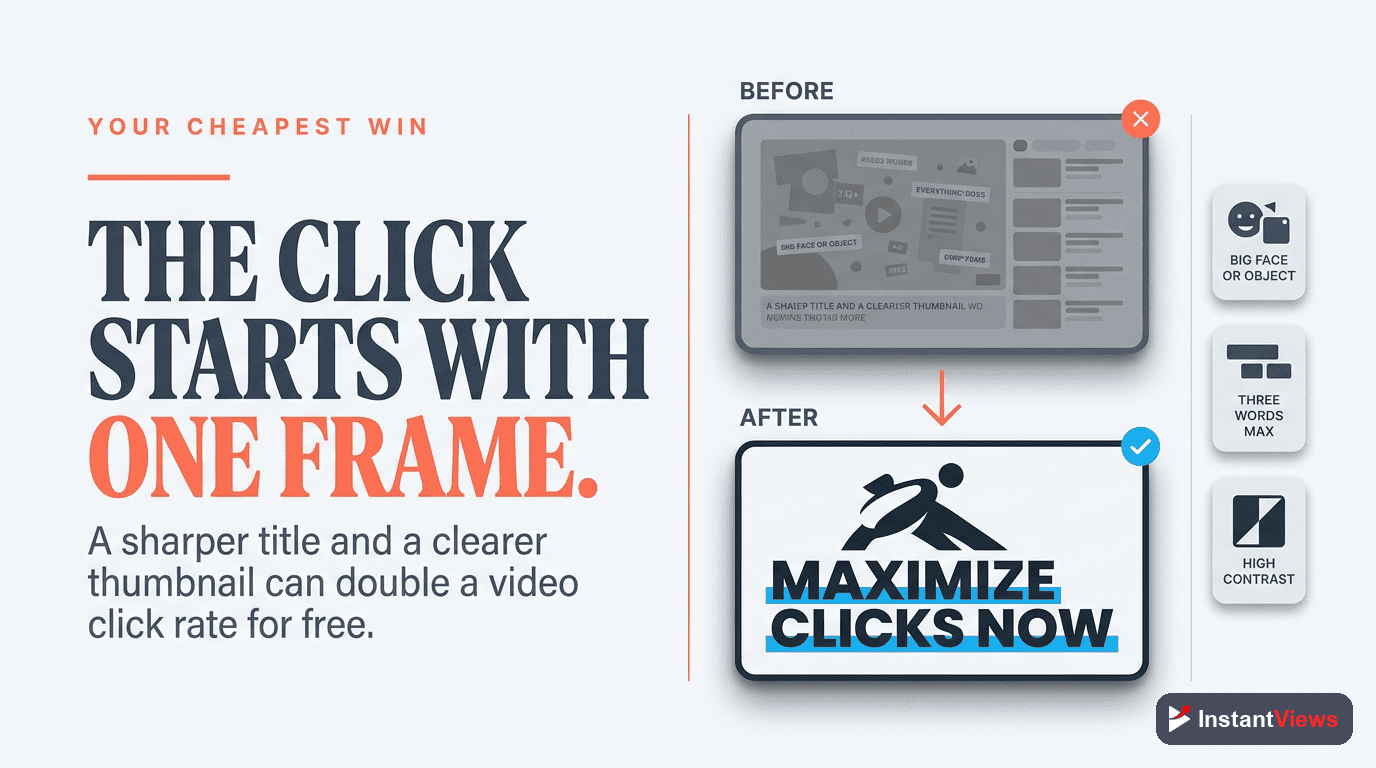
The vast majority of top-performing videos use a custom thumbnail rather than an auto-generated frame, and the reason is obvious — a deliberate image almost always beats a random screenshot. Strong 2026 thumbnails share a few traits:
- One clear focal point the eye lands on instantly, often an expressive face showing emotion.
- Minimal, bold text — a few words at most, readable on a small phone screen.
- High contrast so the image pops against YouTube's interface and competing videos.
- Curiosity — a visual that raises a question the title answers.
Your title and thumbnail should work as a pair, not repeat each other. The thumbnail creates the curiosity; the title resolves just enough of it to earn the click without giving everything away. If your channel has eligible videos, YouTube's built-in test-and-compare feature lets you trial multiple thumbnails and keep the winner — a free way to let data, not guesswork, choose.
Avoid clickbait that the video does not deliver. A thumbnail that over-promises may win the click but it tanks retention and satisfaction — the exact signals the 2026 algorithm watches most. A misleading thumbnail can quietly suppress a video that would otherwise have done well.
Use Shorts to Reach New Viewers
YouTube Shorts is one of the fastest discovery surfaces on the internet, with more than 200 billion views a day. For a budget-conscious creator it is a gift: a feed full of strangers who can find you in seconds, with no ad spend required. The trick is to treat Shorts as the top of your funnel, not a separate channel.
Hook in the First Few Seconds
Shorts live or die on the first one to three seconds. The algorithm watches how quickly viewers swipe away, so lead with the payoff, the surprise, or the question — never a slow intro. Add on-screen captions, because most people scroll with the sound off, and captions keep them watching and make your content accessible.
Make Shorts Feed Your Long-Form
The highest-value Shorts are not standalone — they are trailers. Cut a compelling moment from a long-form video into a Short, then point viewers toward the full version and place both in the same playlist. New viewers discover you through the Short and flow into your deeper content, lengthening the session YouTube rewards.

Playlists and Sessions That Compound
Playlists are one of the most underused free tools on YouTube. A single view is worth far more when it becomes a session of three or four videos, and that is exactly what a well-built playlist does — it autoplays the next relevant video and keeps the viewer with you. In 2026, series and playlist formats tend to out-perform isolated one-off videos with the same retention curve, because they extend watch sessions.
Building them costs nothing. To get the most from playlists:
- Group by topic or journey, so a beginner can move from one logical step to the next without leaving.
- Order for momentum, opening with a strong video that earns the next click.
- Write a keyword-rich playlist title and description, since playlists rank in search too.
- Link to playlists, not just videos, in end screens, cards, and descriptions.
Pair playlists with end screens and cards — both free — that point to a clear continuation video. The goal is that no video is a dead end; every one hands the viewer an obvious next thing to watch on your channel rather than someone else's.
Grow Your Views for Free
Use our free suite of YouTube tools to research keywords, sharpen titles, and see what is working — no budget required.
Explore Free YouTube Tools →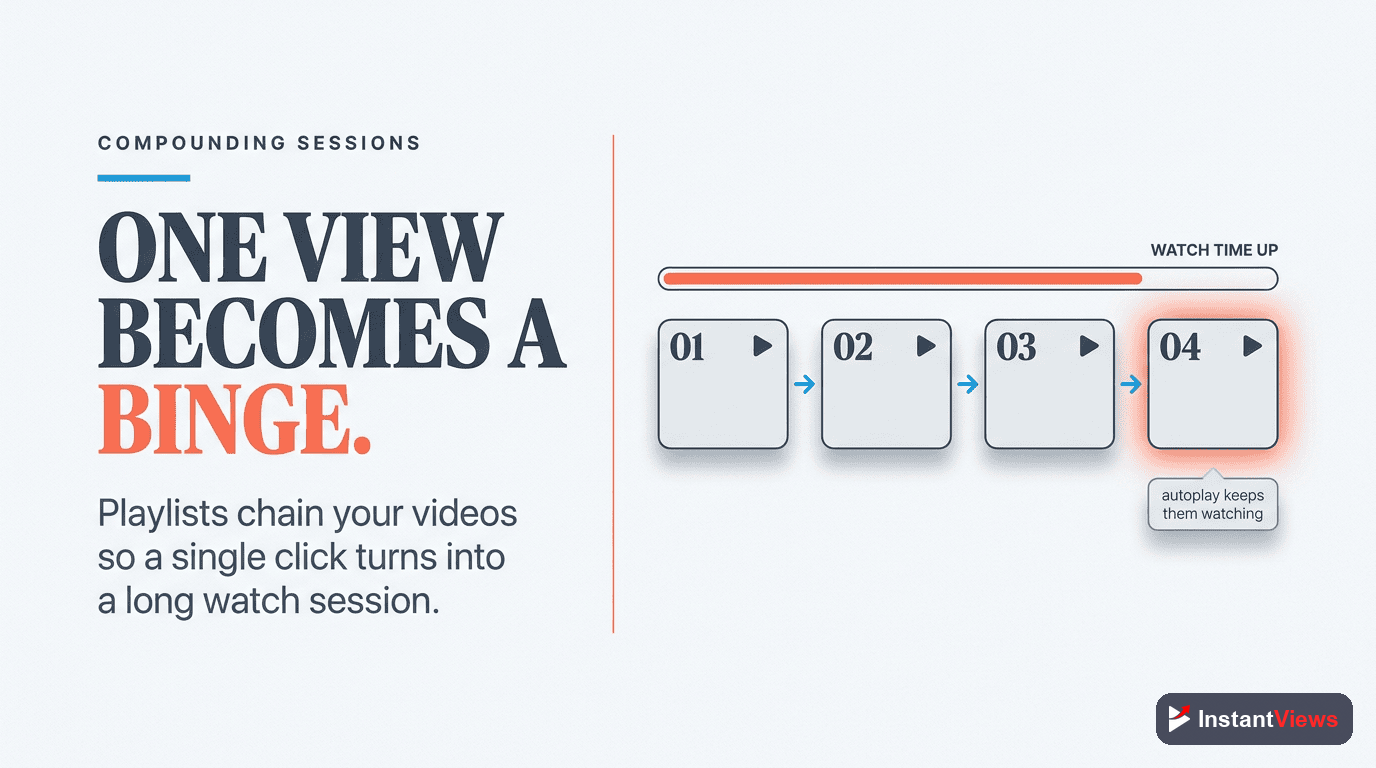
The Community Tab and Engagement
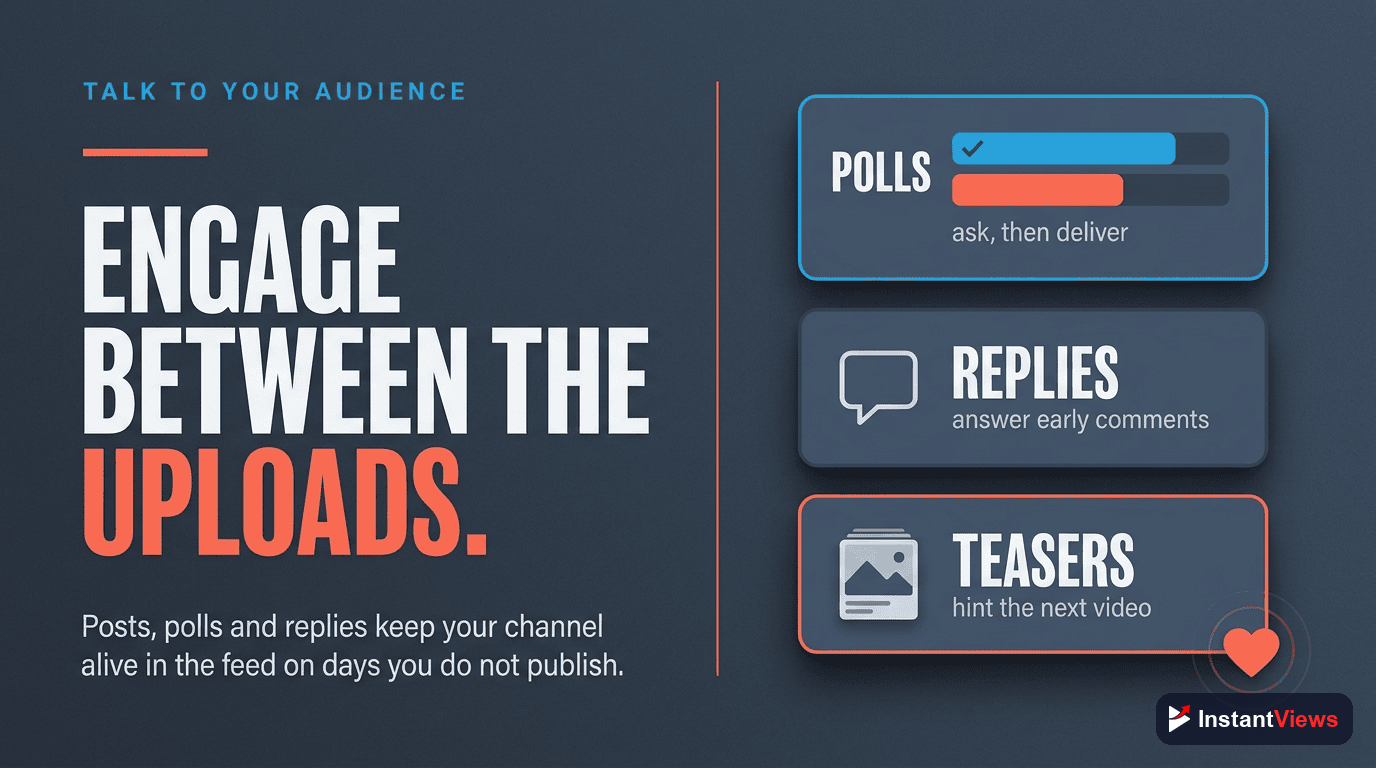
Your existing audience is your cheapest source of new views, and the community tab is the free megaphone to reach them. Polls, image posts, questions, and text updates land directly in subscribers' feeds and notifications, pulling them back to watch and engage. Engagement, in turn, is a satisfaction signal — likes, comments, shares, and saves all tell the algorithm your content is worth recommending.
- Tease upcoming videos with a poll or a behind-the-scenes image to build anticipation before you publish.
- Ask questions that invite comments; a lively comment section signals an engaged audience.
- Pin a comment on each video pointing to a related video, playlist, or resource.
- Reply early, especially in the first hours after publishing, to spark the conversation that lifts a video.
This is relationship work, not media buying. It costs minutes a day and turns passive subscribers into the loyal core that gives every new upload an early boost.
Repurpose Everything You Make
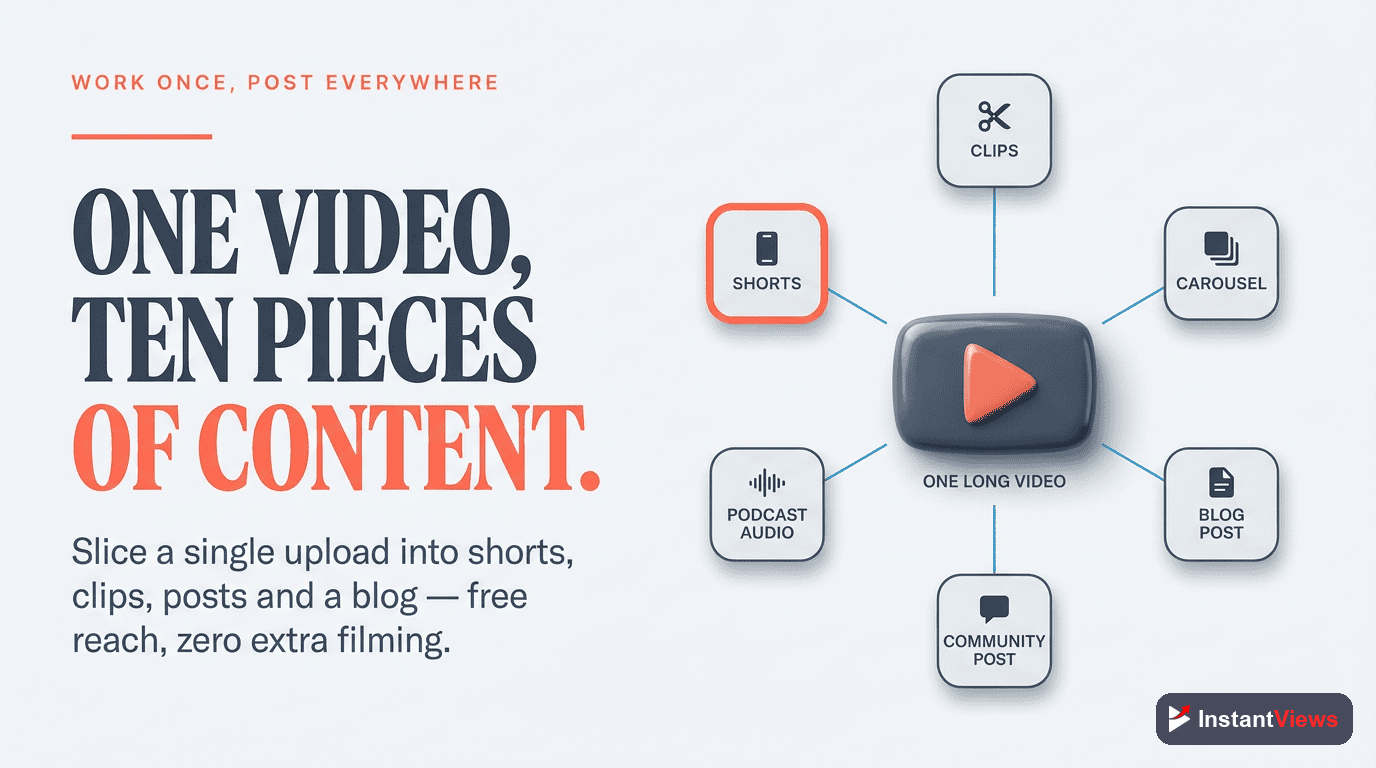
One of the most budget-friendly principles in all of content is this: never create something once. Every video you film already contains a week of free promotion if you slice and reuse it. Repurposing stretches the return on the time you have already spent — the most expensive resource a small creator has.
From a single long-form video you can typically pull:
- Several vertical Shorts from the best moments
- A community-tab post or poll built around the core idea
- Clips and quotes to share on other social platforms that link back
- A blog post, newsletter, or thread that drives traffic to the video
Cross-platform sharing matters because it brings warm, motivated viewers to YouTube at no media cost. A clip on another platform that ends with "watch the full video on YouTube" is free promotion that compounds with every post. The work is in the system, not the spend: decide once how each upload gets repurposed, then run it on autopilot.
Collaborate to Borrow Audiences
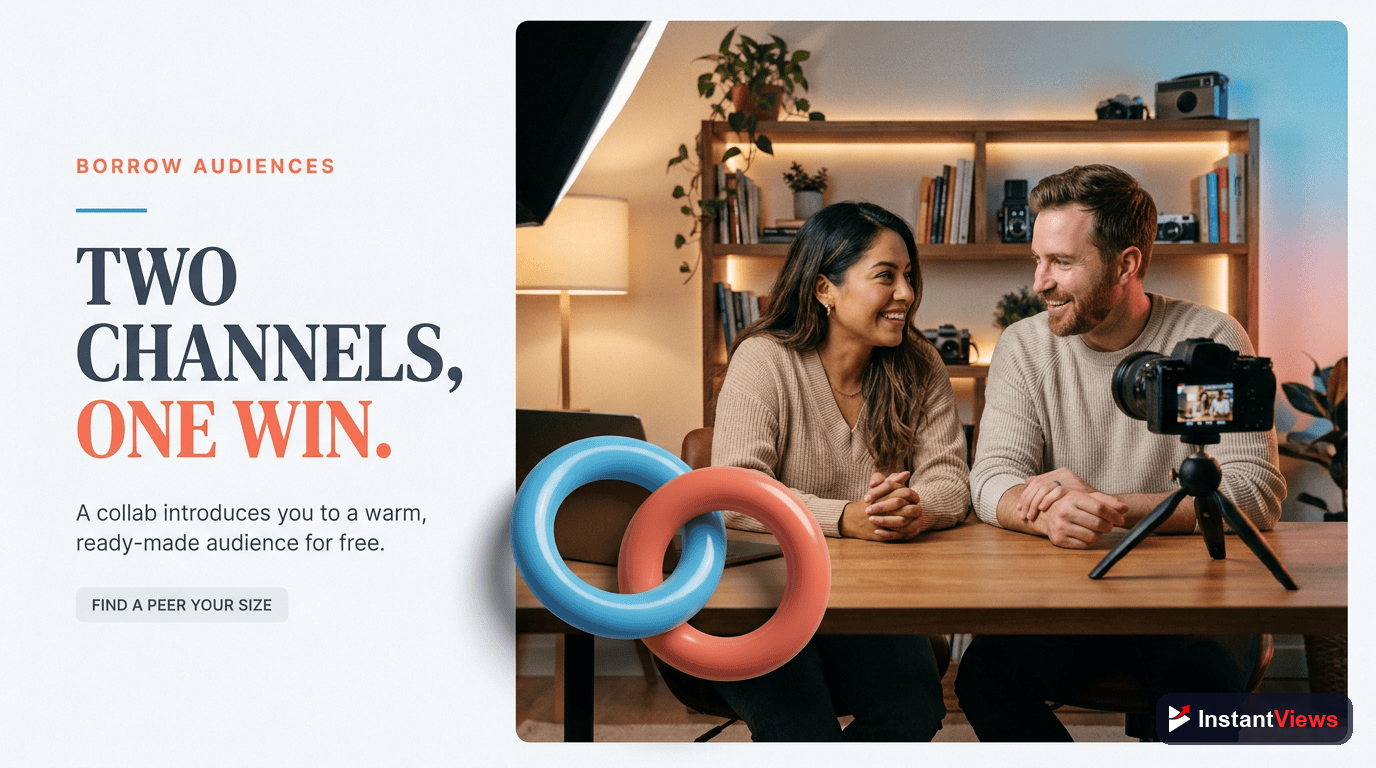
Collaboration is arguably the best free growth lever in existence, because it lets you borrow an audience that already trusts someone in your niche. When a creator features you, their viewers transfer a little of that trust to you instantly — something no ad can buy. The only cost is coordination.
You do not need a famous partner. Collaborating with creators of a similar size is often more effective, because the exchange is balanced and the audiences overlap. Practical, no-cost formats include:
- Guest appearances on each other's videos or channels.
- Joint or response videos that give both audiences a reason to watch.
- Shout-outs and pinned comments pointing to a partner's relevant video.
- Shared playlists that bundle both creators' content into one binge-worthy session.
Approach collaboration as a genuine exchange of value, not a favor. When both channels gain a relevant, warm audience, the partnership keeps paying off long after the video goes live — and it never costs a dollar of ad budget.
Cost vs Impact: A Strategy Table
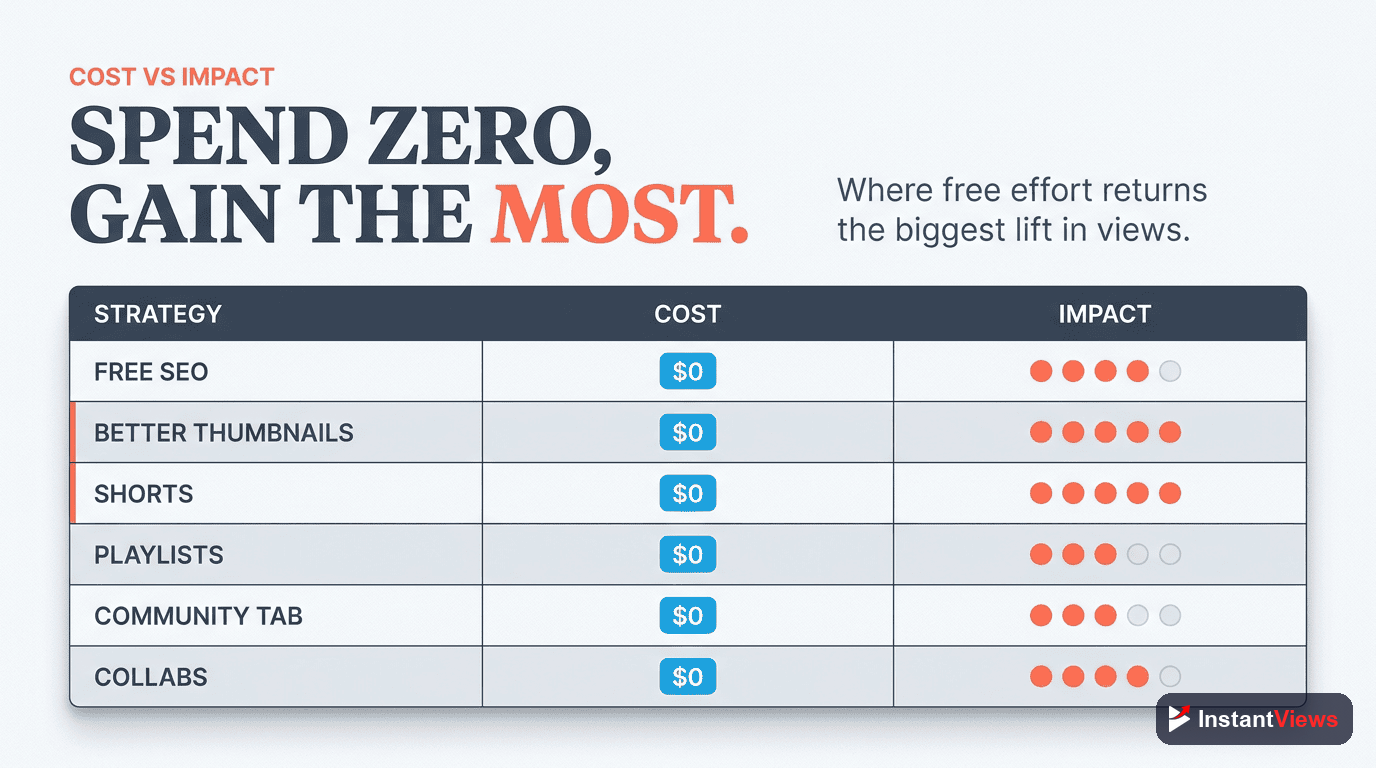
Not every tactic deserves equal attention. The table below sketches the rough cost, effort, and impact of each strategy in this guide, so you can sequence your time toward the biggest free wins first.
| Strategy | Cost | Effort | Impact on Views |
|---|---|---|---|
| Titles & thumbnails | Free | Low | Very high |
| YouTube SEO | Free | Low | High |
| Shorts | Free | Medium | High |
| Playlists & end screens | Free | Low | Medium–high |
| Community tab & engagement | Free | Low | Medium |
| Repurposing & cross-posting | Free | Medium | Medium–high |
| Collaborations | Free | Medium | High |
| Consistent uploads | Free | High (sustained) | Very high (compounds) |
| Paid ads | Optional spend | Medium | Amplifies proven content |
The pattern is clear. The free, low-effort, high-impact corner — packaging and SEO — is where to start. Consistency is the only free strategy that demands sustained effort, and it is also the one that compounds the hardest. Paid ads sit at the bottom not because they are bad, but because they amplify rather than create: they are the optional accelerator you reach for once the free engine is running.
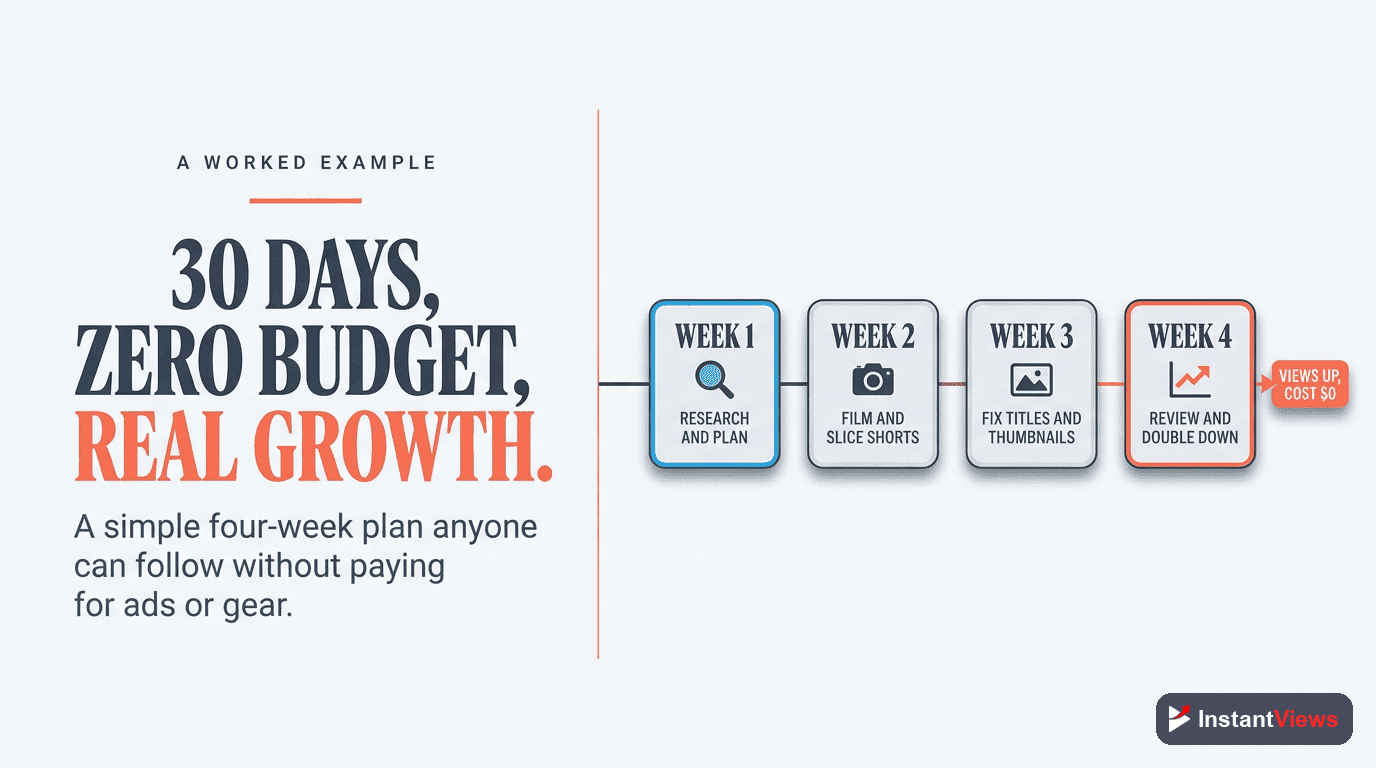
A Worked Example: 30 Days, Zero Budget
Here is how the pieces fit together in a realistic, no-spend month. Imagine a creator with a handful of existing videos and no marketing budget, deciding to grow deliberately for thirty days.
Week 1 — Fix the Front Door
Audit every existing video. Rewrite the weakest titles, redesign the lowest-performing thumbnails with one clear focal point and bold text, and front-load a keyword in each description. No new filming — just better packaging on content that already exists.
Week 2 — Build the Structure
Group related videos into two or three keyword-named playlists, add end screens that point to a clear next video, and pin a helpful comment on each upload. Suddenly one view can become a multi-video session at zero cost.
Week 3 — Multiply With Shorts
Mine existing long-form videos for the best moments and publish a hook-first, captioned Short every couple of days, each pointing back to the full video. Use the community tab to tease and to ask the audience what they want next.
Week 4 — Borrow and Review
Reach out to one similarly sized creator for a simple collaboration, cross-post clips to other platforms with a link back, then open Analytics to see which titles, Shorts, and traffic sources performed — and do more of what worked.
Notice what is missing from that month: an invoice. Every action above is free, and each one feeds the next — better packaging earns clicks, playlists extend sessions, Shorts bring new viewers, and collaboration borrows trust. That is the whole point of a budget-first strategy: the work compounds even when the spend is zero.
If, after a month like this, certain videos are clearly converting viewers into subscribers, that is the moment a small, optional ad budget can make sense — to amplify the proven winners. Until then, free is not a limitation. It is the most honest test of whether your content actually deserves the views.
"You do not buy your way onto YouTube — you earn your way in. The channels that grow without a budget are simply the ones that do the free things consistently, while everyone else waits for money they do not need."
Frequently Asked Questions
Yes. Almost every strategy that moves the needle on YouTube is free to apply: better titles and thumbnails, smarter keywords, Shorts, playlists, the community tab, repurposing, and consistent uploads. These cost time and attention rather than cash. Paid ads are optional and work best to amplify content that is already performing, not to rescue content that is not.
Improving your titles and thumbnails. They decide whether your existing reach turns into a click, so a stronger thumbnail can lift views on a video that is already being shown to people — with no extra production and no spend. It is the highest-leverage free change most channels can make today.
They can, when used deliberately. Shorts are one of the fastest discovery surfaces on the platform, with more than 200 billion views a day. Use a Short to preview an idea your long-form video explains in full, then point viewers toward the full video and keep both in the same playlist so they stay in your ecosystem.
It is the foundation everything else rests on. The 2026 algorithm rewards viewer satisfaction and sessions over time, and that signal only builds when you publish regularly within a clear niche. A steady, sustainable cadence beats occasional bursts, because each upload compounds the trust and watch history the algorithm uses to recommend you.
Viewer satisfaction and retention rather than raw watch time. Signals like how long people stay, whether they return, save to playlists, share, and keep watching across a session all matter. YouTube is also reducing the spread of low-value, mass-produced content, so genuinely useful videos in a focused niche are favored over thin, repetitive uploads.
Aim for a substantial, natural description rather than one line. Front-load your main keyword in the first sentence or two where it carries the most weight, then add genuinely useful context, timestamps, and links. Treat the description as helpful text for viewers first and a relevance signal for search second.
Yes, and they are essentially free. Collaborating with a creator of similar size exposes each of you to a warm, relevant audience at no media cost. Shout-outs, guest appearances, joint videos, and cross-channel playlists all borrow trust that would otherwise take months to build, which is why collaboration is one of the best budget growth levers available.
Only after the free fundamentals are working. Once you have videos with strong retention and a clear next step, a small ad budget can accelerate a proven winner or retarget people who watched but did not subscribe. Spending to promote weak content rarely pays off; spending to amplify what already converts can.
Conclusion
Growing your YouTube views does not require a marketing budget — it requires using the free levers the platform already gives you. Sharper titles and thumbnails turn existing reach into clicks, SEO makes you findable, Shorts open a fast new door, and playlists, the community tab, repurposing, and collaborations all stretch the value of every video at zero media cost.
Start where the leverage is highest. Fix your packaging this week, build playlists and end screens next, then layer in Shorts, engagement, and a collaboration. Above all, publish consistently in a clear niche — that is the one free strategy that compounds, and the signal the 2026 algorithm rewards most.
Paid ads will always be there if you want them, but they are an accelerator for content that already works, not a substitute for it. Do the free things well and you will discover what experienced creators already know: a shoestring budget is no obstacle to a channel that genuinely deserves to be seen.