- Near-zero views are normal at the start — YouTube needs data before it knows who to show your videos to
- Almost every "nobody watches me" problem traces back to one of six fixable causes, not bad luck
- Search is how new channels earn their first views, because you can rank for specific questions with no audience history
- Packaging (title and thumbnail) and the first 30 seconds of retention are the two biggest levers in 2026
- Diagnose the single weakest cause for your channel and fix that one first — then keep uploading consistently
You pour hours into a video. You film it, edit it, write the title, design the thumbnail, and hit publish with a little jolt of hope. Then you refresh the page and watch the view counter sit at 2. A day later it is still 2 — and one of those is probably you. If that feeling is familiar, take a breath: you are not broken, your channel is not cursed, and you have not "missed your chance." This is one of the most common experiences on the entire platform, and it is almost always fixable.
Here is the part nobody tells you when you start. With more than 2.7 billion monthly active users and over a billion hours of video watched every single day, YouTube is the largest discovery engine on the internet — but that reach is not handed to a new video automatically. When you upload to a young channel, the algorithm does not yet know who your audience is. It shows your video to a small test group and waits to see how they respond before deciding whether to show it to more people. Low early views are not a verdict on your talent. They are the system gathering data.
The trap most creators fall into is guessing. They tweak a setting, change a tag, or worse, conclude that "the algorithm hates small channels" and quietly give up. The truth is more useful and more hopeful: when nobody is watching, the cause is almost always one of six specific, diagnosable problems — and each one has a clear fix.
This guide is a calm, honest diagnostic. We will walk through why low early views are normal, name the six real causes one by one, give you a fix for each, and show you how to read your own analytics to figure out which problem is yours. By the end you will know exactly what to change next — and what to stop worrying about.
- Why Low Early Views Are Completely Normal
- Why This Is Different From a Stalled Channel
- The Six Real Causes (and Their Fixes)
- Cause 1: No Search Demand or Discoverability
- Cause 2: Weak Titles and Thumbnails
- Cause 3: No Clear Niche
- Cause 4: Low Retention in the First 30 Seconds
- Cause 5: Not Promoting Your Videos
- Cause 6: Too Few Uploads
- How to Diagnose Your Own Channel
- FAQ
Why Low Early Views Are Completely Normal
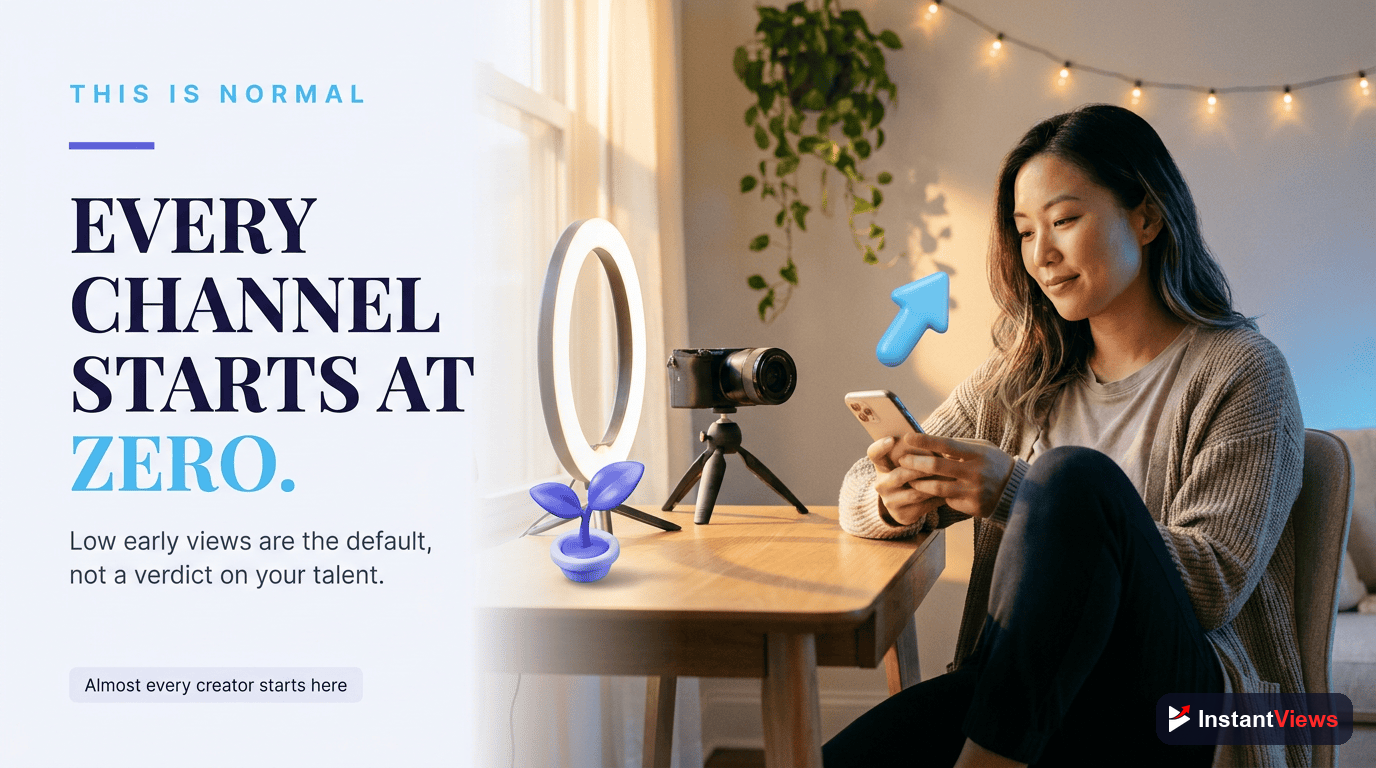
Before we diagnose anything, you need to internalize one fact that will save you weeks of needless worry: a new video on a new channel starting at near-zero views is the default, not the exception. It is how the system is designed to work.
When you publish, YouTube does not know whether your video is brilliant or boring, so it runs a test. It shows the video to a small seed audience — people who might plausibly be interested based on the limited signals it has. If that seed audience clicks and watches, the algorithm shifts gears and shows the video to a larger pool. If they scroll past or click away quickly, distribution stays small. On a brand-new channel there is barely any signal to work with yet, so that first test group can be tiny.
This is why obsessing over a single video's first-day numbers is a mistake. The early weeks are a calibration period. You are not failing — you are teaching the algorithm who you are and who should see you. The encouraging news for 2026 is that this system genuinely does not care how many subscribers you have. The algorithm cares about viewer response, which means a small channel with strong packaging and retention can absolutely break out. Reach is earned per video, not granted by seniority.
Why This Is Different From a Stalled Channel
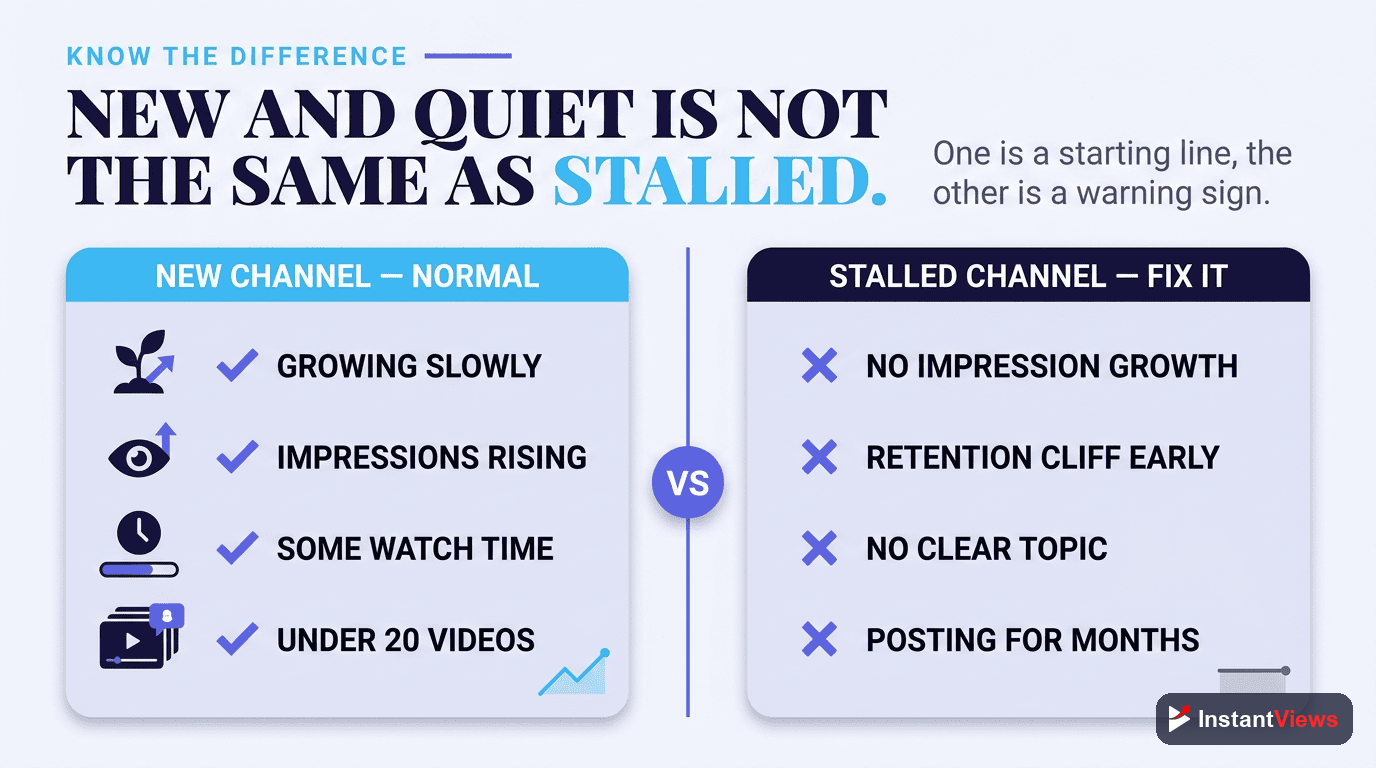
It is worth being precise about the problem we are solving, because the advice for it is different from the advice you will see for a channel that grew and then plateaued.
A stalled channel once had momentum. It built an audience, racked up views, and then flattened out — usually because the creator drifted from what worked, slowed their uploads, or saturated their existing audience. The fix there is about re-igniting an engine that already ran.
The "nobody watches me" problem is different. This is a channel that never got traction in the first place. There is no engine to restart, because it has not turned over yet. That is not a worse position — in many ways it is simpler, because you are not untangling old habits. You are simply building the right foundations from the start: findable topics, clickable packaging, a clear identity, a strong hook, and enough volume for the algorithm to find your people. The rest of this guide is about laying exactly those foundations.
The Six Real Causes (and Their Fixes)
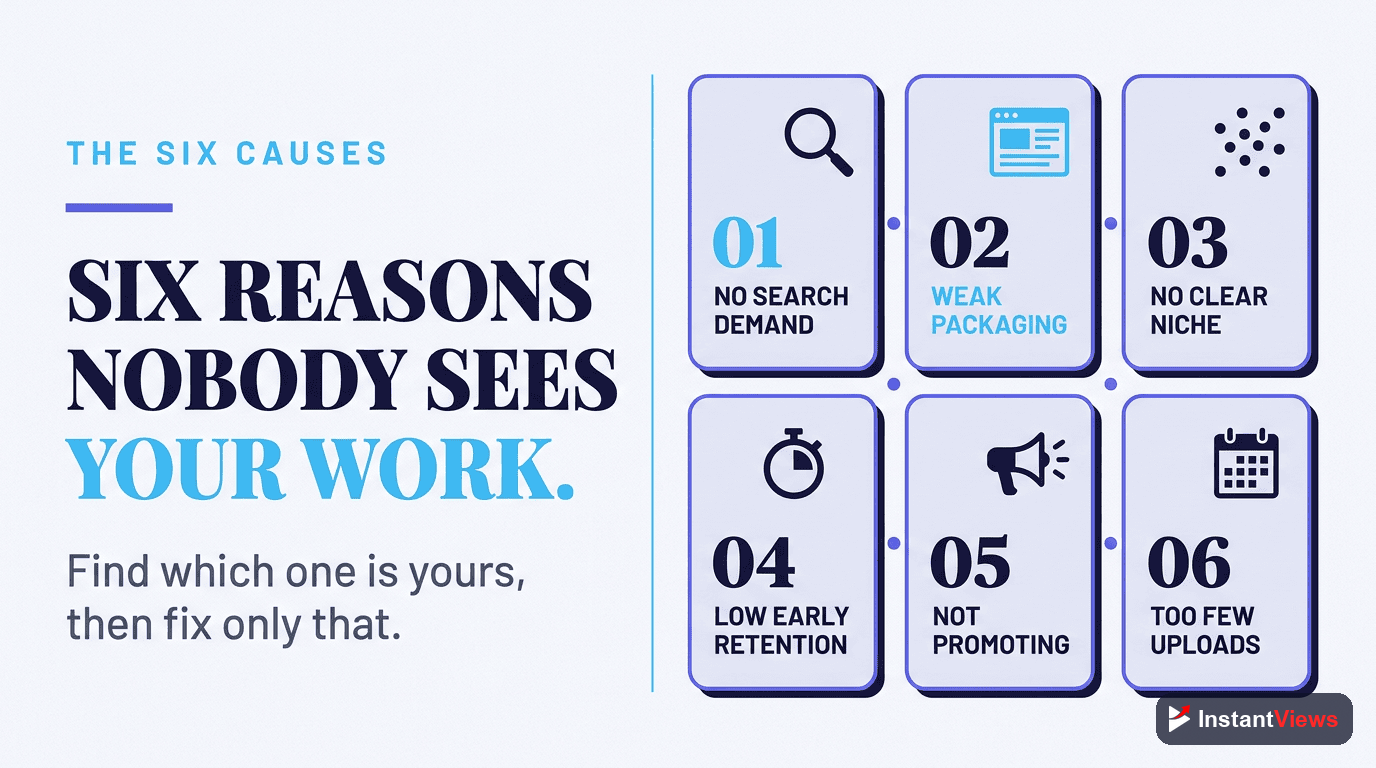
When views are stuck near zero, the cause is almost always one of six things. Most struggling channels have two or three of these working against them at once, but there is usually one that hurts the most. The table below is your quick map — the symptom you notice, the cause behind it, and the fix — and the sections that follow unpack each one in detail.
| Symptom you notice | Likely cause | The fix |
|---|---|---|
| Almost no impressions; nobody is even being shown the video | No search demand or poor discoverability | Make videos that answer questions people already search for |
| You get impressions but a very low click-through rate | Weak titles and thumbnails | Rewrite for clarity and redesign for a phone screen |
| The few who click do not subscribe or come back | No clear niche or channel identity | Commit to one audience and one promise |
| People click but leave within seconds | Low retention in the first 30 seconds | Open with a hook and cut the slow intro |
| Good videos that simply never get seen | No off-platform promotion | Seed early watch data from any audience you have |
| A handful of videos with no momentum | Too few uploads for the algorithm to learn | Publish consistently over months, not weeks |
Cause 1: No Search Demand or Discoverability
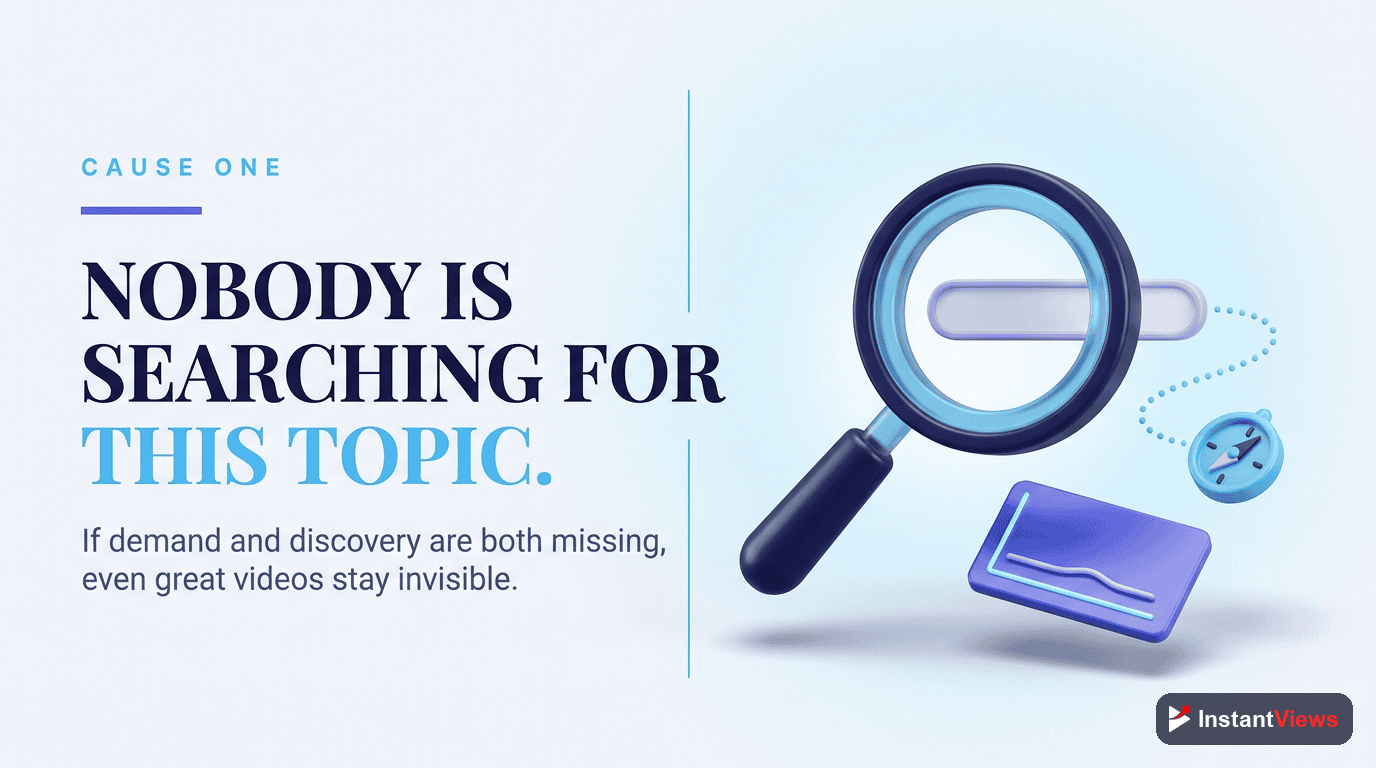
This is the most common and most invisible cause. You can make a beautiful video about a topic that, simply put, nobody is looking for. If there is no demand and no path for the algorithm to surface it, the video has no on-ramp to an audience — it just sits there.
New channels have one traffic source that does not require any audience history: search. You can rank for a specific, low-competition question on day one if your video genuinely answers it, because search matches a query to the best result regardless of how big your channel is. A brand-new cooking channel can rank for something as narrow as "how to fix grainy caramel" the day it publishes. Browse and Suggested come later, once you have retention and satisfaction signals to earn them.
The Fix
- Start from demand, not from inspiration. Before you film, confirm people are actually typing your topic into YouTube. Use the search bar autocomplete and a keyword tool to find real phrasings.
- Target specific, low-competition questions. "How to start a podcast" is a war you will lose; "how to record a podcast with two people in one room" is winnable.
- Match the title to the search. Phrase your title the way a viewer would phrase the question, so the algorithm can connect the two.
- Help the AI understand your video. In 2026 YouTube reads on-screen text in the first few seconds, your thumbnail, and your spoken intro — not just tags — so make the topic obvious in all of them.
Cause 2: Weak Titles and Thumbnails
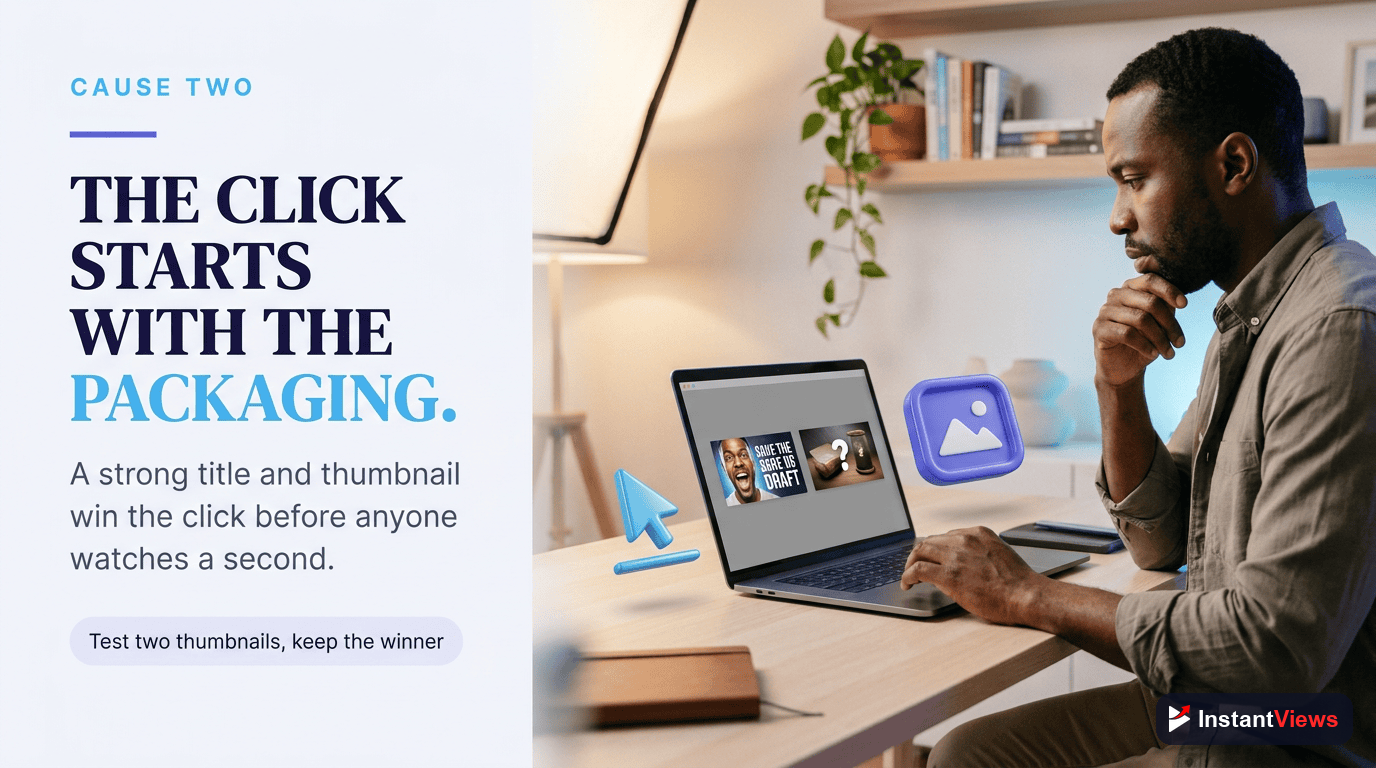
Sometimes the algorithm is showing your video — you are getting impressions — but almost nobody clicks. That is a packaging problem, and it is the single biggest lever you control. Your title and thumbnail are the billboard for your video; if the billboard is weak, it does not matter how good the destination is.
In 2026 the metric that matters most here is your relative click-through rate: how your packaging performs against the specific videos YouTube places you next to. You are not competing in a vacuum. You are competing for the click in a crowded feed, on a small phone screen, against creators who have refined their thumbnails for years.
The Fix
- Design for a thumbnail-sized screen. If the thumbnail is not instantly readable at the size of a postage stamp, it is too busy. Big subject, few words, high contrast.
- Make the title clear before clever. A viewer should know exactly what they will get. Curiosity is good; confusion is fatal.
- Promise one thing, not five. A focused promise out-clicks a cluttered one every time.
- Test against your competition. Search your topic and look at the results page the way a viewer would. Does your packaging stand out or blend in?
Clickbait is not the answer. A title or thumbnail that overpromises will win the click and then lose the viewer in seconds, which wrecks your retention and tells the algorithm to stop showing the video. Your packaging must make a promise the video actually keeps.
Cause 3: No Clear Niche
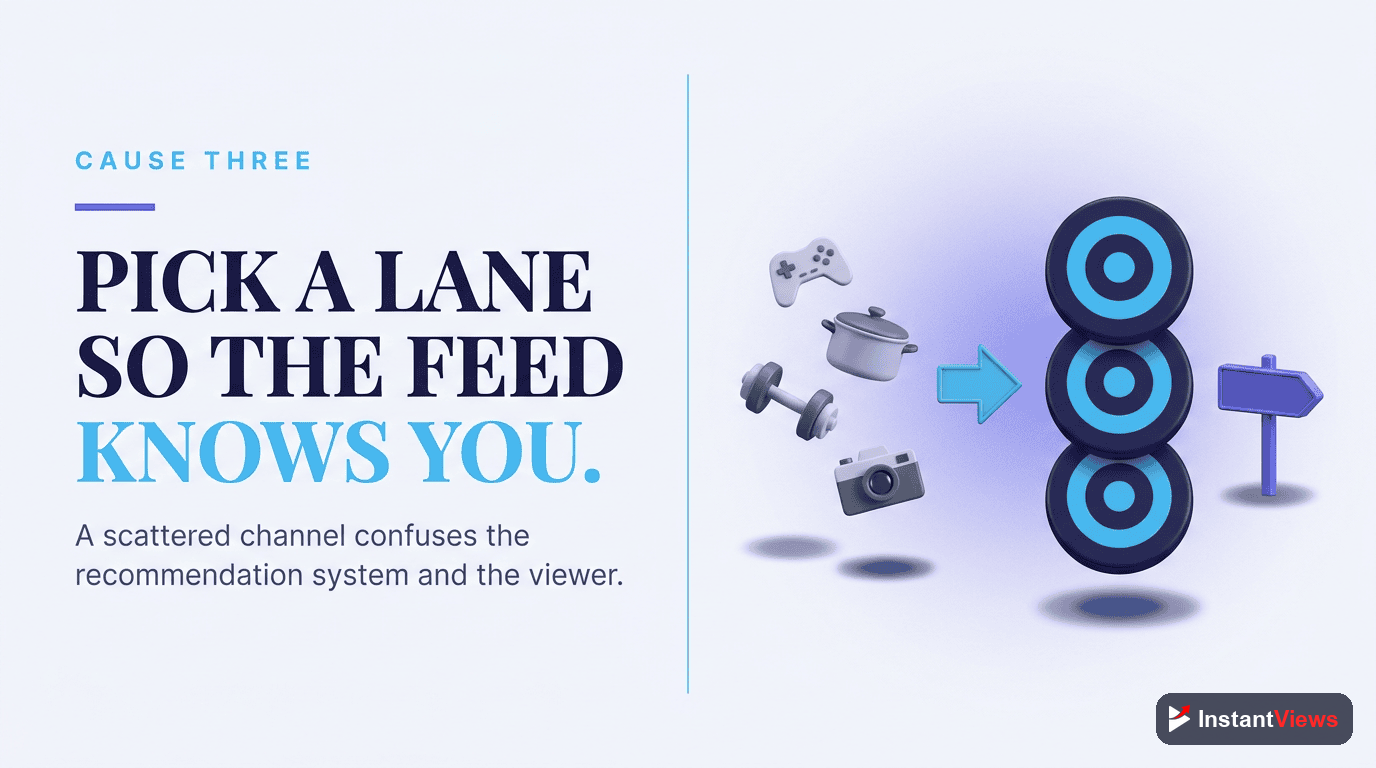
Imagine a viewer finds one of your videos, enjoys it, and clicks your channel to see more — only to find a gaming video, a vlog about your weekend, a product review, and a cooking tutorial. There is no reason for them to subscribe, because they cannot tell what subscribing gets them. A channel with no clear identity gives the algorithm nothing to pattern-match either, so it struggles to find your audience.
Niching down feels like shrinking your potential audience, but it does the opposite early on. A clear, narrow focus makes you the obvious choice for a specific group of people, and the algorithm rewards channels that reliably satisfy a defined audience. You can broaden later, once you have momentum.
The Fix
- Define one audience and one promise. Finish this sentence: "This channel helps [specific person] to [specific outcome]." If you cannot, your viewers cannot either.
- Keep your first 20 to 30 videos tightly themed. Consistency of topic trains both the algorithm and your audience to know what you are about.
- Make your channel scannable. When someone lands on your page, the theme should be obvious from the titles and thumbnails alone.
Cause 4: Low Retention in the First 30 Seconds
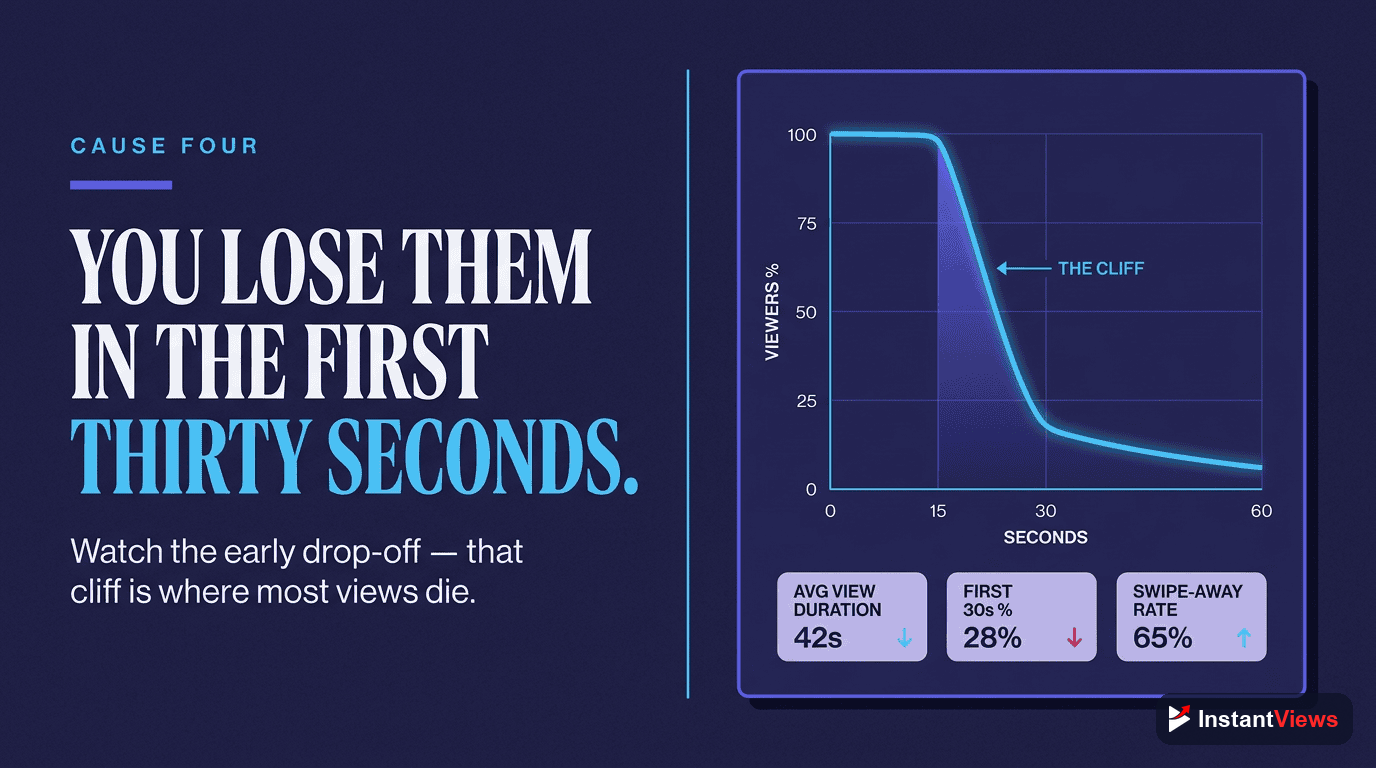
This is the cause that quietly kills the most videos. People click — your packaging worked — but they leave within seconds. The 2026 algorithm optimizes for viewer satisfaction and retention, which means retention now matters more than raw watch time. If viewers bail at the start, the algorithm reads that as "this video did not deliver" and stops distributing it.
The opening seconds are everything. Your first 2 to 24 hours largely determine a video's lifetime performance through that initial impression test, and the first 30 seconds of each viewing session decide whether someone stays. A slow, vague, or self-indulgent intro is where most views die.
The Fix
- Confirm the viewer is in the right place immediately. The first line should pay off the promise the title made — no long logo animation, no rambling welcome.
- Cut the warm-up. Start where the value starts. You can introduce yourself once the viewer is hooked, not before.
- Add captions and on-screen text. A large share of mobile viewers watch with the sound off. Captions hold those viewers and give YouTube's analysis more context about your content.
- Tighten the edit. Remove dead air and tangents. Pace earns the next minute of attention, and the minute after that.
"Getting the click is only half the battle. The other half is the next thirty seconds — that is where the algorithm decides whether your video lives or dies."
Cause 5: Not Promoting Your Videos
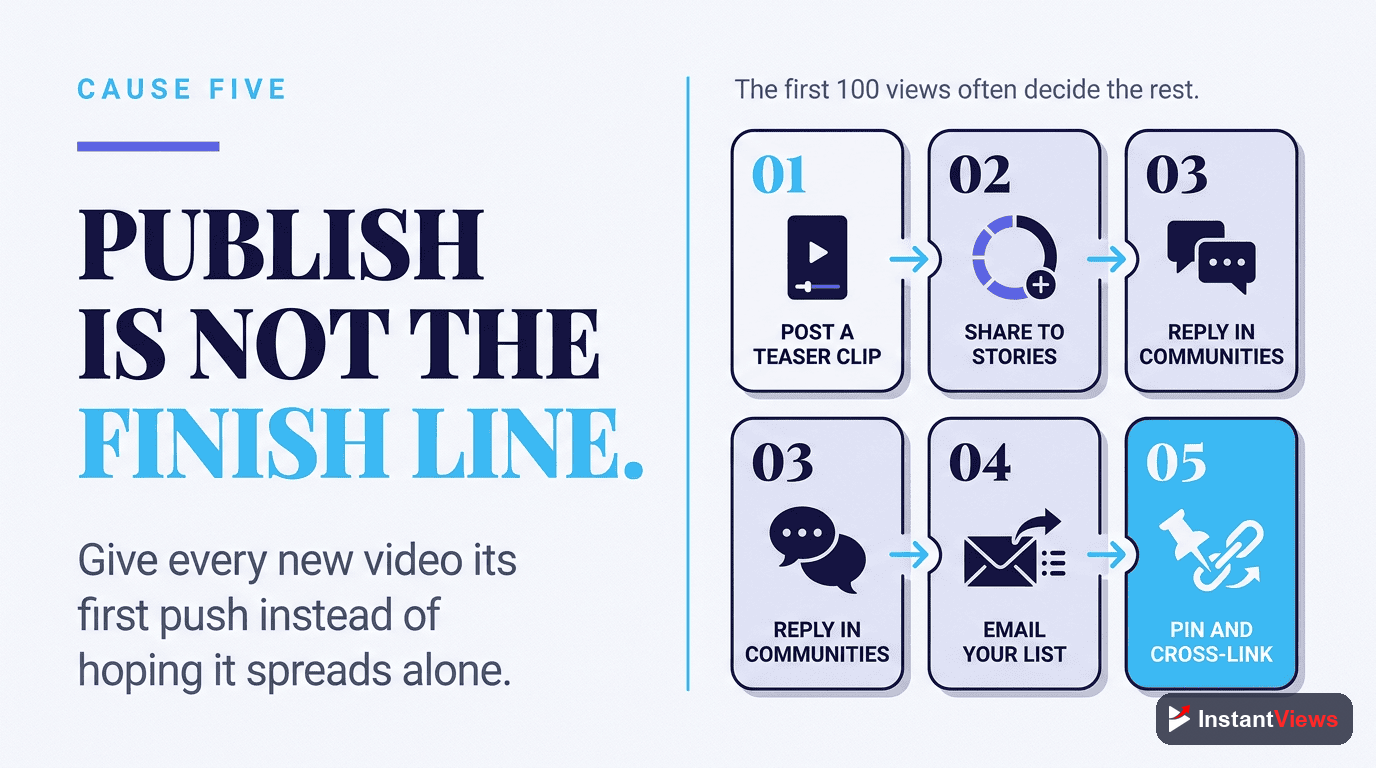
Many creators believe promoting their own videos is somehow cheating, or that "if it is good, the algorithm will find it." Early on, that is backwards. The algorithm needs a response before it will distribute, and on a tiny channel there may not be enough of a seed audience to generate that response on its own. Off-platform promotion is how you prime the pump.
You do not need a huge following elsewhere. Even a small group of genuinely engaged viewers — a couple hundred people — can give YouTube enough early watch data to start recommending your video more broadly. The goal is not vanity traffic; it is real humans who watch and respond, which becomes the signal the algorithm acts on.
The Fix
- Build an audience you own. An email list or a community you control is the most reliable way to seed every new upload, and it survives algorithm changes.
- Share where your audience already gathers. Relevant communities, forums, and other social platforms can deliver your first engaged viewers.
- Use Shorts to feed your channel. Shorts drive over 200 billion views a day and are one of the fastest ways to reach new viewers who can then discover your longer videos.
- Prioritize engagement, not just clicks. A handful of people who watch to the end is worth more than a flood that bounces in two seconds.
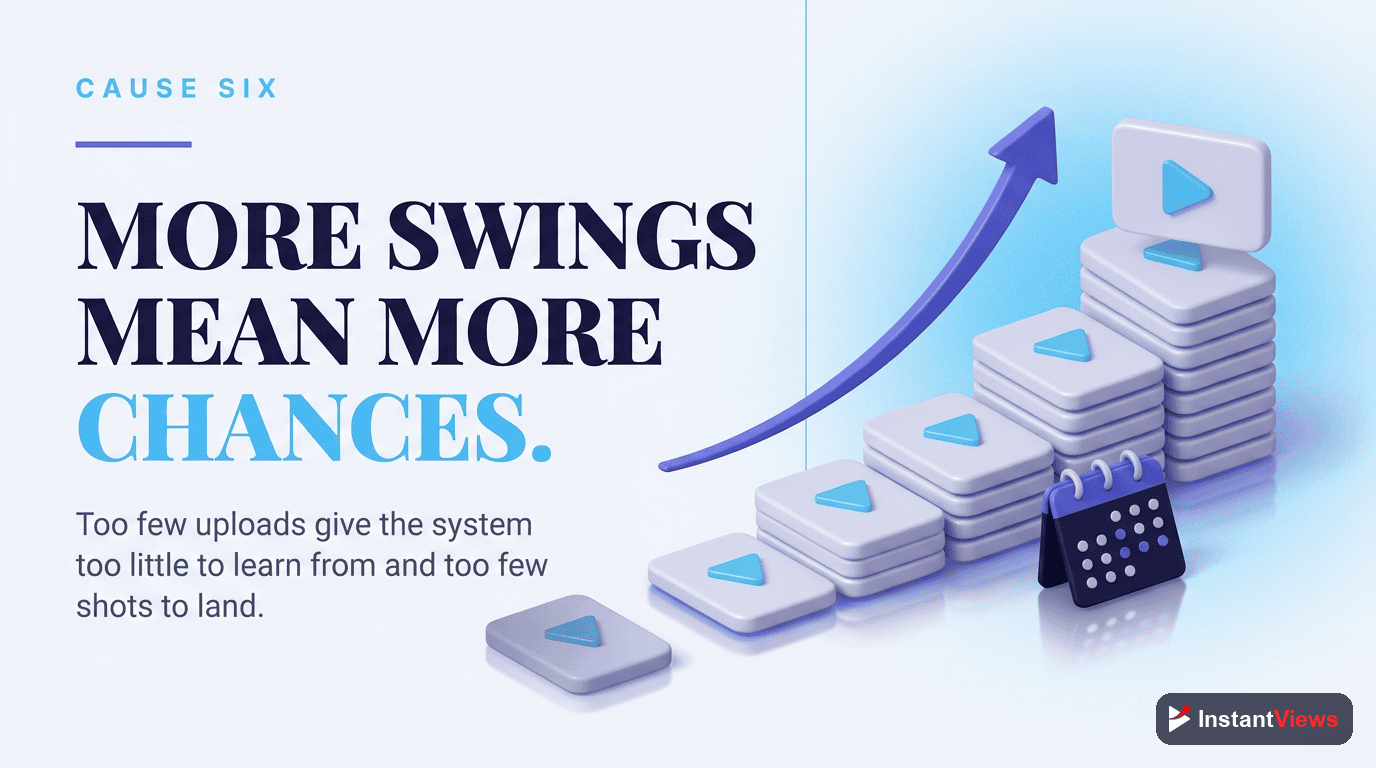
Cause 6: Too Few Uploads
Finally, the simplest cause of all: you may just be too early. Five videos is not enough for the algorithm to understand your channel, and it is not enough for viewers to form a habit around you. Every upload is another data point that helps YouTube learn who to show your content to, and another doorway through which a new viewer might enter and stay.
This is also where most channels quit — right before the data would have started to compound. Growth on YouTube is rarely linear. It tends to be flat, flat, flat, and then a video catches, and the channel that had been invisible suddenly is not. The creators who get there are simply the ones who kept publishing long enough to give themselves that chance.
The Fix
- Commit to a sustainable cadence. A schedule you can keep for six months beats a sprint you abandon in three weeks.
- Treat each video as an experiment. Try a topic, read the data, adjust, and publish again. Volume plus iteration is how you find what works.
- Protect your consistency above all. Funnels and audiences compound through repetition; sporadic uploads never build enough momentum to break out.
How to Diagnose Your Own Channel
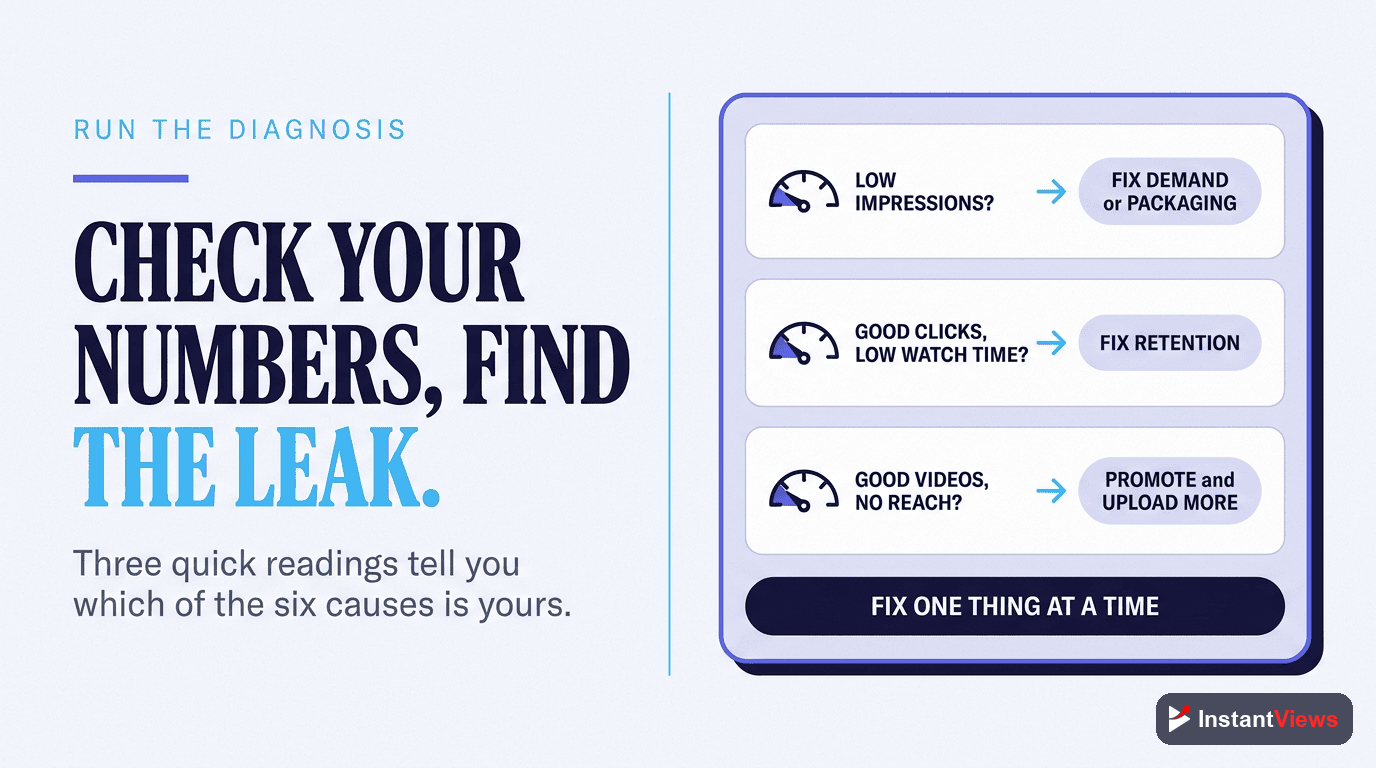
You do not have to guess which of the six causes is hurting you most. Your analytics will tell you. Work through these steps in order and the numbers will point straight at your weakest link.
Check Your Impressions First
Open YouTube Analytics and look at impressions. If you are getting almost none, your problem is discovery — the algorithm has no reason to show your video. Go back to Cause 1 and choose topics with real search demand.
Look at Click-Through Rate
If you have impressions but a very low click-through rate, the algorithm is offering your video and viewers are saying no. That is a packaging problem — rewrite the title and redesign the thumbnail as in Cause 2.
Read Your Audience Retention Graph
If people click but average view duration is tiny and the retention curve drops off a cliff in the first 30 seconds, your hook is the issue. Fix the opening as in Cause 4 before anything else.
Check Returning Viewers and Subscribers
If viewers watch but never return or subscribe, your channel likely lacks a clear identity. Tighten your niche as in Cause 3 so people know what they are signing up for.
Fix One Thing, Then Keep Publishing
Change the single weakest link, publish your next video applying that fix, and compare the numbers. Then repeat. Diagnosis plus consistent iteration is the whole game.
The reassuring throughline across all six causes is that none of them is about talent or luck. They are mechanics, and mechanics can be learned and fixed. Once you can read your own analytics, the question "why does nobody watch my videos?" stops being a source of anxiety and becomes a simple checklist you can work through.
Find Out What Is Holding You Back
Use our free suite of YouTube tools to research topics with real search demand, sharpen your titles, and see how your packaging stacks up — so the right people finally find your videos.
Explore Free YouTube Tools →"Nobody is born knowing how to make videos people watch. Every creator you admire was once staring at a view count of 2. The only difference is they treated it as a problem to solve, not a sign to stop."
Frequently Asked Questions
In almost every case it comes down to one of six fixable causes: you picked topics with no search demand, your titles and thumbnails do not earn clicks, your channel has no clear niche, viewers leave in the first 30 seconds, you never promote off-platform, or you simply have not uploaded enough videos yet for the algorithm to learn who to show them to. The fix is to diagnose which cause applies to you and address that one first.
Yes. When you upload to a brand-new channel, YouTube does not yet know who to show your video to, so it tests it with a small audience and waits for a response. Low or near-zero views in the first days and weeks are completely normal. The algorithm rewards channels once it gathers enough data to find your audience, which is why consistency matters far more than any single upload.
Search is the most reliable first traffic source because you can rank for low-competition questions without any audience history. Make videos that answer specific questions people are already typing into YouTube, write a clear searchable title, and share the video with any audience you already have. Even a small group of engaged early viewers gives YouTube the watch data it needs to start recommending your video more widely.
They are the single biggest lever for getting watched. YouTube shows your video next to others, and your packaging decides whether people click yours. A strong, clear title paired with a readable thumbnail can be the difference between getting found and being invisible, no matter how good the video itself is.
It is critical. The 2026 algorithm optimizes for viewer satisfaction and retention rather than raw watch time, so if viewers leave in the first 30 seconds the algorithm stops showing your video. A strong hook in the opening seconds, a tight edit, and on-screen captions for silent viewers all help keep people watching, which signals YouTube to push your video to more people.
There is no magic number, but a single video rarely takes off. Each upload teaches the algorithm more about your content and audience, and gives new viewers more reasons to stay once they find you. Most channels need a steady run of uploads over several months before views start to compound, so treat each video as one more data point rather than a make-or-break event.
Yes, especially early on. Off-platform promotion gives a new video the initial watch signals it needs before the algorithm will distribute it on its own. Even a small group of engaged viewers from an email list, a community, or another social platform can give YouTube enough early data to start recommending your video more broadly.
No. Fake or low-quality views give the algorithm misleading signals and can hurt distribution, while clickbait that overpromises tanks your retention when viewers leave disappointed. YouTube is actively reducing the spread of low-value content, so the durable fix is real packaging that matches real value inside the video.
Conclusion
If nobody is watching your videos yet, the most important thing to understand is that this is normal, common, and fixable. A new channel starting at near-zero views is not a failure — it is the algorithm doing exactly what it is built to do, gathering data before it decides who to show you to. The creators who break through are not the ones who got lucky; they are the ones who stopped guessing and started diagnosing.
Almost every "nobody watches me" problem comes down to one of six causes: no search demand, weak packaging, no clear niche, low retention, no promotion, or simply too few uploads. Open your analytics, find the single weakest link, and fix that one first. Then publish your next video applying what you learned, and read the numbers again. That loop — diagnose, fix, publish, repeat — is the entire path from invisible to found.
So do not give up at video five. Pick topics people actually search for, package them clearly, hook viewers in the first thirty seconds, share each upload with anyone who will watch, and keep going long enough for the data to compound. The view counter that says 2 today is not your ceiling. It is just the starting line.