- Trends create sharp spikes of new viewers, but only if you arrive while interest is still climbing
- Find trends early by combining several signals: search autocomplete, Google Trends, niche communities, comments, and competitors
- Speed beats polish — a timely Short often outperforms a perfect video that lands after the peak
- A unique angle is what separates a viral take from one of a hundred identical copies
- Use trends for spikes and evergreen content for steady traffic; the strongest channels run both together
Every week, a handful of topics catch fire on YouTube. A new format takes over Shorts, a piece of news sweeps a niche, or a single question suddenly appears in millions of searches. Channels that move on those moments quickly can earn more new viewers in forty-eight hours than they normally gather in a month. Channels that ignore them, or arrive too late, watch the wave roll past.
With 2.7 billion monthly active users and roughly a billion hours of video watched every day, YouTube is the largest engine of cultural attention on the planet. That attention moves fast, and it rewards creators who notice where it is heading next. Riding trends is not about chasing every fad — it is a repeatable skill: find the signal early, validate it, add your own spin, and publish before the moment fades.
But trends are only half of a healthy strategy. They spike and they vanish. The other half is evergreen content, which builds slow, compounding traffic for years. The creators who win treat the two as partners, not rivals.
This guide walks through exactly how to find trends, how to ride them fast, how to newsjack responsibly, how to plan around seasons, how to put your unique stamp on a trend, and how to balance all of it against the evergreen library that keeps your channel growing when no trend is in sight.
- Why Trends Matter for Channel Growth
- Where to Find Trends Before They Peak
- Trend Sources at a Glance
- Acting Fast: The Trend Window
- Newsjacking Responsibly
- Putting Your Unique Spin on a Trend
- How to Ride a Trend: Step by Step
- Seasonal Trends and Predictable Demand
- Balancing Trends With Evergreen Content
- Mistakes That Kill Trending Content
- FAQ
Why Trends Matter for Channel Growth
A trend is simply a topic, format, or cultural moment that is gaining attention faster than usual. When something trends, the number of people searching for it and the number of times YouTube recommends it climb sharply at the same time. That surge in demand is an opportunity: for a short window, there are far more interested viewers than there are good videos to serve them.
This is why trending content can grow a channel so quickly. Instead of competing in a saturated space, you step into a moment where supply has not yet caught up with demand. A small channel that publishes a strong, timely video on a rising topic can land in front of audiences far larger than its subscriber count, because the algorithm is actively looking for fresh content to satisfy a spike in interest.
Trends matter for three reasons in particular:
- Discovery: Rising topics get boosted in search and suggestions, putting new creators in front of audiences they could not otherwise reach.
- Relevance: Covering what people care about right now signals to both viewers and the algorithm that your channel is current and alive.
- Momentum: A single trend spike can lift your channel into the recommendation system, where one strong video pulls attention to the rest of your library.
The catch is that trends are temporary. A spike that lifts you today is gone next week, which is why trending content is best understood as a growth accelerator layered on top of a stable foundation — never the foundation itself.

Where to Find Trends Before They Peak
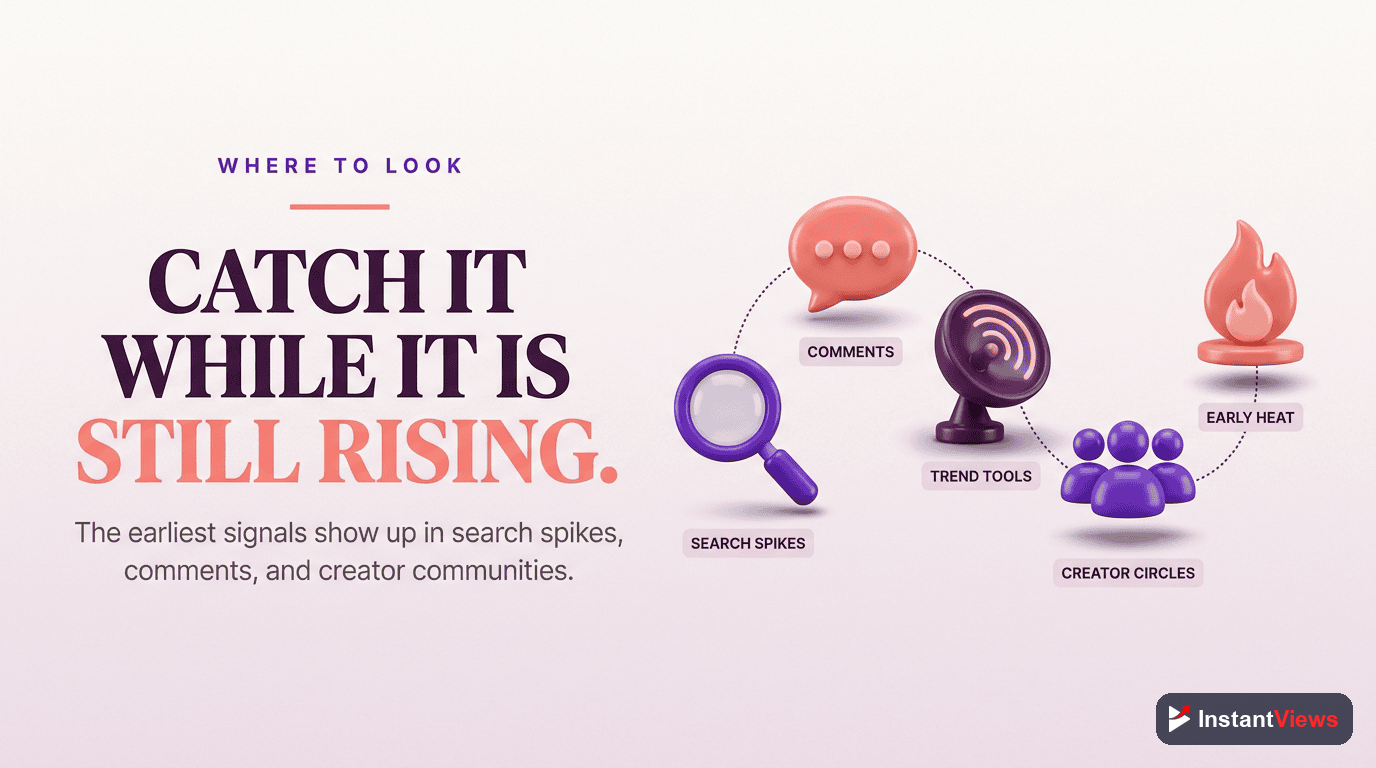
The value of a trend lives almost entirely in timing. Catch it on the way up and you ride the wave; catch it on the way down and you are competing for shrinking attention against everyone who got there first. So the real skill is not reacting to trends — it is spotting them early. No single tool does this well, which is why experienced creators watch several signals at once.
Watch the YouTube Search Bar and Trending Feed
YouTube's own search autocomplete is a live readout of what people are typing right now. Start typing a topic in your niche and the suggestions reveal the exact phrases viewers are searching for. The Trending feed and YouTube Charts show what is breaking out across the platform, while YouTube Studio surfaces topics your own audience is searching for but cannot find good answers to.
Use Google Trends With the YouTube Filter
Google Trends has a setting most creators miss: you can change the search type to YouTube Search, which filters out the wider web and shows only the searches happening inside YouTube. That lets you confirm whether a topic is genuinely rising, compare two competing terms, and see the shape of the demand curve before you commit to producing anything.
Listen to Niche Communities and Comments
Trends almost always start small. Before a topic reaches the masses it usually begins as a whisper inside niche communities — a fandom reference, an aesthetic experiment, or a meme circulating without context. Reddit threads, Discord servers, niche forums, and the comment sections on your own and competitors' videos are where these whispers are loudest. A question that keeps reappearing in your comments is a trend you can answer before anyone else does.
Monitor Fast-Moving Competitors
Watch the channels in your niche that consistently move quickly. When several of them suddenly pivot to the same topic, a trend is forming. Sort their recent uploads by view count to spot a video that is dramatically outperforming their average — that outlier is often an early signal of a topic with room left to run.
Trend Sources at a Glance
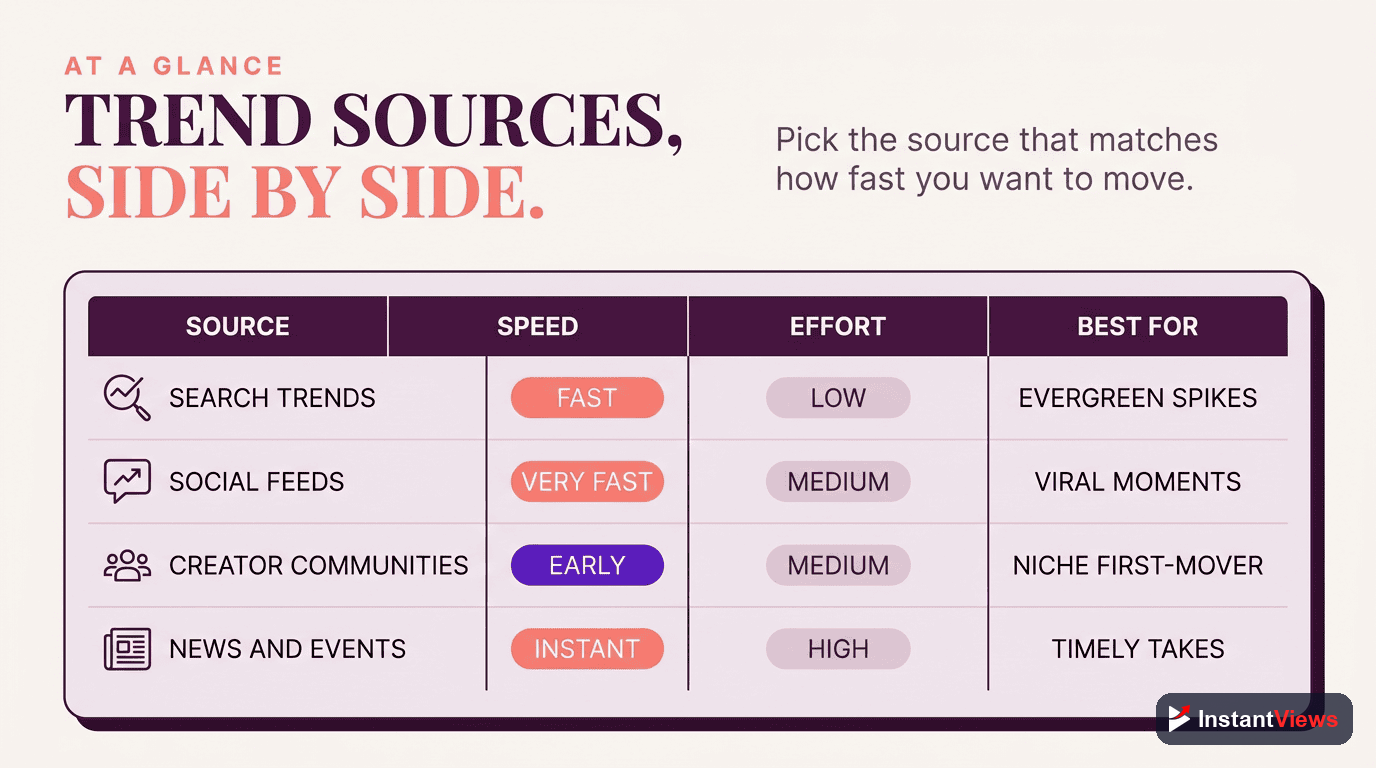
Each trend source tells you something different. The strongest workflow combines platform signals, search demand, community chatter, and performance data so you are never relying on a single, lagging indicator.
| Trend Source | What It Shows | How to Use It |
|---|---|---|
| YouTube search autocomplete | The exact phrases viewers are typing right now | Mine it for title wording and rising sub-topics in your niche |
| Trending feed & Charts | What is breaking out across the whole platform | Scan daily for moments you can adapt to your niche |
| Google Trends (YouTube filter) | Whether in-platform demand is rising or fading | Validate a topic and check the demand curve before producing |
| Niche communities | Early whispers before a trend goes mainstream | Catch topics weeks before competitors notice them |
| Your own comments | Questions your audience keeps asking | Turn repeated questions into timely, on-demand videos |
| Competitor outliers | A video beating a channel's usual numbers | Spot proven demand and offer a better, fresher take |
Acting Fast: The Trend Window
A trend has a lifecycle: it rises, it peaks, and it declines. Your job is to publish on the way up, ideally well before the peak, because that is when demand outstrips supply and the algorithm is hungriest for fresh content. Once a trend peaks, the feed fills with near-identical videos and the same topic that lifted early movers now buries latecomers.
This changes how you should think about production quality. For most content, polish pays off. For trends, speed usually beats polish. A rough but timely video that lands while interest is climbing will frequently outperform a beautifully edited one that arrives a few days late. The window is the asset; spend your effort getting inside it, not perfecting something that will miss it.
Why Shorts Are the Fastest Way In
YouTube Shorts now drive over 200 billion views a day, and they are the single fastest way to reach a trending audience. A Short can be produced in a fraction of the time of a long-form video and travels far beyond your existing subscribers. A proven pattern in 2026 is to publish a Short to ride the spike immediately, then follow with a long-form video that captures the lasting search demand the trend leaves behind — using the Short as a trailer that funnels viewers to the deeper piece.
Speed is not an excuse for misinformation. Moving fast means trimming editing and production time — not skipping fact-checking. A timely video built on a wrong claim spreads the error faster than a slow one, and the correction never travels as far as the mistake.

Newsjacking Responsibly
Newsjacking means publishing your own editorial take on a breaking news story while it is still current. Done well, it positions you as a timely voice in your field and captures the surge of people searching for context. The difference between newsjacking and broader trendjacking is intent: newsjacking is mostly about informing and adding perspective, while trendjacking is about entertaining and iterating on a cultural moment. Both can work, but news carries more responsibility.
Before you newsjack anything, run it through three filters:
- Relevance: Does this story genuinely connect to your niche and your audience? If you have to stretch to make it fit, skip it.
- Value: Can you add real insight, analysis, or a useful angle — not just repeat the headline everyone has already seen?
- Sensitivity: Is this an appropriate story to comment on? Tragedies, disasters, and deeply sensitive events are not opportunities, and treating them as such will rightly cost you trust.
The best newsjacking feels like a natural extension of what you already do, arriving while the conversation is live and offering something the wire reports cannot: your expertise. The worst feels like an opportunist crashing a moment for clicks. The relevance test keeps you on the right side of that line.

Putting Your Unique Spin on a Trend
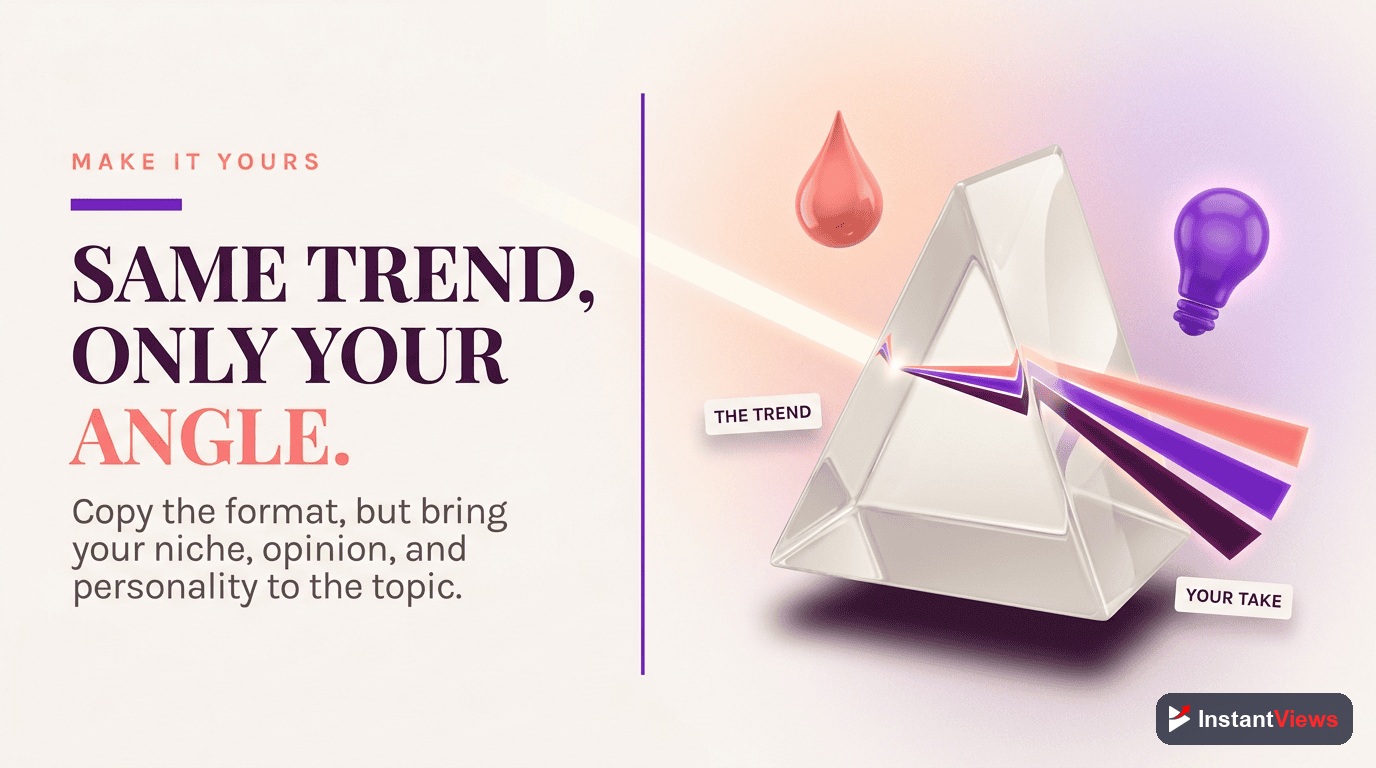
When a trend breaks, dozens or even hundreds of creators rush to cover it. If your video looks and sounds like everyone else's, it drowns in the flood. The way to stand out is not to be first at any cost — it is to be different in a way only you can be. A trend filtered through a genuine point of view is far more memorable than a faithful copy.
Ask yourself what you can add that the crowd cannot:
- Your niche lens: Apply the trend to your specific field. A general topic becomes fresh when it is reframed for cooks, gamers, investors, or teachers.
- Your expertise: Explain the why behind a trend, fact-check it, or add the professional context casual creators miss.
- Your opinion: A clear, honest stance — even a contrarian one — gives viewers a reason to watch you specifically.
- Your data or experience: A test, a result, or a story from your own work turns a recycled topic into something nobody else has.
The format can be borrowed; the substance should be yours. When you wrap a trending subject in an angle that fits your channel, you do more than ride the wave — you convert the new viewers it brings into people who recognize and remember you, which is what turns a one-day spike into lasting growth.
How to Ride a Trend: Step by Step
Here is a repeatable process for turning a rising trend into a video that lands inside the window:
Spot the Signal Early
Scan your search autocomplete, the Trending feed, niche communities, your comments, and competitor outliers. When several signals point the same direction, a trend is forming.
Validate the Demand Curve
Set Google Trends to the YouTube Search filter and confirm interest is still rising, not fading. Check that the topic genuinely fits your niche before you invest any time.
Decide Your Angle
Pin down the one thing you can add that copycats cannot — your niche lens, expertise, opinion, or data. The angle is what makes your version worth watching.
Publish Fast — Lead With a Short
Produce a quick, timely video while interest climbs. Use a Short to catch the spike, and follow with a long-form video to capture the lasting search demand.
Connect It to Your Evergreen Library
Link the trending video to a related evergreen guide with end screens and cards, so the new viewers it brings turn into watch time, subscribers, and lasting growth.
Spot Trends Faster
Use our free suite of YouTube tools to research rising topics, validate demand, and optimize titles so your trending videos land inside the window.
Explore Free YouTube Tools →
Seasonal Trends and Predictable Demand
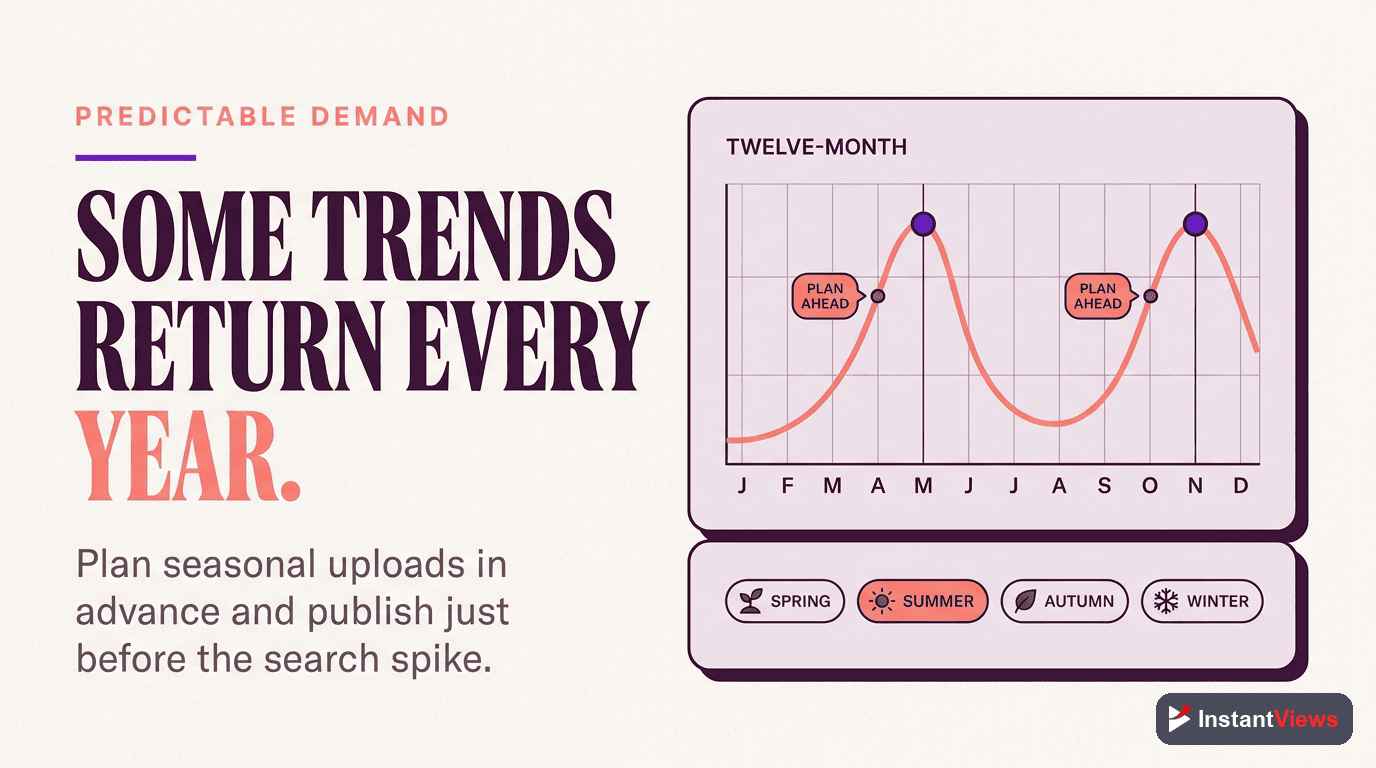
Not every trend is a surprise. Many are completely predictable because they repeat on a calendar. Holidays, tax season, back-to-school, major sporting events, product launch cycles, and end-of-year roundups all generate reliable surges in search demand at the same time every year. These seasonal trends are the easiest trends to win because you can prepare for them weeks or months in advance.
Google Trends is especially useful here. Because it shows multi-year history, you can see exactly when interest in a topic starts climbing each year and publish just ahead of that ramp, while competitors are still scrambling. The work of riding a seasonal trend happens in the planning window, long before the spike arrives.
How to Plan for Seasonal Spikes
- Map your calendar: List the recurring moments that matter to your niche across the year.
- Check the ramp: Use Google Trends to find when interest historically begins rising for each one.
- Publish early: Have your video live before demand peaks so it accumulates signals as the surge builds.
- Refresh, do not rebuild: A seasonal video can often be lightly updated and re-promoted each year instead of made from scratch.
Seasonal content sits in a useful middle ground between fleeting trends and pure evergreen: it spikes predictably, and the same asset can pay off again every cycle.
Balancing Trends With Evergreen Content
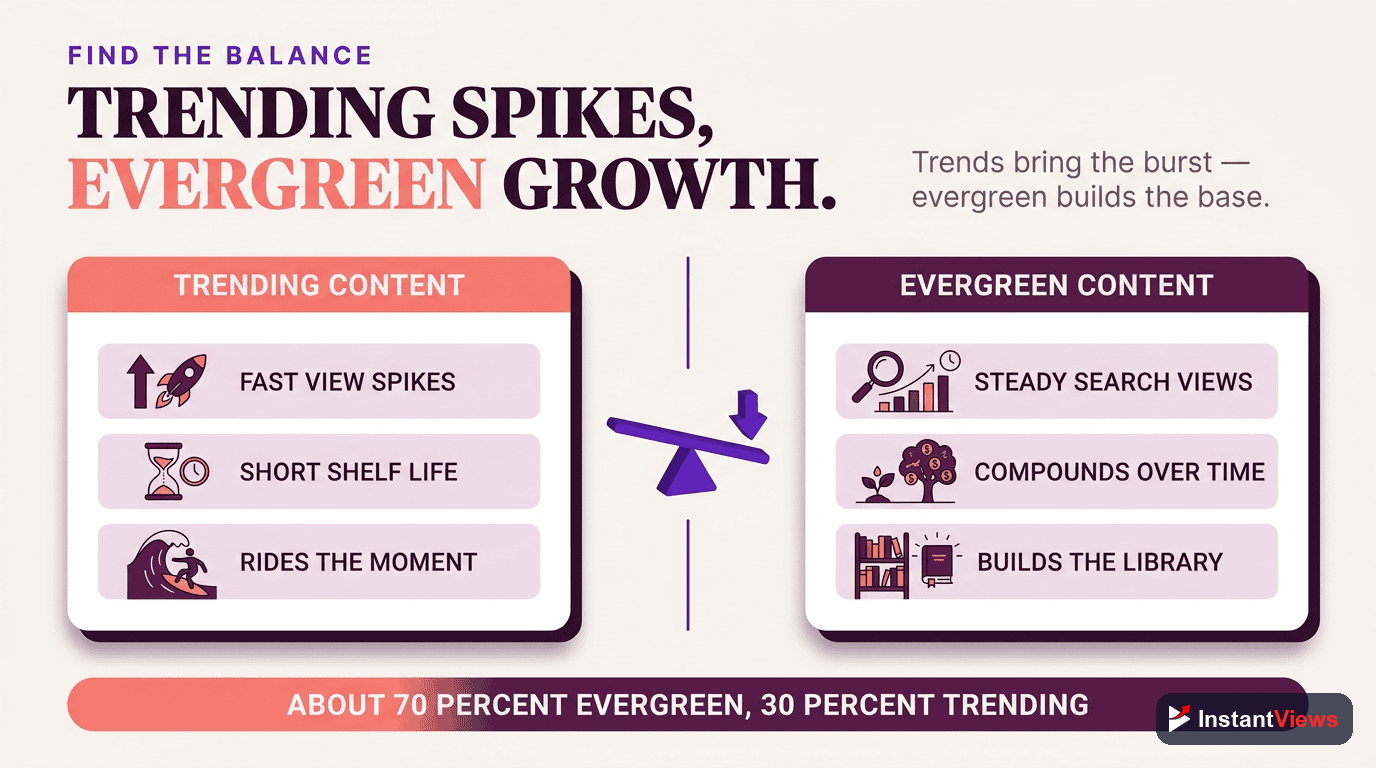
Trends and evergreen content do opposite jobs, and a strong channel needs both. Trending videos deliver sharp spikes of new viewers but fade quickly. Evergreen content — tutorials, how-to guides, and answers to questions that never go out of style — builds slow, steady traffic that compounds for years through search and suggestions. Lean only on trends and your channel becomes a series of disconnected spikes with nothing in between. Lean only on evergreen and you grow steadily but miss the bursts of momentum that trends provide.
| Dimension | Trending Content | Evergreen Content |
|---|---|---|
| Traffic shape | Sharp spike, then decline | Steady, compounding over time |
| Shelf life | Days to weeks | Months to years |
| Main job | Reach new audiences fast | Build a durable, searchable library |
| Best format | Shorts and quick reactions | In-depth tutorials and guides |
| Timing pressure | High — the window is short | Low — value lasts |
A practical way to combine them is to make evergreen content your foundation and treat trends as opportunistic additions on top. Search-driven topics are stronger for evergreen planning, while platform trends help you move with cultural momentum. Crucially, the two feed each other: a trending video brings a flood of new viewers, and a well-placed link to a related evergreen guide converts that flood into lasting watch time and subscribers. The spike fills the top of the bucket; the evergreen library keeps it from draining out.
Mistakes That Kill Trending Content
Chasing trends badly can waste effort and even hurt your channel. These are the errors that turn trend-chasing into a treadmill:
- Chasing dead trends: Publishing after a trend has peaked means competing for shrinking attention against everyone who arrived first. Always confirm the demand curve is still rising.
- Chasing irrelevant trends: Jumping on an unrelated viral moment confuses both your audience and the algorithm, which works hardest when your channel sends a consistent signal about what it is for.
- Copying with no angle: A faithful copy of what everyone else made is invisible. Without a unique spin, you are one of a hundred identical results.
- Sacrificing accuracy for speed: Speed should come from leaner production, never from skipping fact-checks. A fast, wrong video spreads its error widely.
- Living on trends alone: A channel with no evergreen foundation resets to zero after every spike, rebuilding its audience again and again with nothing compounding underneath.
- Ignoring sensitivity: Treating tragedies or serious events as content opportunities reads as opportunistic and erodes the trust that took years to build.
Avoid these and trend content becomes what it should be: a reliable accelerator that injects new viewers into a channel already built to keep them.
"Trends bring the crowd; your angle and your library decide whether they stay. Chase the moment, but build for the years — the creators who do both turn a single spike into lasting growth."

Frequently Asked Questions
Creating trending content means spotting a topic, format, or cultural moment that is rapidly gaining attention and publishing your own take on it while interest is still climbing. The goal is to ride the wave of search and recommendation demand before it peaks, then capture a spike of new viewers who are actively looking for that subject.
Combine several signals rather than relying on one. Watch the YouTube search bar autocomplete and the Trending feed, set Google Trends to the YouTube Search filter to confirm rising demand, monitor niche communities and comment sections where trends start as whispers, and track what fast-moving competitors publish. When multiple signals point the same way and the curve is still rising, you have found a trend early.
Yes. On Google Trends you can set the search type to YouTube Search, which shows only the searches happening inside YouTube rather than across the whole web. That lets you confirm whether interest in a topic is rising or fading, compare related terms, and spot seasonal patterns that repeat every year so you can plan content in advance.
Newsjacking means publishing your editorial take on a breaking news story while it is still current. It is safe and effective when the story is genuinely relevant to your niche, your angle adds real value, and you avoid tragedy or sensitive events you have no business commenting on. Done carelessly it looks opportunistic and can damage trust, so the relevance test always comes first.
Speed matters more for trends than almost any other content. A rough but timely video that lands while interest is climbing will usually beat a polished one that arrives after the peak. YouTube Shorts are the fastest way to reach a trending audience because they are quick to produce and travel widely, which is why many creators use a Short to ride the spike and a long-form video to capture the lasting demand.
Both, in balance. Trends create sharp spikes of new viewers but fade quickly, while evergreen tutorials and guides build steady, compounding traffic for years. A healthy channel leans on evergreen content as its foundation and uses trends opportunistically to inject growth, rather than chasing every passing moment at the expense of a durable library.
Filter the trend through your specific niche, expertise, or audience. Instead of copying what everyone else is doing, ask what unique angle, data, opinion, or use case only you can offer. A trend filtered through a clear point of view stands out in a crowded feed, while a carbon copy gets lost among hundreds of identical videos.
Chasing trends that are irrelevant to your channel or already dead. Jumping on an unrelated viral moment confuses the algorithm and your audience, while arriving after a trend has peaked means competing for shrinking attention. The fix is to only ride trends that connect to your niche and to verify the demand curve is still climbing before you invest time in production.
Conclusion
Trending content is one of the fastest ways to grow a YouTube channel, but only when you treat it as a skill rather than a scramble. Find the signal early across search, Google Trends, niche communities, and competitor outliers; validate that demand is still rising; add the one angle only you can bring; and publish fast, leading with a Short to catch the spike.
The creators who win are not the ones who chase every passing fad. They are the ones who ride the trends that genuinely fit their niche, newsjack responsibly, plan for the seasonal spikes they can see coming, and connect every trending video back to a library of evergreen content that keeps working long after the moment fades.
Spikes get you noticed; your evergreen foundation makes the growth stick. Build both, and a single trending moment stops being a one-day bump and becomes the start of a viewer's long relationship with your channel.