- Virality is engineered, not lucky: it stacks packaging, emotion, retention, and reach into one chain
- The title and thumbnail are the click trigger — design them before you film, not after
- You have only the first few seconds to hook a viewer, so lead with the payoff and cut slow intros
- Every shareable video has one clear “moment” a viewer can repeat to a friend in a single sentence
- Shorts drive 200B+ views a day and reach non-subscribers, making them the fastest reach engine on the platform
Every creator has watched it happen. Two videos, similar quality, similar topic — one quietly collects a few hundred views, the other explodes to millions and shows up in everyone’s feed for weeks. It is tempting to call the difference luck. It is not. With more than 2.7 billion monthly active users and over a billion hours of video watched every day, YouTube has more than enough demand to make almost any idea spread. The question is whether your video is built to spread.
This guide is deliberately practical. It is not about the psychology of why humans share, and it is not about chasing trends. It is about the mechanics and formats — the concrete, repeatable choices that turn a normal upload into something people cannot stop sending to each other. Packaging, hooks, pacing, the shareable moment, the right format, and the reach engines that carry it beyond your own audience.
Think of virality as a chain: packaging earns the click, the hook holds the open, retention keeps people watching, an emotional or useful moment makes them want to share, and a travel-friendly format and a clear prompt push it outward. Every link has to hold. When one breaks, the whole thing stalls — which is exactly why “good” videos so often flop.
By the end you will be able to look at any video idea and engineer each link in that chain on purpose. Let us break down the machine, piece by piece.
- What Virality Really Is (The Mechanics)
- Packaging: The Click Trigger
- The Hook: Winning the First Few Seconds
- Retention and Pacing: Keeping Them Watching
- The Shareable Moment: One Thing Worth Repeating
- The Best Formats for Spreading
- Shorts as a Virality Engine
- Prompting the Share
- Engineer a Shareable Video: Step by Step
- Common Mistakes That Kill Shares
- FAQ
What Virality Really Is (The Mechanics)
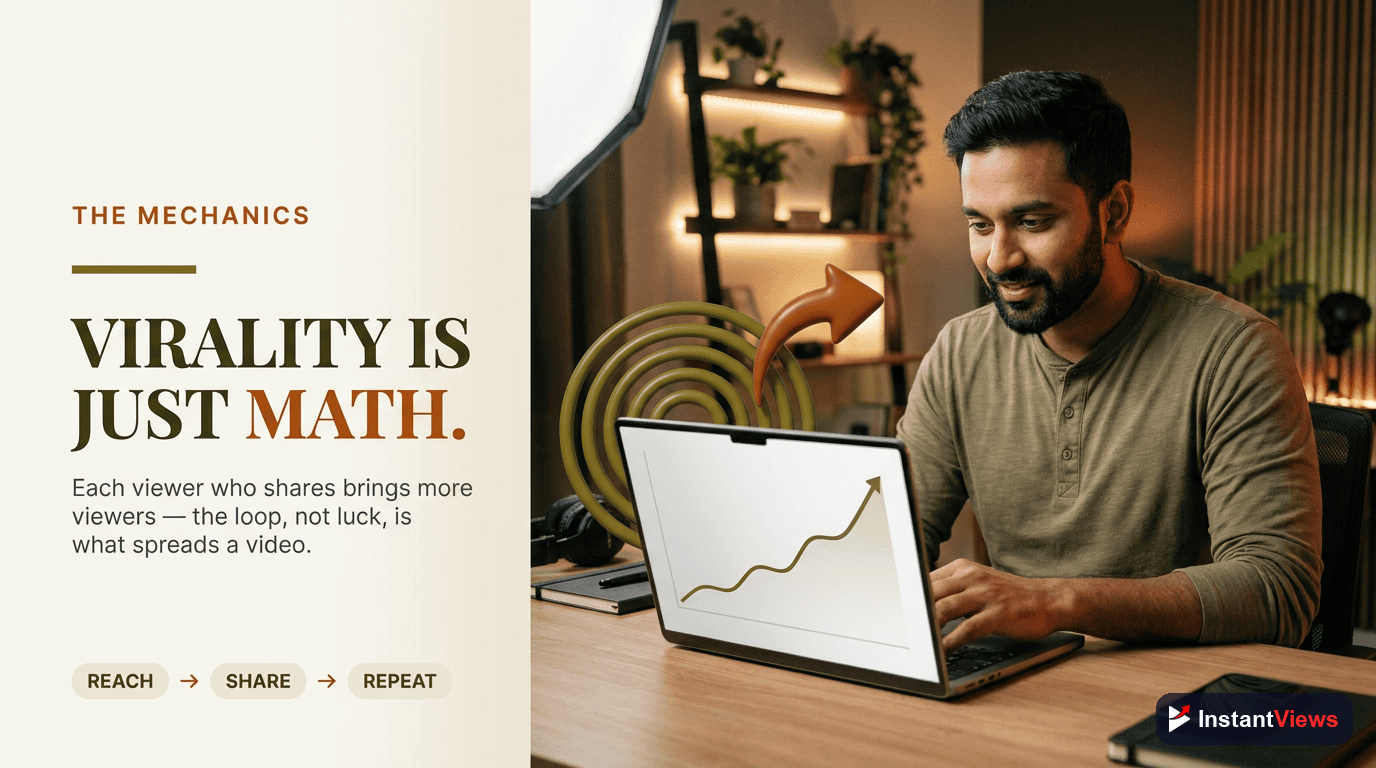
Virality is not a single quality a video either has or lacks. It is the product of several mechanics multiplying together. If we wrote it as a rough equation, it would look like this: virality = packaging × emotion × retention × reach. Because the terms multiply rather than add, a zero in any one of them collapses the whole result. A brilliant payoff behind a boring thumbnail spreads to no one. A clickable thumbnail on a video that bores people in ten seconds dies just as fast.
This is the most important mental shift for anyone trying to make shareable content. Stop asking “is this a good video?” and start asking “is every link in the chain strong?” A video can be excellent and still fail because one mechanic leaked. Diagnosing which link broke — not adding more polish everywhere — is how creators turn a flop into a hit on the next attempt.
The 2026 algorithm makes this even clearer. YouTube now optimizes heavily for viewer satisfaction and retention rather than raw watch time alone, and it is actively reducing the spread of low-value, mass-produced content. In plain terms: the platform is trying to surface videos that real people genuinely want to watch and pass on. The mechanics in this guide are simply the levers that signal exactly that.
The Four Links in the Chain
- Packaging: the title and thumbnail that decide whether anyone clicks at all.
- Emotion: the feeling — surprise, delight, awe, recognition, usefulness — that makes a video worth talking about.
- Retention: the pacing and structure that keep viewers watching long enough to reach the payoff.
- Reach: the format and distribution surfaces, especially Shorts, that carry the video to people who do not yet follow you.
Packaging: The Click Trigger
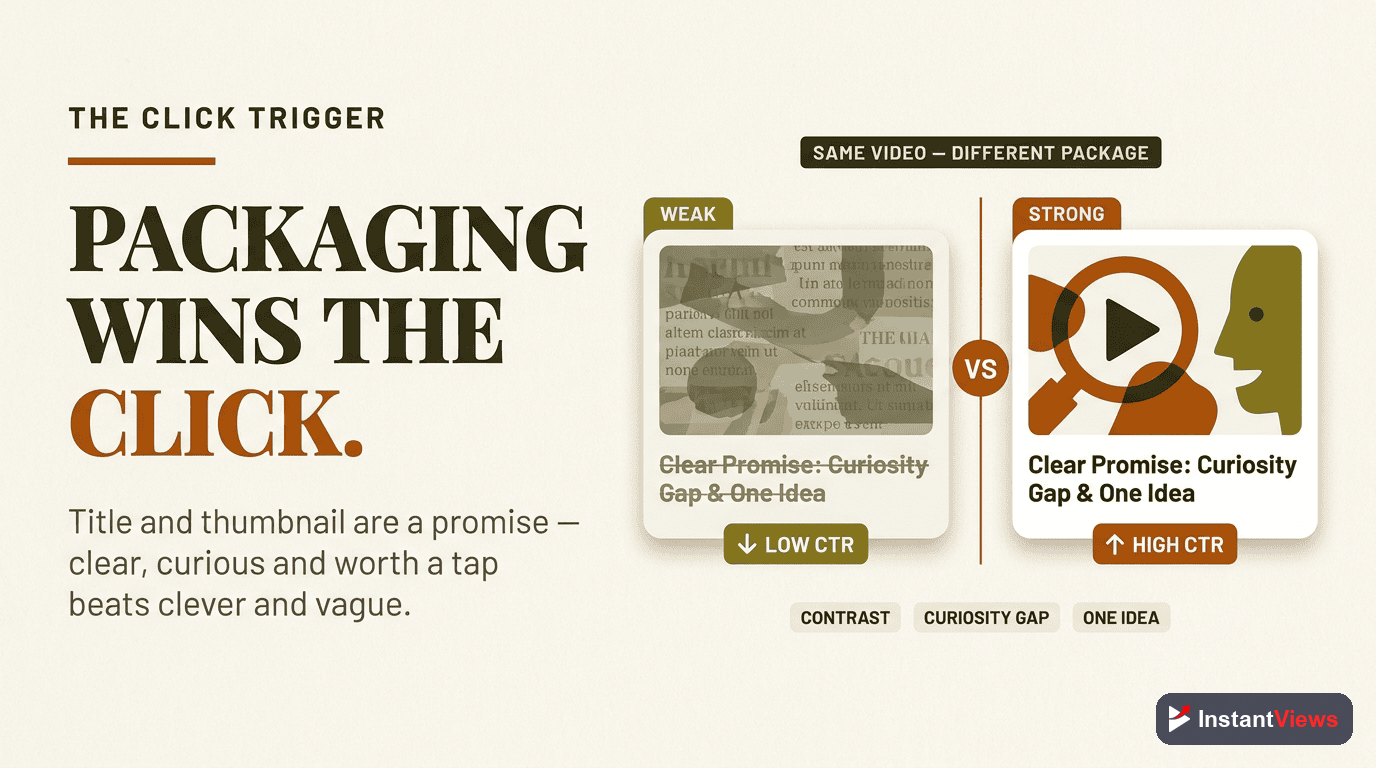
Packaging is your title and thumbnail working as a pair, and it is the single biggest lever on whether reach becomes views. The algorithm can put your video in front of millions of people, but impressions only convert when the package earns the click. This is why seasoned creators design the title and thumbnail before filming: if the concept cannot produce a compelling package, the idea itself needs work.
Strong packaging creates a curiosity gap — it promises something specific and interesting without giving away the whole answer. It tells the viewer exactly what they will get and makes that outcome feel worth their time. Vague, clever, or inside-joke titles almost always lose to clear, concrete ones.
Title Principles
- Lead with the payoff or the stakes. Put the most interesting word or idea at the front, not buried at the end.
- Be specific. Concrete details and outcomes beat generic promises — specificity reads as credibility.
- Open a loop. Hint at a result, transformation, or question that only watching can close.
- Match the thumbnail. The title and image should tell one combined story, not two separate ones.
Thumbnail Principles
- One clear focal point. A thumbnail is read in a fraction of a second, so it must communicate a single idea instantly.
- Show emotion or a face. Expressive human faces consistently draw attention and add the human signal viewers respond to.
- High contrast, few words. Three or four large words at most; the image should carry the meaning.
- Legible on a phone. Most viewing happens on small screens, so design for thumbnail-size first.
The Hook: Winning the First Few Seconds
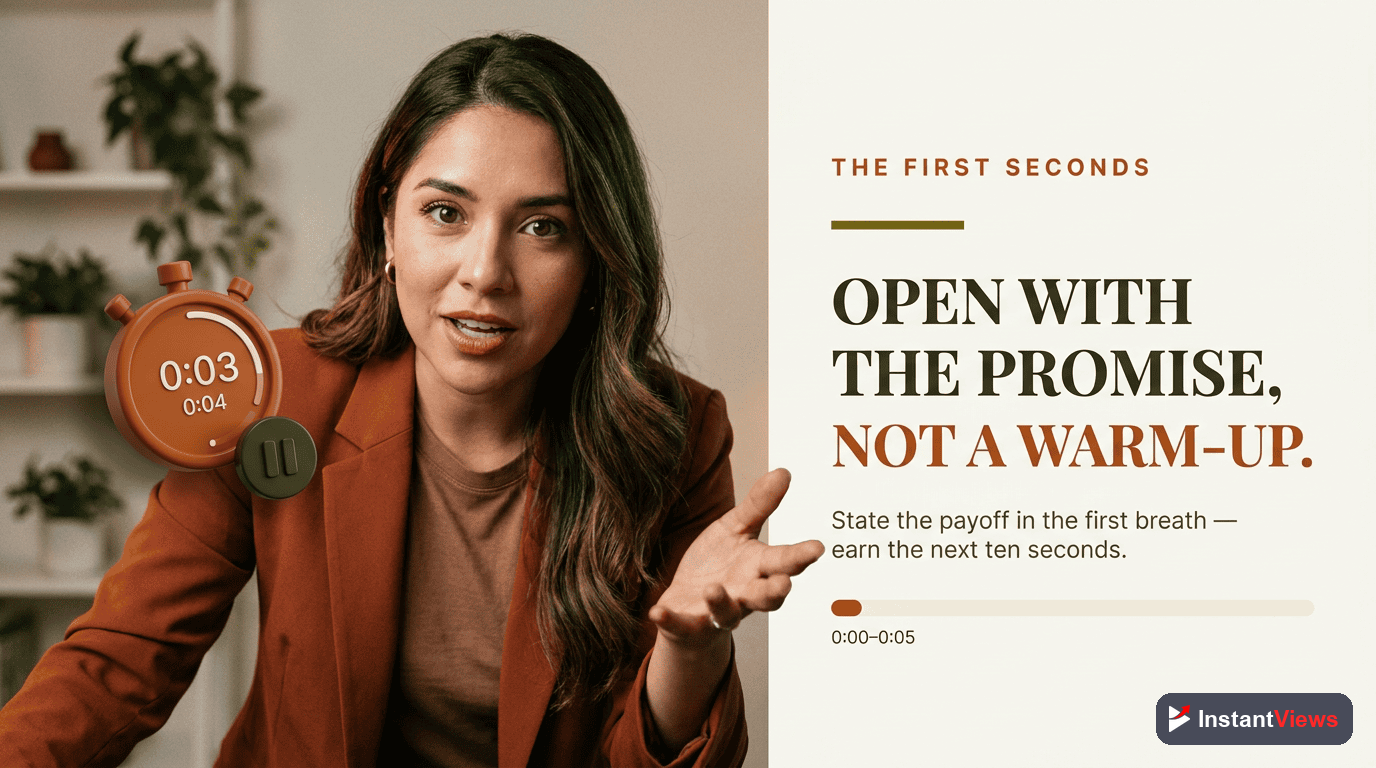
If packaging wins the click, the hook wins the stay. The opening of a video is where most of them quietly die: a large share of viewers leave within the first fifteen seconds when the intro fails to connect. Those seconds are not a warm-up — they are the audition. Lose them and nothing else in the video matters, because no one is left to see it.
The fix is almost always to cut the front. Long channel intros, animated logos, “hey guys welcome back, before we start don’t forget to…” — these are retention killers. The best hooks deliver value or intrigue from the very first frame.
Hook Patterns That Work
- Lead with the payoff: show the final result first, then promise to explain how you got there.
- Open a question loop: pose the exact question the whole video answers, so leaving means not knowing.
- Show the most dramatic moment: a quick cut to the peak of the video tells viewers the destination is worth the trip.
- State a bold, specific claim: a clear promise that this video does something differently keeps people watching to verify it.
A useful test: watch your first ten seconds with the sound off and ask, “would a stranger keep watching?” If the answer is “only if they already like me,” the hook is too weak for a video meant to reach new people.
Retention and Pacing: Keeping Them Watching
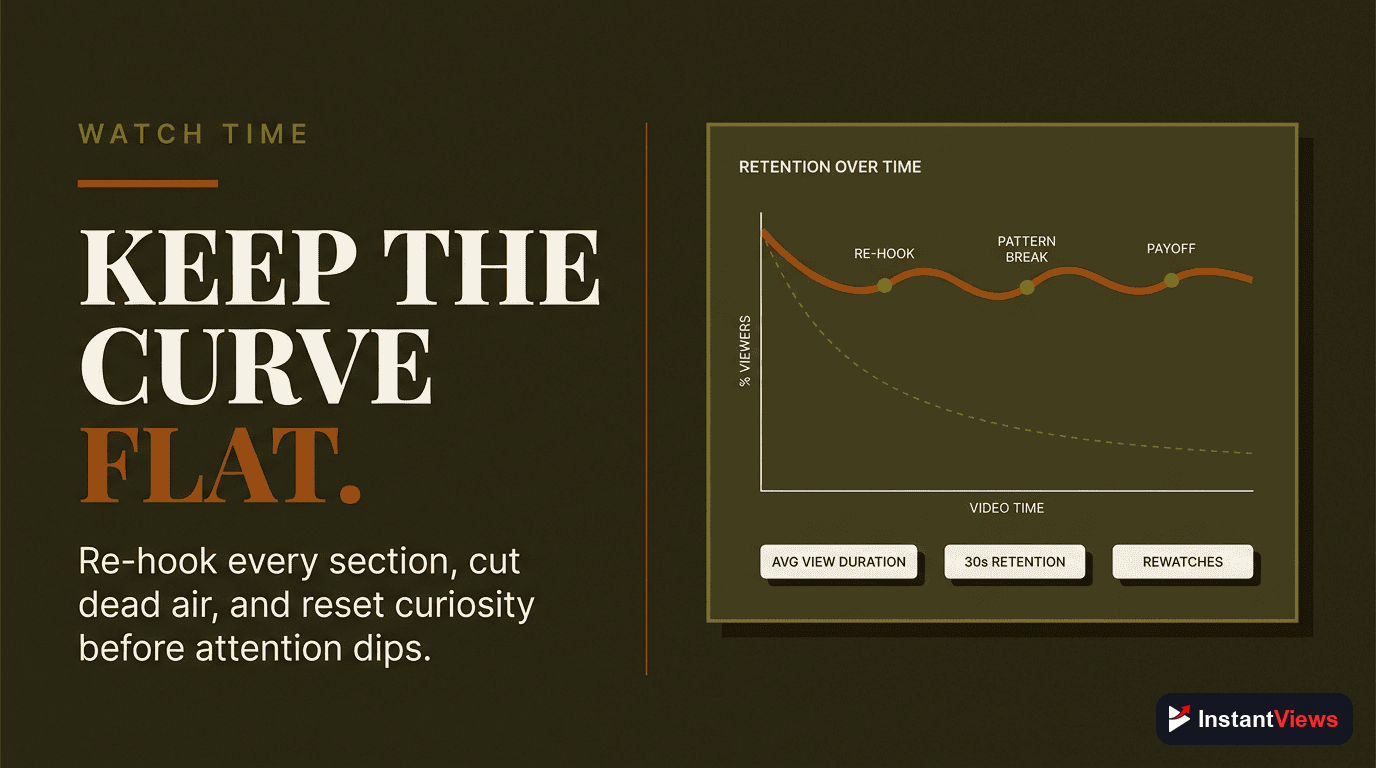
Once viewers are in, retention decides how far they get. This matters for two reasons. First, the longer people watch, the more the algorithm trusts that the video satisfies viewers and the wider it pushes it. Second — and this is the part creators forget — people only share videos they actually finished, or at least reached the good part of. A high retention graph and a high share rate are deeply linked.
Most videos retain only a minority of their audience to the midpoint, and the ones that hold past the halfway mark dramatically outperform the rest. Pacing is how you get there. The goal is to make every segment earn the next one.
Pacing Techniques
- Cut dead air ruthlessly. Remove pauses, repeated points, and tangents. If a sentence does not add, delete it.
- Use pattern interrupts. Change the shot, add a graphic, switch location, or shift tone every so often to reset attention.
- Open small loops throughout. Tease what is coming (“but the third one surprised me”) so viewers stay for the answer.
- Front-load value. Deliver real substance early instead of saving everything for the end, which builds trust to keep watching.
The Shareable Moment: One Thing Worth Repeating
Here is the link most creators miss entirely. A video can be perfectly packaged, tightly paced, and beautifully shot — and still get zero shares — because it gives the viewer nothing to say. People do not share videos; they share what a video makes them feel or realize. So every shareable video needs a clear moment: one idea, reaction, transformation, or takeaway a viewer can repeat to a friend in a single sentence.
Ask yourself: when someone sends this video to a friend, what do they type in the message? “Watch what happens at the end.” “This explains it better than anyone.” “This is literally us.” If you cannot easily imagine that one-sentence pitch, your video probably does not have a moment yet — and you should build one in before you publish.
Types of Shareable Moments
- The surprise: an unexpected result or twist that people want others to witness too.
- The transformation: a clear before-and-after that delivers a satisfying payoff.
- The “that’s so true” moment: a relatable observation people share to say “this is me.”
- The genuinely useful nugget: a tip or insight so good people send it to help someone specific.
- The awe moment: something beautiful, impressive, or hard to believe that begs to be shown off.
Sharing is a social act — people pass along things that make them look smart, helpful, funny, or in-the-know. Your job is to engineer one unmistakable moment that gives them a reason to do it.
The Best Formats for Spreading
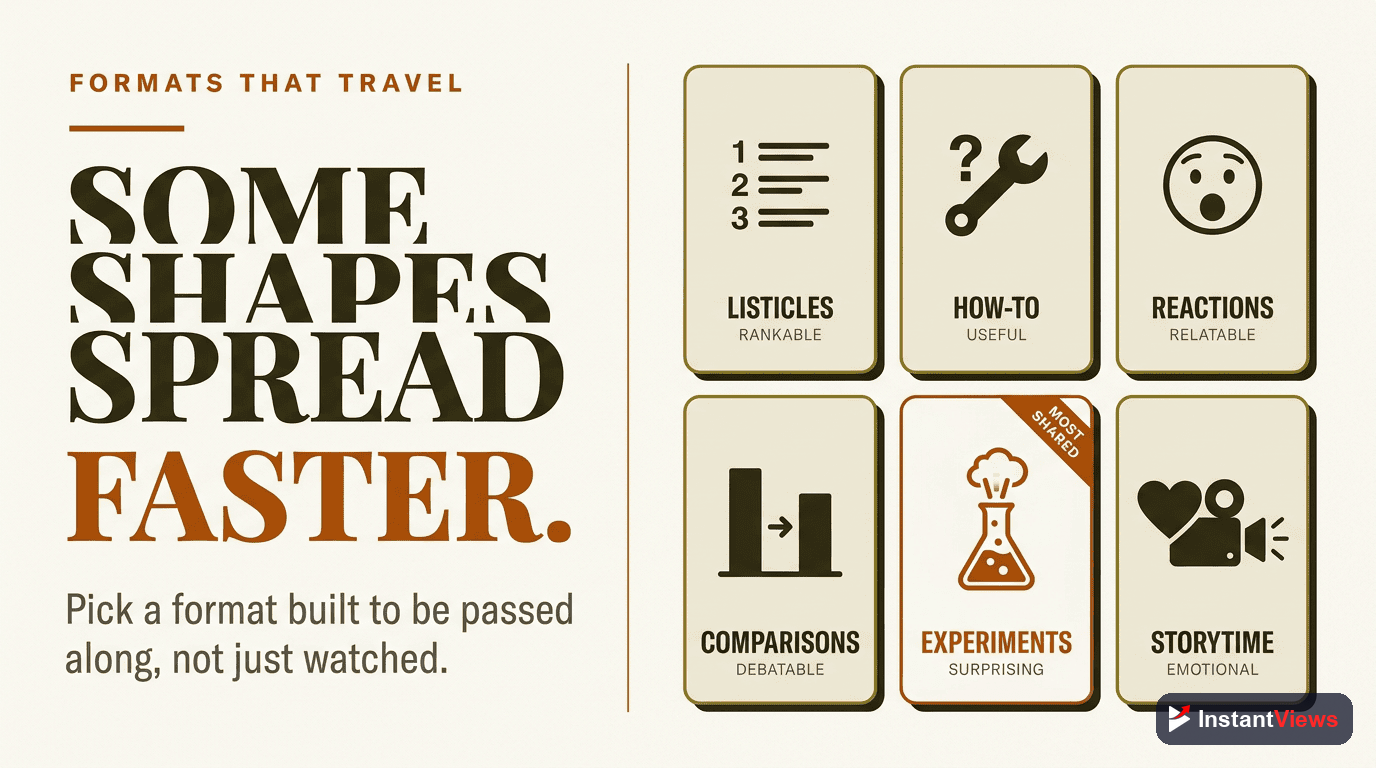
Some formats are simply easier to share than others because they package emotion and payoff into a structure viewers already understand. You do not have to invent a format from scratch — you can choose one proven to travel and bring your own angle. The table below maps popular shareable formats to why they spread and where to use them.
| Video Format | Why It Spreads | Example Use |
|---|---|---|
| Listicle / ranking | Easy to follow, built-in loops (“wait for number one”), and debatable — people share to argue or agree | “7 tools that changed how I work” |
| Transformation / before-and-after | Clear payoff and visible progress create a satisfying, screenshot-worthy result | Room makeover, glow-up, skill in 30 days |
| Challenge / experiment | Built-in stakes and uncertainty — viewers stay and share to see if it works | “I tried X for 30 days” |
| Surprising result / myth test | Curiosity gap plus a payoff that contradicts expectations sparks “you have to see this” | “Does the expensive one actually win?” |
| Relatable skit / observation | Recognition — people tag friends to say “this is literally us” | “Every group chat ever” |
| Tutorial / how-to | Genuine utility — viewers save and send it to someone who needs it | “The fastest way to do X” |
Notice the common thread: each format has a built-in reason to keep watching and a built-in reason to share. When you pick a format, you are not limiting your creativity — you are borrowing a structure that already does half the work of holding attention and earning the pass-along.
Shorts as a Virality Engine
If there is one distribution surface purpose-built for going viral, it is YouTube Shorts. Shorts now drive more than 200 billion views a day, and crucially, the Shorts feed surfaces content to people based on interest rather than subscription. That means a Short can reach an enormous audience of non-subscribers — exactly the people you need to reach for something to spread beyond your existing fans.
Shorts also lower the cost of experimentation. Because they are fast to make and fast to watch, you can test many hooks, ideas, and moments quickly, then double down on whatever catches. A Short that pops becomes a feeder: a slice of new viewers discovers you, and your longer content converts them into subscribers and repeat watchers.
How to Use Shorts Strategically
- Lead with the hook in the first second. The Shorts feed is endlessly swipeable, so there is no patience for a build-up.
- Make it loop. Shorts that end where they began encourage rewatches, which boost performance.
- Repurpose your best moment. Clip the single most shareable moment from a long video into a standalone Short.
- Point to the deeper content. Use Shorts for reach, then guide interested viewers to the long-form video that expands the idea.
Do not treat Shorts as a separate channel from your long-form strategy. The reach is real, but reach without a next step is wasted — a viewer who watches one Short and leaves was never really yours. Always give Shorts viewers a reason and a path to go deeper, or the virality evaporates the moment they swipe on.
Find Your Next Viral Idea
Use our free suite of YouTube tools to research topics, test title ideas, and analyze which packaging and formats are already working in your niche.
Explore Free YouTube Tools →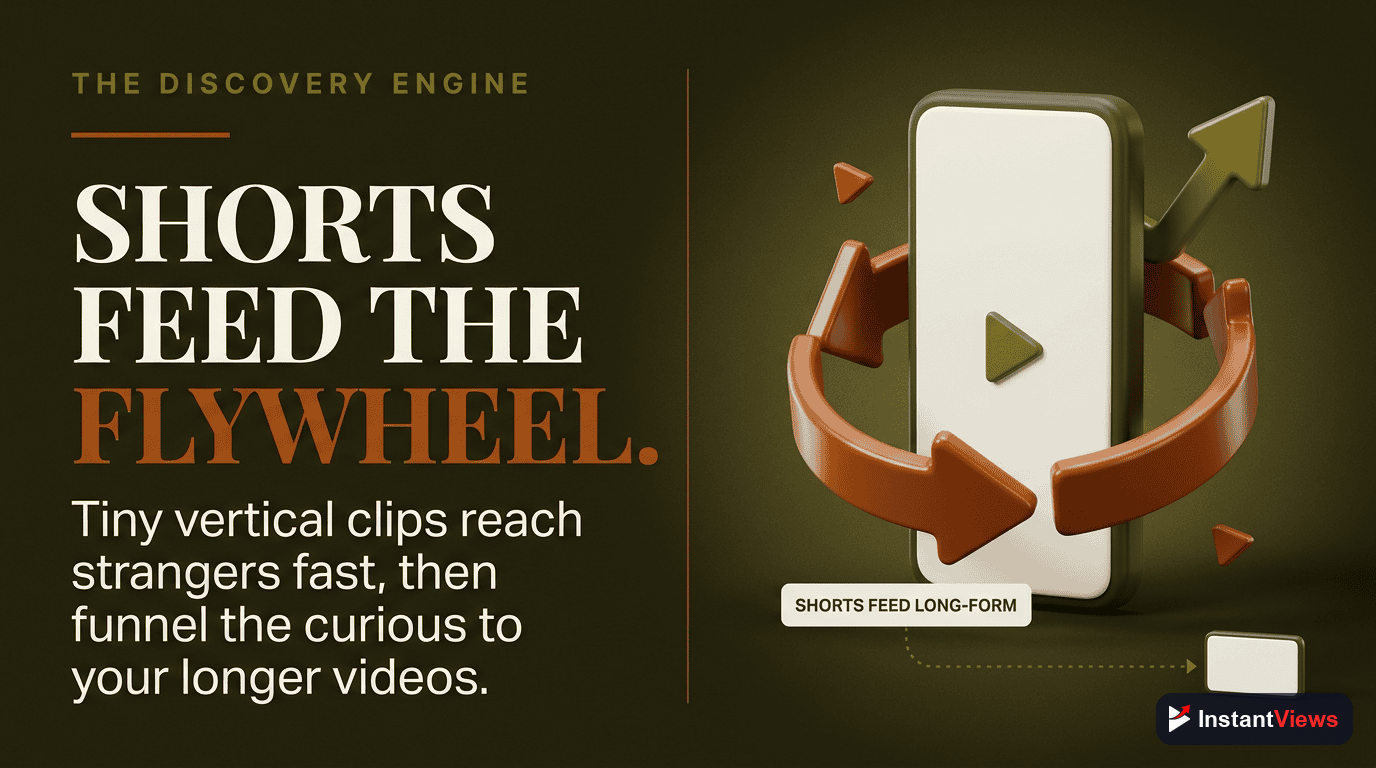
Prompting the Share
Even a video full of shareable moments benefits from a nudge. Many viewers enjoy something and simply never think to pass it on — a short, specific prompt closes that gap. But there is a right and a wrong way to ask, and timing is everything.
The wrong way is the generic, early plea: “please like, comment, and share” tacked onto the intro before you have earned anything. The right way is a specific prompt placed at the moment of peak emotion — right after the payoff, the surprise, or the most useful takeaway, when the viewer already feels the urge.
How to Ask Well
- Be specific about who. “Send this to someone who keeps saying they want to start” beats “share with your friends.”
- Tie it to the emotion. Ask right after the moment that made them feel something, not before it.
- Give a reason. “If this helped, it’ll help them too” gives a justification that makes sharing feel generous, not promotional.
- Keep it light and brief. One sentence, then move on. A long pitch breaks the spell you just created.
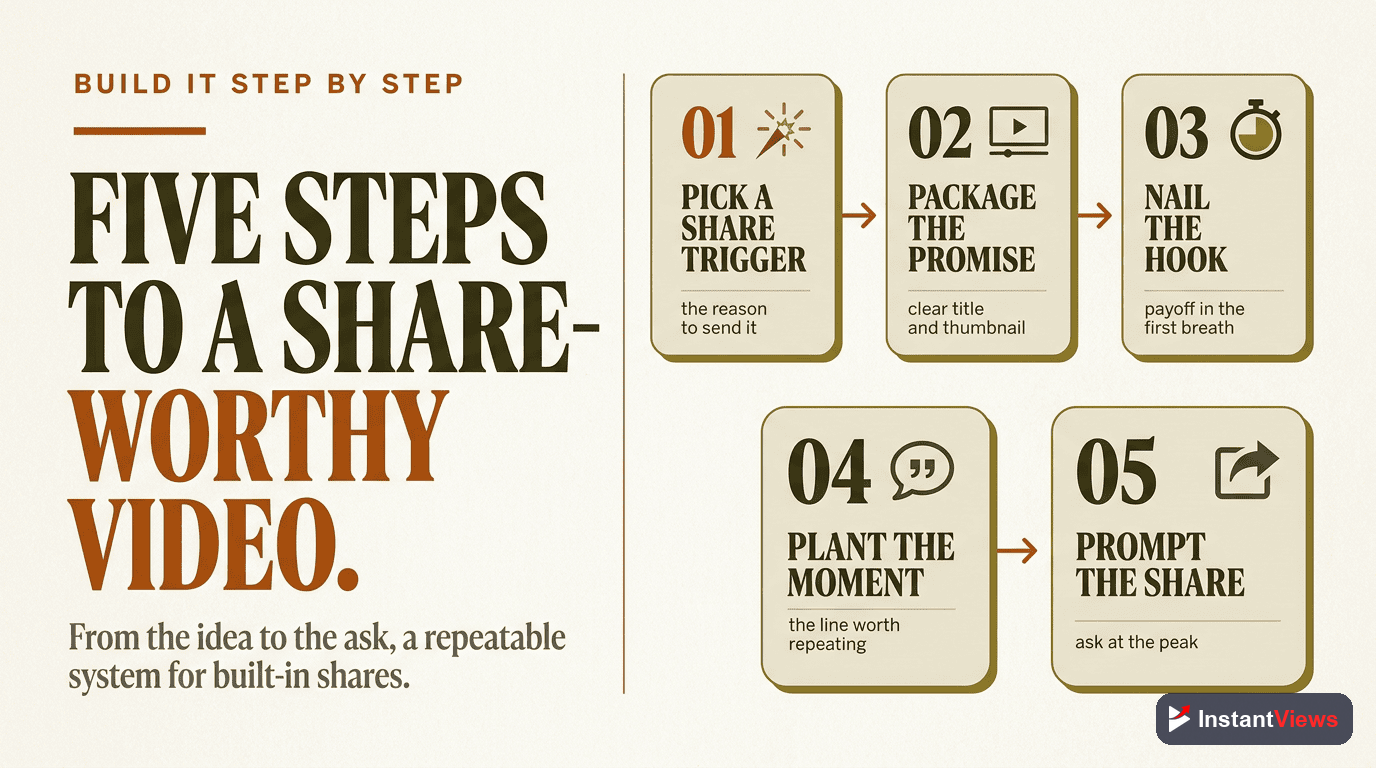
Engineer a Shareable Video: Step by Step
Here is how to put every mechanic together into one repeatable process, in the order that actually works — starting from the package and building inward.
Design the Packaging First
Before you film, write the title and sketch the thumbnail. If the idea cannot produce a clickable, curiosity-driven package on a phone screen, sharpen the concept until it can. Packaging is the gate — nothing else matters if it stays shut.
Script the First Few Seconds
Write the hook before anything else in the video. Lead with the payoff, the most dramatic moment, or the exact question you will answer. Cut every logo, slow intro, and throat-clearing line that delays it.
Build Around One Shareable Moment
Decide the single sentence a viewer will type when they send this to a friend. Then structure the entire video to set up and deliver that one moment as clearly and satisfyingly as possible.
Edit for Retention
Cut dead air, add pattern interrupts, and open small loops to pull viewers forward. Every segment should make the next one feel worth staying for, so the retention graph holds high.
Prompt the Share and Clip a Short
Add a specific share prompt at the moment of peak emotion. Then cut your single strongest moment into a Short to reach non-subscribers and feed new viewers back to the full video.
Common Mistakes That Kill Shares
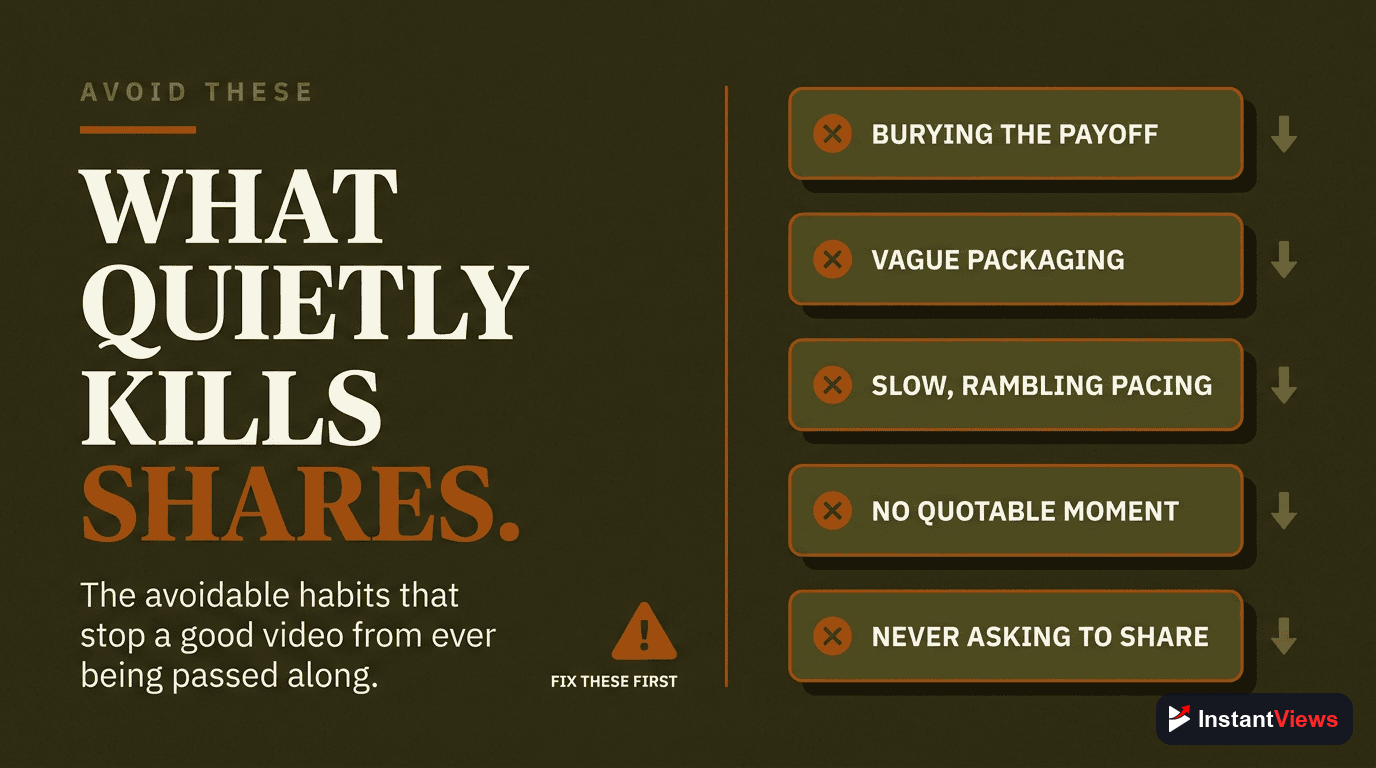
Most videos that should have spread were sabotaged by one of a handful of avoidable mistakes. Run through this list before you publish:
- Polishing the video but ignoring the package. Hours on the edit, two minutes on the thumbnail — and nobody clicks. Packaging deserves real time.
- A slow, self-indulgent intro. The longer your front, the more viewers you lose before the good part. Start with the payoff.
- No clear moment. If you cannot name the one-sentence reason someone would share it, neither can your viewer.
- Padding for length. Stretching a five-minute idea to ten to hit a target wrecks retention and satisfaction. Let the idea set the length.
- Treating Shorts as throwaway. Ignoring the platform’s biggest reach engine, or using it with no path to your deeper content.
- Asking for the share too early or too vaguely. A generic plea before the payoff converts almost no one.
- Never reading the data. Without checking impressions, click-through rate, retention, and shares, you cannot tell which link in the chain broke.
The good news is that every one of these is fixable, and fixing them is cumulative. Each video teaches you which mechanic you tend to neglect, and tightening that link makes your next upload more likely to travel.
"A video does not go viral because it is good. It goes viral because it is built to spread — clickable to find, gripping to start, satisfying to finish, and impossible not to send to someone."
Frequently Asked Questions
Virality is not luck — it is a stack of mechanics working together: packaging that earns the click, a hook that holds the first few seconds, pacing that sustains retention, a clear emotional or useful moment worth sharing, and a format that travels easily beyond your subscribers. Get all of these right and the algorithm amplifies the reach for you.
Packaging is the gatekeeper. No matter how good the video is, it cannot spread if nobody clicks. The title and thumbnail are the single biggest lever on whether your reach turns into views, which is why experienced creators often design the title and thumbnail before they ever film.
The first few seconds decide everything. A large share of viewers leave within the opening fifteen seconds if the intro does not connect, so cut slow logos and long introductions. State the payoff, show the most interesting moment, or pose the question the whole video answers — immediately.
A shareable moment is the single idea, transformation, reaction, or takeaway a viewer can repeat to a friend in one sentence. People share videos to express something about themselves or to help someone else. If your video has no clear moment to talk about, there is nothing to pass along.
Yes. Shorts now drive more than 200 billion views a day and surface heavily to people who do not subscribe to you, which makes them one of the fastest reach engines on the platform. They are ideal for testing hooks and ideas, then converting new viewers into watchers of your longer content.
Length should match the idea, not a target number. A tight Short can spread faster than a long video because it is easy to finish and pass on, while a longer video can earn deep watch time if every minute justifies itself. The 2026 algorithm rewards viewer satisfaction and retention, so a focused short video usually beats a padded long one.
A clear, well-timed prompt does help — but only after you have given people something worth sharing. Ask at the moment of peak emotion or right after the payoff, and make the reason specific, such as “send this to someone who needs to see it,” rather than a generic “please share.”
Usually one mechanic in the chain broke. Weak packaging means nobody clicks; a slow hook means they leave; no clear moment means nobody shares. Production quality alone does not create virality. Diagnose which stage leaked — impressions, click-through rate, retention, or sharing — and fix that one first.
Conclusion
Shareable, viral content is not a lottery ticket — it is a machine with named, repeatable parts. Packaging earns the click, the hook wins the first few seconds, pacing protects retention, a clear moment gives people something to say, the right format makes it easy to pass on, and Shorts and a well-timed prompt carry it beyond your subscribers. Build every link on purpose and you stop hoping for hits and start engineering them.
You will not nail all six on day one, and you do not have to. Pick the link you most often neglect — for most creators it is packaging or the hook — and obsess over it for your next few uploads. Then read the data, find the next leak, and tighten that one. Virality compounds as your weakest link keeps getting stronger.
The platform is bigger than ever, the reach is real, and in 2026 it rewards exactly what this guide describes: videos that genuinely satisfy viewers and that viewers genuinely want to share. Make something worth sending, make it effortless to find and finish, and then ask. That is the whole machine — now go build one.