- The living-room TV is now the biggest screen for YouTube viewing, so design your videos for the couch, not just the phone
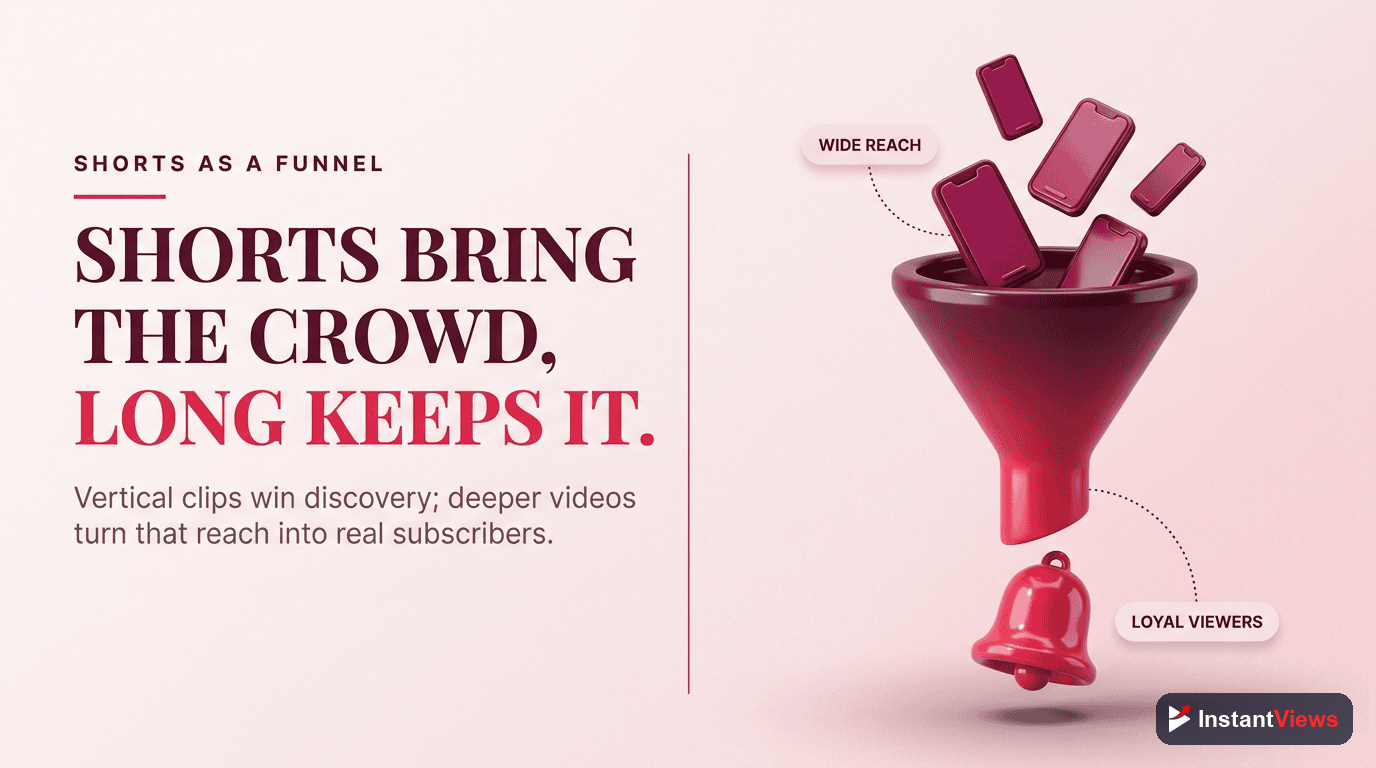
- Shorts pull in over 200 billion views a day, but they work best as the top of a funnel that feeds your longer content
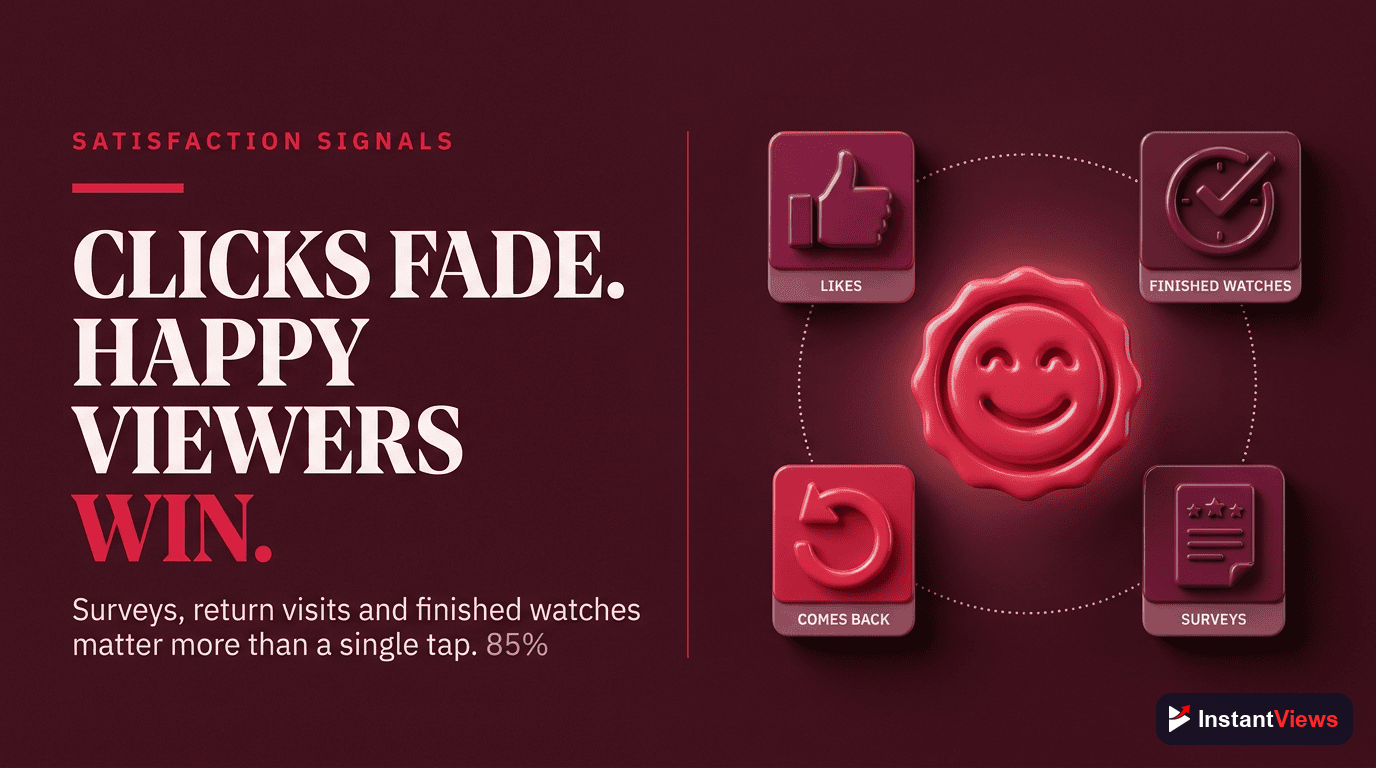
- The algorithm now rewards viewer satisfaction, so a tight, fulfilling video can beat a longer one that pads its runtime
- AI tools are welcome, but mass-produced, low-effort content is being reduced — keep a clear human point of view
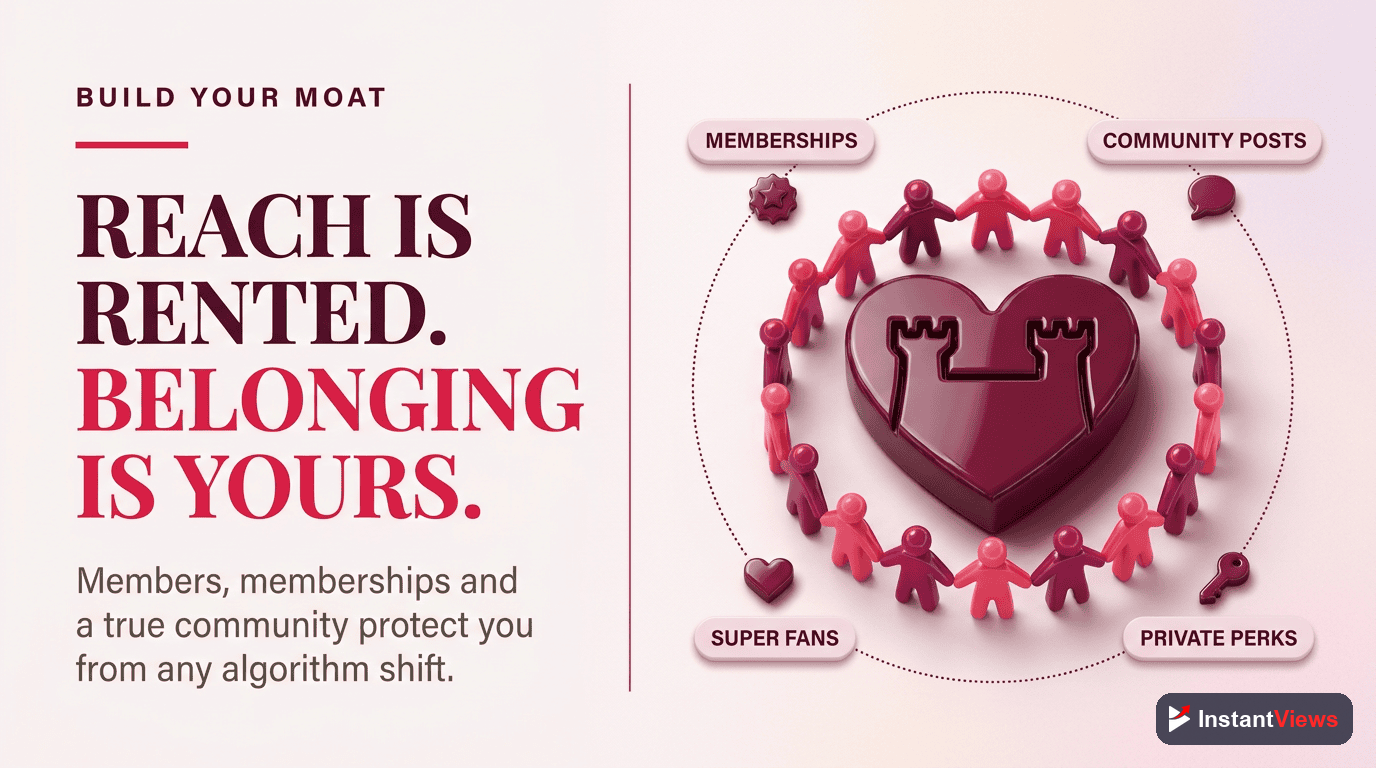
- Memberships, community, and podcasts turn one-time viewers into an owned audience that returns and supports you directly
YouTube is not the platform it was even two years ago. With more than 2.7 billion monthly active users and over a billion hours watched every single day, it remains the largest video destination on earth — but the way people watch, what the algorithm rewards, and how creators get paid have all shifted underneath us. The playbook that grew channels a couple of years ago is quietly going stale.
This is not a history lesson about how YouTube got here, and it is not a far-off prediction about where video is heading. It is a snapshot of what is happening right now — the concrete shifts already affecting your reach, your watch time, and your revenue — paired with a clear "what to do about it" for each one.
Some of these trends will matter enormously to your channel and some will barely apply. You do not need to chase all of them. The goal is to recognize where attention and money are moving, pick the shifts that fit your niche, and act before the rest of your competition does.
Let us walk through the trends shaping YouTube today and exactly how to respond to each.
- The Living Room Won: Connected TV Viewing
- Shorts Dominate Discovery — But They Are a Funnel
- The Algorithm Now Rewards Satisfaction
- AI Tools Are Mainstream — And So Is the Crackdown
- Community and Memberships Become the Moat
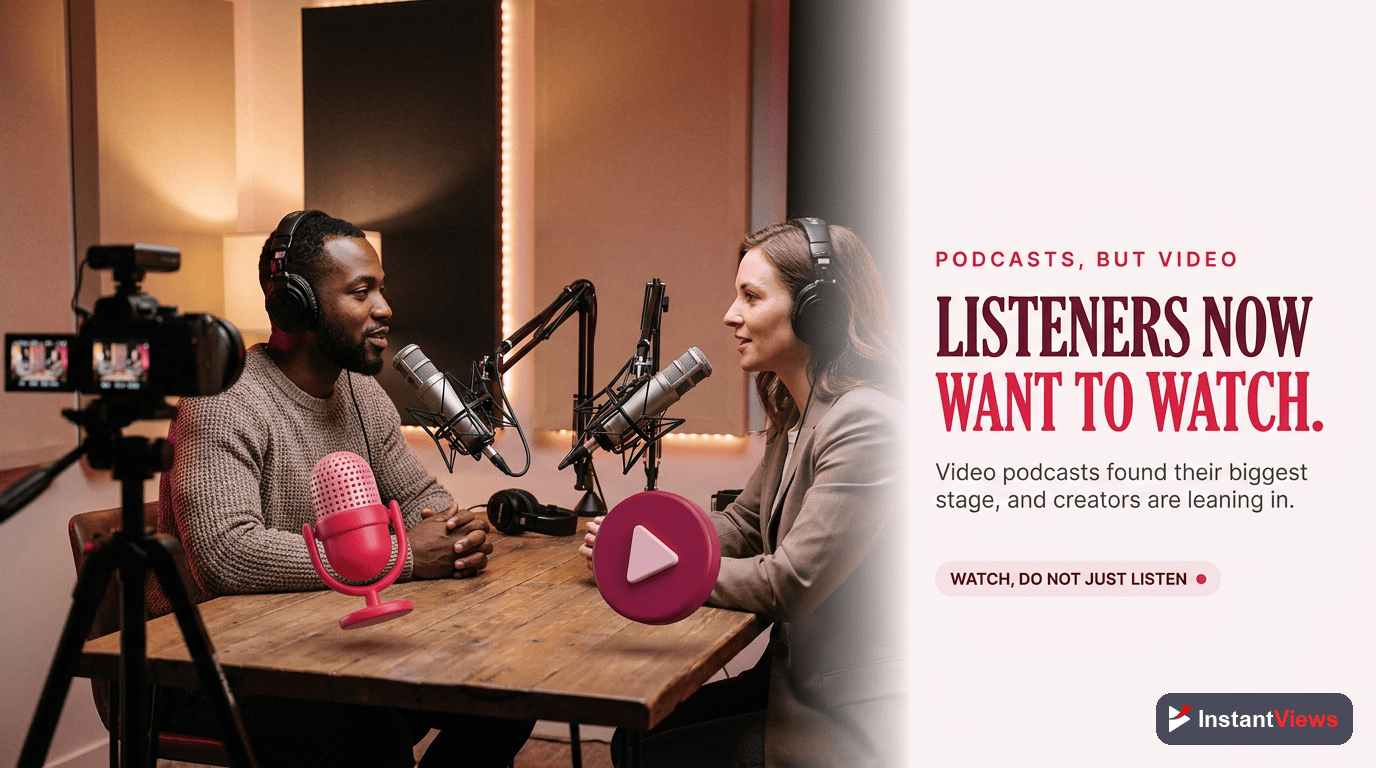
- Podcasts Found Their Home on YouTube
- The Trends at a Glance: What to Do
- A Worked Example: One Channel, Six Trends
- Your 5-Step Action Plan
- How to Prioritize Without Burning Out
- FAQ
The Living Room Won: Connected TV Viewing
For most of YouTube's life, the default assumption was that people watched on a phone. That assumption is now wrong. The connected TV (CTV) — the smart television in the living room — has become the single largest surface where people watch YouTube, overtaking mobile as the leading screen. Audiences increasingly lean back on the couch and treat YouTube the way previous generations treated cable.
This changes the physics of your content. A thumbnail that pops on a six-inch phone can look cluttered and unreadable from ten feet away on a TV. Tiny text, busy collages, and three competing focal points all fall apart on the big screen. Pacing changes too: lean-back viewers are more patient than thumb-scrolling mobile users, which makes longer, more immersive formats viable again.
What to do about it
- Check your device data first. Open YouTube Analytics and look at the device breakdown. If a meaningful share of your watch time already comes from TV, this trend is your priority.
- Design thumbnails for distance. Use bold, high-contrast images, large faces, and minimal text that reads clearly from across a room.
- Rethink length. Lean-back viewing rewards content people can settle into. Longer documentaries, deep dives, and multi-part stories suit the living room far better than they suit a commute.
- Mind the audio. TV viewers often listen through better speakers and from a distance, so clean audio and clear narration matter more than ever.

Shorts Dominate Discovery — But They Are a Funnel
YouTube Shorts are no longer the experiment they once were. They now draw well over 200 billion views a day and are one of the fastest ways to put your channel in front of people who have never heard of you. For pure reach and discovery, nothing on the platform moves faster.
But the way smart creators use Shorts has matured. A view on a Short is cheap attention — a few seconds of a scroll — and on its own it rarely builds a business or a loyal audience. The winning approach treats Shorts as the top of a funnel: a discovery layer that hooks new viewers, then guides them toward the longer videos, podcasts, and memberships where real relationships and revenue form.
What to do about it
- Use Shorts to introduce, not to conclude. Tease an idea, share a quick win, or show your personality, then point viewers to the long video that goes deeper.
- Connect the dots. Pin a comment, add an end element, or mention the related long-form video so a curious Shorts viewer has an obvious next step.
- Keep your niche tight. Viral Shorts that have nothing to do with your core content bring viewers who never come back. Reach is only valuable if it is relevant.
- Repurpose deliberately. Slice your best long-form moments into Shorts rather than producing throwaway clips, so every Short doubles as an advertisement for deeper work.
The Algorithm Now Rewards Satisfaction
For years, the unofficial mantra was "watch time is king." Creators padded intros, stretched videos past the ten-minute mark, and chased session time at any cost. That era is ending. YouTube's recommendation system has shifted toward measuring viewer satisfaction — how good people actually feel about what they watched — rather than raw minutes alone.
Satisfaction is inferred from signals like survey responses, likes, shares, returning viewers, and whether someone finishes feeling their time was well spent. The practical consequence surprises a lot of creators: a tightly edited shorter video that fully delivers can now outperform a longer one that drags. Padding for watch time can actively hurt you when it leaves viewers feeling cheated.
What to do about it
- Deliver on the title fast. If your title promises an answer, give a clear payoff early instead of burying it behind a five-minute preamble.
- Cut ruthlessly. Remove the filler that exists only to extend runtime. Make every video as long as it needs to be and no longer.
- End strong. The final impression shapes the satisfaction signal. Close with a clear takeaway, a satisfying conclusion, or a genuine reason to watch more.
- Read the comments as feedback. Repeated complaints about pacing or clickbait are direct evidence that your satisfaction signal is weak.
Do not confuse "satisfaction matters" with "shorter is always better." Some topics genuinely need depth, and a rushed video that leaves questions unanswered also scores poorly. The real signal is whether viewers feel their time was well spent — match your length to the value you deliver.
AI Tools Are Mainstream — And So Is the Crackdown
AI has moved from novelty to everyday workflow. Creators now use AI for brainstorming, scripting first drafts, generating thumbnails, cleaning up audio, translating, and more. YouTube itself has rolled out AI creation features, and using these tools is firmly within the rules — the platform has openly said it welcomes creators who use AI to enhance storytelling.
At the same time, YouTube is actively reducing the spread of low-value, mass-produced AI content — the kind of repetitive, low-effort uploads churned out with no human creative input. The dividing line is not whether AI touched your video. It is whether a real person made meaningful creative decisions. Channels that simply automate and publish are the ones at risk; channels that use AI as a helper while bringing a genuine human point of view remain in good standing.
What to do about it
- Stay the author, not the operator. Use AI for ideas and rough drafts, then edit heavily, add your own analysis, and make the final product unmistakably yours.
- Disclose synthetic media. When you use altered or synthetic content, label it in Studio. Transparency keeps you on the right side of policy.
- Compete on what AI cannot fake. First-hand experience, real testing, original opinion, and on-camera personality are exactly the things mass-produced content lacks.
- Avoid the automation trap. If your entire process is "prompt, generate, publish," you are building on sand. Add the human layer that makes content worth recommending.

Community and Memberships Become the Moat
As discovery gets more crowded and AI lowers the cost of producing content, the scarce resource is no longer reach — it is relationship. The creators building durable channels are converting passive viewers into a committed community that returns on purpose rather than by algorithmic accident.
YouTube has leaned into this with channel memberships, community posts, live formats, and tools that reward loyalty. An owned audience does two things at once: it gives you a revenue stream that does not depend on ad rates, and it feeds the algorithm strong satisfaction and loyalty signals, because members and regulars are exactly the engaged, returning viewers the system now prizes.
What to do about it
- Pick one community format and commit. A membership tier, a weekly community post routine, or a recurring live stream — consistency matters more than variety.
- Give members a real reason. Behind-the-scenes access, early uploads, exclusive posts, or direct interaction work far better than a badge alone.
- Capture the relationship off-platform too. An email list or community space you control protects you from any single algorithm change.
- Reward your regulars. Reply to comments, feature viewers, and make returning fans feel seen. Loyalty compounds.
Podcasts Found Their Home on YouTube
Podcasting and YouTube have effectively merged. YouTube has become the default place audiences discover new shows — people may still listen audio-only later, but they find the show through a YouTube clip or a full video episode first. For conversation-friendly niches, the video podcast is one of the most leveraged formats available today.
The leverage comes from repurposing. A single recording session produces a full long-form episode for the living-room TV crowd, a set of Shorts for discovery, standalone clips for social, and an audio version for traditional podcast apps. One conversation becomes a week of content across multiple surfaces and audiences.
What to do about it
- Record with video by default. Even a simple, well-lit setup unlocks the YouTube discovery engine that audio-only platforms cannot match.
- Plan for clips while you record. Encourage self-contained moments and strong soundbites that slice cleanly into Shorts.
- Title and thumbnail each episode like a video. "Episode 47" is invisible; a curiosity-driven title and a clear thumbnail get the click.
- Bring guests with audiences. Cross-promotion is built into the format and is one of the fastest organic growth levers in 2026.
The Trends at a Glance: What to Do
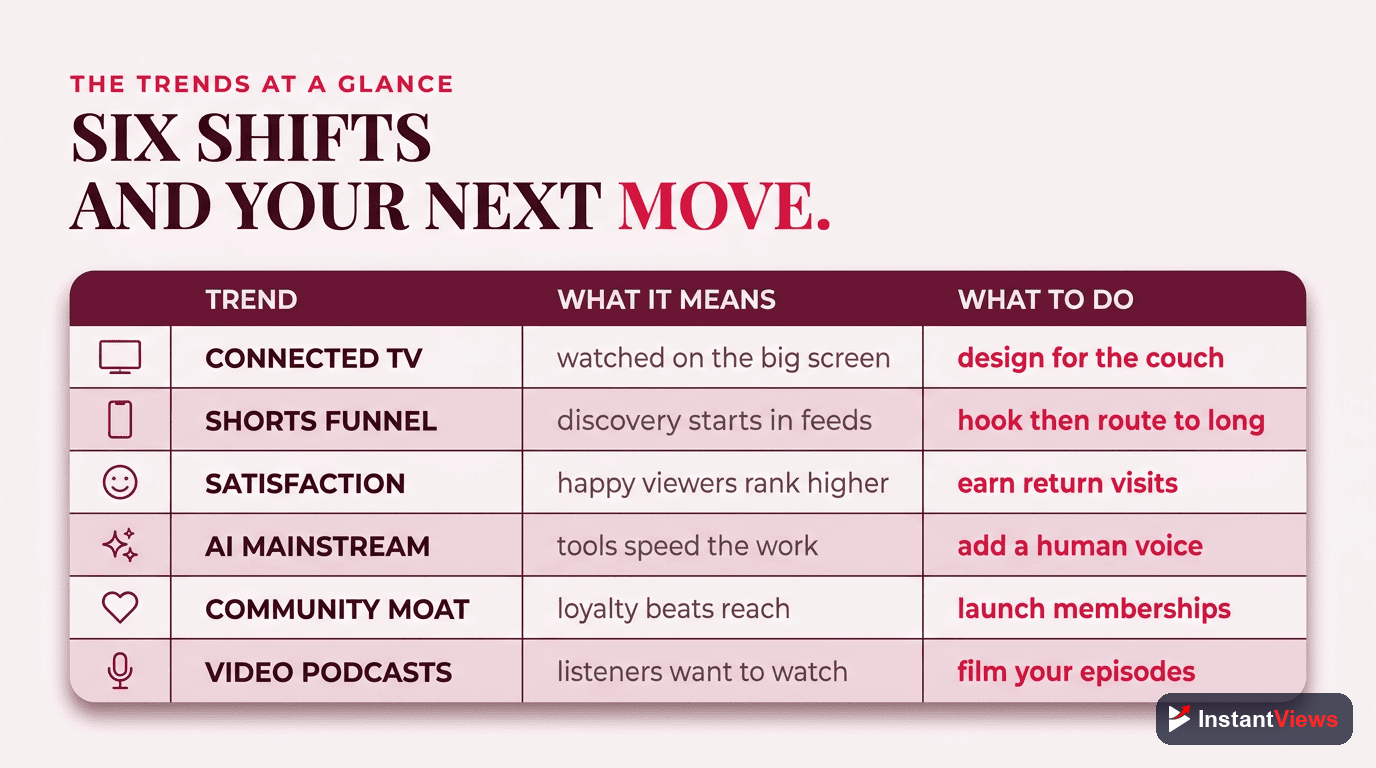
Here is the whole landscape in one place — each trend, what it actually means for your channel, and the single most important action to take.
| Trend | What It Means | What to Do |
|---|---|---|
| Connected TV viewing | The living-room screen is now the biggest YouTube surface | Design thumbnails and pacing for the couch; embrace longer, immersive formats |
| Shorts dominance | 200B+ daily views, unmatched for discovery | Use Shorts as a funnel that points viewers to deeper long-form content |
| Satisfaction-based algorithm | How happy viewers feel now outweighs raw watch time | Cut filler, deliver fast, and end on a strong, fulfilling note |
| AI tools and the crackdown | AI help is welcome; low-value mass-produced content is reduced | Keep a human point of view, edit heavily, and disclose synthetic media |
| Community and memberships | Owned relationships outvalue raw reach | Launch one consistent membership or community format |
| Podcasts on YouTube | YouTube is the default discovery layer for shows | Record with video and repurpose one session into many assets |
A Worked Example: One Channel, Six Trends
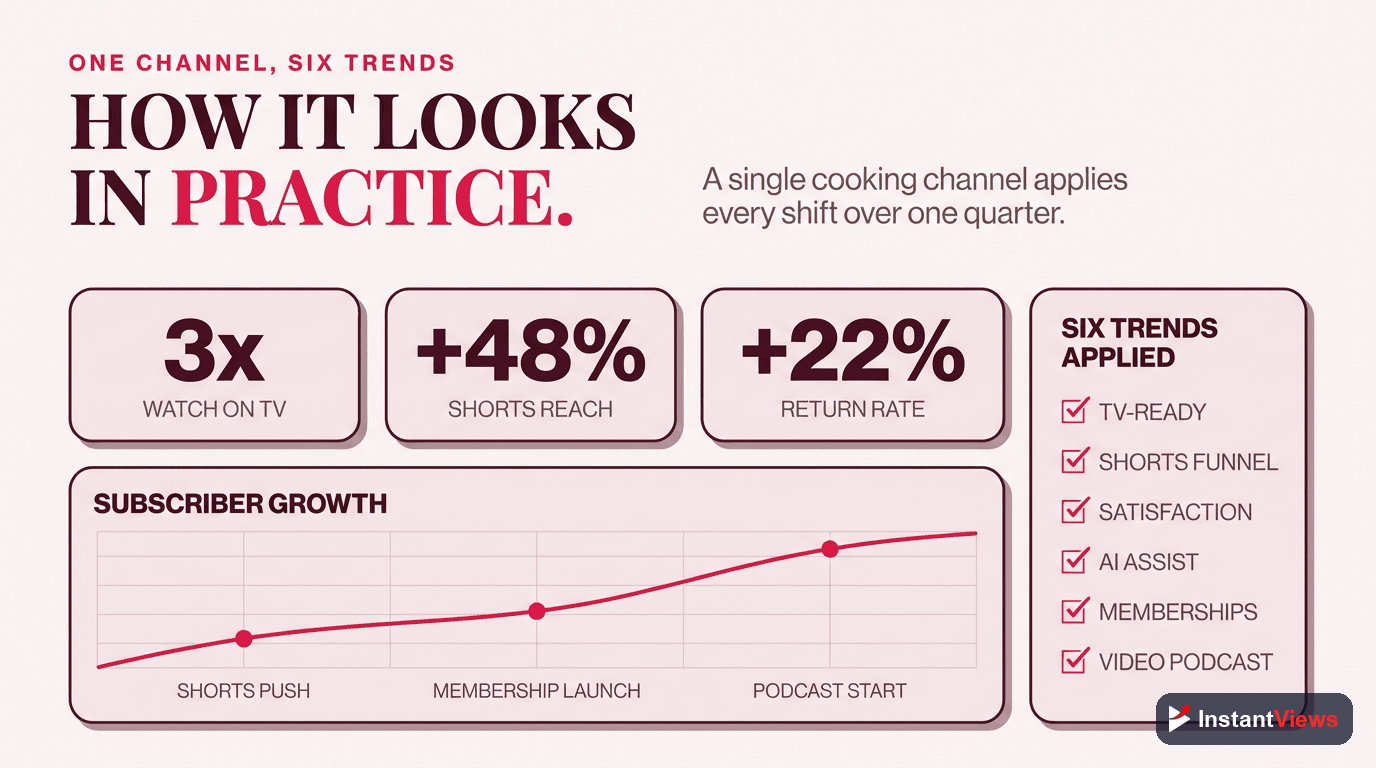
To make this concrete, imagine a creator who teaches home cooking. Two years ago their channel was a steady stream of ten-minute recipe videos optimized for mobile search. Here is how acting on today's trends transforms that same channel without changing the core topic.
First, they check their analytics and discover that a large share of watch time now comes from TV screens — people cook with the video playing on the kitchen television. So they redesign thumbnails with one bold dish and a large, readable label, and they start producing longer "cook along" episodes that suit lean-back viewing.
Next, they add Shorts: a quick knife-skill tip, a 30-second sauce, a plating trick. Each Short ends by pointing to the full recipe video. The Shorts bring in strangers; the long videos turn them into subscribers.
They also stop padding. Their old intros rambled for two minutes; now they get to the first step within fifteen seconds, which lifts their satisfaction signals and, counterintuitively, their reach. They use an AI tool to draft episode outlines and generate thumbnail concepts, but every recipe is genuinely tested in their own kitchen and narrated in their own voice — the human layer the crackdown protects.
Finally, they launch a membership with printable recipe cards and a monthly live cook-along, and they spin up a weekly podcast interviewing local chefs, recorded on camera and sliced into Shorts. Same creator, same topic — but now firing on all six trends at once.
Your 5-Step Action Plan
You do not need to overhaul everything overnight. Work through these steps in order and you will be aligned with where YouTube is heading.
Audit Where Your Audience Watches
Open YouTube Analytics and review your device and traffic-source breakdown. Knowing how much of your watch time comes from TV, search, and Shorts tells you which trend to prioritize first.
Build a Shorts-to-Long Funnel
Plan Shorts that introduce ideas and explicitly point to a longer video, playlist, or podcast. Make sure every discovery clip has an obvious next step for the curious viewer.
Optimize for Satisfaction, Not Length
Cut filler, deliver on your title quickly, and end every video on a strong note. Let value, not a runtime target, decide how long your content should be.
Add a Human Layer to Any AI Workflow
Use AI for speed, then bring your own testing, opinion, and voice to the final product. Disclose synthetic media in Studio and stay firmly on the right side of policy.
Launch One Owned-Audience Format
Choose a membership tier, a community routine, or a recurring podcast or live format, and commit to it consistently. Turn passive viewers into a loyal audience you can rely on.
Put These Trends to Work
Explore our free suite of YouTube tools to research topics, sharpen your titles and thumbnails, and see what is actually working as the platform shifts around you.
Explore Free YouTube Tools →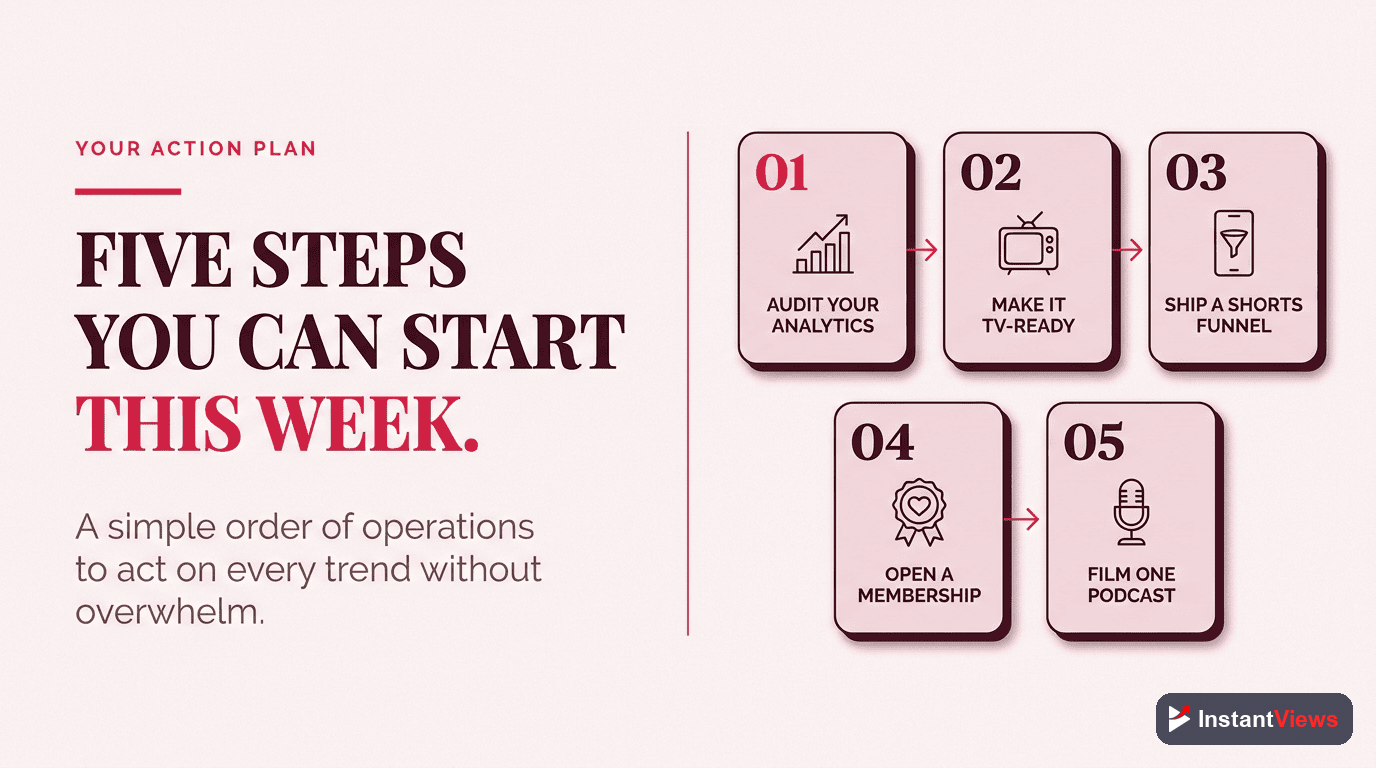
How to Prioritize Without Burning Out
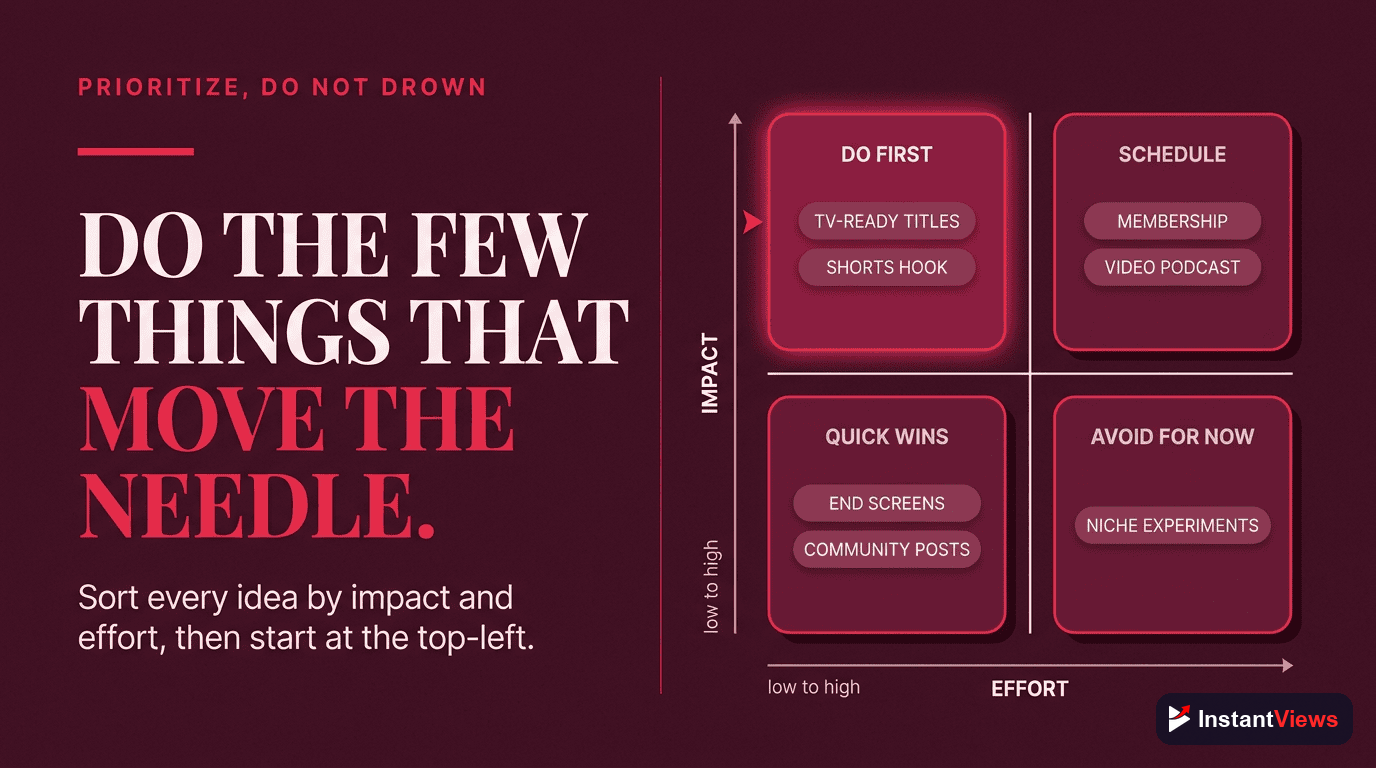
The fastest way to stall is to try to do all six trends at once. Spreading thin across connected TV, Shorts, podcasts, memberships, and AI workflows simultaneously usually means doing none of them well. The creators who win pick deliberately.
Start with the trend that maps to your current reality. If your analytics show heavy TV viewing, make your channel TV-ready before anything else. If you are great on camera and your niche loves conversation, the podcast play may be your biggest lever. If you already have a passionate core audience, memberships could unlock revenue faster than chasing more reach.
A simple prioritization filter
- Fit: Does this trend match your niche and your strengths?
- Evidence: Does your own data already point toward it?
- Capacity: Can you sustain it consistently, or is it a one-time burst?
Run each trend through those three questions. The one that scores highest across all three is where you should put your energy this quarter. You can layer in the others once the first becomes a habit.
"You do not have to chase every trend — you have to read where attention is moving and meet it with content only you can make. The platform rewards creators who adapt early and stay unmistakably human."
Frequently Asked Questions
Connected TV is the shift with the widest impact. The living-room television is now the single largest surface where people watch YouTube, so creators should design titles, thumbnails, and pacing that hold up on a large screen and consider longer, more cinematic formats that suit lean-back viewing.
Yes, but the smart approach has changed. Shorts now draw well over 200 billion views a day and remain one of the fastest discovery tools, yet they work best as the top of a funnel. Use Shorts to introduce ideas and personality, then guide viewers toward longer videos, podcasts, and memberships where deeper relationships and revenue form.
Using AI tools to assist your work does not get you demonetized. YouTube has stated it welcomes creators who use AI to enhance storytelling. What the platform is reducing is mass-produced, low-effort content with no human creative input. Keep a clear human point of view, edit heavily, and disclose synthetic or altered media in Studio.
YouTube has shifted toward measuring viewer satisfaction, not just raw watch time. Satisfaction signals such as survey responses, likes, shares, and returning viewers now carry more weight, so a tightly edited shorter video that leaves viewers happy can outperform a longer one that pads its runtime.
If your niche supports conversation, a video podcast is one of the strongest formats available in 2026. YouTube has become the default place audiences discover new shows, and a single podcast episode can be sliced into Shorts, clips, and audio versions, giving you many touchpoints from one recording session.
As discovery becomes more competitive, owned relationships matter more. Channel memberships, community posts, and live formats turn passive viewers into a committed audience that returns reliably and supports you directly. They also send strong satisfaction and loyalty signals back to the algorithm.
No. Pick the one or two trends that match your niche, audience, and capacity, and execute them well. A creator who masters connected-TV-friendly long form and one strong community format will outperform someone who spreads thin across every format at once.
These trends describe where audiences and the platform are moving right now: which screens people watch on, which formats are growing, and what the algorithm rewards. Acting on them positions your channel for where attention is heading rather than reacting to last year's playbook.
Conclusion
YouTube is shifting on every front at once: viewers have moved to the living-room TV, Shorts have become the front door to discovery, the algorithm has started rewarding genuine satisfaction over padded watch time, AI has become a standard tool with clear guardrails, and owned formats like memberships and podcasts are where loyalty and revenue now grow. None of these are predictions — they are the reality of the platform today.
The creators who pull ahead are not the ones who panic at every change. They are the ones who watch where attention is moving, pick the one or two shifts that fit their channel, and act before the crowd catches up. Adaptation, not perfection, is the advantage.
Choose your priority trend, run it through the fit-evidence-capacity filter, and make one concrete change this week. Do that consistently and you will not just keep up with YouTube in 2026 — you will be positioned for wherever it goes next.