- A channel that stops growing is almost always blocked by one or two specific, fixable problems — not a secret algorithm penalty
- The most common blockers are no clear niche, weak packaging, low retention, inconsistency, no promotion, wrong topics, ignored analytics, and an unclear value proposition
- Your analytics tell you which blocker is active: low impressions, low click-through rate, or early drop-off each point to a different fix
- In 2026 the algorithm optimizes for viewer satisfaction and retention, so holding attention matters more than raw watch time
- Fix the single weakest stage first, judge progress over a month rather than one upload, and let the data choose your next move
You upload. You wait. The views trickle in, the subscriber count barely moves, and the nagging question gets louder: why isn’t my YouTube channel growing? It is one of the most frustrating places a creator can be — doing the work, hitting publish, and watching the needle refuse to budge.
Here is the good news. A channel that has plateaued is almost never the victim of a hidden punishment or bad luck. In nearly every case the growth is being held back by one or two specific, identifiable blockers. Once you know what they are, each has a concrete fix. On a platform with more than 2.7 billion monthly active users and over a billion hours watched every day, the audience is not the problem — something in the system between your video and that audience is.
This guide is a diagnostic checklist. We will walk through the eight reasons channels most commonly stall, and pair each one with a fix you can apply this week. You will also learn how to read your own analytics to figure out which blocker is active, so you can stop guessing and start fixing the thing that actually matters.
Work through them in order, find the one or two that describe your channel, and treat the rest as a checklist to keep clean. You do not need to solve everything at once — you need to find your weakest link and strengthen it.
- First, Diagnose Before You Fix
- The 8 Growth Blockers at a Glance
- Reason 1: You Have No Clear Niche
- Reason 2: Weak Packaging (Titles & Thumbnails)
- Reason 3: Low Retention and a Weak Hook
- Reason 4: Inconsistency
- Reason 5: No Promotion
- Reasons 6–8: Wrong Topics, Ignored Analytics, Unclear Value
- Fix It in the Right Order
- FAQ
First, Diagnose Before You Fix
Before you change a single thing, you need to know which blocker is actually slowing you down. The biggest mistake stalled creators make is fixing the wrong problem — pouring effort into fancier editing when the real issue is that nobody clicks the thumbnail in the first place.
Your YouTube Analytics already holds the answer. Every growth blocker leaves a distinct fingerprint in three numbers, and reading them in sequence tells you where the funnel leaks:
- Impressions are low. YouTube is barely showing your videos to anyone. This points to a topic or niche problem — the system does not understand who to recommend you to, or the topic has little demand.
- Impressions are fine but click-through rate is low. People see your video and scroll past. This is a packaging problem: your titles and thumbnails are not earning the click.
- Clicks are fine but viewers leave early. Your average view duration and 30-second retention are weak. This is a hook and retention problem.
- Views are healthy but subscribers and link clicks are not. People watch and leave for good. This is an unclear value proposition or a missing call to action.
Creators who regularly review their analytics make more informed decisions and tend to grow faster than those who rely on intuition alone. So start there. Find the single weakest number, then read the matching section below.

The 8 Growth Blockers at a Glance
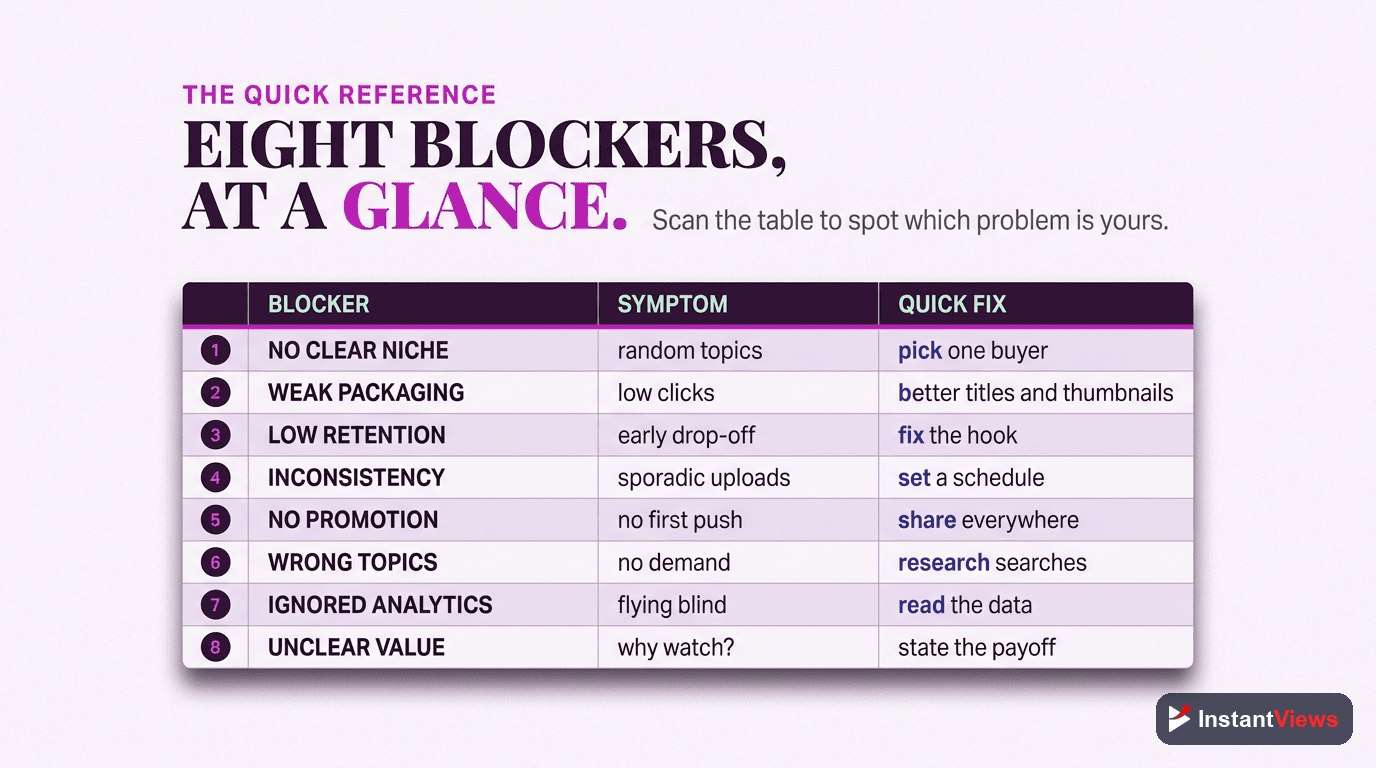
Here is the full checklist in one view. Each blocker maps to a metric you can check and a fix you can apply. Skim it, mark the ones that sound like your channel, then dig into the detailed sections.
| Growth Blocker (Reason) | Tell-Tale Signal | The Fix |
|---|---|---|
| No clear niche | Low impressions; unrelated uploads; subscribers do not return | Commit to one audience and topic so the algorithm and viewers know what to expect |
| Weak packaging | Decent impressions but low click-through rate | Rewrite titles, rebuild high-contrast thumbnails, and A/B test them |
| Low retention | Steep early drop-off; weak 30-second retention | Cut long intros, deliver the payoff fast, tighten pacing |
| Inconsistency | Long gaps between uploads; sporadic schedule | Pick a realistic, repeatable cadence and protect it |
| No promotion | Reach depends entirely on the upload itself | Use Shorts, clips, and cross-platform sharing to seed every video |
| Wrong topics | Good production, low demand; topics nobody searches | Research what your audience actually wants before you film |
| Ignoring analytics | You guess instead of measure; you cannot name your weakest metric | Review impressions, CTR, and retention after every upload |
| Unclear value | Views are fine but subscribers and clicks are not | Make the benefit of subscribing explicit and consistent |
Reason 1: You Have No Clear Niche
This is the quietest killer because it does not look like a problem — you are publishing good videos, after all. But when those videos jump between unrelated topics, you make the recommendation system’s job impossible. YouTube grows channels by learning who to show them to. Upload a cooking video, then a tech review, then a travel vlog, and the algorithm never builds a confident picture of your audience.
It hurts on the human side too. Someone who loved your cooking video has no reason to expect your next upload will be anything they care about, so they do not subscribe, and if they do, they do not return. A scattered channel trains its own audience not to come back.
The Fix: Commit to One Audience
Pick a specific audience with a genuine need and serve it consistently. A focused niche gives the algorithm clean signals and gives viewers a reason to subscribe. This does not mean you can only ever make one kind of video — it means your channel should have an obvious centre of gravity that a stranger could describe in one sentence after watching two uploads.
- Define the one viewer you are making videos for and the one problem you solve for them.
- Audit your last ten uploads — if a stranger could not guess what your channel is about, tighten the focus.
- Use playlists and channel sections to group related content so the theme is unmistakable.

Reason 2: Weak Packaging (Titles & Thumbnails)
If your videos earn impressions but few people click, the content quality is not your problem — the packaging is. Discovery on YouTube starts with a single decision the viewer makes in a fraction of a second: click, or scroll past. Your title and thumbnail are the entire pitch, and a low click-through rate means the pitch is losing.
Two failures are extremely common. The first is low-contrast, cluttered thumbnails that disappear in a crowded feed. The second is a mismatch between the title and the content — if viewers sense the video will not deliver what the title promised, they either scroll past or click and bail early, which damages retention as well.
The Fix: Earn the Click, Then Keep the Promise
- Build for contrast. High-contrast, clean thumbnails with a clear focal point consistently outperform busy, monochromatic designs in a feed.
- Lead with the payoff. Your title should make a specific, intriguing promise that the video actually keeps.
- A/B test. Testing thumbnail variations on a sample of uploads commonly yields meaningful CTR gains within a couple of weeks — let real viewers vote rather than guessing.
- Never bait. A title that overpromises tanks retention the moment viewers realize the mismatch, and that hurts you more than a slightly lower click rate.
Clickbait that breaks its promise is a double loss: you may win the click, but the early drop-off tells the algorithm the video did not satisfy viewers, and it stops recommending it. In 2026 the system optimizes for viewer satisfaction, so a broken promise is one of the fastest ways to suppress a video.

Reason 3: Low Retention and a Weak Hook
You earned the click — and then lost the viewer. If people are leaving in the first thirty seconds, retention is your blocker, and in 2026 it is the one that matters most. The algorithm now optimizes for viewer satisfaction and retention, meaning a video that holds attention is far more likely to be pushed to new audiences than one that simply racks up raw watch time on paper.
The most common retention killer is the opening. Long branded intros, slow setups, and throat-clearing before the value all create a cliff in the retention graph at the exact moment they play. Viewers came for a payoff; make them wait and they leave.
The Fix: Hook Fast, Pay Off Faster
- Cut the intro. Drop the long branded animation and start with the promise or the most interesting moment.
- Deliver value early. Give viewers a reason to stay in the first several seconds, not after a two-minute preamble.
- Tighten pacing. Predictable, slow structure makes viewers drift; vary your pacing and cut dead air.
- Study the curve. Open the retention graph for your recent videos and find the exact second viewers leave — then fix that moment in your next upload.
Retention is not a single number to obsess over in isolation; it is a feedback loop. Every improvement to your hook and structure compounds, because higher retention earns more impressions, which earns more clicks, which earns more growth.
Find Your Weak Spot Faster
Use our free suite of YouTube tools to research in-demand topics, sharpen your titles, and analyze what is working — so you can fix the right blocker first.
Explore Free YouTube Tools →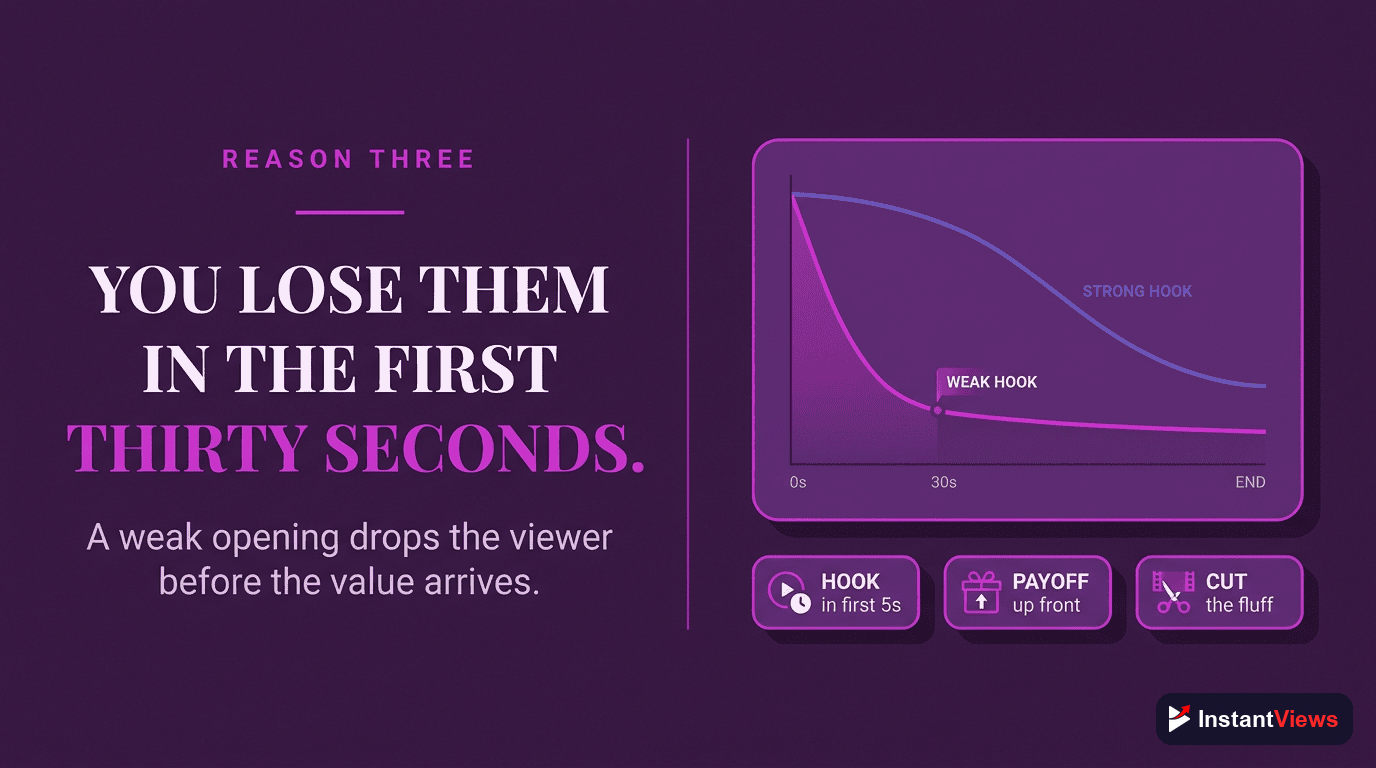
Reason 4: Inconsistency
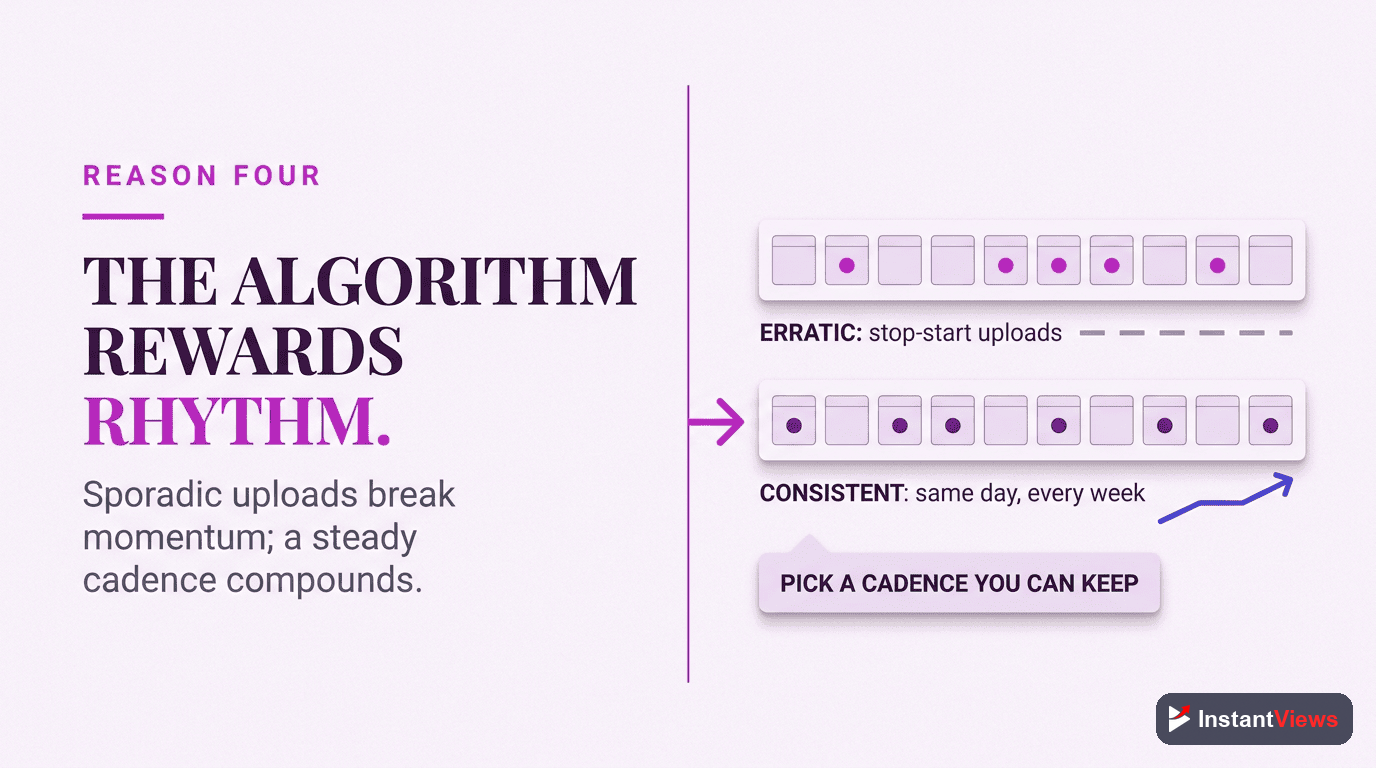
Growth on YouTube compounds, and compounding requires repetition. A channel that uploads three times one week and then goes dark for a month never builds the momentum that turns occasional viewers into a habit. Abrupt gaps also let regular followers drift away, and the algorithm has fewer recent signals to work with.
The fix is not to upload more — it is to upload predictably. For most channels, consistency beats frequency. One strong video every week, reliably, will out-grow a daily burst that ends in burnout within a month.
The Fix: Pick a Cadence You Can Actually Keep
- Choose a realistic schedule — weekly is plenty for most creators — and treat it as non-negotiable.
- Batch and plan ahead with a simple content calendar so a busy week does not break your streak.
- Protect quality: a steady cadence of strong videos beats a frantic cadence of weak ones, because weak uploads just generate weak signals.
Reason 5: No Promotion
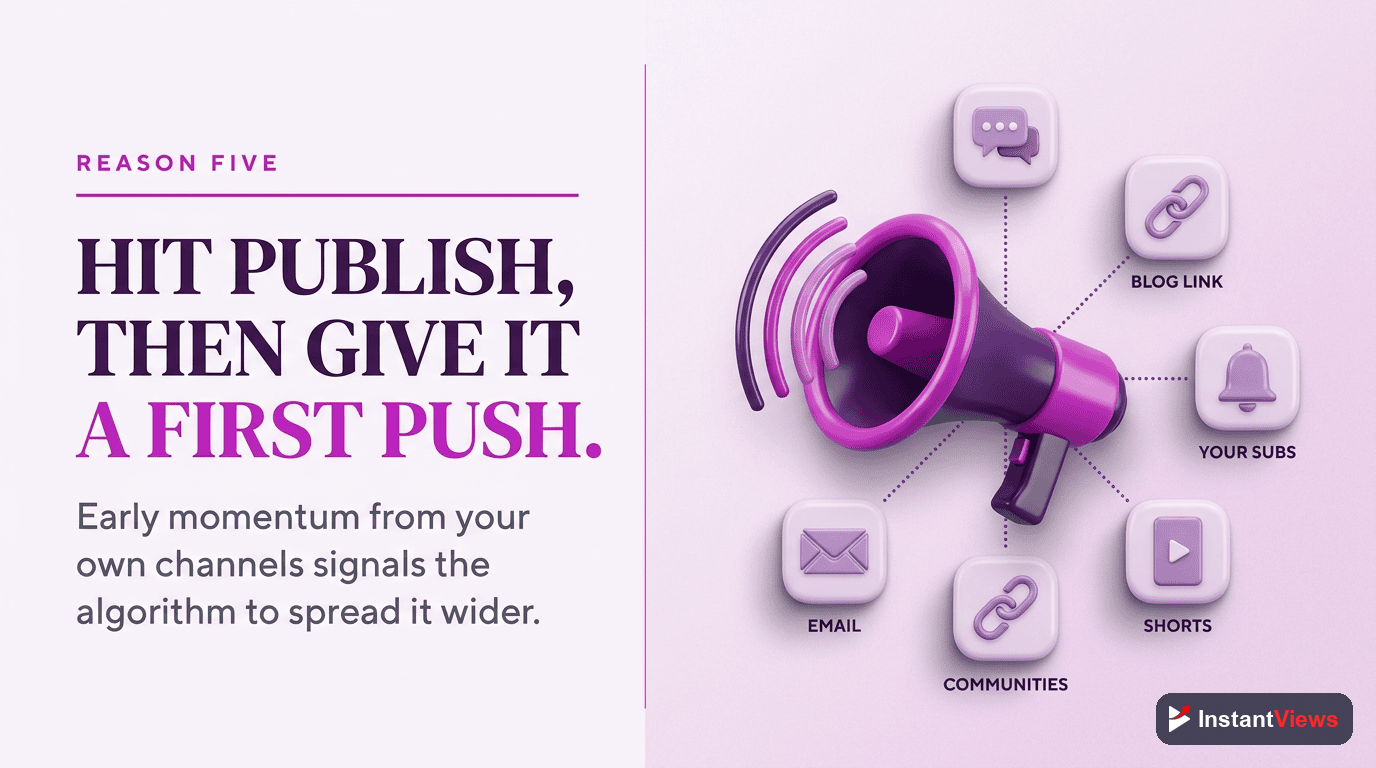
Many creators believe that if a video is good enough, the algorithm will find an audience on its own. That is rarely how a new or stalled channel breaks out. A video needs a first push — an initial pool of engaged viewers whose watch behavior tells YouTube the content is worth recommending. If your reach depends entirely on the moment you hit publish, you are leaving that first push to chance.
The Fix: Seed Every Upload
- Use Shorts. With Shorts generating over 200 billion views a day, a vertical clip is one of the fastest ways to put a new topic in front of fresh viewers and funnel them toward your long-form video.
- Cross-promote. Share clips and links on the other platforms where your audience already spends time to drive outside traffic to your channel.
- Tap your existing audience. A community post, a pinned comment, or an end screen pointing to the new video gives it the early engagement that signals quality.
Reasons 6–8: Wrong Topics, Ignored Analytics, Unclear Value
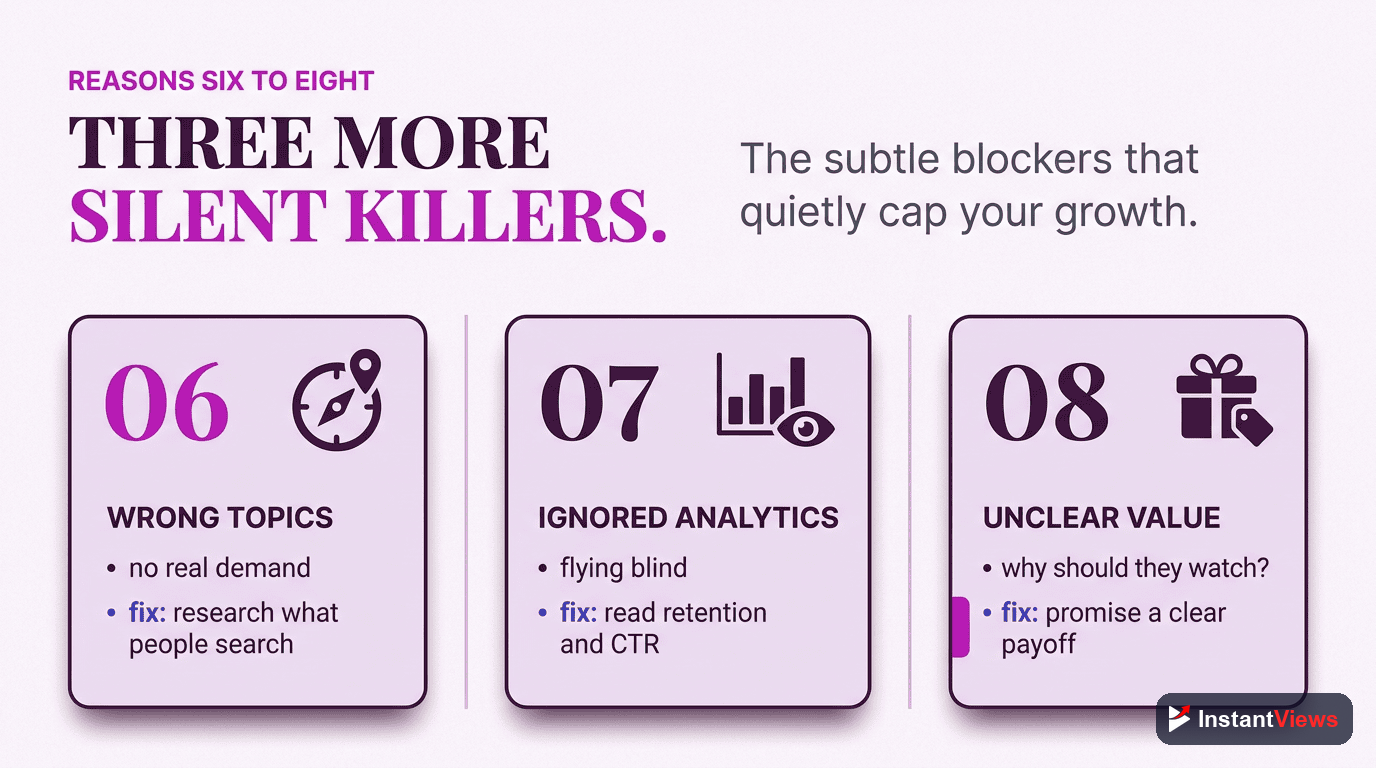
The final three blockers are subtle, because each can hide behind genuinely good work. You can produce a beautifully edited video that still fails — if it is about something nobody is searching for, if you never look at the data to learn why, or if viewers leave without understanding why they should stay.
Reason 6: You Make the Wrong Topics
High production value cannot rescue a topic with no demand. If your impressions stay low no matter how polished the video, you may be making content for yourself rather than for an audience that is actively looking for it. The fix is research: study what your viewers ask for in comments, what performs in your niche, and what people actually search, then build videos around proven demand instead of guesses.
Reason 7: You Ignore Your Analytics
You cannot fix a leak you cannot see. Creators who actively use their analytics tend to grow markedly faster than those who run on intuition, because the data names the weak stage for them. After every upload, check impressions, click-through rate, and average view duration, and let the weakest of the three direct your next experiment. Skipping this step means every fix is a guess.
Reason 8: Your Value Proposition Is Unclear
If your videos get views but few subscribers, viewers are enjoying a single video without understanding what subscribing gets them. The fix is to make the benefit explicit and repeatable: tell viewers what your channel consistently delivers, keep that promise across uploads, and connect related videos with playlists and end screens so a one-time viewer has an obvious reason to become a regular one.
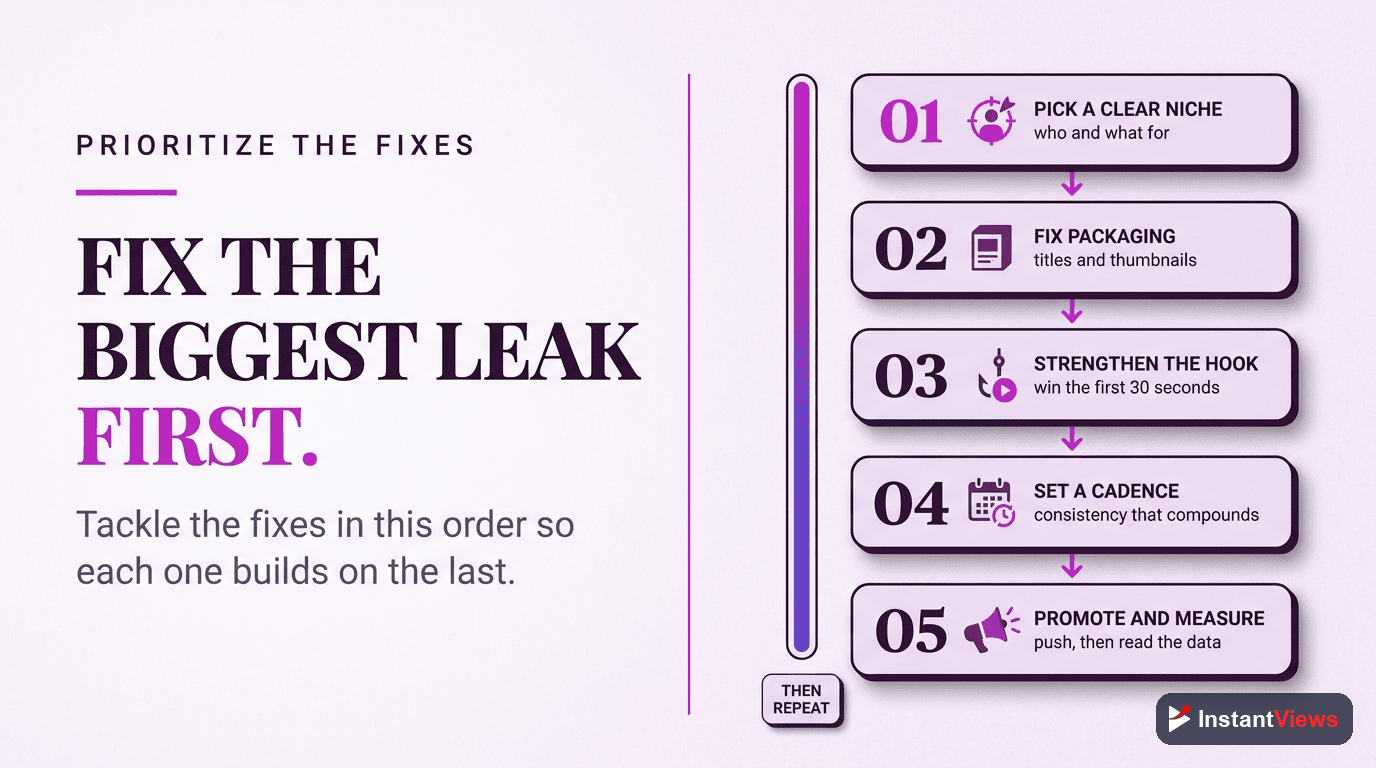
Fix It in the Right Order
You now have eight blockers and eight fixes. The temptation is to attack all of them at once — resist it. Fixing everything simultaneously means you never learn what actually worked. Instead, run a simple diagnostic loop, fix one thing, and measure.
Open Your Analytics
Look across your recent videos at impressions, click-through rate, and average view duration. Whichever is weakest is your starting point — the data, not your gut, picks the blocker.
Match the Signal to the Reason
Low impressions point to niche or topic problems. Low CTR points to packaging. Early drop-off points to retention. Views without subscribers point to unclear value. Use the table above to confirm.
Fix the One Weakest Blocker
Apply only the fix for that single blocker on your next few videos. Changing one variable at a time is the only way to know what moved the numbers.
Measure Over a Month
Judge the change across several uploads on a rolling window, not a single video. Look for a trend in the metric you targeted, not a one-off spike.
Repeat the Loop
Once one blocker is cleared, run the diagnosis again. The new weakest number becomes your next project. Growth compounds as each leak gets sealed.
This loop turns a vague feeling of being stuck into a precise, repeatable process. You stop reacting to every flat video and start systematically removing the things that hold you back.
"Channels do not plateau because of bad luck or a vengeful algorithm. They plateau because of one fixable weak link — and the creators who grow are the ones who find it, fix it, and move to the next."
Frequently Asked Questions
Uploading regularly is only one ingredient. If your videos are not getting found (low impressions and click-through rate) or viewers leave early (low retention), the algorithm has little reason to recommend them more widely. Consistency keeps you in the game, but packaging and retention are usually what actually unlocks growth. Diagnose which stage is failing in YouTube Analytics before adding more uploads.
Let your analytics point to it. Low impressions usually means a topic or search problem; a low click-through rate points to weak titles and thumbnails; a steep early drop-off points to a weak hook or retention; and good views with no subscribers or clicks points to an unclear value proposition or call to action. Find the single weakest number and fix that one first.
It is one of the most common blockers. When you upload videos on unrelated topics, YouTube struggles to learn who to recommend you to, and viewers who liked one video have no reason to expect another like it. A focused niche gives the recommendation system clear signals and gives viewers a reason to subscribe and return.
That usually signals an unclear value proposition. Viewers enjoyed a single video but did not understand what they would get by subscribing. Tighten your channel theme, make the benefit of subscribing explicit, link related videos with end screens and playlists, and make sure your content keeps a consistent promise so a one-time viewer becomes a regular one.
It is central. In 2026 the algorithm optimizes for viewer satisfaction and retention rather than raw watch time, so a video that holds attention is far more likely to be recommended. A strong hook in the first several seconds, a clear payoff, and tight pacing with no long branded intro are the levers that most directly improve retention.
Not on its own. Posting more low-retention or poorly packaged videos simply produces more weak signals. Consistency matters, but it works only once the fundamentals — a clear niche, strong titles and thumbnails, and a solid hook — are in place. A steady weekly upload of strong videos beats a daily upload of weak ones.
No. Most channels grow entirely through organic discovery, search, and cross-platform promotion such as Shorts and sharing clips on other networks. Paid ads can accelerate something that already works, but they cannot fix weak packaging or low retention. Fix the fundamentals first, then consider paid promotion to amplify a video that is already converting.
Look at trends over a rolling window of several weeks rather than reacting to a single video. Individual videos vary widely, and the first 48 hours of a new upload can be volatile. If impressions, click-through rate, and retention are flat or declining across many videos over a month or more, that is a genuine plateau worth diagnosing with the checklist in this guide.
Conclusion
A stalled YouTube channel is almost never the victim of a mysterious algorithm punishment. It is usually one or two specific, fixable blockers: a niche that is too scattered for the system to understand, packaging that does not earn the click, a hook that loses viewers in the first few seconds, an upload schedule too erratic to build momentum, no promotion beyond the upload button, topics that do not match what your audience actually searches for, or analytics you have never opened. Each of those has a concrete fix, and you rarely need to solve all of them at once.
The fastest path forward is to stop guessing and let the data choose your next move. Open your analytics, find the single weakest number — impressions, click-through rate, or retention — and attack that one blocker first. Ship the fix, watch the next few videos, and let the results tell you what to repeat. Growth on YouTube compounds, so one corrected weakness often lifts everything downstream of it.
Be patient but deliberate. Judge your progress over a rolling month, not a single upload, and keep the fundamentals — a clear niche, strong packaging, a tight hook, and consistency — in place while you experiment. Do that, and the channel that felt stuck becomes a channel that climbs, one diagnosed-and-fixed blocker at a time.