- The first views are the hardest because a new channel has no subscribers and no track record — search is your way in
- Target searchable, low-competition topics so your videos get found without an existing audience
- Strong packaging — a clear title and a thumbnail people actually click — is the gatekeeper to every view
- Use Shorts to reach non-subscribers and promote each video in the critical first 24–48 hours
- 1,000 views in 30 days is realistic but not guaranteed; consistency is what compounds the result
Hitting your first 1,000 views feels disproportionately hard. You upload a video you are proud of, refresh the analytics, and watch the counter crawl from 3 to 7 to 11. Meanwhile, channels you admire pull in tens of thousands of views on what looks like a casual upload. The gap is real — but it is not about talent or luck. It is about how YouTube distributes content to channels that have not yet earned the platform's trust.
With more than 2.7 billion monthly active users and roughly a billion hours of video watched every day, the audience exists. Your problem is not demand; it is discovery. A brand-new channel has no subscribers to notify and no history for the algorithm to learn from, so your videos start cold. The entire job of your first month is to break that cold start — and there is a repeatable way to do it.
This guide lays out a realistic, week-by-week 30-day plan: set up and choose searchable topics in week one, publish in week two, add Shorts and promote in week three, then double down on what works in week four. None of it requires a budget, an existing audience, or expensive gear. It requires the right topics, sharp packaging, and the discipline to keep going.
One honest note up front: 1,000 views in 30 days is an achievable target, not a guarantee. Some channels blow past it in a week; others take six. What follows maximizes your odds and, just as importantly, builds the habits that keep working long after this first milestone.
- Why the First Views Are the Hardest
- Choose a Searchable Niche
- Find Low-Competition Topics People Search
- Packaging: Titles and Thumbnails That Get Clicked
- The 30-Day Plan, Week by Week
- Promotion Tactics That Work With No Audience
- Using Shorts to Reach New Viewers
- Tracking Progress the Right Way
- Mistakes That Keep New Channels Stuck
- FAQ
Why the First Views Are the Hardest
When you publish a video, YouTube does not immediately show it to thousands of people. Instead, it shows it to a small test audience — a handful of search results, a few suggested-video slots, a slice of the Shorts feed — and watches what happens. Do people click? Do they keep watching? If the early signals are good, distribution expands. If not, it stays small. This is the algorithm's way of learning who your video is for.
For an established channel, that test audience includes existing subscribers who already like the creator, so videos get a warm start. A new channel has none of that. You are starting from a genuine cold start: no subscribers to seed the test, no watch history to match you to viewers, and no reputation telling the system your content is worth promoting.
That is why the first views are the hardest — and why two strategies matter more than anything else early on:
- Search: Search-driven views do not depend on you having an audience. If someone types a question and your video is the best answer, it can surface no matter how new you are.
- Shorts: The Shorts feed is shown overwhelmingly to people who do not subscribe to you, so it is built for reaching strangers.
Almost everything in this plan flows from those two facts. You are not trying to beat big channels at suggested videos yet — you are slipping in through the doors that stay open to newcomers.

Choose a Searchable Niche
Before you film anything, decide what your channel is about. A focused niche helps both the viewer and the algorithm: viewers know what to expect, and YouTube learns who to recommend you to. A channel that posts cooking one day, gaming the next, and travel the day after gives the system nothing to work with.
What Makes a Niche Beginner-Friendly
The best starting niche sits where three things overlap:
- You can speak to it credibly — you know the topic or are genuinely learning it in public.
- People search for it — there is real, ongoing demand, not just one viral moment.
- It is not impossibly crowded — you can find sub-topics where you are not competing only against million-subscriber channels.
Notice that "what I am passionate about" is part of the formula but not the whole thing. Passion keeps you publishing through the quiet early weeks; demand and competition decide whether anyone finds the work. You need all three.
Go Narrow First, Then Widen
New creators routinely pick a niche that is too broad. "Fitness" is a battlefield; "kettlebell workouts for desk workers over 40" is a doorway. The narrower angle has less competition, a clearer audience, and topics you can actually rank for. You can always widen later once you have momentum — but you cannot win a broad niche from a standing start.

Find Low-Competition Topics People Search
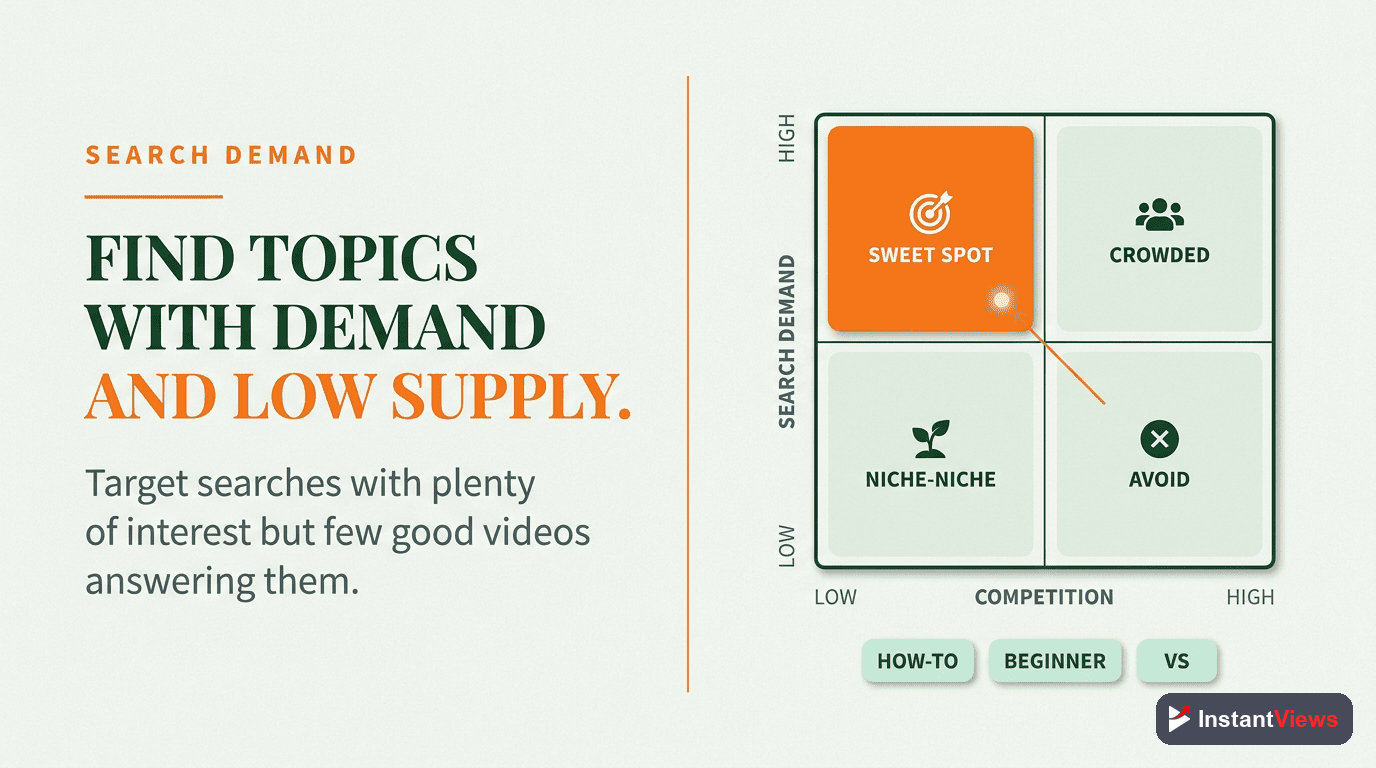
This is the single highest-leverage skill for a new channel. A searchable topic is one people actively type into YouTube, and a low-competition version of it is one where the existing videos are weak, outdated, or few. Find those, and your video can rank even with zero subscribers.
You do not need paid software to start. Three free methods cover most of the work:
- YouTube autocomplete: Start typing a topic into the YouTube search bar and note the suggestions that drop down. Those are real phrases real people search. Add words like "how to," "best," "for beginners," and "without" to find longer, more specific variations.
- Google Trends: Compare a few topic ideas to see which are rising versus fading, and check whether interest is steady enough to keep earning views over time.
- YouTube Studio search analytics: Once you have a few videos up, the "Search terms" report shows the exact queries bringing people to you — pure gold for your next round of topics.
How to Spot a Beatable Topic
Search your candidate phrase and study the first page of results. You may have found a low-competition opening if you notice:
- The top videos are several years old or visibly low quality
- Several results are from small channels, not just giants
- The thumbnails and titles are weak and easy to beat
- None of the videos fully answers the specific question you would answer
Packaging: Titles and Thumbnails That Get Clicked
You can pick the perfect topic and still get no views if nobody clicks. Your packaging — the title and thumbnail — is the gatekeeper to every single view. YouTube can put your video in front of someone, but the click is earned by the package, not the content.
Writing Titles That Earn the Click
- Lead with the search phrase: If people search "fix a slow laptop," your title should clearly contain that idea so both the viewer and the algorithm see the match.
- Promise a specific outcome: "Fix a Slow Laptop in 10 Minutes (No Tools Needed)" beats "Laptop Tips."
- Front-load the important words: Titles get truncated, so put the value at the start.
- Be honest: A title that overpromises wins the click but loses the watch — and weak retention kills your reach.
Thumbnails That Stand Out
A thumbnail is a tiny billboard competing in a crowded feed. Keep it simple and bold: one clear focal point, large legible text of three or four words at most, high contrast, and an expression or image that creates curiosity. Test how it looks at the small size it actually appears at — if you cannot read it on your phone, neither can your audience.
Do not let a great video die behind a lazy thumbnail. Many new creators spend hours editing and ten seconds on the thumbnail — then wonder why nobody clicks. Treat the title and thumbnail as half the job, not an afterthought, because no click means no view, no matter how good the video is.

The 30-Day Plan, Week by Week
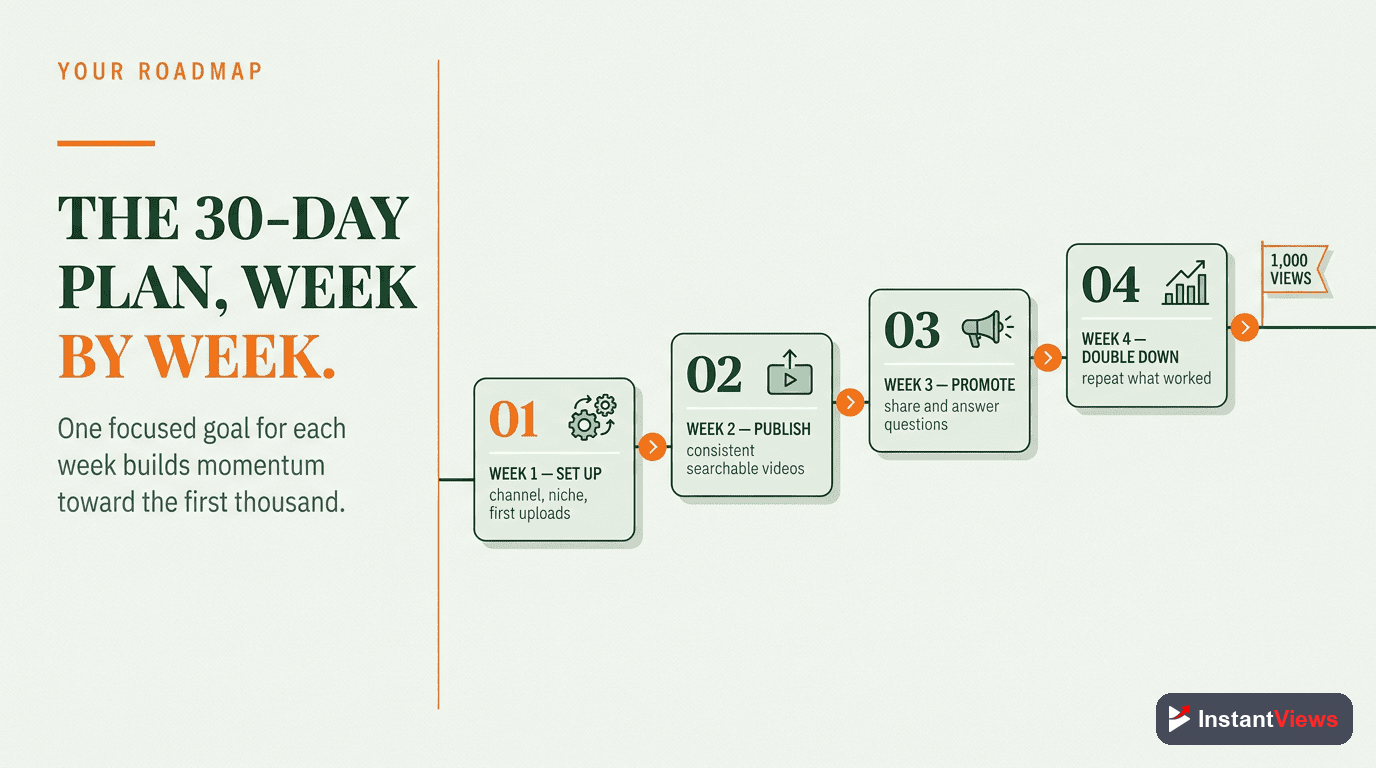
Here is the whole month at a glance. Each week has one clear focus so you are never guessing what to do next.
| Week | Focus | What You Do | Goal |
|---|---|---|---|
| Week 1 | Setup & research | Pick your niche, brand the channel, and build a list of 10–15 searchable, low-competition topics | A clear plan and topic list |
| Week 2 | Publish & search | Film and upload 1–2 long-form videos with strong titles, thumbnails, and keyword-rich descriptions | Your first searchable videos live |
| Week 3 | Shorts & promote | Post several Shorts, share in relevant communities, and publish 1–2 more long videos | Reach new viewers fast |
| Week 4 | Double down | Review analytics, repeat what worked, keep publishing, and refine packaging | Cross 1,000 and build momentum |
Now the same plan as concrete steps you can follow in order:
Week 1 — Set Up and Research
Choose one focused niche and complete your channel basics: name, profile image, banner, and a one-line description of who the channel helps. Then build a list of 10 to 15 searchable, low-competition topics using autocomplete and Google Trends. Do not film yet — the research is the foundation.
Week 2 — Publish Searchable Videos
Film and upload your first one or two long-form videos, each targeting a specific search term from your list. Give every video a click-worthy title, a bold thumbnail, and a description that naturally includes the topic and related phrases. Aim for a strong hook in the first 30 seconds.
Week 3 — Add Shorts and Promote
Publish several Shorts to reach non-subscribers, and slice highlights from your long videos into vertical clips. Share each upload in communities where your topic is genuinely welcome and with your own network. Keep publishing — add one or two more long-form videos this week.
Week 4 — Double Down on What Works
Open YouTube Studio and find your best-performing video. Study why it worked — the topic, the title, the thumbnail — and make more like it. Improve the packaging on any video with good watch time but low clicks. Hold your schedule steady; this is where momentum compounds.
Promotion Tactics That Work With No Audience
Publishing is not the finish line. In your first month, deliberate promotion can be the difference between a video that gathers early signals and one that stalls. The goal is not spam — it is putting your video in front of people who genuinely want it, so their clicks and watch time tell YouTube to show it to more.
Promote in Relevant Communities
- Topic forums and groups: Reddit communities, Discord servers, and niche Facebook groups can send real, interested viewers — if you contribute genuinely and share only where your video truly answers a question being asked.
- Q&A sites: Answer a relevant question thoroughly in text, then link your video as a deeper resource.
- Other platforms: Repurpose clips to other short-video feeds and your own social profiles to funnel traffic back.
Use Your Own Network — Carefully
Sharing with friends, family, and contacts is a legitimate way to get your earliest views. It helps a video gather initial momentum. The caution: a friend who clicks out of politeness and leaves after ten seconds can actually hurt your retention signal. Share with people who would actually want the topic, and you get the benefit without the downside.
Find Your First Winning Topics
Use our free suite of YouTube tools to research searchable topics, sharpen your titles, and see what is already working in your niche before you film.
Explore Free YouTube Tools →
Using Shorts to Reach New Viewers
If long-form search is your steady drip, Shorts are your firehose. The Shorts feed is shown largely to people who do not subscribe to you, which makes it one of the fastest ways for a brand-new channel to reach strangers. With Shorts now driving over 200 billion views a day, the surface area for discovery is enormous.
How to Use Shorts in Your First Month
- Hook in the first second: The Shorts feed is a swipe-fest. Open with the most interesting moment, not an introduction.
- Repurpose your long videos: Pull the best 30-second moment from each long-form upload into a vertical clip. It is efficient and points viewers toward the full video.
- Post more of them: Shorts are quick to make, so a higher volume gives you more chances for one to catch on.
- Keep them on-topic: Random viral Shorts bring views that never come back. Topical Shorts bring viewers who might watch your long videos and subscribe.
One realistic caveat: Shorts views are easy to earn but shallow. A Short can rack up hundreds of views from people who forget you instantly. That is fine for hitting 1,000 views — just remember that long-form is what turns those passing viewers into a returning audience. Use Shorts for reach and long videos for relationship.

Tracking Progress the Right Way
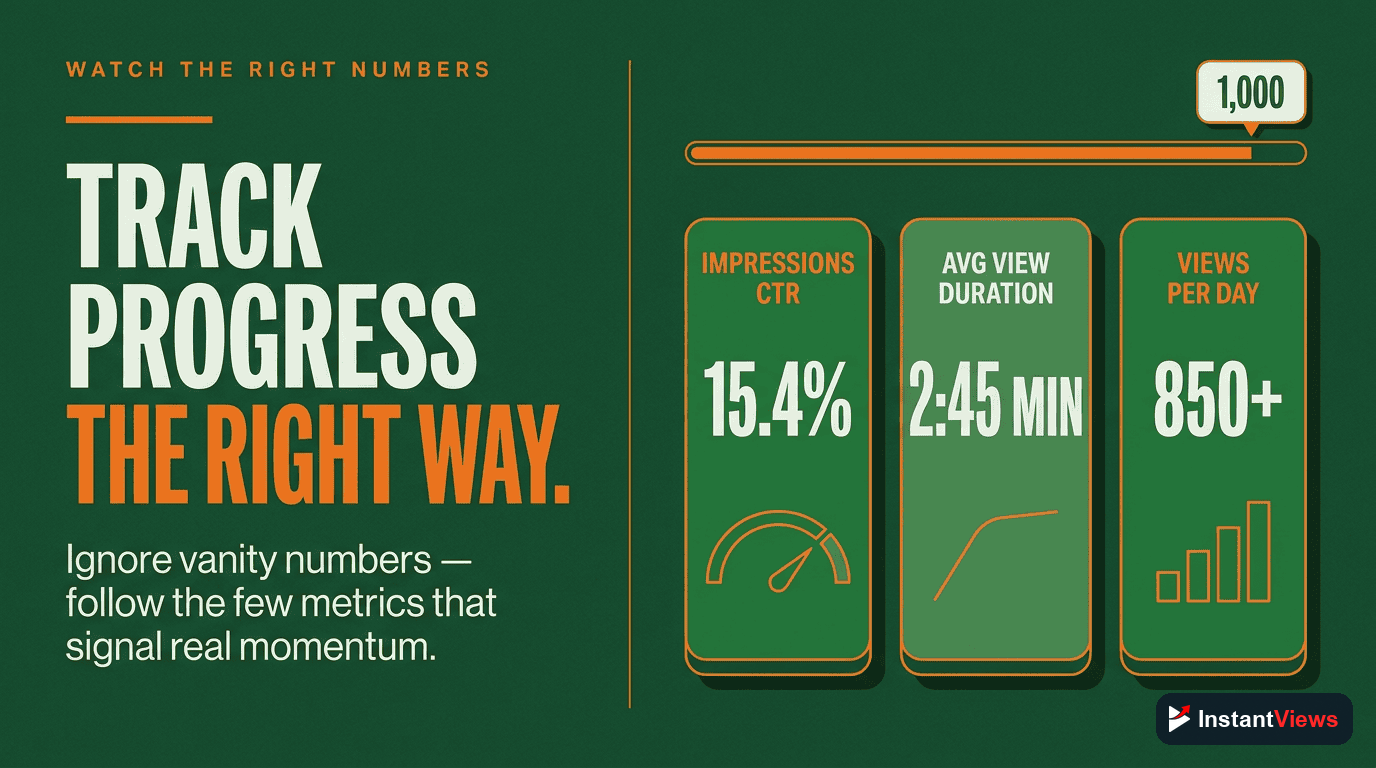
What you measure shapes what you improve. In your first 30 days, ignore vanity metrics and watch the few numbers that actually tell you whether your strategy is working. YouTube Studio gives you everything you need for free.
| Metric | What It Tells You | If It Is Low |
|---|---|---|
| Impressions | How often YouTube is showing your video | Topic may be too niche or not yet trusted — keep publishing |
| Click-through rate | Whether your packaging earns the click | Rework the title and thumbnail |
| Average view duration | Whether the content holds attention | Tighten the intro and cut slow sections |
| Traffic sources | Where your views come from | Lean into whatever source is already working |
The most useful report for a new channel is Search terms: it shows the exact phrases bringing people to you. Those proven phrases are your best ideas for the next batch of videos — you are no longer guessing what people search, because the data is telling you.
Set a simple weekly check-in. Once a week, look at impressions, click-through rate, and average view duration across your videos, identify the single weakest link, and fix that one thing next. Resist the urge to obsessively refresh the view counter every hour — it tells you nothing actionable and only feeds anxiety.
Mistakes That Keep New Channels Stuck
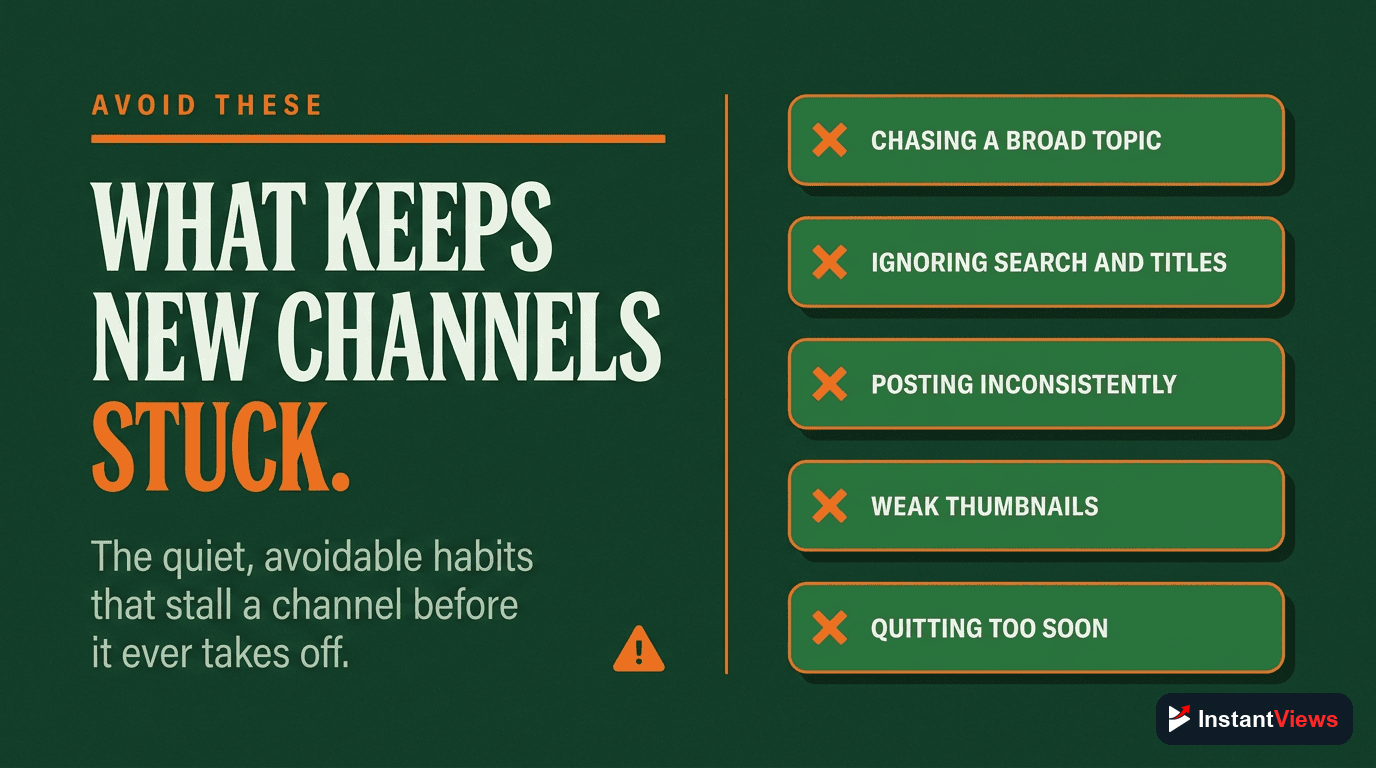
Most new channels that fail to reach 1,000 views do not fail because of bad luck. They fail because of a handful of avoidable mistakes. Watch for these:
- Picking topics nobody searches: Making videos about whatever you feel like, instead of what people look for, leaves your work invisible. Lead with demand.
- Choosing a niche that is too broad: Competing in a giant category from day one is a losing fight. Go narrow and specific.
- Neglecting packaging: A weak title and thumbnail mean even a perfect video gets no clicks.
- Giving up after a few videos: The algorithm needs data and you need reps. Quitting at five videos guarantees you never break out.
- Posting inconsistently: A burst of uploads followed by silence kills the momentum the first burst built. A steady cadence beats sporadic bingeing.
- Ignoring the analytics: Refusing to look at the data means repeating the same mistakes blindly. Let the numbers guide your next move.
- Chasing trends only: Trend videos spike and vanish. Without evergreen searchable content underneath, your views never accumulate steadily.
Notice the theme: nearly every mistake is a strategy or consistency problem, not a production-quality problem. You do not need a studio or expensive gear to reach 1,000 views — you need searchable topics, sharp packaging, and the persistence to keep going while the algorithm learns who you are.
"The first 1,000 views are not a popularity contest — they are a learning exercise. Pick topics people search, package them to be clicked, promote them in the first 48 hours, and keep showing up. Consistency is the one input that compounds everything else."
Frequently Asked Questions
Yes, it is achievable for most new channels, but it is not guaranteed. Reaching 1,000 views in your first month depends on publishing several videos, choosing searchable topics that people are already looking for, and promoting your work beyond YouTube. Think of it as a realistic target to aim for rather than a promise — some channels pass it in a week, others take a little longer.
A practical goal is one to two long-form videos per week plus two to three Shorts per week. That gives you four to eight long videos and roughly a dozen Shorts in a month — enough surface area for the algorithm to learn who your content is for and enough chances for one video to catch on.
A searchable topic is one that people actively type into the YouTube search bar, such as a specific "how to" or "best" question. It matters because a new channel has no subscribers and little suggested-video reach, so search is the most reliable way to get found. Targeting low-competition search terms lets your video surface even without an existing audience.
Yes. Views on Shorts count, and Shorts are shown largely to people who do not subscribe to you, which makes them one of the fastest ways to reach new viewers. They are excellent for racking up views and discovery, though long-form videos usually do more to build a loyal, returning audience.
Sharing with your own network is a fine way to get your earliest views, and it can help a video gather its first signals. Just do not rely on it as your whole strategy — aim for viewers who genuinely want the topic, because engaged, relevant viewers tell YouTube to show your video to more people like them.
New videos start with no track record, so YouTube shows them to a small test audience first. If those viewers click and watch, it expands reach; if not, distribution stays small. Combined with no existing subscribers, that is why the first views are the hardest. Searchable topics and strong packaging are what break the cold-start problem.
Packaging — your title and thumbnail — decides whether anyone clicks, so it is the gatekeeper to every view. A great video with weak packaging stays invisible. That said, retention keeps you in the algorithm once people click, so you need both: packaging to earn the click and content quality to keep the watch.
Treat it as proof your approach works and double down. Look at which video drove the views, study why it worked — the topic, the title, the thumbnail — and make more videos in that direction. Momentum compounds, so the worst thing you can do after early success is stop publishing.
Conclusion
Your first 1,000 views are the steepest part of the climb, because you are starting with no audience and no track record. But the path through is clear and repeatable: choose a focused niche, target searchable low-competition topics, package every video to earn the click, lean on Shorts for reach, promote hard in the first 48 hours, and keep publishing on a steady schedule.
Follow the 30-day plan and you give yourself a genuine shot at the milestone — setup in week one, publishing in week two, Shorts and promotion in week three, and doubling down on your winners in week four. Treat the number as a realistic target, not a promise, and judge yourself on the habits more than the counter.
Most of all, do not stop at video five. The creators who break through are simply the ones who kept showing up while the algorithm learned who they were. Hit 1,000 views, study what worked, and point all of that momentum at the next thousand — because once the compounding starts, it rarely stops.