- There is no universal “best” video length — the right length depends on your niche, your viewer’s intent, and what your retention data shows
- Retention percentage matters more than raw length; a tight video that holds viewers beats a padded one that loses them
- Most long-form niches sit comfortably in the 8 to 15 minute range, while Shorts perform best around 15 to 30 seconds
- Different niches have different natural lengths: tutorials, gaming, kids, reviews, and podcasts all behave differently
- A hybrid of Shorts for discovery and long-form for depth works best for most creators in 2026
“How long should my YouTube video be?” is one of the most common questions creators ask — and one of the most misunderstood. People want a single number, a magic minute count that guarantees views. But on a platform with more than 2.7 billion monthly active users watching over a billion hours of video every day, no single length could possibly fit a cooking tutorial, a gaming stream, a kids’ cartoon, and a two-hour podcast all at once.
The truth is both simpler and more useful: the ideal length is whatever holds your audience’s attention for your specific niche. A ten-minute tutorial and a forty-five second Short can both be perfectly optimized, because they serve different viewers with different intent. The question is not “how long?” but “how long can I stay genuinely interesting?”
This guide breaks down typical length ranges for the most common YouTube niches and formats, explains the one principle that beats every length rule, and shows you how to use your own retention data to find the length that works for your channel.
By the end, you will stop chasing a magic number and start making length decisions the way successful creators do — based on intent, niche, and the audience retention graph in your analytics.
- The Myth of the Magic Length
- Retention Beats Raw Length
- Ideal Video Length by Niche
- Tutorials and How-To Content
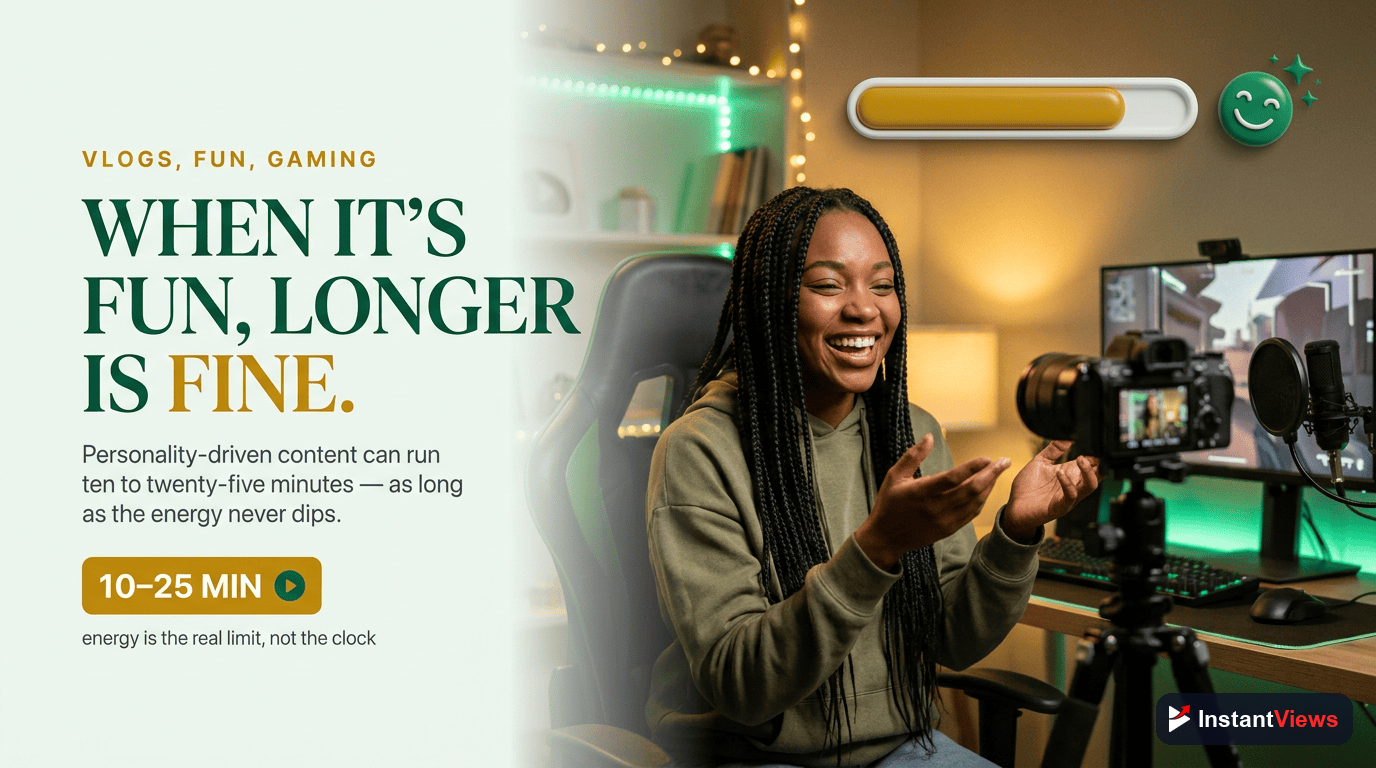
- Vlogs, Entertainment, and Gaming
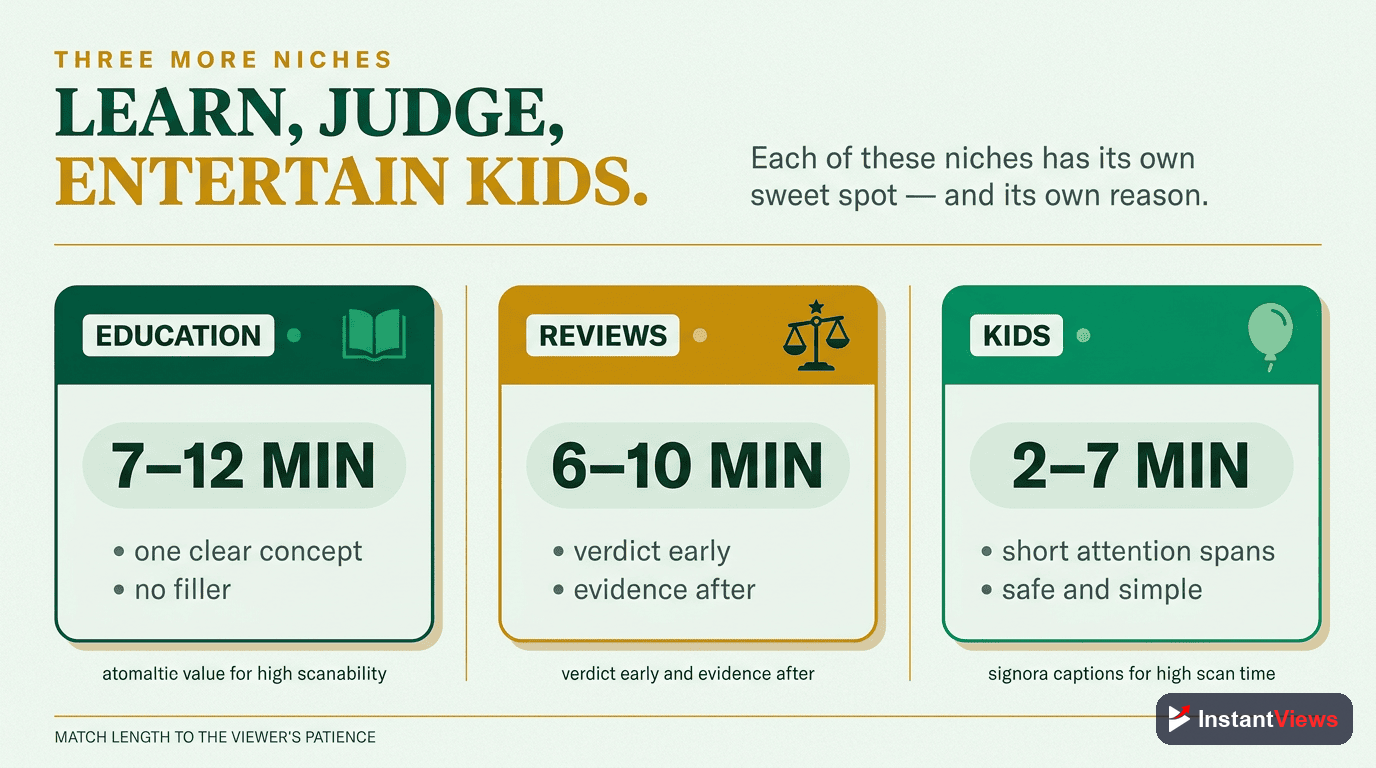
- Education, Reviews, and Kids Content
- Shorts vs Long-Form: The Hybrid Strategy
- Podcasts and Long-Form Deep Dives
- How to Find Your Own Ideal Length
- Length Mistakes to Avoid
- FAQ
The Myth of the Magic Length
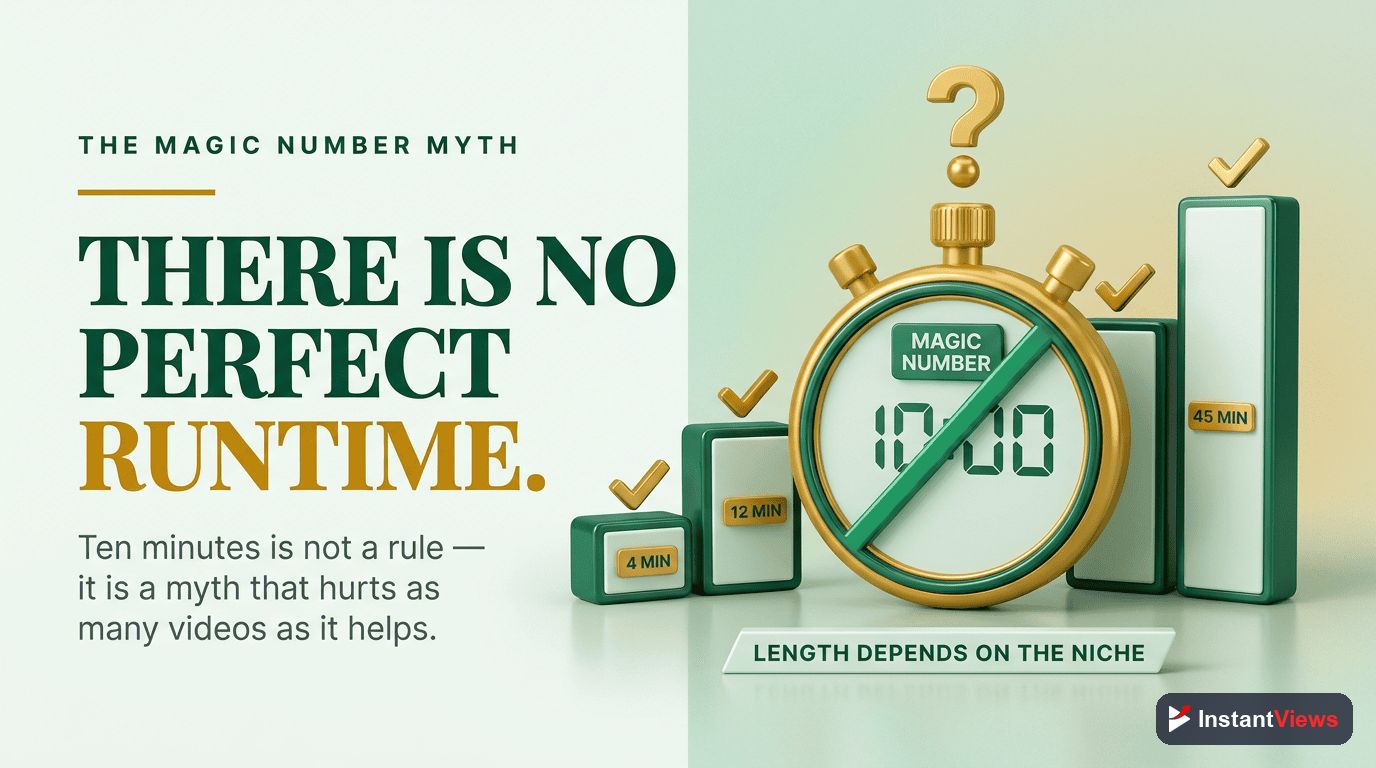
For years, creators have traded around “rules” about video length: keep it under ten minutes, always go past eight minutes for more ad breaks, never exceed twenty. Each rule had a kernel of truth at some point, but treating any of them as universal law is exactly how good content gets ruined.
The problem is that length, on its own, is a meaningless number. A twenty-minute video is not better than a five-minute video, and it is not worse either. What matters is what happens inside those minutes — whether the viewer stays, leans in, and finishes satisfied. Two videos of identical length can perform completely differently depending on how well they hold attention.
YouTube itself has moved firmly in this direction. The 2026 recommendation system optimizes for viewer satisfaction and retention rather than raw watch time or any preferred duration. The platform is also actively reducing the spread of low-value, mass-produced content — which means padding a video just to hit a length target is more likely to hurt you than help you.
So before we look at niche-by-niche ranges, internalize this: every range in this guide is a starting point, not a finish line. The numbers tell you where similar creators tend to land. Your retention graph tells you where you should land.
Retention Beats Raw Length
If you remember one idea from this entire guide, make it this: retention percentage matters more than absolute length. The single most important metric for length decisions is how much of your video the average viewer actually watches.
Here is the nuance that confuses people. YouTube’s distribution does reward total watch time, which is why a longer video that holds a decent percentage can out-distribute a shorter video with higher percentage retention. But that only works if the longer video genuinely holds attention. The moment you stretch a video past the point where it stays interesting, your percentage viewed collapses, and the extra minutes generate dead air instead of watch time.
Think of it as a balance between two forces:
- Percentage viewed — how much of the video the average person watches. Shorter videos naturally score higher here.
- Total watch time — the raw minutes accumulated. Longer videos can score higher here, but only if retention holds up.
The winning move is to make a video exactly as long as it stays compelling, and not a second longer. That is why a focused ten-minute tutorial often outperforms a rambling twenty-minute one: it earns a high percentage viewed and respectable watch time, instead of trading one away for the other.

Ideal Video Length by Niche
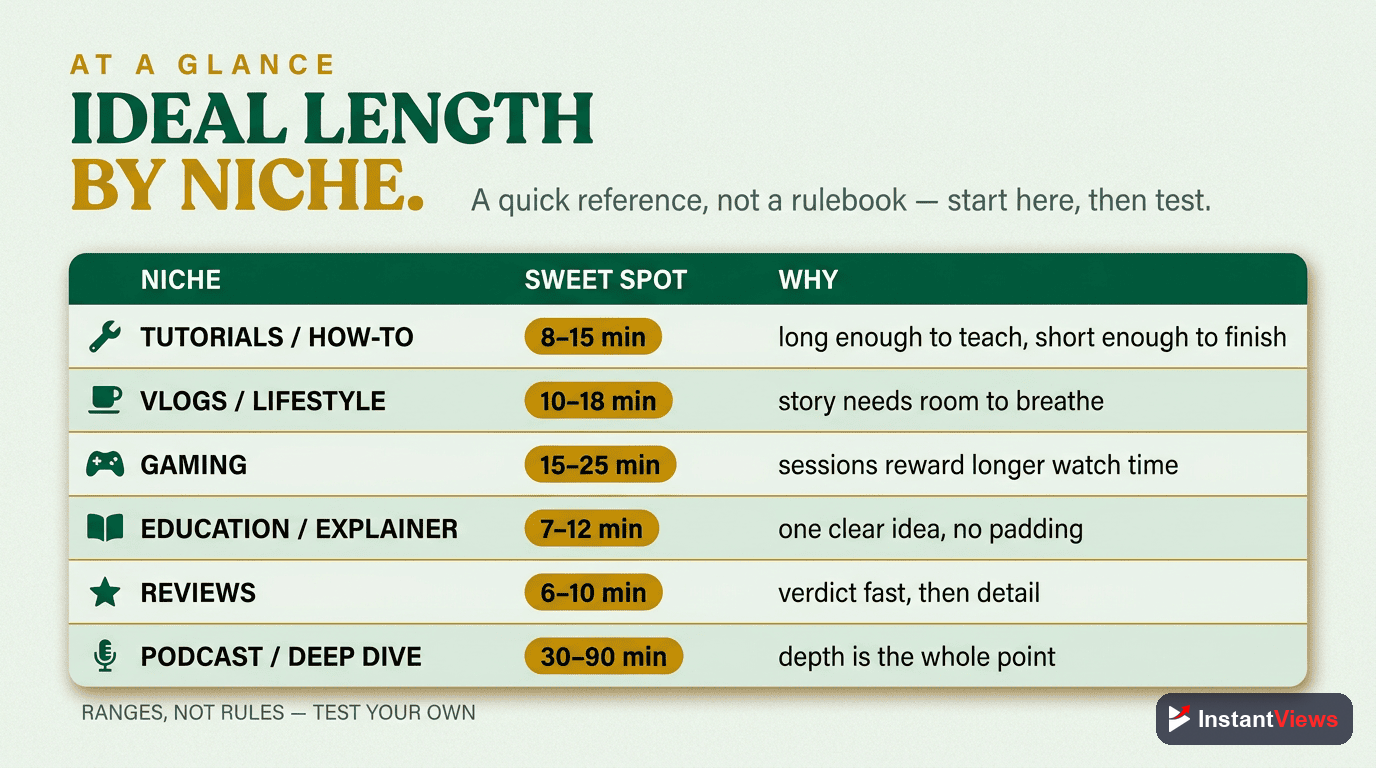
The table below summarizes typical length ranges by niche and format. Treat these as the middle of a bell curve — plenty of successful videos sit outside these ranges, but most cluster inside them because the length fits how viewers consume that kind of content.
| Niche / Format | Typical Length Range | Why This Length Works |
|---|---|---|
| YouTube Shorts | 15–30 seconds | Short enough to loop and hold a high percentage of viewers; built for fast discovery. |
| Tutorials / How-To | 10–15 minutes | Long enough to fully solve a problem, short enough to stay focused; viewers tolerate length when learning. |
| Product Reviews | 8–12 minutes | Covers features, pros, and a verdict without dragging; respects a buyer’s limited patience. |
| Education / Explainers | 8–15 minutes | Enough room to build understanding while a clear structure sustains retention. |
| Vlogs | 8–15 minutes | Story-driven pacing keeps viewers along for the journey without overstaying. |
| Entertainment / Comedy | 5–10 minutes | Tight, high-energy pacing earns strong retention; fast payoff suits the intent. |
| Gaming | 10–20 minutes | Viewers follow along with gameplay and happily stay longer for immersive sessions. |
| Kids / Family | 2–8 minutes | Matches shorter attention spans; episodic, repeatable, and easy to re-watch. |
| Podcasts / Interviews | 30–90 minutes | A loyal, intentional audience commits to long conversations they often play in the background. |
Notice the pattern: length tracks viewer intent. People arrive at a Short to be hooked in seconds, at a tutorial to finish a task, at a podcast to settle in for a while. The closer your length matches why the viewer showed up, the better your retention will be.
Tutorials and How-To Content
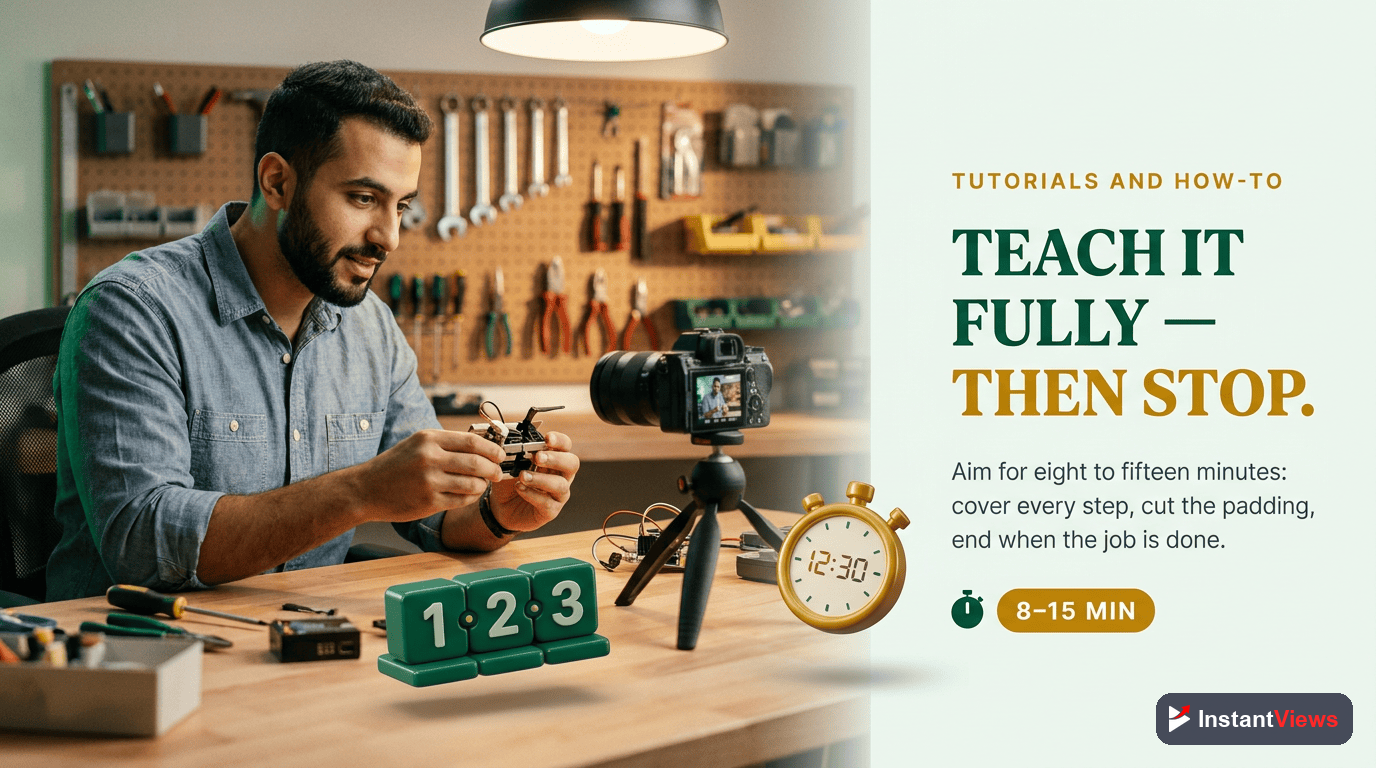
Tutorials are one of the strongest niches on YouTube because they answer a search query directly. A viewer with a specific problem — how to fix something, how to use a tool, how to learn a skill — is willing to invest more time, which is why tutorials can hold a healthy percentage of viewers even at ten to fifteen minutes.
The key with tutorials is completeness without filler. The viewer’s implicit promise is “I’ll stay as long as you keep moving me toward the solution.” The moment you pad with a long intro, repeated points, or off-topic stories, retention drops.
How to Pace a Tutorial
- Open with the outcome: Show the finished result in the first few seconds so viewers know it is worth staying.
- Front-load value: Get to the first useful step quickly — do not bury it behind a long preamble.
- Use chapters: Timestamps let viewers jump to the part they need, which improves satisfaction even on longer tutorials.
- End at the solution: Once the problem is solved, wrap up. Do not stretch the runtime for its own sake.
For complex topics, it is fine to go longer — a deep software walkthrough or a multi-step build can justify twenty minutes or more. The deciding factor is always whether each additional minute keeps earning attention.
Vlogs, Entertainment, and Gaming
Entertainment-driven niches live and die by pacing. Unlike a tutorial, the viewer is not chasing a specific outcome — they are there for the experience, so any dull stretch sends them straight to the next video.
Vlogs
Vlogs work best when they are built like a story with a beginning, middle, and payoff. Most successful vlogs land in the eight to fifteen minute range, long enough to take the viewer on a journey but short enough that the energy never sags. Strong editing — cutting the boring parts — matters far more than hitting a particular runtime.
Entertainment and Comedy
Fast-paced entertainment and comedy often perform best in the five to ten minute range, where tight editing and quick payoffs keep retention high. These videos reward ruthless cutting: every second that does not earn a laugh or move the bit forward is a second a viewer might leave.
Gaming
Gaming is a notable exception to the “shorter is safer” instinct. Because viewers are following along with gameplay, they will happily stay for ten to twenty minutes or longer. The action itself sustains attention, so the natural length stretches well past what an explainer could hold. Live streams and full playthroughs run far longer still, supported by an audience that treats them as ongoing company rather than a quick watch.
Do not copy the runtime of a creator in a different niche. A gaming channel can hold viewers for twenty minutes because the format supports it; the same length applied to a fast comedy sketch would tank its retention. Match length to your niche, not to whoever you admire.
Education, Reviews, and Kids Content
These three niches show just how widely natural length varies based on who is watching and why.
Education and Explainers
Educational content sits comfortably in the eight to fifteen minute range. Like tutorials, viewers grant more patience when they are learning — but only if the structure is clear. A strong explainer uses a logical progression, visual aids, and signposting so the viewer always knows where they are in the lesson. Clarity is what protects retention as the minutes add up.
Product Reviews
Reviews serve viewers who are usually close to a buying decision and short on patience. The eight to twelve minute range is typically enough to cover the key features, the pros and cons, and a clear verdict. Get to the point quickly, and put the bottom-line recommendation somewhere the viewer can find it — padding a review erodes the trust that makes it useful.
Kids and Family Content
Content for young children follows its own rules. Shorter attention spans mean two to eight minutes is often the sweet spot, with episodic, repeatable formats that children re-watch again and again. Re-watchability and consistency tend to matter more than length in this niche, and creators here must always follow YouTube’s rules for content made for kids.
Shorts vs Long-Form: The Hybrid Strategy
No length conversation in 2026 is complete without Shorts. With Shorts driving over 200 billion views a day, they are one of the most powerful discovery tools on the platform — but they play a very different role from long-form video.
What Shorts Are For
Shorts can run up to three minutes, but the shorter clips around fifteen to thirty seconds tend to hold the highest percentage of viewers and loop most effectively. Their job is reach: a quick hook that introduces you to people who have never seen your channel. They sit at the very top of your funnel, optimized for a fast, satisfying payoff.
What Long-Form Is For
Long-form video is where you build the things Shorts cannot: deep watch time, real trust, and the relationship that supports subscriptions and monetization. A viewer might discover you through a thirty-second clip, but it is the ten-minute video that turns them into a fan.
The Hybrid Approach
For most creators, the strongest 2026 strategy combines both formats so they feed each other:
- Shorts pull in new viewers and keep you visible in the algorithm.
- Long-form converts that attention into watch time, loyalty, and revenue.
- Together, a viewer can travel from a Short to a full video to a subscription — a complete journey across two lengths.
The mistake is treating Shorts and long-form as rivals. They are two ends of the same length spectrum, each doing a job the other cannot.
Optimize Every Video You Publish
Explore our free suite of YouTube tools to research topics, sharpen your titles, and analyze what is working — so you can match length to what your audience actually wants.
Explore Free YouTube Tools →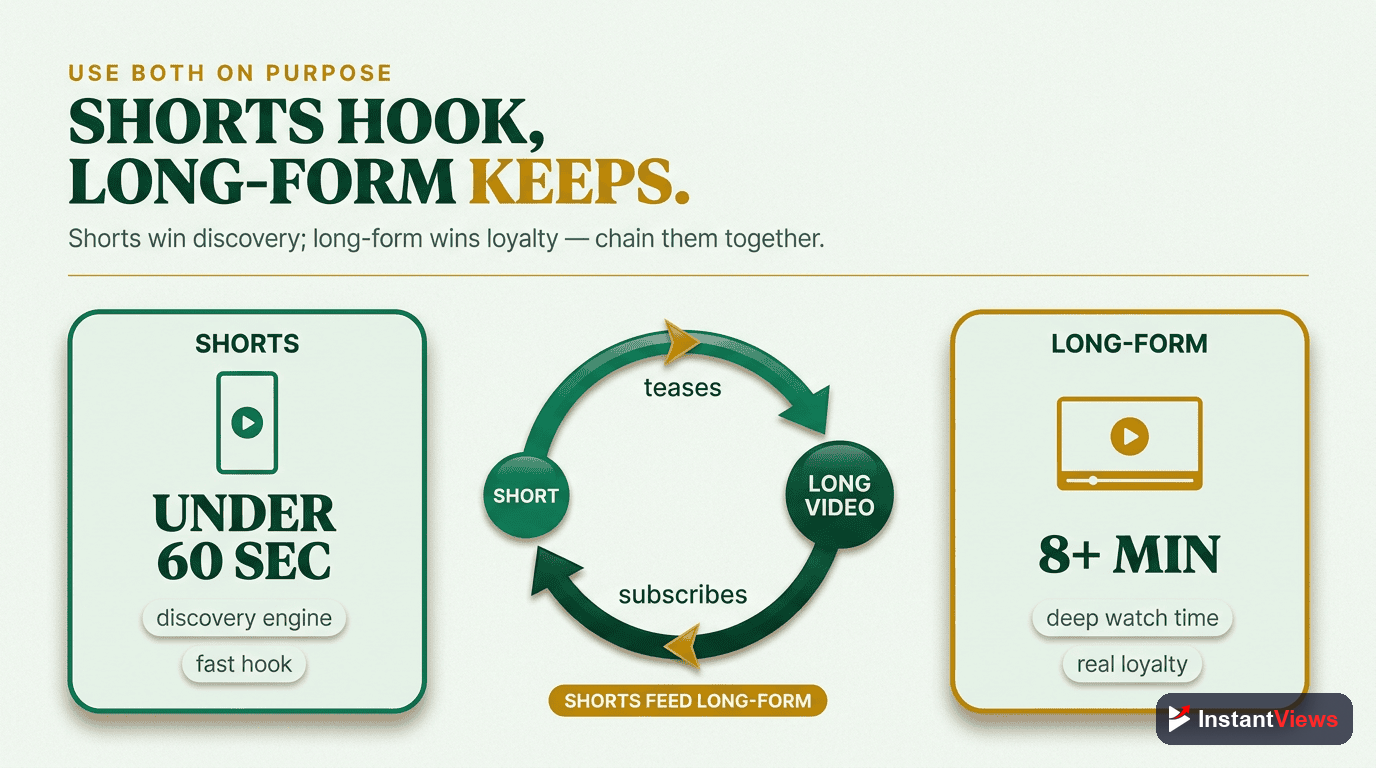
Podcasts and Long-Form Deep Dives
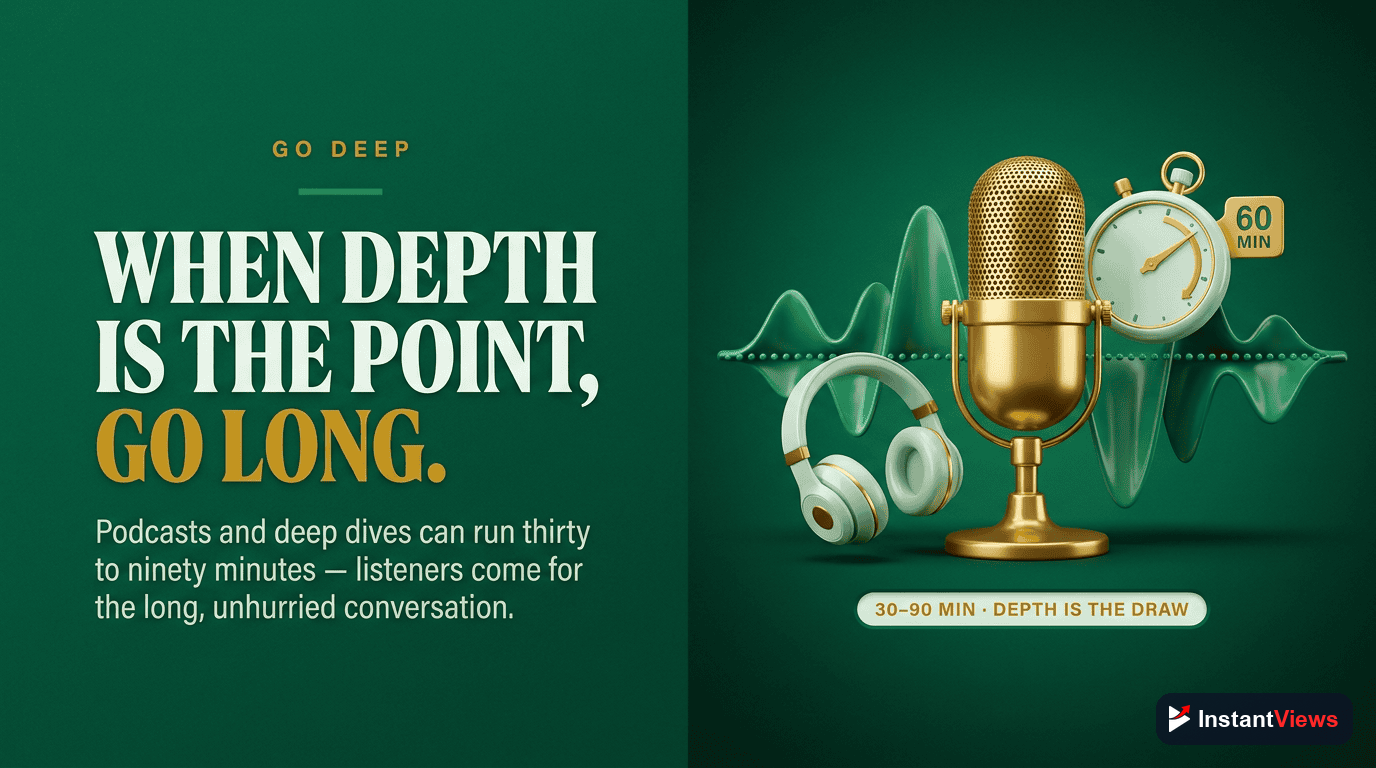
At the far end of the length spectrum sit podcasts, interviews, and long-form deep dives, which routinely run thirty to ninety minutes or more. On the surface this breaks every “keep it short” rule — but it works because the audience is fundamentally different.
Podcast viewers arrive with high intent and low time pressure. They often play episodes in the background while commuting, working, or relaxing, which means they are not constantly evaluating whether to click away. For this audience, length is a feature: a longer conversation means more value per session.
That said, long does not mean lazy. The same retention principle applies — just measured differently:
- Strong open: The first minute still decides whether someone commits to the full episode.
- Chapters and timestamps: Long-form thrives on navigation, letting listeners jump to the segments they care about.
- Natural arcs: Even a ninety-minute conversation needs momentum — topics that build, tension that resolves, moments worth clipping into Shorts.
Long-form deep dives also pair beautifully with Shorts: a single episode can be sliced into dozens of short clips that drive discovery back to the full version. The long format builds depth; the short format spreads reach.
How to Find Your Own Ideal Length
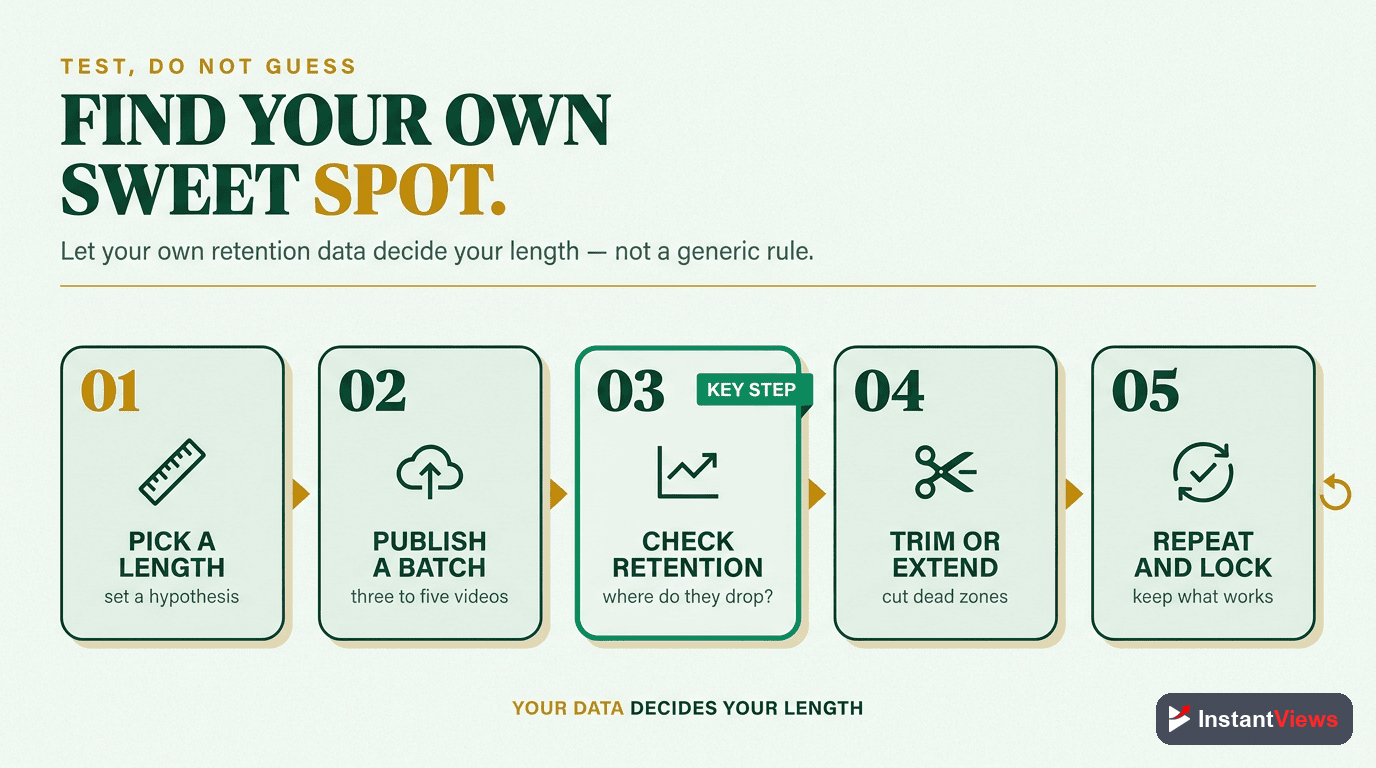
Benchmarks point you in the right direction, but your own analytics give you the real answer. Here is a simple process to find the ideal length for your specific channel.
Identify Your Niche and Intent
Decide what your viewers actually came to do — learn, be entertained, follow gameplay, or relax with a long conversation. Intent sets the natural length before you film a single second.
Start With Your Niche Range
Use the typical range for your niche from the table above as a starting point. For most long-form content that means somewhere in the 8 to 15 minute range, and roughly 15 to 30 seconds for Shorts.
Study Your Retention Graph
Open YouTube Analytics and review the audience retention curve on your best and worst videos. Find the moments where viewers stay glued and the cliffs where they drop off in large numbers.
Cut to the Drop-Off Point
Trim slow intros, repetition, and filler so your video ends near where viewers naturally leave. A shorter, tighter cut almost always lifts your percentage viewed.
Test, Compare, and Refine
Publish a few videos at different lengths inside your range, compare their retention and watch time, then let your own data — not a generic benchmark — settle on your ideal length.
Length Mistakes to Avoid
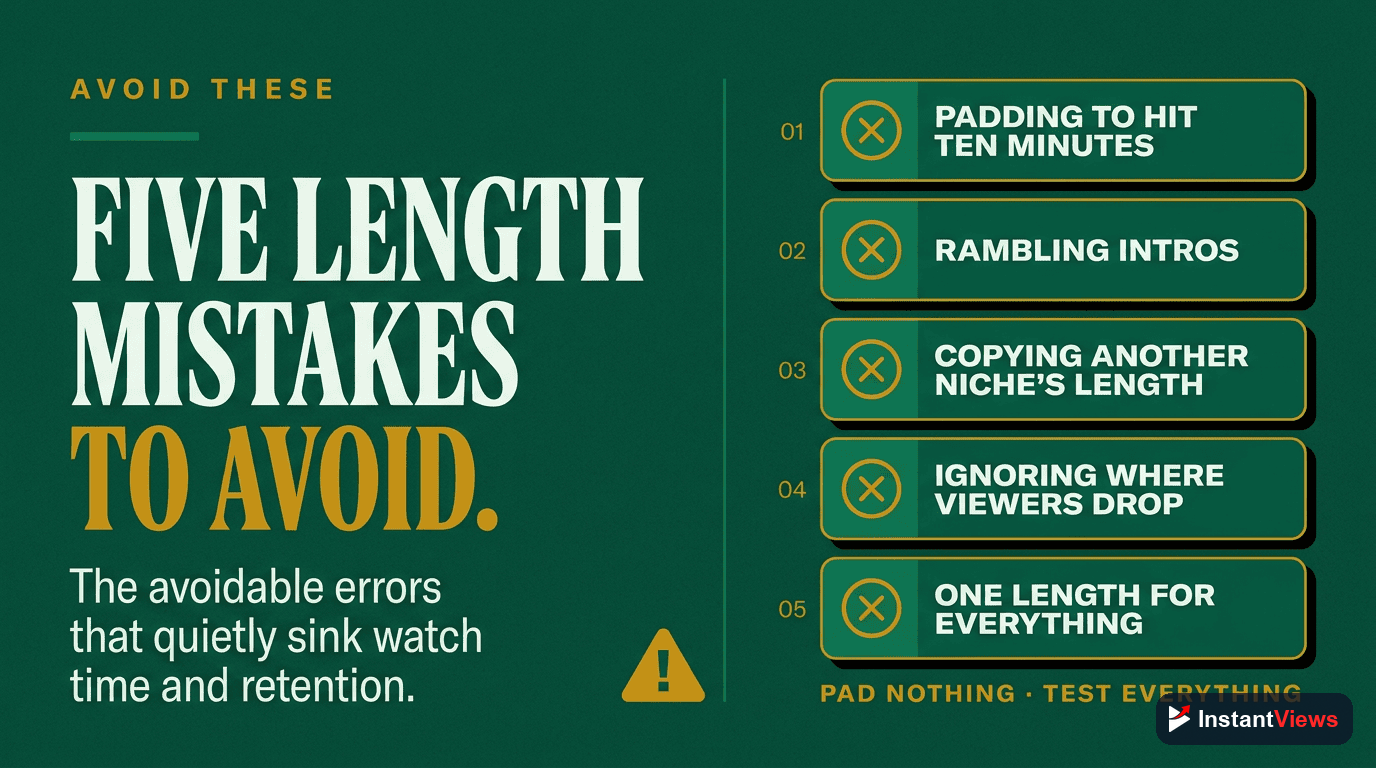
Even experienced creators sabotage their own retention by making the same length errors. Watch for these:
- Padding to hit a target: Stretching a video just to reach a certain runtime adds filler that drags down your percentage viewed.
- Slow intros: A long, self-indulgent opening is where most early drop-off happens. Hook viewers in the first few seconds.
- Copying another niche’s length: What works for a gaming channel will not work for a comedy sketch. Match your niche, not your idol.
- Cutting good content too short: Trimming is good, but amputating a video that was holding attention throws away watch time you had earned.
- Ignoring the retention graph: Without studying where viewers actually leave, you are guessing at length instead of measuring it.
- Treating Shorts and long-form as either/or: Skipping one format entirely means leaving either discovery or depth on the table.
The thread running through every mistake is the same: letting a number dictate the content, instead of letting the content dictate the number. Make the video as good as it can be, then make it exactly as long as it stays that good.
“The best length for a video is the moment it stops being interesting — minus one second. Everything before that earns attention; everything after it gives attention away.”
Frequently Asked Questions
There is no single right length. For most long-form niches the sweet spot tends to fall in the 8 to 15 minute range, while Shorts perform best in the 15 to 30 second range. The truly correct length is whatever holds a strong percentage of your audience for your specific niche — retention matters more than any target number.
Indirectly, yes. The 2026 algorithm optimizes for viewer satisfaction and retention rather than raw length. A longer video that holds a healthy percentage of viewers accumulates more total watch time, which can help distribution — but only if the retention holds. Padding a video to be longer usually backfires by lowering the percentage viewed.
Healthy retention depends on length and niche. Shorter videos naturally retain a higher percentage than longer ones, and tutorials or education content often hold viewers better than fast-paced entertainment. As a rule of thumb, the longer the video, the lower the percentage you can expect — so compare your retention against videos of similar length in your own niche.
Not always. A long video only builds more watch time if viewers actually stay. A 20-minute video that loses most of its audience in the first few minutes generates less effective watch time than a tight 10-minute video that holds people to the end. Length should follow the content, never the other way around.
Shorts can run up to three minutes, but the shorter clips in the 15 to 30 second range tend to hold the highest percentage of viewers and loop most effectively. Use Shorts for fast hooks and discovery at the top of your funnel, then guide interested viewers toward your longer content.
For most creators in 2026, a hybrid approach works best. Shorts help you reach new audiences and stay visible, while long-form videos build watch time, deepen trust, and support monetization. The two formats feed each other when a viewer discovers you through a Short and then stays for a longer video.
Open YouTube Analytics and study the audience retention graph for your best and worst performing videos. Look for where viewers drop off and where they stay engaged. Test a few different lengths within your niche range, then let your own retention data — not a generic benchmark — decide your ideal length.
No. A gaming playthrough, a product review, a kids cartoon, and a long-form podcast all have different natural lengths because viewers arrive with different intent and attention spans. Match the length to what your specific audience came to do, which is why this guide breaks length down niche by niche.
Conclusion
There is no magic number that makes a YouTube video succeed. The creators who win in 2026 understand that length is a result, not a goal. They choose a length that fits their niche and their viewer’s intent, then let audience retention tell them whether they got it right.
Use the niche ranges in this guide as a starting point, not a rulebook. A tutorial may want ten focused minutes, a podcast may breathe across ninety, and a Short may land in thirty seconds — and all three can be exactly right for their audience. What never changes is the principle underneath: hold attention, deliver on the promise, and end before you overstay your welcome.
Open your analytics, study your retention curves, and edit toward the version of each video that keeps the highest percentage of viewers engaged. Do that consistently and the right length stops being a guess and becomes something your own data decides for you.