- For entrepreneurs, YouTube is a 24/7 customer-acquisition engine — not a place to chase views
- Three structural advantages stack in your favor: search intent, fast-building trust, and content that keeps working for years
- Pick a niche at the intersection of your expertise and what your ideal customer searches before they buy
- Capture leads with a free resource sent to a dedicated landing page, then nurture them off-platform
- Use systems to publish consistently, and judge success by leads, conversions, and customer acquisition cost — not vanity metrics
Most advice about growing a YouTube channel is written for creators who want to be famous. That advice is wrong for you. As an entrepreneur, your goal is not a million subscribers or a viral moment — it is customers. The good news is that YouTube, with more than 2.7 billion monthly active users and roughly a billion hours watched every day, is arguably the single best place on the internet to find them.
The shift that changes everything is this: stop treating YouTube as a content platform and start treating it as a 24/7 sales engine. A salesperson sleeps; a well-built channel does not. While you are with your family or working on the rest of your business, your videos are out there answering the exact questions your future customers are typing into the search bar — and they keep doing it long after you hit publish.
That reframe also changes what success looks like. A video with ten thousand views and zero leads is a failure. A video with five hundred views that produces three high-value clients is a triumph. Once you stop measuring your channel like a creator and start measuring it like a business owner, almost every decision gets easier.
This guide walks through the entire system: why YouTube works so well for businesses in 2026, how to pick a niche that attracts buyers, the content formats that build authority, how to turn viewers into leads, the systems that let a busy founder keep publishing, the metrics that actually matter, and the mistakes that quietly waste the opportunity.
- Why Entrepreneurs Should Be on YouTube
- The Three Advantages: Intent, Trust, Longevity
- Choosing a Niche That Attracts Buyers
- Building Authority Content That Sells
- The Content-to-Goal Map
- Turning Viewers Into Leads
- Building Systems So You Can Stay Consistent
- Measuring What Actually Matters
- A Worked Example: Ninety Days In
- Mistakes Entrepreneurs Make on YouTube
- FAQ
Why Entrepreneurs Should Be on YouTube
Every business needs a reliable way to get in front of people who might buy from it. Paid ads work until you stop paying. Cold outreach scales poorly and wears your team down. Referrals are wonderful but unpredictable. YouTube offers something different: a channel that grows in value over time and compounds while you sleep.
Part of the reason is sheer reach, but reach alone is not the point — television has reach too. What makes YouTube uniquely powerful for a business is where the attention now lives. Connected TV has become the leading way Americans watch YouTube, with the living-room screen overtaking mobile as the number-one viewing surface. That means a video you film on a modest budget can play on a sixty-inch screen in a prospect's home, lending it the authority of broadcast television without a broadcast budget.
At the same time, YouTube in 2026 rewards substance. The algorithm optimizes for viewer satisfaction and retention rather than raw watch time, and the platform is actively reducing the spread of low-value, mass-produced content. For an entrepreneur with genuine expertise, that is excellent news: the system is tilting toward exactly the kind of useful, credible content you are best positioned to make.
It Is a Sales Engine, Not a Hobby
The entrepreneurs who succeed on YouTube treat it like infrastructure. They do not ask "how do I go viral?" They ask "what does my ideal customer need to understand before they trust me with their money, and how do I answer that on video once, well, so it keeps working?" That question turns YouTube from a creative gamble into a predictable acquisition channel.

The Three Advantages: Intent, Trust, Longevity
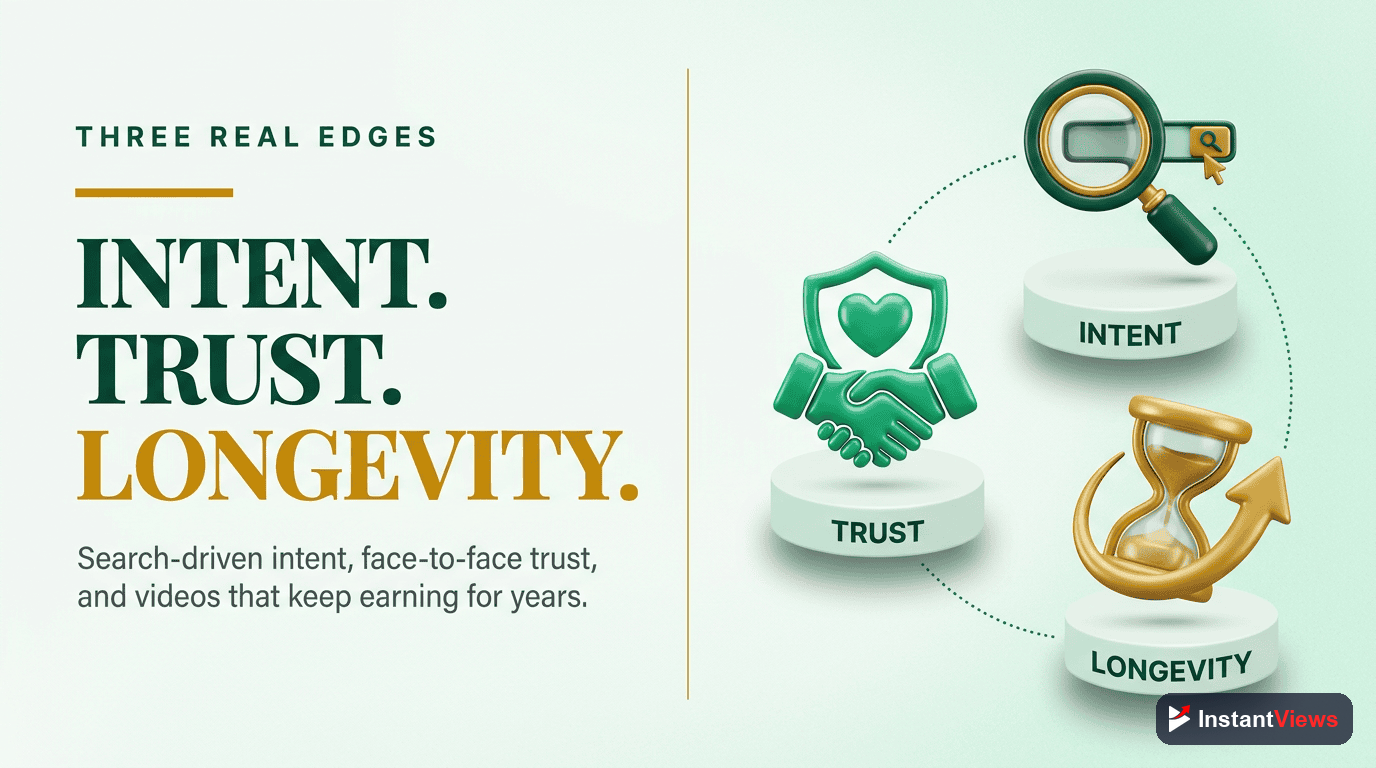
Three structural advantages make YouTube unusually effective for customer acquisition. Understand them and you will understand why the platform deserves a place in your business, not just your marketing calendar.
1. Intent
YouTube is the second-largest search engine in the world, and people use it to solve problems. When someone searches "how to choose accounting software for a small business" or "best way to fix a leaking flat roof," they are telling you precisely what they need — often moments before they are ready to buy. Showing up with a genuinely helpful answer puts you in front of a prospect at the exact moment of intent. Few channels deliver buyers who are already leaning forward in their chairs.
2. Trust
Video builds credibility faster than any other format. A prospect who reads your blog post knows your words; a prospect who watches you explain something for ten minutes knows your face, your voice, your competence, and your character. That accumulated familiarity does the heavy lifting of a sales call before the call ever happens. By the time a regular viewer reaches out, they often feel like they already know you — and they buy accordingly.
3. Longevity
A social-media post lives for a day. An optimized YouTube video can attract viewers for years. Because YouTube surfaces content through search and suggestions rather than a strictly chronological feed, a video you publish today can still be acquiring customers long after you have forgotten about it. This is the compounding asset that separates YouTube from platforms where you are only as relevant as your last post.
Choosing a Niche That Attracts Buyers
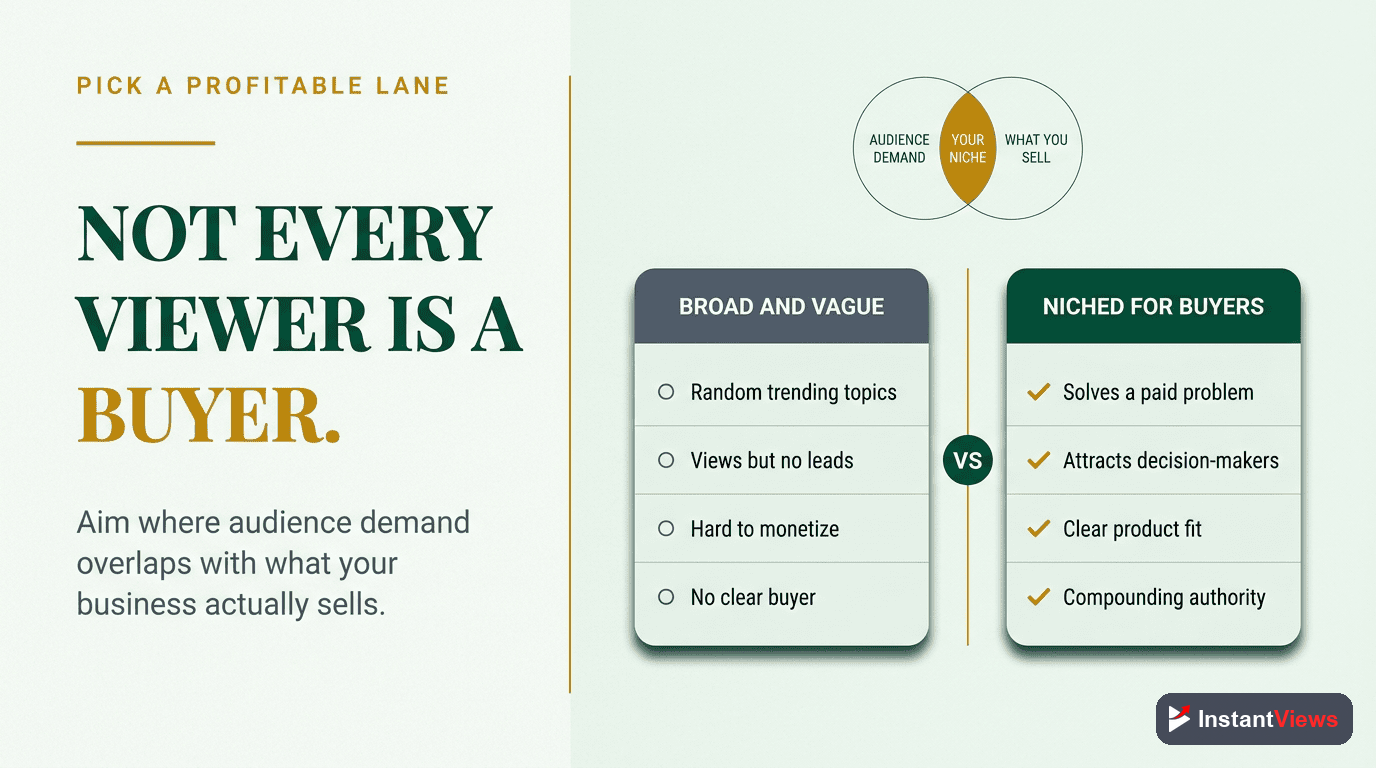
The most common mistake entrepreneurs make is choosing a niche based on what is popular rather than what is profitable for their business. The right niche sits at a specific intersection: your expertise and what your ideal customer searches for before they buy.
Your expertise is the part you already have. The second half — the buyer's pre-purchase questions — is where most channels go wrong. Before someone buys, they research. They want to know whether a solution exists, how it works, what it costs, how to choose between options, and whether they can trust the provider. Every one of those questions is a video, and every one of those videos attracts someone who is closer to buying than the average viewer.
How to Find the Intersection
- List your customers' pre-purchase questions. Think about the last ten sales conversations you had. What did people need to understand first? Those are your highest-value topics.
- Search YouTube as your customer would. Type those questions in and study what already ranks — and what is missing or done poorly.
- Stay narrow on purpose. A focused channel that owns one clear problem beats a broad channel that is vaguely relevant to everyone. Narrow attracts buyers; broad attracts browsers.
- Confirm there is a path to revenue. Every core topic should connect logically to something you sell. If a video idea cannot lead a viewer toward your offer, it belongs on someone else's channel.
Resist the temptation to broaden your niche to grow faster. As an entrepreneur, you are not optimizing for the largest audience — you are optimizing for the right one. A thousand viewers who all have the exact problem you solve are worth more than a hundred thousand who do not.
Building Authority Content That Sells
Authority is the currency of business YouTube. People buy from those they perceive as credible, and video is the fastest way to demonstrate credibility at scale. Four formats consistently build that authority and move prospects toward a purchase.
Tutorials and How-Tos
Teaching is the most powerful trust-builder on the platform. When you walk a viewer through solving a real problem — for free — you prove your expertise and trigger reciprocity. Counterintuitively, giving away your "secrets" rarely costs you sales; it earns them, because viewers conclude that if the free advice is this good, the paid solution must be excellent.
Case Studies and Results
Nothing removes doubt like evidence. Showing a real before-and-after, a client outcome, or a measurable result proves you do what you say. These videos speak directly to prospects who are close to deciding and just need confirmation that you deliver.
Comparisons and Buying Guides
When people are ready to spend, they compare options. A video that honestly compares approaches, tools, or providers captures viewers at the decision stage and positions you as the trusted guide. Honesty is the key word — the moment a comparison feels like a sales pitch, it loses the credibility that makes it work.
Behind-the-Scenes and Story
People buy from people. Showing how your business actually works, the principles behind it, and the human beings involved creates connection that pure information cannot. Story content turns a competent stranger into someone a viewer actively wants to support.

The Content-to-Goal Map
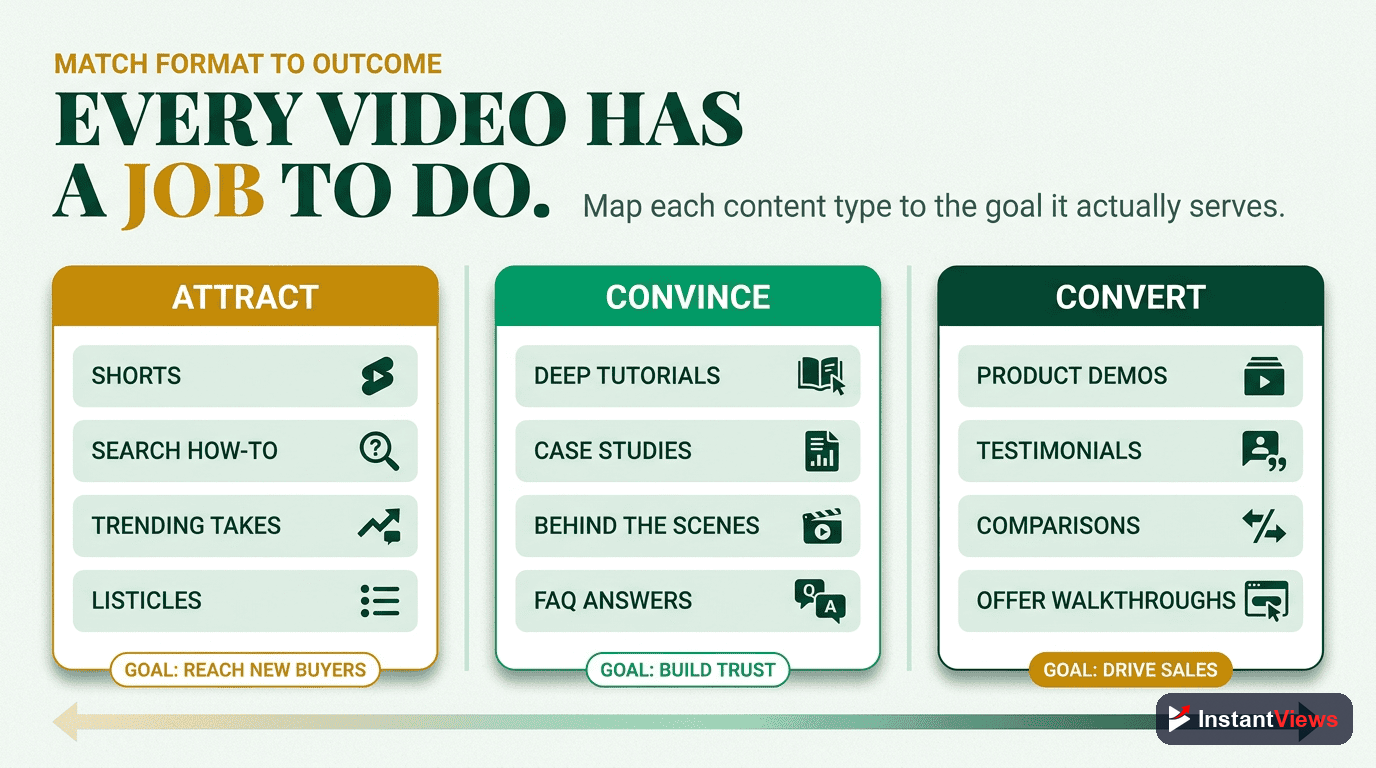
Every video should have a job. Mapping each format to the buyer's stage and a specific business goal keeps your channel pointed at revenue instead of applause. This is the heart of treating YouTube like a funnel rather than a feed — for the deeper mechanics, see our guide to building a YouTube marketing funnel that converts.
| Content Type | Funnel Stage | Business Goal |
|---|---|---|
| Tutorials & how-tos | Awareness | Get discovered by people searching for solutions and prove competence |
| Behind-the-scenes & story | Awareness / Consideration | Build connection and earn the subscribe |
| Comparisons & buying guides | Consideration | Capture leads and position you as the trusted choice |
| Case studies & results | Decision | Remove doubt and drive the inquiry or purchase |
| Shorts & clips | Awareness | Expand reach and feed viewers into your longer videos |
You do not need every format in equal measure. Most businesses benefit from plenty of discovery-stage tutorials at the top and a smaller number of high-quality decision videos at the bottom. The balance depends on how long your sales cycle is and how much trust your offer requires.
Turning Viewers Into Leads
A view that disappears is a wasted opportunity. The job of a business channel is to convert anonymous attention into a relationship you control — and that means capturing leads. The mechanism is simple and proven: offer a genuinely useful free resource in exchange for an email, and send viewers to a dedicated landing page to claim it.
The Lead Magnet
Your free resource should solve a specific problem related to the video and move the viewer one step closer to needing what you sell. Strong options include:
- A checklist or template that complements the video's topic
- A short email course or mini-guide that goes deeper than the video could
- A toolkit, calculator, or resource library your customer would actually use
The Landing Page
Send viewers to a dedicated landing page — never your homepage. A homepage asks visitors to figure out what to do next; a landing page has one job and one button. Place the link in the first line of your description, in a pinned comment, and on your end screen, then reference it clearly inside the video so viewers know it exists and why they want it.
Never let YouTube be your only connection to your audience. Algorithms shift and channels can be lost overnight. An email list is the one audience you truly own, and it is the bridge between a free viewer and a paying customer. If your channel is not capturing emails, it is leaking its most valuable output.
Grow Your Channel Faster
Explore our free suite of YouTube tools to research buyer topics, sharpen your titles and thumbnails, and see exactly what is working on your channel.
Explore Free YouTube Tools →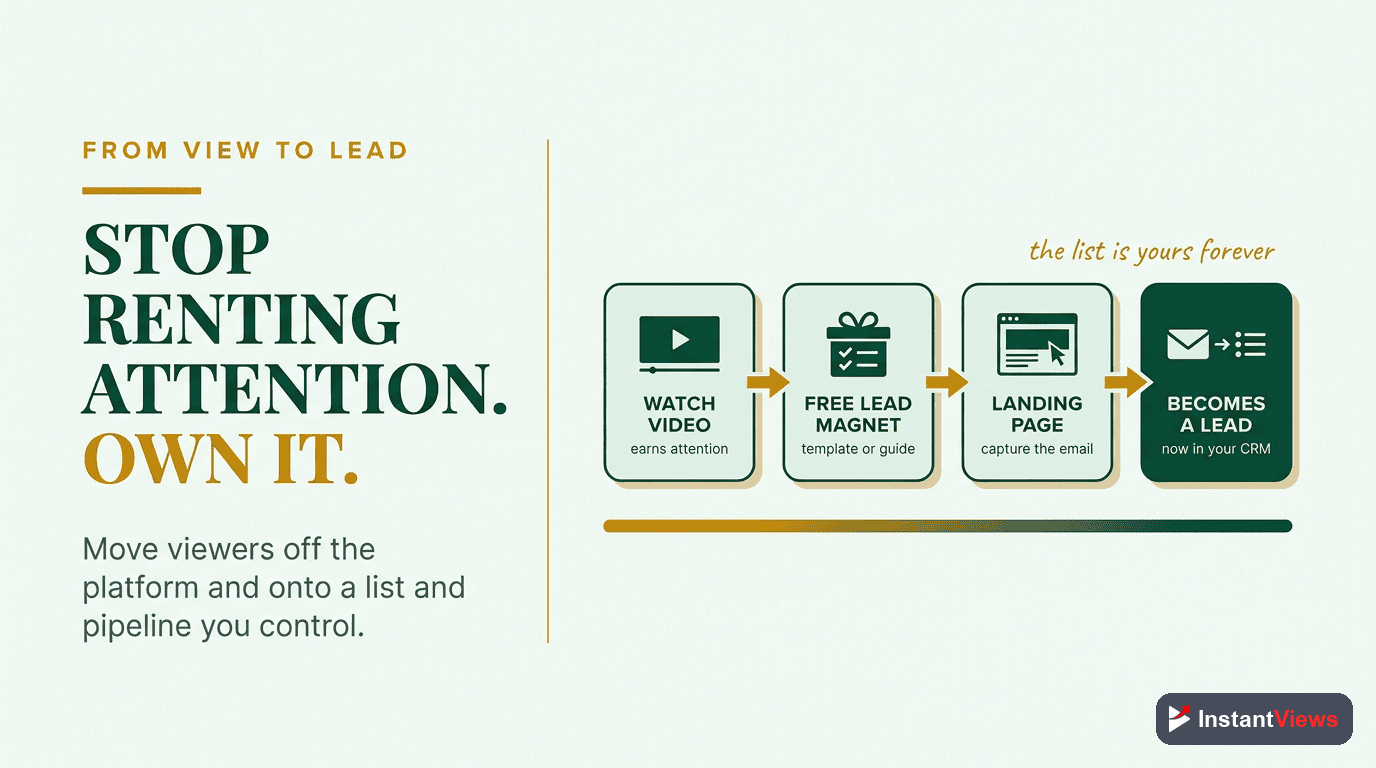
Building Systems So You Can Stay Consistent
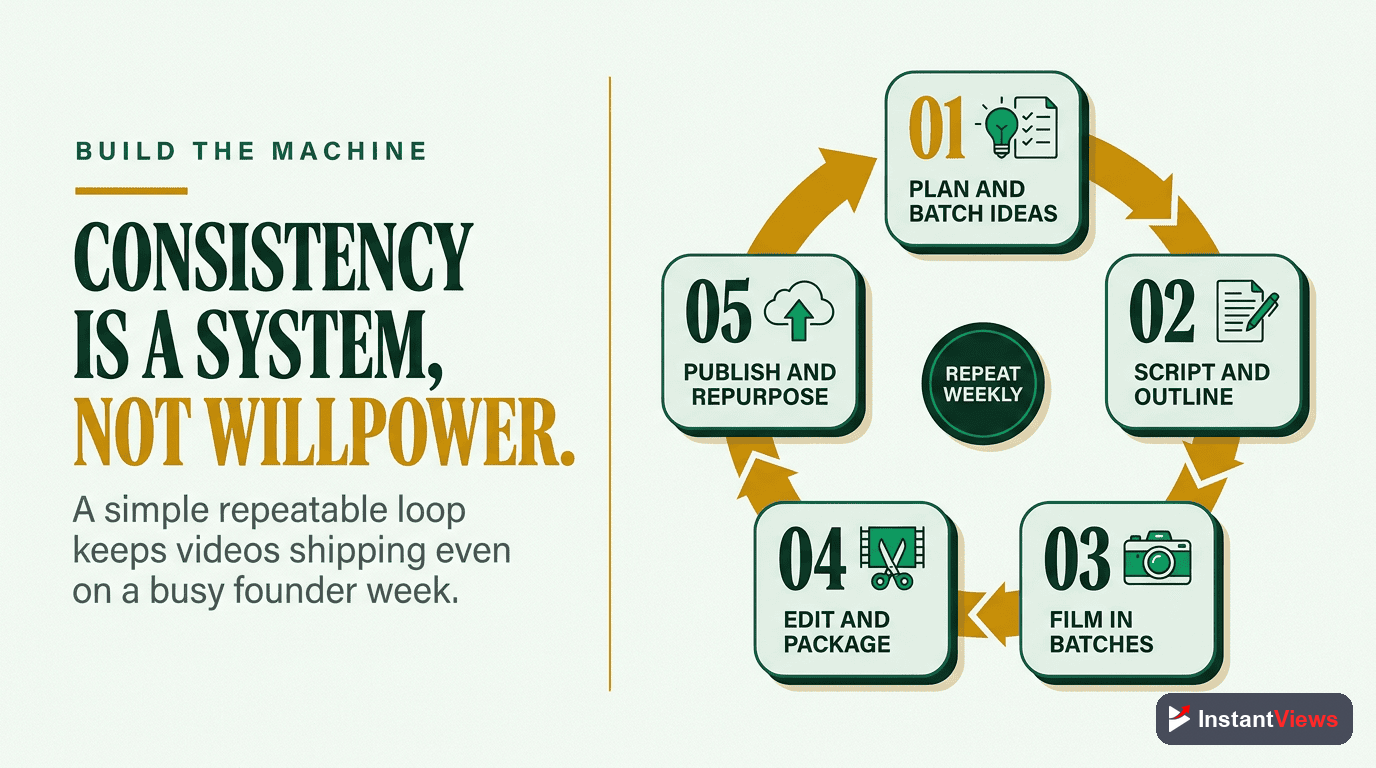
Consistency is where most entrepreneurial channels die. The first month is exciting; by month three, the business gets busy and uploads stop. The solution is not more discipline — it is better systems. A founder should not be personally doing every step of video production. The strategy is yours; the execution should be a repeatable line.
Batch Your Filming
Set aside one focused block and film several videos back to back. You are already set up, dressed, and in the right headspace — use that momentum to bank a month of content in a single session.
Repurpose Into Shorts and Clips
Every long video contains several short ones. Pull the best moments into Shorts and clips to expand reach and feed new viewers back toward your full videos — one filming session, many assets.
Delegate Editing and Thumbnails
Editing and thumbnail design are skilled but delegable. Hand them to a freelancer or team member with a clear brief so your time goes to strategy and on-camera work, not the timeline.
Run a Simple Content Calendar
Plan topics in advance so you are never staring at a blank slate. A predictable publishing rhythm is what lets the channel compound and what keeps your team aligned.
Review and Refine Monthly
Once a month, look at which videos produced leads and customers, then make more like them. The system improves itself when you feed it real business data.
The point of systems is leverage. When filming, editing, thumbnails, and scheduling each have a defined process, the channel keeps running even during your busiest weeks — which are exactly the weeks an undisciplined channel goes silent.
Measuring What Actually Matters
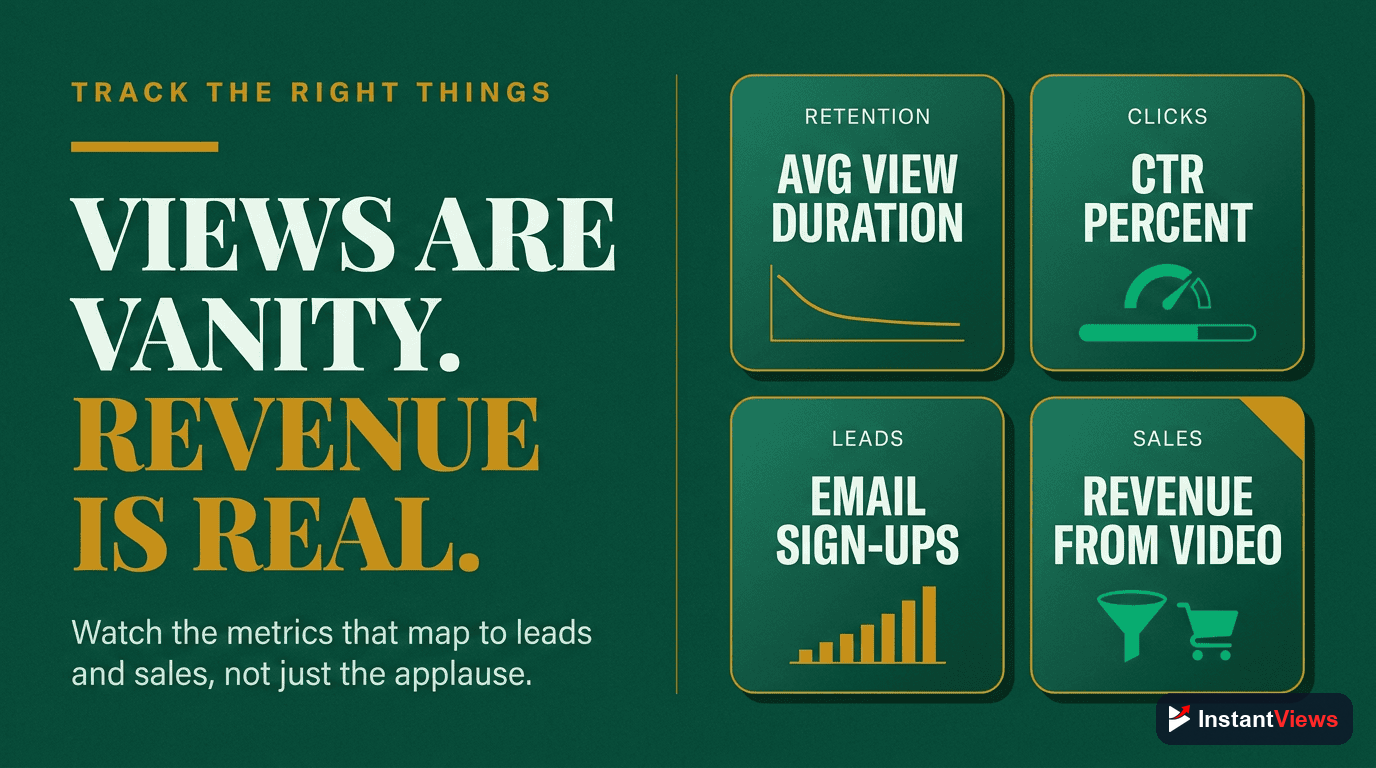
This is where the entrepreneur's approach diverges most sharply from the creator's. Creators obsess over views, likes, and subscriber counts. For a business, those are vanity metrics — interesting, occasionally useful as leading indicators, but not the point. The metrics that matter are the ones that show up on your profit-and-loss statement.
- Leads: How many people gave you an email or inquiry because of your channel? This is the first real business signal.
- Conversions: How many of those leads became paying customers? This tells you whether you are attracting the right people, not just a lot of people.
- Customer acquisition cost (CAC): What did it cost — in time, money, and production — to acquire a customer through YouTube? As your evergreen library grows, this number should fall, because old videos keep producing customers at no extra cost.
Connect YouTube Analytics to your website or CRM so you can follow the journey from view to lead to sale. When you can see which topics and formats produce actual customers, your content strategy stops being guesswork. You simply make more of what already pays.
None of this means views are worthless. A video with strong retention and click-through is doing its job of getting discovered. The discipline is to treat those numbers as inputs to a business outcome, never as the goal itself.
A Worked Example: Ninety Days In
Imagine a founder who runs a small bookkeeping firm for online stores. She has deep expertise and a clear ideal customer, but no audience. Here is how the system comes together over a first quarter.
Niche. She picks the intersection of her expertise and her buyers' pre-purchase questions: "bookkeeping for ecommerce." Every topic she plans answers something a store owner asks before hiring help — how to track inventory costs, when to switch from a spreadsheet, how to read a profit margin.
Authority content. In one batched session she films four tutorials and one comparison ("spreadsheet versus bookkeeping software for a growing store"). Each is honest, specific, and genuinely useful. From those five long videos her editor cuts a dozen Shorts.
Lead capture. She builds one resource — a "month-end close checklist for ecommerce" — on a dedicated landing page, and links it from every video's description, pinned comment, and end screen.
Results. By the end of ninety days her view counts are modest, but the tutorials are starting to surface in search, the checklist is collecting emails, and two of those emails have become paying clients whose combined value dwarfs her production costs. Her customer acquisition cost is already trending down because the videos keep working without further effort. She is not famous — she is profitable. That is the entire goal.

Mistakes Entrepreneurs Make on YouTube
The same avoidable errors quietly waste the opportunity. Watch for these:
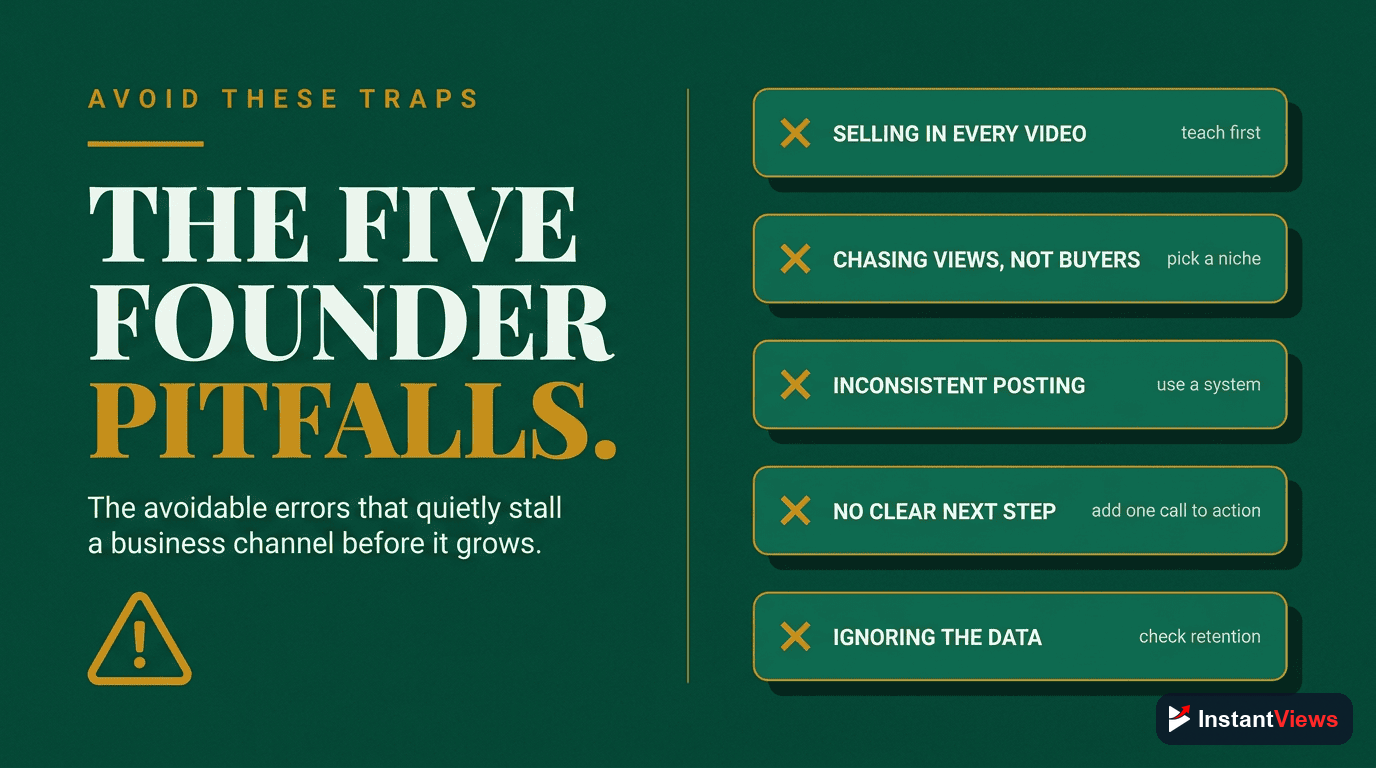
- Chasing views instead of customers. Optimizing for the biggest audience pulls you toward broad, low-intent content that never converts. Optimize for the right viewer instead.
- Choosing a niche with no path to revenue. If a topic cannot lead toward something you sell, it does not belong on your channel, however popular it is.
- No lead capture. Sending every viewer back into the feed with no way to follow up means rebuilding your audience from zero with every upload.
- Selling too early. Pitching brand-new viewers wastes your reach. Earn trust first; the sale follows naturally.
- Doing everything yourself. Founders who personally film, edit, and design every video burn out and go silent. Build systems and delegate.
- Measuring the wrong things. Judging the channel by subscriber count instead of leads and conversions leads you to make more of what feels good rather than what pays.
- Quitting before it compounds. YouTube rewards patience. Most channels stop right before the library is large enough to start producing steady results.
"The entrepreneurs who win on YouTube are not the ones with the most views — they are the ones who built a machine that turns attention into customers while they sleep, and then had the patience to let it compound."
Frequently Asked Questions
YouTube is the rare channel that combines search intent, deep trust, and longevity. People actively search YouTube for solutions before they buy, video builds credibility faster than text, and a well-optimized video can keep attracting qualified viewers for years. For a business, that makes YouTube a 24/7 sales engine rather than a feed you have to feed constantly.
Far fewer than most people think. Subscriber count is a vanity metric. A channel with a few thousand of the right viewers — people who match your ideal customer — can generate more revenue than a channel with hundreds of thousands of casual viewers. Focus on attracting the buyers in your niche, not the biggest possible crowd.
Four formats consistently perform for businesses: tutorials and how-tos that demonstrate your expertise, case studies and results that prove you deliver, comparisons and buying guides that help people decide, and behind-the-scenes or story content that builds connection. Each format meets a buyer at a different point in their decision.
Offer a genuinely useful free resource — a checklist, template, or short guide — that solves a problem related to your video, and send viewers to a dedicated landing page to claim it. Place the link in the first line of your description, in a pinned comment, and on your end screen, then mention it clearly inside the video.
Use systems rather than willpower. Batch-film several videos in one session, repurpose each long video into Shorts and clips for other platforms, and delegate editing and thumbnail design to freelancers or a small team. Systems turn YouTube from a time sink into a repeatable production line.
Track business metrics, not vanity metrics. Leads captured, conversions, and customer acquisition cost tell you whether YouTube is profitable. Views, likes, and subscriber count are only useful when they correlate with those business outcomes. Connect YouTube Analytics with your website or CRM data to follow the full journey.
Yes. Connected TV is now the leading way people watch YouTube in the United States, which means your content can play on living-room screens, not just phones. For an entrepreneur, that means a single well-made video can reach a prospect on the largest screen in their home, lending it the authority of television without a television budget.
Most channels need several months of consistent, focused uploads before they produce steady leads, because buyers rarely act on the first video they see. The advantage is that the work compounds: optimized videos keep working long after you publish them, so the channel you build this year keeps acquiring customers next year.
Conclusion
YouTube is not a popularity contest for entrepreneurs — it is a customer-acquisition engine that runs around the clock. When you combine the platform's three structural advantages of intent, trust, and longevity, a single well-made video can keep attracting qualified buyers for years, on screens that now stretch from the phone in someone's hand to the largest television in their living room.
The path is straightforward, even if it requires patience. Pick a niche at the intersection of your expertise and your customers' pre-purchase questions. Build authority with tutorials, case studies, comparisons, and story. Capture leads with a genuinely useful resource and a dedicated landing page. Run systems so you can publish consistently without burning out. And judge the whole thing by leads, conversions, and customer acquisition cost — never by vanity metrics.
Start before you feel ready, film in batches, and give the library time to compound. The channel you build this quarter will still be acquiring customers next year. That is the quiet power of treating YouTube as infrastructure for your business rather than a stage for your ego — and it is available to any entrepreneur willing to be useful, consistent, and patient.